Code Moment | DeepMaterial Lands Order from Top New Energy Vehicle Maker, Uses AI to Slash Metal R&D Cycle

MaHui Member DeepMaterial Lands Order From Top New-Energy Vehicle Maker

Materials are a foundational resource for human civilization and have long been at the heart of transformative technological revolutions. Their development plays a critical role in driving industrial upgrading and social progress.
Yet in conventional materials R&D, the high technical barriers, lengthy timelines, and massive engineering demands often stretch development cycles to 10 or even 20 years — far too slow to meet today's diverse industrial needs.
According to data from the Ministry of Industry and Information Technology and Choice, China's self-sufficiency rate for high-end new materials remains low, with imports accounting for 84% of consumption. Key materials carry a 52% import dependency rate, while superalloys stand at 50%, creating urgent demand for domestic alternatives.
In recent years, as AI, big data, and IoT technologies have penetrated the materials sector, data-driven approaches marked by "big data + AI" have emerged as the fourth paradigm of materials science. R&D, production, sales, and application are all advancing toward intelligent development.
By collecting and training on massive datasets, numerous companies are attempting to introduce AI into materials design and research, boosting efficiency and cutting costs.
36Kr recently connected with DeepMaterial (Suzhou) Technology Co., Ltd. (hereinafter referred to as "DeepMaterial"), a company focused on the industrialization of AI-enhanced high-end metal materials.
Founded in February 2021, DeepMaterial accelerates the R&D and commercialization of high-end metal materials through computational materials science, materials informatics, machine learning, and deep neural networks. The company also provides end-to-end services spanning independent product development, sample design, metal powders, production processing, quality inspection, and performance analysis.
By early 2022, DeepMaterial had completed angel and pre-A rounds totaling tens of millions of RMB, with investors including Source Code Capital, BlueRun Ventures, and Linear Capital.
Unlike most AI + new materials companies, which structure their business around software sales and contracted R&D projects, DeepMaterial focuses on the materials themselves — developing metal products and handling their production and sales.
The company has already developed multiple high-end metal 3D printing materials and high-performance die-cast aluminum alloys, now in mass production. R&D personnel comprise 80% of the team, which includes senior algorithm scientists and materials scientists with extensive technical expertise and product commercialization experience across materials development, process optimization, algorithm design, mechanical design, metal die casting, and finished product quality inspection — giving the company full batch delivery capability.
To address the protracted materials development cycle, DeepMaterial has built proprietary high-throughput equipment that standardizes, streamlines, and automates the collection of experimental data, ensuring high-quality data generation. Throughout the R&D process, the company has deployed high-throughput laboratories and an industrial-grade big data platform to support fully digitalized development workflows.
Take superalloys as an example. The high-throughput laboratory leverages machine learning and deep learning to gather extensive experimental data. Team members then construct generative model algorithms tailored for superalloy materials, followed by materials testing and performance optimization.
DeepMaterial's AI-driven R&D model offers the advantage of faster development speed and shorter cycles. Compared to the minimum five-year timeline of traditional laboratory approaches, DeepMaterial can complete development of three to five new materials in just six months, dramatically reducing R&D costs.
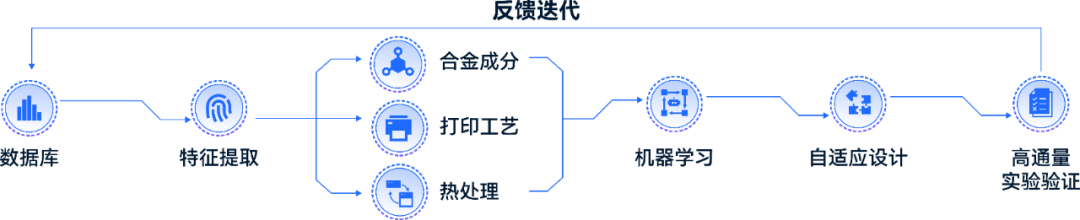
High-throughput platform workflow diagram
Additionally, AI technology demonstrates greater consistency in data processing and process parameters, with strong algorithm transferability, disturbance resistance, and multi-element joint tuning capabilities — better handling real-world perturbations. Materials developed through the platform meet performance standards for aerospace and other demanding applications.
Zexuan Wang, founder of DeepMaterial, told 36Kr, "The feasibility of our AI R&D platform has already been validated in practical applications." By late 2023, the company completed development of three advanced alloy material pipelines: superalloys, high-strength aluminum alloys, and die-cast aluminum alloys.
"Our materials carry fully independent intellectual property rights and offer certain performance and cost advantages over imported alternatives, enabling domestic substitution that effectively resolves chokepoint issues. These materials have broad applications in aerospace, defense, new energy vehicles, consumer electronics, and other sectors with massive market demand," Wang said.

Metal materials product images
On the domestic customer front, DeepMaterial has established partnerships with industry benchmark clients, with products entering small-batch trial production. The company has also signed new energy vehicle material orders exceeding 10 million RMB with a leading automotive brand.
Currently, many high-end metal materials remain in a "chokepoint" situation, with expanding demand for domestic alternatives. AI technology has shown tremendous potential in materials design, promising to advance China's metal materials market, drive intelligent transformation across the industry, and achieve self-sufficiency in critical materials.
Source: 36Kr. Author: Huang Nan. Editor: Yuan Silai.