Code Engraving | Behind the Air Suspension Boom: How KH Automotive Technologies Became an Industry Leader in Five Years

Konghui currently holds a 39.2% market share in China's air suspension market, ranking first.

Source Code Capital was a joint lead investor in KH Automotive Technologies Co., Ltd.'s (KH Automotive) Series B equity financing.
KH Automotive is the first domestic supplier of passenger vehicle air suspension systems for front-loading (OEM) applications. In June 2021, it successfully developed and began supplying air suspension systems for Voyah's Free model, ending China's history of having no domestic OEM air suspension supply resources.
Against the backdrop of premiumization among domestic-brand electric vehicles, electronically controlled air suspensions — which deliver a superior driving experience — have seen rapidly increasing penetration. Drawing on years of accumulated deep expertise in vehicle chassis and whole-vehicle dynamics, KH Automotive has delivered reliable, high-quality air suspension products to its partners. By February 2023, its air spring assemblies had achieved their 100,000th unit in mass production deliveries, and the company now ranks first in domestic market share for this product category.
The KH Automotive team has a clear roadmap for long-term technological iteration and is steadily building a vertically integrated closed loop across the product category. We believe KH Automotive is very well positioned to grow into a leading component supplier in this new category, riding the wave of domestic EVs.
This article is republished with permission from LatePost Auto; author: Zinan Li, editor: Hailu Wang
Because of the battery pack, an electric vehicle weighs about 0.5 tons more than a gasoline car. That extra weight makes EVs more dangerous to drive — harder to control braking and bump absorption. It's like a gas car overloaded with 8 to 10 extra adults.
All that risk and weight rests on the vehicle's four suspension systems — four steel rods wrapped in springs. They support the entire car and control its shock absorption, reducing the jolts from uneven roads.
Electric vehicles need better-performing suspensions. The battery pack at the bottom of an EV is prone to rupture and spontaneous combustion if impacted, and only the suspension can prevent underbody strikes.
One solution in the auto industry is air suspension, which replaces the traditional coil spring with an inflatable rubber bladder. The bladder works like a balloon, providing better vibration damping and allowing adjustable spring force and vehicle height to reduce drag and improve range.
Before the rise of pure electric vehicles, air suspension appeared only in luxury gas cars priced above 800,000 yuan — brands like BMW and Porsche — with technology controlled mainly by Germany's Continental and Vibracoustic.
The emergence of EVs has changed vehicle architecture and created new opportunities to reshape automotive supply chains.
KH Automotive Technologies, a Chinese air suspension company founded just five years ago, seized that opportunity. It is now the leader in this field in China, with market share approaching 40% in the first half of this year.
A Band of Technically-Minded Academics Decides to Start a Company
Di Wang, Managing Director at Source Code Capital, first took notice of KH Automotive in 2021 while researching automotive chassis components, and observed the company for a full year before investing.
Wang believed that starting a company in automotive chassis components would be extremely difficult for most Chinese firms. The chassis can be divided into three main areas: steering, braking, and suspension. In steering and braking, international suppliers held technological and scale advantages that Chinese suppliers could hardly challenge. Air suspension, meanwhile, was a tiny market at the time, with only Continental and Vibracoustic as major international players, serving vehicles above 800,000 yuan.
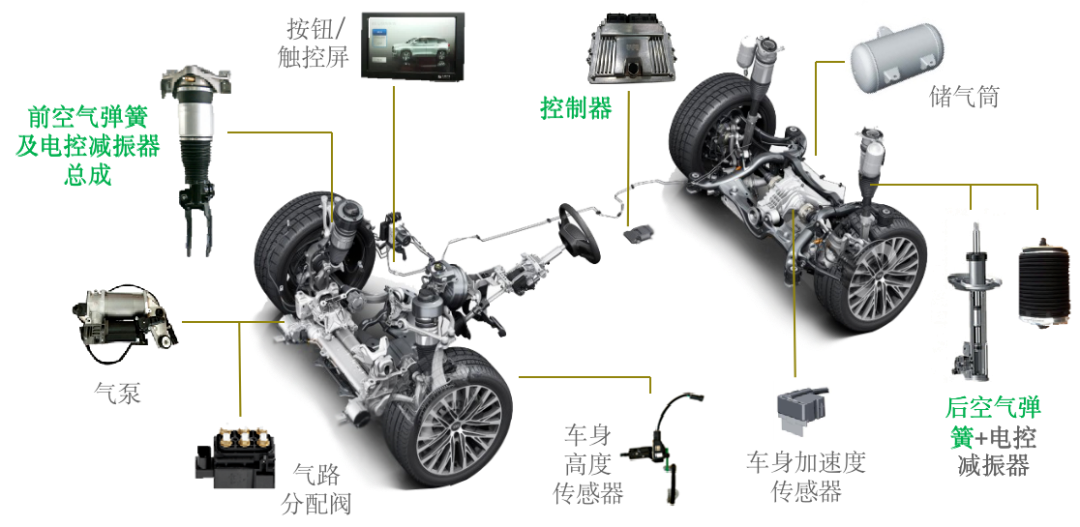
A complete air suspension system consists of multiple mechanical components and electronic parts. Image source: KH Automotive Technologies.
The suspension market only became interesting after EVs took off. Electric vehicles need better-performing suspensions to better control body stability and prevent underbody strikes. "We reasoned through it logically — the air suspension category was certain to grow," Wang said.
How large could the air suspension market become? That was hard to judge at the time. But once he locked onto this sector, choosing KH Automotive was a relatively straightforward decision, Wang said. At that point, only two Chinese companies were working on air suspension: Zhejiang-based KH Automotive and Shanghai-based Baolong Technology. Baolong was a publicly listed company founded in 1997 that made metal and rubber structural components for vehicles and had entered air suspension in 2017. KH Automotive was the only startup on investors' radar.
Zhejiang KH Automotive was founded in 2018, but the team behind it had been researching automotive chassis technology for much longer.
Zhejiang KH Automotive's predecessor was Changchun KH Automotive, founded by Konghui Guo, the first academician of the Chinese Academy of Engineering in China's automotive industry. Guo is the founding father of Chinese automotive dynamics research. Since the 1960s, he had been working on tire mechanics, vehicle handling stability, and related fields, published textbooks, served as vice president of Jilin University of Technology and professor at Jilin University, and mentored over 300 master's students, PhDs, and postdoctoral researchers.
In 2007, at age 73, Guo brought more than 30 students to found Changchun KH Automotive, with his son Chuan Guo serving as general manager. Chuan Guo said his father started the company out of an obsession with technology — academic research had too many constraints and insufficient funding to support more research and realize his technical ideals.
Changchun KH Automotive was an automotive engineering design firm whose main business was providing chassis technology services to automakers. It had tuned steering and suspension systems for FAW Hongqi and served Dongfeng, Brilliance, SAIC, and other manufacturers.
Technical services require testing, and testing requires equipment. The most critical piece was the KC test rig for evaluating vehicle suspensions — without it, researchers couldn't quantify suspension parameters or optimize vehicle performance.
At the time, a foreign KC test rig cost over 30 million yuan, which Changchun KH Automotive couldn't afford. So Konghui Guo led more than 30 students to build one themselves. The first rig cost 2 million yuan to produce. "It could tell you where a suspension design was abnormal, but fell far short on measurement precision, test efficiency, and reliability," said Mian Wang, who was then in charge of suspension technology at Changchun KH Automotive.
Test equipment capability and technical service capability reinforced each other. With the first KC test rig, Changchun KH Automotive's technical consulting business advanced. In 2010, it took on a project for FAW Hongqi to prototype and trial-install electronically controlled suspension systems, replacing the original conventional suspension. This venture led the KH team into control algorithms, software, air spring design matching, system integration, and related testing for passenger vehicle electronically controlled suspension systems.
The technical consulting and test equipment sales businesses were tough. A typical project required dozens of technical staff and 1–2 years of work — impossible to scale, unable to retain talent, and unable to leverage resources. Consulting meant teaching your clients, and once they learned, they no longer needed you — a "one-time deal." A test rig lasts ten years, and China only had dozens of automakers, so selling equipment was also a "one-time deal."
Chuan Guo recognized the bottleneck and concluded that KH had to transform from a technical consulting firm into a components company, amplifying the technical advantages accumulated over the years at Changchun KH Automotive.
Chuan Guo studied industrial design at Jilin University for his undergraduate degree, then earned a master's in mechanical engineering at The University of Hong Kong and an MBA from the University of Nottingham. He had worked as an engineer at FAW and Hong Kong Bus Services, joined auto parts company "Tianjin Huanyu Rubber & Plastic" as general manager in 2004, and left in 2007 to start a business with his father.
Until 2015, Chuan Guo hadn't seen a clear opportunity for transformation. He believed Chinese components companies could initially only target Chinese automakers, because foreign manufacturers had mature supply chains and wouldn't give emerging Chinese suppliers a chance. For KH to start a chassis components business, it had to wait for Chinese automakers to develop premium models.
In 2016, Chuan Guo learned that FAW Hongqi was already discussing air suspension orders with overseas suppliers. He realized the opportunity for transformation had arrived.
Air suspension is an expensive system — even without the shock absorbers, it costs over 7,000 yuan. On gasoline cars, it wasn't a particularly necessary component, used only in a few high-end luxury vehicles. The growth of the new energy vehicle market and the premiumization of domestic brands gave Chuan Guo a glimmer that the air suspension market might be opening up.
KH had decades of accumulated expertise in automotive chassis technology and was no stranger to electronically controlled suspension. It had previously built an electronically controlled suspension prototype for FAW and had developed a hydro-pneumatic suspension system for missile launch vehicles for China South Industries Group. Starting in 2016, KH formally entered air spring production, first making imitation parts for the aftermarket — manufacturing and selling air springs for vehicle repair — to learn mass production processes and supply chains.
In mid-2018, NIO launched the ES8 with air suspension as standard equipment, selling over 7,000 units per quarter. This was the first time a Chinese automaker had sold a vehicle above 400,000 yuan and used air suspension at this price level. This strengthened Chuan Guo's conviction in the market's prospects. He decided to shed his baggage, leave the Northeast, and start over.
"Fellow Sufferers" with Voyah
In October 2018, Chuan Guo brought more than twenty people from Changchun KH Automotive to the Yangtze River Delta, where the automotive supply chain is most developed, and registered "Zhejiang KH Automotive." Changchun KH Automotive continued to exist, still doing chassis technical consulting with a team of about 150 people. Zhejiang KH Automotive was a components company focused on developing, designing, and producing passenger vehicle electronically controlled suspension, operating independently with Chuan Guo as chairman and CEO. "Starting with a blank sheet of paper," he said.
Mian Wang also moved with Chuan Guo to Huzhou, serving as head of KH Automotive's hardware research institute. Jian Miao, who had previously handled finance at FAW, joined KH in 2020 as head of marketing. Miao was also a shareholder of Changchun KH Automotive and had known Chuan Guo for years.
Zhejiang KH Automotive's startup capital was 4 million yuan from Changchun KH Automotive's existing shareholders. After that, Wuxing District in Huzhou provided several million yuan in startup funding and coordinated three small workshops in an industrial park, where KH began its journey into domestic electronically controlled suspension.
The following year, KH grew to 60 people, half in R&D and design. Mian Wang led engineers to design air suspension from scratch — electric vehicles are heavier than gas cars, and China's road conditions are more complex, so he believed copying existing designs wouldn't help much.
At the same time, Liu Yang, KH's head of electronic control technology, was expanding the control algorithm, software, and controller hardware teams. Developing both software and hardware capabilities early on also enriched KH's business model — selling complete suspension systems rather than simple hardware.
While designing products, KH also began simultaneously developing production equipment. The air suspension market had been small, so having equipment companies custom-build non-standard machinery was industry practice. Mian Wang said a foreign air spring production line would cost 30 million yuan with a 2-year delivery time. After weighing the options, they decided to co-develop equipment with domestic suppliers.
KH's first customer was Voyah. Chuan Guo had known Voyah CEO Fang Lu from their time at FAW, when Lu was head of product at FAW Car. Before leaving for Huzhou, Chuan Guo had told Lu about his plans for electronically controlled suspension. Shortly after Zhejiang KH Automotive was founded, Lu moved from FAW to Dongfeng's H Division — Voyah's predecessor.
In July 2020, Dongfeng officially launched the Voyah brand, aiming to learn from new EV makers in the premium electric segment, with air suspension as a key feature.
Before approaching KH, Voyah had discussed partnerships with Continental, Vibracoustic, and other foreign suppliers without success. Voyah was a new automaker, and many foreign suppliers simply didn't believe it could sell several thousand units a month. "You can pay, but I'll quote an outrageously high price — I'm not taking the risk," Chuan Guo said, describing the prevailing attitude among foreign suppliers at the time.
Lu later approached Chuan Guo, and after repeatedly comparing technical proposals from several bidding companies, concluded that KH was the most viable option. A new automaker and a newly founded components company with no mass production experience came together. "Kindred spirits, fellow sufferers," Chuan Guo said.
Because both sides lacked mass production experience, the partnership between KH and Voyah hit some bumps. Voyah didn't have enough staff or resources to support KH's development, so it handed over the entire air suspension system definition to KH. Voyah's vehicle design had a full-load weight of 3.7 tons — equivalent to three Volkswagen Bora sedans. KH was also undertaking its first complete mass production project, facing numerous challenges.
During the production of the first batch of hand-built prototypes, a serious accident occurred — the air suspension's air bladder exploded. Mian Wang brought more than ten people to Wuhan overnight to work with Voyah on the problem, working until the day before Spring Festival, when the COVID-19 pandemic hit. Due to the pandemic, the entire Voyah project was delayed by nearly half a year.
By May 2021, just two months before Voyah's first model, the Free, was scheduled to launch, KH's air spring prototypes had another problem — due to incorrect process parameters, the air bladder's rubber skin risked delamination.
Lu was extremely anxious and told Chuan Guo directly: "Maybe we skip air suspension this time." KH had already invested two years, and the Voyah project would determine the company's survival. "If the Voyah project was aborted, the company might have been finished. A new company fails on its first project — who would dare use your products afterward?" Chuan Guo said.
Voyah marked KH in deep red on its project management dashboard, indicating extreme supply disruption risk. At the time, the only other suppliers in deep red were chip and electronic component suppliers disrupted by the pandemic.
Chuan Guo and Mian Wang brought dozens of engineers to report to Voyah, item by item explaining corrective measures, breaking down the supply disruption risk into over 100 deep-red issue items. Back at the company, Mian Wang revised sample designs during the day and stood at CNC machines with engineers at night, digging out molds from 8 p.m. until dawn — getting a supplier would take at least two months, there wasn't time, they had to do it themselves.
Chuan Guo and other executives also moved into the company. Jian Miao, who was then in charge of project management, even prepared an induction cooker and cookware in the office — when overtime work made them hungry, he'd cook for everyone. Sometimes dumplings, sometimes fried sausages.
By the product validation phase before mass production, KH had built over 100 sets of prototypes for testing, passing 5.6 million cycles of durability testing. Mian Wang said typical suppliers usually only do 3 million cycles.
In July 2021, the Voyah Free finally launched, and after relentless effort, KH's products passed Voyah's acceptance and began mass production and delivery, installed in Voyah's vehicles. The risk of the first project failing was resolved. Moreover, after the Voyah Free's launch, 95% of consumers chose the version with air suspension — KH had completed its first mass production delivery, and the importance of air suspension was validated by the market.
That year, KH also successfully completed two rounds of equity financing: a Pre-A round from Legend Star and an A round from Xiaomi Industrial Investment.
During the Voyah partnership, KH's cash flow nearly ran dry. In the first half of 2020, with only a little over 1 million yuan in the bank and unable to raise money, the company wouldn't survive six months. During that period, Chuan Guo often suffered from insomnia, meeting with over 20 groups of investors in a few months — after most meetings, the investors simply disappeared. At the most difficult moment, Chuan Guo secured a 30 million yuan loan from Wuxing District Rural Commercial Bank in Huzhou based on personal credit. At the time, KH had no collateral — only three small workshops rented from the government, and it was already six months behind on rent. It wasn't until the second half of 2020, when Legend Star's 20 million yuan investment came in, that KH's survival crisis temporarily eased.
Source Code Capital invested in 2022, after KH had begun volume shipments. Before that, Wang believed air suspension was a noteworthy incremental component for electric vehicles but had difficulty judging how large this market would become. More investors weren't even familiar with air suspension as a product — it wasn't hot like lithium batteries or semiconductors, and didn't seem connected to autonomous driving or intelligence. What is air suspension? Can it really make a lot of money?
Signing a "Military Pledge"
Li Auto initially selected three air suspension suppliers for its L series, and KH was the last to complete the design freeze.
After delivering the Voyah project, Chuan Guo heard from an alumnus: "Baolong is already in Li Auto's air suspension supplier directory, how come I don't see you guys?"
Chuan Guo urgently brought several executives to Changzhou to "report." KH was already supplying Voyah and was the only domestic company with mass-produced air spring products. But at that point, suppliers for the Li Auto L8 and L9 had already been determined, and KH only secured the L7 order.
Li Auto also gave KH a supply assurance "military pledge," which stated that KH promised to "go all out to ensure the development of Li Auto air springs, find no excuses, overcome all difficulties, and guarantee achieving targets on schedule." This pledge still sits on the bookshelf in Chuan Guo's office, with his signature on it.
KH wasn't satisfied with only supplying the L7. They learned at the time that Li Auto L9's air suspension capacity was insufficient. At Li Auto's "Air Suspension Technology Day" in July this year, Liu Liguo, Li Auto's VP of vehicle engineering, recalled that Li Auto had approached overseas suppliers Continental and Vibracoustic, but Continental only sold complete packages requiring the vehicle body and other suspension hardware to be adapted to their specifications. Vibracoustic didn't believe the Li Auto L9 would sell over 10,000 units monthly and was only willing to supply based on 5,000 sets per month (one set per vehicle, containing four air springs).
Jian Miao judged that the Li Auto L series combined could sell 20,000 units a month without problem. "The Li Auto ONE was already selling over 10,000 a month. As long as the L series didn't have major problems, it would only sell better than the ONE, and Li Auto had no competition in the family SUV market at the time," Miao said.
Based on this judgment, KH prepared capacity from the start for monthly supply exceeding 10,000 units. To shorten delivery time, the project team was severely sleep-deprived for a period — anything that could be done in parallel was never done sequentially, forcibly compressing development time by six months.
"Molds can be remade if they fail — that's a cost of one or two million. I thought gambling that one or two million was no problem," Miao said.
KH bet right.
On July 17, 2022, 40 days before Li Auto L9 deliveries began, during a customer test drive in Chongqing, the vehicle that Xiang Li had called "the best SUV under 5 million" suffered a sudden air suspension failure, with the wheel arch nearly touching the wheel.
Public outcry ensued. Li Auto later responded that the suspension had not "broken" but that "the internal buffer ring of the air spring was damaged." The test drive vehicle had hit a "20-centimeter deep, 1-meter square pothole" at "90 kilometers per hour," a condition exceeding the component's engineering design limits.
The L9 was not yet in mass production at the time, and the test vehicle's air springs came from an overseas supplier. Shortly after this incident, Li Auto suspended procurement from this supplier. The replacement was KH.
At the July event this year, Liu Liguo said Li Auto's reason for switching from that overseas supplier was its inability to guarantee sufficient capacity when the L9 was to be delivered. The first reason for choosing KH was "aligned values with Li Auto — others didn't believe Li Auto could sell tens of thousands monthly, but KH did."
Before the Li Auto L9 launch, Xiang Li had conducted a "blind test" of products from Baolong, KH, and Vibracoustic — installing the three companies' air suspensions on three vehicles. After test driving, Li Auto concluded that KH's tuning style better suited the L9's vehicle positioning.
Although KH had prepared capacity in advance, on the night of the L9 launch, orders exceeded 10,000, with steady growth afterward — sales still exceeded expectations.
Per the original plan, KH still had three months to prepare capacity, but with the L9's rapid order growth, work originally planned for three months had to be compressed into one. At the same time, KH also had to prepare for L7 deliveries six months later, needing to expand capacity for at least 30,000 units monthly.
Li Auto sent R&D, procurement, and quality teams to embed at KH, monitoring test completion and capacity ramp-up. KH even prepared a special "Li Auto War Room" for these visiting guests.
KH also sent people to Shanghai for "suicide" deliveries. At the time, Shanghai was in semi-lockdown due to COVID, and Li Auto's Shanghai R&D center's calibration staff were living at the office. KH sent people to deliver parts to Shanghai, returning to 15 days of quarantine — at peak, 10 people were in quarantine simultaneously. To ensure delivery, nearly the entire project department was devoted to the Li Auto L project.
KH's own capacity was ready, but supply chain capacity still lagged far behind. Qianxiang Qian, KH's VP of supply chain, led teams to visit suppliers one by one, demanding they expand capacity, signing new contracts on the spot, and having them recontract with upstream suppliers for assurance. He "brainwashed" suppliers: "You have to believe in this — Li Auto really can sell 30,000 a month. If you don't expand this time, you'll never get to do business with KH again. Whoever won't do it gets replaced immediately."
Ultimately, through collective efforts, KH completed data lock on schedule, ensuring the L9 mass production delivery timeline. In one month, they did three months' work, ramping the first Li Auto-dedicated line from zero to 10,000 units monthly capacity.
Last year, KH sold 70,000 air spring assemblies. Without the L9 orders, that number would have been 30,000. In just one quarter, KH went from third in the industry to first. This year's expected shipments will reach 300,000 units. More and more investors are interested in KH — Chuan Guo receives dozens of WeChat friend requests weekly for investment discussions.
In Chuan Guo's view, Voyah gave KH its ticket, validating years of accumulated technical expertise. Li Auto helped KH become a qualified automotive components supplier. When the Voyah partnership began, KH had only three small workshops and hadn't even established a quality department. When the Li Auto partnership started, KH didn't even have a dedicated prototyping department.
"We were developing products, developing processes, improving organization, expanding markets, raising financing, renovating factories, and moving — all at the same time," Chuan Guo said.
Last year, KH moved out of the Wuxing District workshops to a larger park in Nan Taihu New District, Huzhou, with a five-story office building and 90,000 square meters of factory space completed. The factory currently has eight production lines, expected to expand to eleven by year-end. KH has engaged professional production equipment companies to continuously optimize lines, with automation now exceeding 90% and two-shift daily output of 330 units, up nearly 27% from last year.
To attract more talented people, KH also plans to move its headquarters from Huzhou to Suzhou in the second half of this year, establishing a new R&D center.
Competitors Often Sneak Into the Factory
Currently, KH holds 39.2% market share in China's air suspension market, ranking first. Second-place Vibracoustic has 23.3%.
Jian Miao has set up two blackboards in the project department, listing over 40 vehicle projects, covering two-thirds of the boards. He says he'll fill both boards by year-end.
By next June, these projects in development will convert to market share for KH. Based on current orders, KH will remain China's air suspension market share leader at least through 2025. Di Wang predicts China's air suspension market will exceed 10 billion yuan by 2025.
The market has grown, and competition is fiercer than before. Continental, Vibracoustic, and other international giants are increasing investment in air suspension. Baolong has also secured many orders and is close behind. Tuopu Group, which makes automotive chassis, began laying out air suspension business in 2021 with products expected to launch in Q3 this year. Some automakers with "vertical integration" capabilities are also entering directly, developing and producing this high-value component themselves. BYD's FinDreams Technology and Great Wall Motor's Great Wall Seiko both plan to self-develop and self-produce air suspension.
"Competitors' people often sneak into our factory," Miao said. Once, when a KH-contracted automaker's procurement department came for a supplier audit, they brought along suspension engineers from their own components company.
Chuan Guo clearly sees both the enormous opportunity in today's market and the fierce competition tomorrow. For KH to maintain its lead long-term, it must find its positioning and build a moat.
Compared to Continental and Vibracoustic, KH has more convenient conditions and stronger willingness to serve Chinese market customers, with faster response to automaker needs. Baolong is KH's main current competitor, but KH has greater scale and cost advantages. Tuopu, FinDreams, and Great Wall Seiko are still in early investment stages with products not yet launched — KH still has time to make better products and control costs better.
Air suspension involves product design, R&D, manufacturing, and multiple other domains, requiring sustained technology investment, sufficient scale, and production experience. On the technology side, Mian Wang candidly admits KH still has room for improvement compared to foreign manufacturers. Take the rubber for air bladders — the difference between rubbers lies mainly in formulation, and formulations can't be bought. Even air bladder manufacturers may not fully understand them, because bladder factories just buy several additives and mix them in certain ratios to make rubber. And the additive factory's formulation is in turn the raw material ratio from the next level up in the supply chain. The world's best air bladder rubber formulation isn't held by any single company but is dispersed throughout the entire industry chain.
"Even if you poach the CEO and technical director, they probably wouldn't know what this rubber formulation is," Wang said.
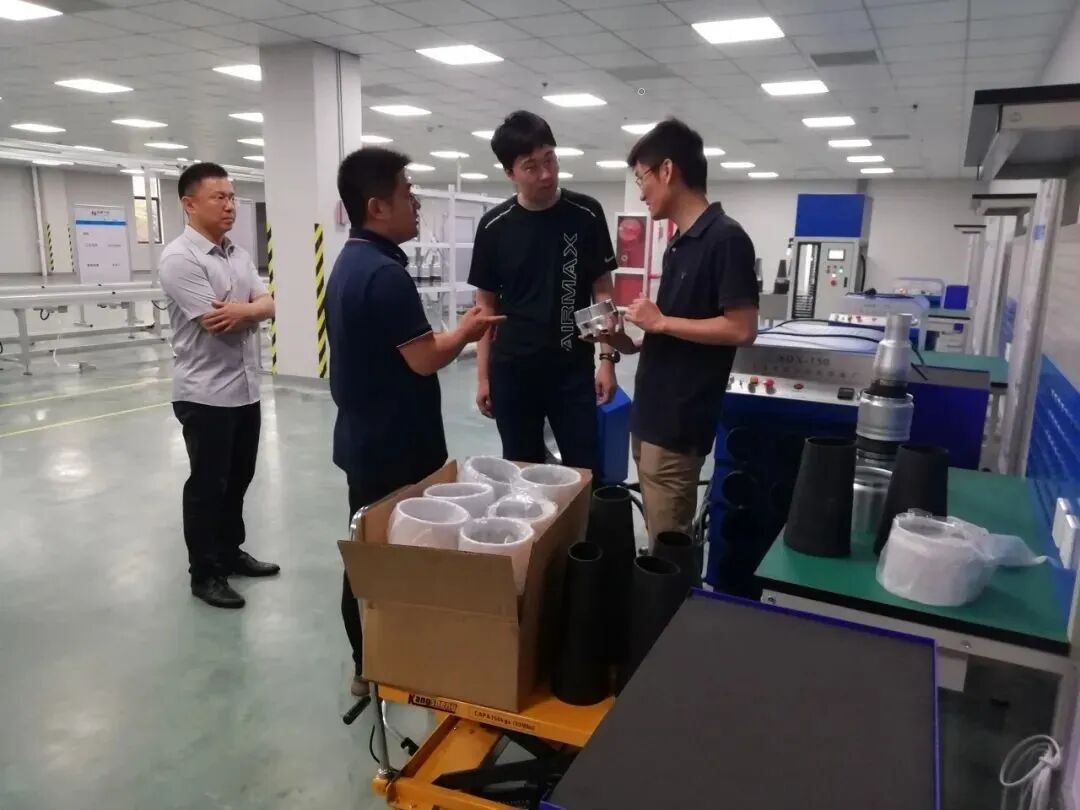
Li Auto technical staff visiting KH's production line; second from right is Mian Wang.
Currently, most of KH's orders are for air springs. Li Auto buys air springs from KH and develops its own software algorithms and controllers. Voyah buys complete suspension systems from KH, with air springs from KH and other components sourced and integrated. Chuan Guo believes that to maintain its lead, KH must eventually have the capability to provide complete vehicle electronically controlled suspension systems. This year, KH began supplying dual-chamber air springs to ZEEKR, with plans to expand to "more advanced electronically controlled suspension categories."
Di Wang believes competition in air suspension will ultimately return to cost advantages from scale, which once established are hard to shake. Compared to overseas suppliers, Chinese companies enjoy lower personnel costs and can operate normally with 20-25% gross margins, while German companies typically pursue gross margins above 30-40%. "Companies like KH" won't leave this space in the market.
For new entrants in this market today, he thinks it will be hard to survive. Air suspension's barrier isn't high, but it's not low either — you need to master rubber, crimping processes, and understand chassis dynamics. Today, KH and Baolong's products have been market-validated with well-controlled costs, so automakers have little incentive to take risks with new suppliers.
Unless there are supply chain disruptions or major changes in technical approaches, he believes once market structure forms, it's hard to break — a common characteristic of many industrial products. "Once costs reach a certain ratio, new entrants have no profit to pursue, unless there's a revolutionary technological iteration."
KH will keep gross margins below 25% in the future, Chuan Guo said, maintaining price advantages while sufficiently supporting daily operations — "automakers won't find it tempting."
Di Wang believes 2023–2025 will be KH's fastest growth period, as new energy vehicle penetration continues to rise. He summarizes KH's success as coming from two factors: on one hand, a team of "people willing to grind away at technology" with years of accumulated expertise in chassis technology; on the other hand, seizing the moment as China's automotive industry moves "upmarket" — unimaginable in the gasoline car era.
"KH's success is like that of many industrial niche companies — 'unintentionally planted willows grow into shade.' You keep researching and exploring, and suddenly discover a new product, a new business, and build it up. By the time you see the target and start acting, it's too late," Wang said.
Konghui Guo, now 88, is deeply gratified by KH Automotive Technologies' achievements today. In his era of entrepreneurship, Chinese components companies relied more on China's demographic dividend, doing low-margin, low-barrier material processing business. Today, KH has surpassed overseas suppliers to become market share leader in air suspension, a complex component.
Currently, nearly all 300,000-yuan electric vehicles come with air suspension. A set of air springs costs 2,000–3,000 yuan, while a complete system costs around 7,000 yuan. Automakers generally allocate only 5% of BOM cost (Bill of Materials, total component costs) to air suspension.
As costs continue to decrease, Chuan Guo expects that in five years, air suspension may become standard equipment on 200,000-yuan or even 180,000-yuan models. By next year, there will be vehicles around 250,000 yuan using air suspension.
The cost reduction space for air suspension is KH's own growth space. To bring air suspension to 180,000-yuan vehicles, KH must continuously improve products and expand manufacturing scale. Of course, popularizing such an expensive component also requires automakers with greater product ambition and a market more open to new things.