MaHui | MakeSens Announces Completion of Hundreds of Millions of RMB in Series B Financing

Starting from "battery safety," the company aims to provide "safer" technical solutions for grid systems.
#MaKe Key Updates from Source Code Capital and MaHui Members
MakeSens recently completed a Series B financing round totaling several hundred million RMB, with the B+ round led by GGV Capital. To date, MakeSens has closed four funding rounds within a single year. Its angel round was backed by Hong Kong X Fund and Inno Angel Fund; its Series A was led by Source Code Capital, with participation from Legend Capital; and its Series B was led by Creo Capital, a subsidiary of NWS Holdings, with Source Code Capital and Legend Capital following on.
According to sources, the new capital will primarily fund product R&D and market expansion. MakeSens has entered the market through distributed photovoltaics and energy storage, offering integrated "generation-grid-load-storage" solutions for user-side scenarios such as energy-intensive enterprises and high-tech industrial parks, improving clients' overall electricity cost efficiency. The company has also made inroads into consumer-facing segments like EV charging and low-speed electric vehicles — for instance, embedding diagnostic algorithms directly into chips for low-speed vehicle applications to enhance battery safety management at the hardware level.
Founded in 2018, MakeSens is a high-tech enterprise established by returning scientists. As early as the 1980s, founder and chief scientist Professor Xiao Yan began his research on new energy and battery safety testing at the University of Pennsylvania. In 1982, Professor Yan — then a recent graduate of Peking University's physics department — went to the United States for doctoral studies through the CUSPEA program (China-U.S. Physics Examination and Application Program) initiated by Tsu Tung Lee, studying under Lee himself. Decades later, recruited through Shanghai's "Thousand Talents Plan" for high-level overseas talent, Professor Yan — who had remained dedicated to battery safety testing — returned to China to found the company alongside co-founder Qiong Wei. Together, they set out to explore green power applications under China's "dual carbon" policy. Drawing on their deep insight into high-quality green energy development and their reverence for scientific rigor, the pair integrated "industry-academia-research-application" and started from "battery safety" to deliver "safer" technical solutions for grid systems.
MakeSens's core team members each bring over 15 years of energy industry experience from leading enterprises and top academic institutions, with most having spent years in the United States and holding multiple core patents in energy storage technology. The company name derives from "MakeSense," embodying its core value of "doing things that MakeSense."
As the lead investor in the company's Series A, Yiwen Hao of Source Code Capital commented: "Beyond cost, safety is the major bottleneck preventing energy storage from scaling. MakeSens starts from fundamental physics and chemistry principles, achieving leadership in battery safety algorithms and electrochemical model hardware solvers, and in 2021 launched a series of software and hardware products that have rapidly deployed across multiple energy storage scenarios. We believe the company will continue iterating excellent solutions and contribute to achieving dual carbon goals."

MakeSens Application Scenarios
Distinguished Research Achievements Addressing Root Causes
2021 marked MakeSens's "market debut year." Through large-scale power station projects in collaboration with central SOEs including State Grid Corporation of China and Huayun Group, the company successfully established the application foundation for its core energy storage safety technology. Its key R&D outcome, "Key Technologies and Engineering Applications for Fire Prevention and Control in Large-Scale Lithium Iron Phosphate Battery Energy Storage Power Stations," was awarded the First Prize of the 2021 State Grid Science and Technology Progress Award — one of the highest honors in China's electric power industry.
Moreover, on the subject of energy storage safety, the market's foremost concern is how to address the frequent fires at electrochemical energy storage stations. MakeSens has been continuously exploring solutions that tackle the problem at its root.
First, after repeated validation, its research team decisively abandoned the equivalent circuit model used by most battery management systems on the market, switching instead to an electrochemical model to capture the battery's internal reality. The equivalent circuit model can only reflect macroscopic battery states, unable to provide intrinsic microscopic physicochemical parameters. "A battery is like a black box; by using an electrochemical model, we're essentially installing an X-ray machine for energy storage scenarios, enabling real-time monitoring of internal conditions such as electrolyte changes and separator thickness. Once anomalies are detected, early warnings can be issued — truly putting prevention ahead of firefighting," summarized Qiong Wei, founder and chair of MakeSens.
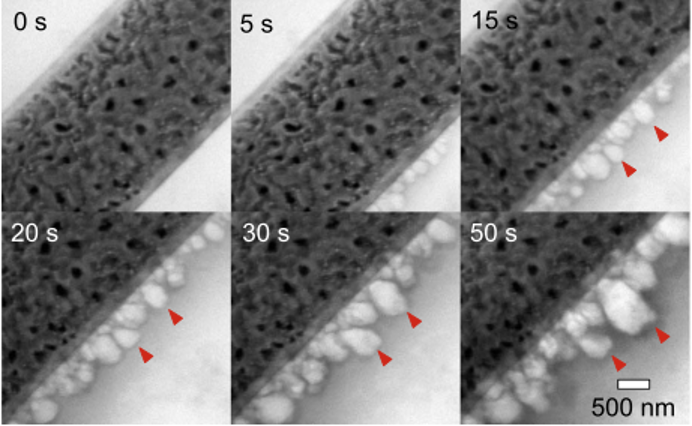
The triangle marks indicate growing lithium dendrites
Second, MakeSens's research team has achieved major breakthroughs in advancing its electrochemical model hardware solver. Late last year, its lithium battery electrochemical model hardware solver successfully completed testing, reducing single-cell computation time from 0.1 seconds to 0.05 milliseconds. With parallel computing, battery management and maintenance calculation speeds will improve by 200,000x, solving the worldwide problem of slow commercial model computation that prevented real-time processing. Recently, building on its P2D-stage electrochemical model hardware solver algorithm, MakeSens successfully simulated lithium dendrite growth, obtaining changes in internal physicochemical parameters and simulating dendrite growth within 10 seconds on software and 0.1 seconds on hardware (compared to approximately 90 seconds with currently available general computation). This enables more accurate prediction of lithium battery lifespan degradation, more effective prevention of lithium battery safety incidents, and precise assessment of true safe operating conditions — helping enterprises manage lithium batteries and power stations more purposefully, predictively, and economically.
"We have no ceiling on our R&D budget," said Qiong Wei, founder and chair of MakeSens. "I believe only by maintaining relentless pursuit and exploration in scientific research can MakeSens continue achieving breakthroughs in critical energy technologies. Going forward, we hope more research talent will join our team."


MaKe | METiS Pharmaceuticals Announces Two Consecutive Rounds Totaling $150 Million
MaKe | XMIRROR Announces Series B Financing of Several Hundred Million RMB, Led by Source Code Capital

MaKe | Nutshell Therapeutics Announces $40 Million Series A+ Round, with Existing Investor Source Code Capital Increasing Stake
MaKe | Fairino Announces Series B Financing of Over $50 Million, Led by Source Code Capital

MaKe | New Retail Home Tech Brand Banrixian Announces Pre-A Round of Several Ten Million RMB, Led by Source Code Capital
Click "Read Original" to view more Source Code Capital portfolio companies