Code Moment | Source Code Capital Wins the 7th Golden Bull Award for Sustained Excellence in Venture Capital

A New Era of Quality-Driven Innovation, A New Ecosystem for Investment


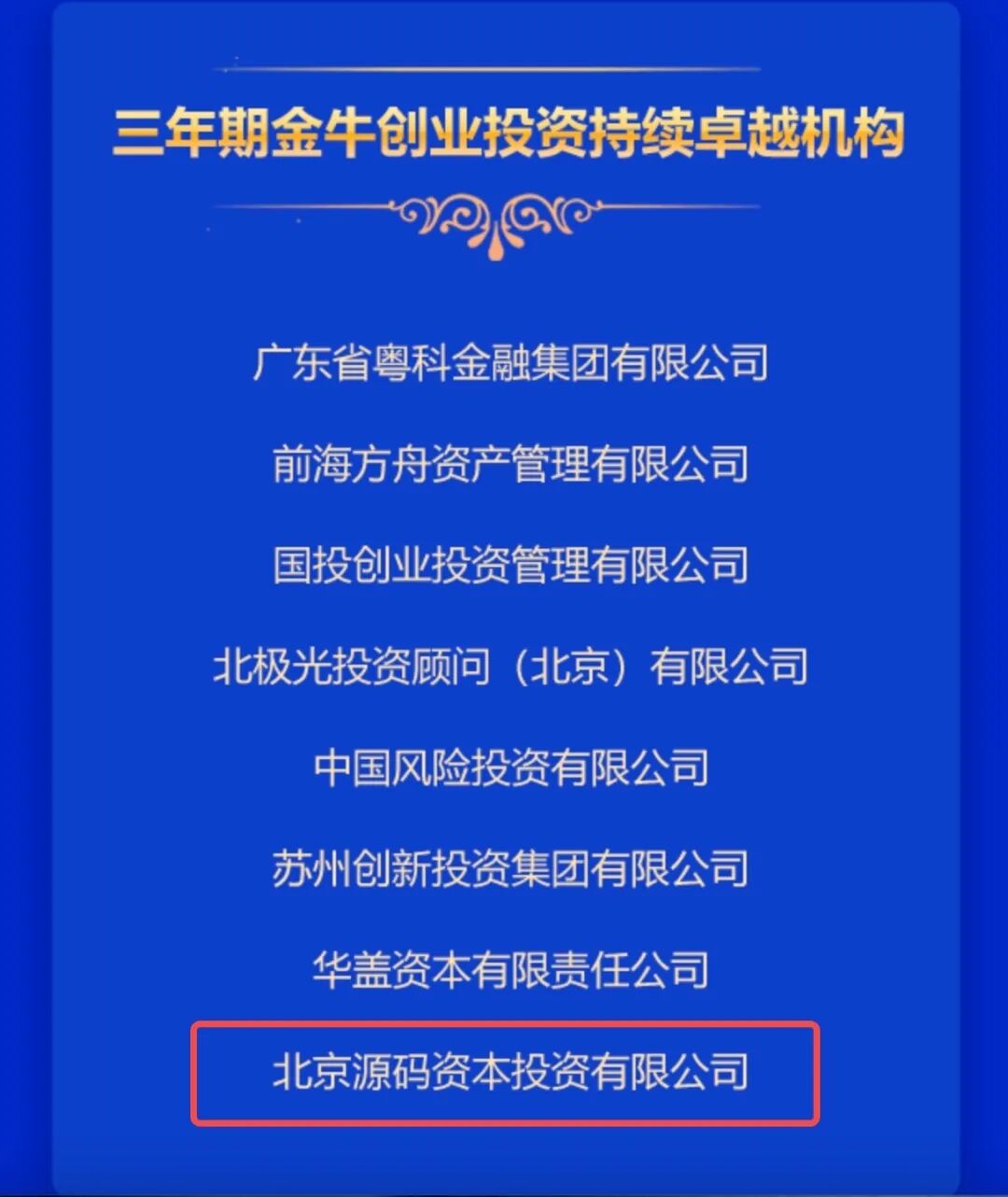
On November 7, in Nanjing, the 7th Golden Bull Equity Investment Awards list was officially announced! Only those who navigate bull and bear markets reveal their true strength — amid fierce competition, a year of remarkable achievements. Source Code Capital was honored with the Three-Year Golden Bull Venture Capital Sustained Excellence award.

The 2023 Equity Investment Development Forum, hosted by China Securities Journal with the theme "A New Era of Quality Innovation, A New Ecosystem for Investment," was held in Jianye District, Nanjing. The forum also hosted the 7th Golden Bull Equity Investment Awards ceremony.

The forum brought together industry elites to discuss the mission and opportunities facing the equity investment industry amid the reshaping of the global innovation landscape, and to explore how the industry can seize the opportunity to build new quality productive forces.
At the forum, Liu Shijin, former Vice Chairman of the Economic Committee of the 13th CPPCC National Committee, former Deputy Director of the Development Research Center of the State Council, and member of the Monetary Policy Committee of the People's Bank of China, stated that China's economy remains in a transition period from high-speed to medium-speed growth, or from high-speed growth to high-quality development. The key is to unlock new growth potential:
First, "horizontal demand space" — in simple terms, narrowing the gap in terminal demand structure (including consumption and non-productive investment) between low- and middle-income groups and middle- and high-income groups, so that consumption levels of low- and middle-income groups gradually approach those of middle- and high-income groups;
Second, "vertical upgrading momentum" — raising the technological content and added value of industries to expand the upward space of the economy, including value chain upgrading of existing industries and the emergence and development of new industries or "future industries" driven by new technologies.
Shi Yong, State Council Counselor, Academician of the Academy of Sciences for the Developing World, and Director of the Research Center on Virtual Economy and Data Science at the Chinese Academy of Sciences, stated that China's leading advantages in digital economic development are reflected in:
First, the systematic, scientific, and forward-looking top-level design enabled by the advantages of the socialist system;
Second, the advantage of an ultra-large-scale market;
Third, China's large basic research workforce, which provides an advantage in digital technology R&D.
Liu Jianjun, Professor at Hunan University, Chief Expert at Tsinghua University's Private Equity Research Institute, and principal drafter of the Private Investment Fund Supervision and Administration Regulations, systematically reviewed the legislative history of China's private equity funds and outlined six innovative developments in the regulations based on existing legislative practice.
First, adhering to the basic approach of "behavioral regulation framework with appropriately defined normative requirements," enhancing industry participant quality by adding necessary qualification requirements and establishing exit mechanisms.
Second, upholding the principle of "combining rule-based and principle-based regulation," improving regulatory effectiveness by strengthening relevant normative requirements.
Third, adhering to the principle of "combining purpose and means, with purpose outweighing means and substance outweighing form," clarifying special provisions such as exempting one layer of nesting for compliant fund-of-funds operations, enhancing the precision of regulatory rules.
Fourth, upholding the principle of "focused monitoring on the basis of comprehensive registration and filing," improving regulatory comprehensiveness by clarifying the establishment of robust monitoring mechanisms.
Fifth, adhering to the principle of "categorized regulation on the basis of unified legislation," improving regulatory targeting by enriching classification dimensions.
Sixth, upholding the principle of "differentiated regulation and special policy support for venture capital funds," promoting the implementation of relevant systems by refining definitions of venture capital funds at two levels.