MaHui | Woan Robotics Founder Li Zhichen: The Future of Home Robots Is 'Clear Division of Labor,' Not 'All-Powerful Superhumans'

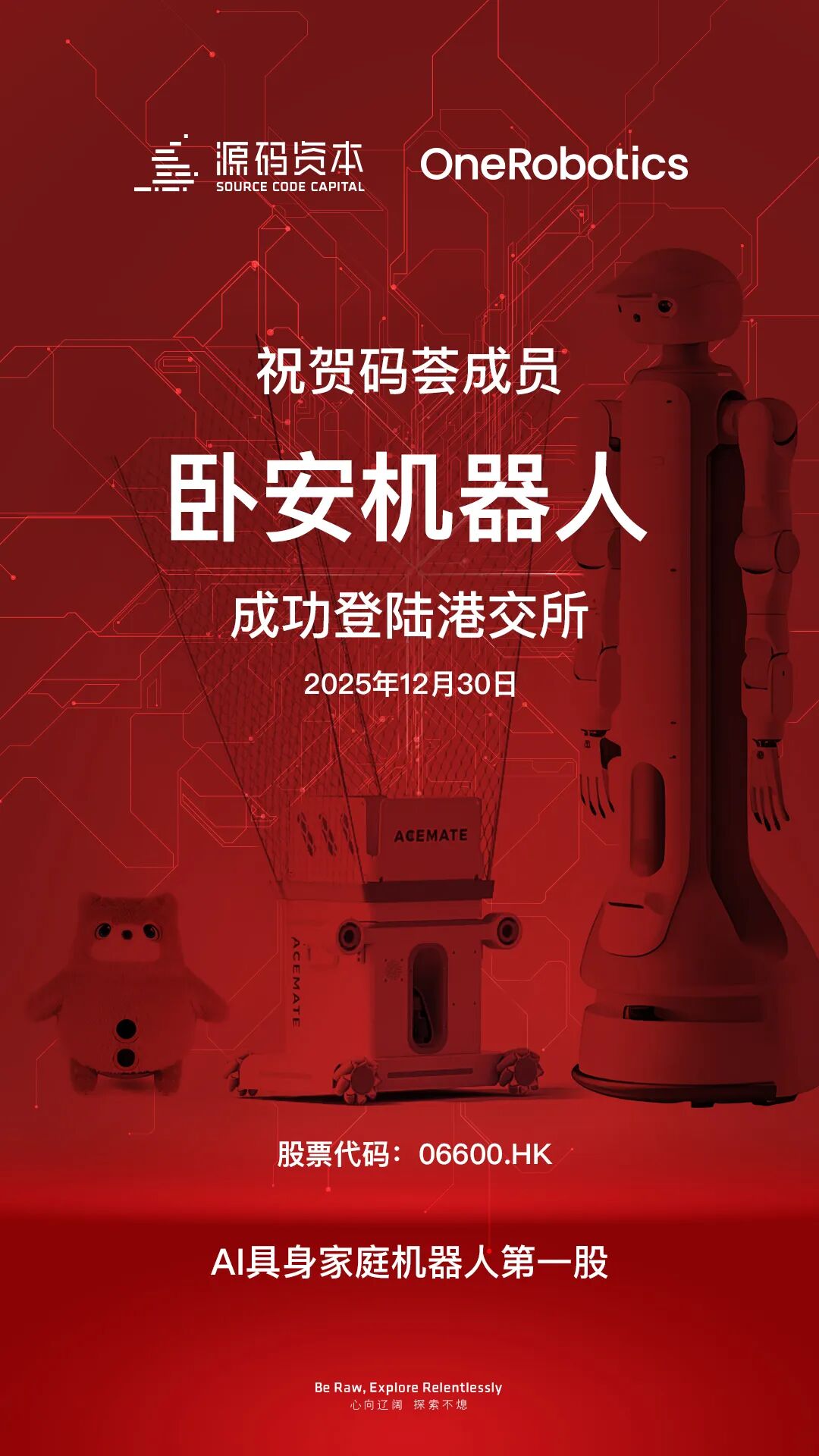
Woan Robotics, a member of MaHui, successfully listed on the Hong Kong Stock Exchange, becoming the "first AI embodied home robotics stock."

On December 30, 2025, Beijing time, MaHui member Woan Robotics successfully listed on the Hong Kong Stock Exchange, becoming the "first AI embodied home robotics stock". The IPO price was HK$73.8 per share, with total gross proceeds of HK$1.64 billion and a market capitalization of HK$16.4 billion at listing.
Source Code Capital participated in Woan Robotics' (OneRobotics, hereafter referred to as Woan) Series A+ round in 2021, subsequently followed on in multiple rounds, and has continued to support the company to this day. As of immediately prior to the IPO, Source Code Capital remained one of Woan's largest institutional shareholders. A Source Code Capital investor noted that Woan has always kept "using technology and innovation to make life better" as its endgame, thinking through product definition and innovation to achieve the optimal match between AI embodied technical capabilities and commercial scenario deployment. "We have been fortunate to witness Woan Robotics' critical leap from 'product innovation' to 'platformization and scale.' We look forward to the company continuing to amplify the positive feedback flywheel of 'product definition × technology iteration × globalization,' and launching more innovative robotics products to serve global users. Source Code will also continue to support and accompany excellent companies in creating lasting, real value over the long term."
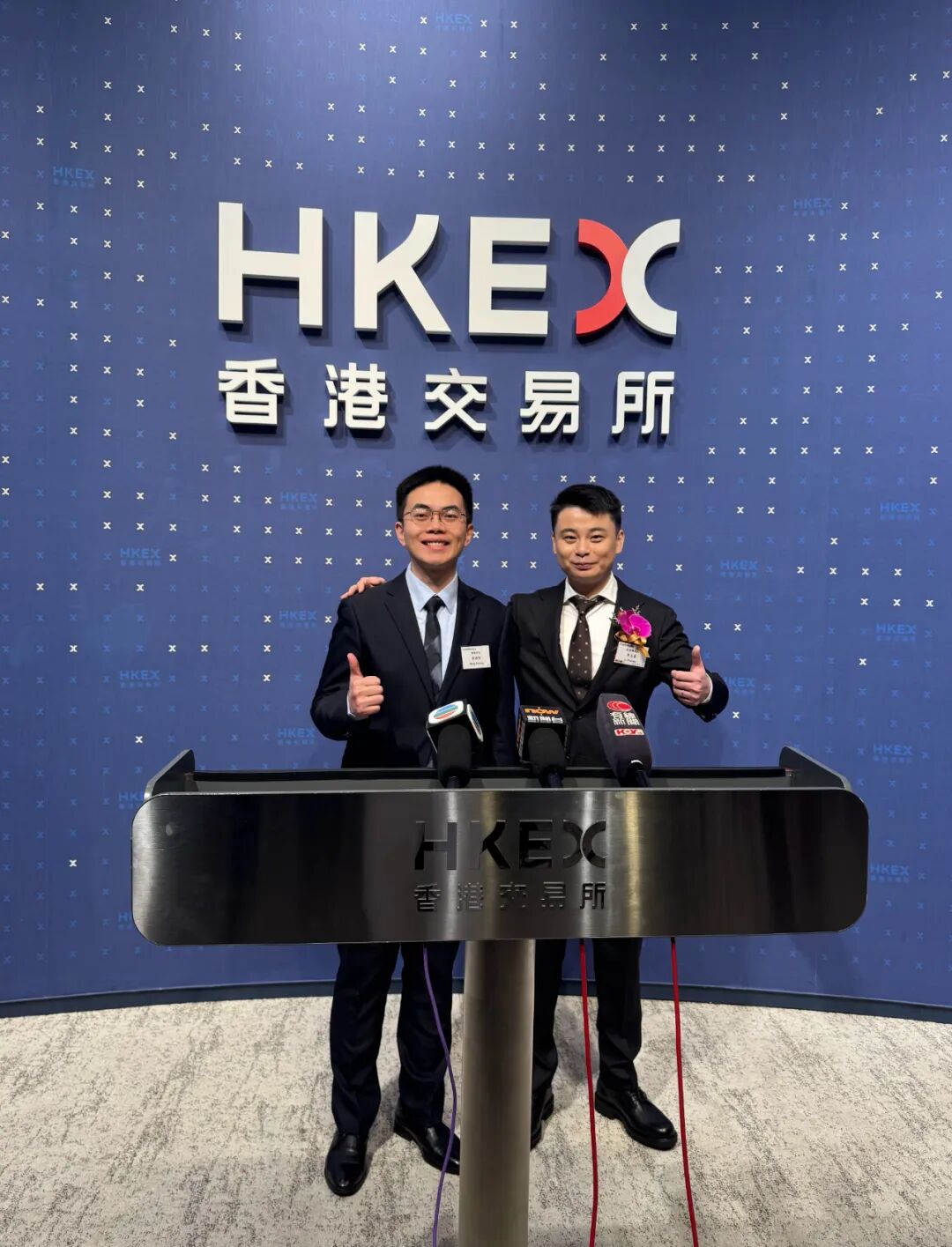
At the listing ceremony, Source Code Capital Senior Investment Manager Deming Weng (left) with Woan Founder and CEO Zhichen Li (right)
Woan is one of the very few companies globally in the AI embodied home robotics industry to have launched multiple world-first products and successfully commercialized them. Leveraging its integrated R&D-manufacturing-sales全产业链优势 across the entire industry chain, particularly its three self-developed core AI embodied technologies — AI machine vision control technology, robotic positioning and environment mapping technology, and distributed neural control network technology — Woan has launched the world's first AI tennis robot capable of playing against real humans, Acemate; the world's first locally deployed large-model AI companion robot, Kata Friends; and the world's first multi-functional home robot, among other world-first products. Its products are sold in over 90 countries and regions overseas, with key markets including Japan, Europe, and North America.
According to a public report by Frost & Sullivan, ranked by 2024 revenue scale, Woan is already the world's largest AI embodied home robotics system provider, and the only company in this field with a comprehensive layout of home robotics product categories across family life scenarios.
Yet this Shenzhen-headquartered enterprise is extremely low-profile, with scant publicly searchable information. Founder and CEO Zhichen Li and the core team rarely appear in public settings.
How did Woan manage to stand out in the fiercely competitive global market? What enabled it to take the top spot overseas? How did it rapidly achieve PMF and commercialization? What is its "moat"? What kind of people make up this company's founding team? And what is its corporate culture like? — With these critical questions in mind, the Source Code Capital team sat down with Zhichen Li for a three-hour conversation on the eve of the IPO. This is only the second interview Zhichen Li has given since founding the company; the first was during a previous MaHui entrepreneurs' annual meeting.
His office is filled with various anime IP merchandise and trinkets. He says that as a child, he dreamed of having a Doraemon — no need to go out, just pull whatever you needed straight from its pocket. — This was also Zhichen Li's original motivation for starting his business. The name "Woan" means creating a comfortable state where people can recline and relax at home. As for the books stacked on the shelves behind him, Zhichen Li joked, "I can't read as fast as MaHui gives them away."
The following is an edited transcript of the conversation, with some content abridged:
1
A "Lazy" Person
Making "Reclining in Peace" a Lifelong Goal
Source Code Capital: Congratulations on Woan's official listing on the Hong Kong Stock Exchange. They say an IPO is a startup's "coming-of-age ceremony." How does your state of mind compare to when you were designing robots at Harbin Institute of Technology or returning from Singapore to start your business? What has changed most, and what hasn't?
Zhichen Li: First of all, I'm definitely happy. An IPO is an important milestone for any company.
But in terms of "qualitative" difference, it's actually not that significant. Because an IPO is just a stage of public fundraising, much like when we raised new funding in the primary market — it's not an endpoint, and certainly not a summary of the past. Whether or not there's an IPO, what we do every day remains the same: continuously identify market opportunities, and use the most cutting-edge technology to address them. Getting the balance right between PMF (Product-Market Fit) and R&D investment — this has always been our core working method.
The "quantitative" changes are greater: first, the responsibility is much larger. Before listing, we were accountable to primary market shareholders; after listing, it's public shareholders — the scale and scope are simply not comparable. What matters deeply to me is that the IPO gives users, colleagues, partners, and shareholders who have been with us along the way a greater sense of security in this new phase. The second change is that resources are clearly more abundant. This IPO raised over US$200 million, allowing us to undertake longer-term, more challenging R&D, stronger productization, and more systematic global deployment.
Personally, my mindset is calmer and more pragmatic: it's still the same endeavor, but I'm more rigorous about "how to make it bigger, more stable, and more long-term." Of course, there's also greater security — more room to explore, bolder and more decisive upfront investment, and the ability to build something bigger, more stable, and more long-term with greater composure.
Source Code Capital: Woan is called the "first AI embodied home robotics stock." Compared to other robotics paths that are easier to implement and validate, why did you choose the seemingly harder road of "embodied home robots"? Is this related to your longstanding technical convictions?
Zhichen Li: There are two reasons: first, a very personal need. I'm not particularly fond of the outdoors, and frankly, I'm somewhat lazy. The future home scenario I've always imagined is: having a nanny robot to do all kinds of dirty and tiring work for me; a pet robot to provide emotional value; and when I need exercise, a sports robot to play ball with me...
This is a real, long-term, and very clear need that existed from day one of founding the company, and I believe there must be many people like me. But to realize this long-term vision, it's absolutely not achievable with just one or two robotics products — it requires building an entire robotics home ecosystem.
The second is a sense of groundedness in commercialization. Home robots are B2C products; consumers vote with their wallets. Whether a product is good or not, whether the need truly exists — the market gives the most direct feedback: are users willing to pay, repurchase, and recommend? This can't be faked, and it's the most sustainable path that forces enterprises to continuously evolve.
This is indeed closely tied to my personal technical convictions. I've always believed that technology isn't for showing off; technology ultimately must serve scenarios and user value.
Source Code Capital: This reminds me of when we interviewed you at the MaHui annual meeting — you said you got into home robotics mainly because you're "lazy." Still the case?
Zhichen Li: Always has been, and now I'd define "lazy" more precisely: the essence of "laziness" isn't escaping labor, but refusing to waste time on repetitive labor. If robots can do these things better, more stably, and with less worry, people can devote their time and energy to more important matters. In recent years, I've become increasingly certain of one thing: beyond "more convenient, more comfortable," home also needs to be "more joyful." Today's AI often provides emotional value more stably, patiently, and consistently than humans. If robots handle all the housework, people have time to exercise and pursue healthy lives — you can't just lie flat completely. So beyond "nanny robots" to solve tedious household labor, we're also very committed to "companion robots" and "sports robots," hoping users at home can not only have things easier, but also be happier, more relaxed, and more motivated.

Woan Robotics Founder and CEO Zhichen Li being interviewed during a previous MaHui entrepreneurs' annual meeting
Source Code Capital: But achieving this goal still seems quite distant. As people say, entrepreneurship is nine deaths and one life. From Woan's founding to its IPO is exactly ten years. Have you ever thought about giving up? Have you experienced any darkest moments?
Zhichen Li: In the strictest sense, there haven't been any "darkest moments." Because our entrepreneurship has been more like daily progress, no effort wasted — growing a little bit each day. Many new problems that emerge in the process of continuous growth get resolved at earlier stages. If I had to name difficult times, they were more around when we first started and were choosing our direction — with limited experience and information, we couldn't be 100% confident we had chosen the absolutely correct direction. There was纠结 and pressure.
But giving up truly never crossed my mind. I think people only choose to give up in two situations: either they feel the goal can never be reached, or they've completed the previous goal and start wondering what the next one is. But my goal is very distant — enabling people to truly "recline and relax" at home — this isn't achievable in the short term, so giving up isn't even a consideration.
There's a passage at the beginning of Cixin Liu's Ball Lightning that deeply influenced me. The protagonist's father wants his son to become someone as focused as Chen Jingrun, who spent his entire life working on the problem of one plus one equals two, perhaps never solving it in his lifetime. But this spirit of focus is deeply admirable and worth learning from, and it influenced me profoundly.
I've always held onto this long-term vision. Though very difficult to achieve, every step forward brings me closer than yesterday, and there's much joy and meaning to be found along the way. This was originally my personal life goal, and fortunately it merged with the company's vision. But now there's a group of people, a thousand people, working toward it together. When you see the team improving every day, see the industry advancing as a whole, see us getting closer to the goal — it's very hard to generate any feeling of "wanting to give up."
2
Building the Team on "Can It Ship?"
Source Code Capital: Back to you — you entered Harbin Institute of Technology at 16, and I heard you were already tinkering with robots in college. How did those years shape your path to entrepreneurship?
Zhichen Li: I was in a secondary school youth class, so I entered university earlier than most, with five years of secondary schooling. During my time at HIT, my deepest connection with robots came down to one thing: seeing things through. I spent nearly every winter and summer break on campus, competing in robotics contests.
What HIT gave me most was its motto: "Strict Standards, Solid Skills." As a student, I thought it sounded a bit corny. But later I realized how pragmatic it really is — engineers simply need to get things done, and done well. That motto eventually became Woan Robotics' culture: know your role, build real skills, seek truth from facts.
The founding team shared a trait back in college: we weren't content following our professors' or seniors' research topics. We always wanted our own. We'd pose challenging, innovative questions, then test our ideas through competitions. The process mirrors entrepreneurship almost exactly — start with a hypothesis, frame the problem, then validate whether it can work commercially.
In 2009, our team won the only first prize in the advanced undergraduate category at the ADI University Design Competition. We came to Shenzhen to collect the award — our first time in the city. That trip opened our eyes to the possibility of starting a company.
Source Code Capital: As you mentioned, Woan's founding team all came from HIT, a classic engineering background. That's quite different from many startups that deliberately mix diverse backgrounds. Why build the team this way? And how does a purely technical team balance technological idealism with commercial reality?
Zhichen Li: Our founding team's DNA is engineering. Everyone works within the same engineering language and standards — that makes us extremely efficient, and默契 comes naturally. The hardest part of building robots isn't "sounding impressive" — it's "can you build it, can you deliver it, can you scale it." That demands enormous engineering rigor and respect for detail, so we built the team from day one on the logic of "can it ship?"
As for balancing idealism with reality, our approach has always been clear: use PMF to constrain technology, use technology to create new PMF. We don't wander around with a hammer looking for nails — if a scene lacks real demand and users won't pay, it's not worth the investment. But once we've confirmed a real scene exists, we deploy the most advanced technology to make it "noticeably better than the old way."
Internally, we often frame decisions as a "value function": which are first-order variables that directly determine user value, which are second-order, and which are just illusions that excite us but users don't care about. That's how we maintain balance between idealism and reality.
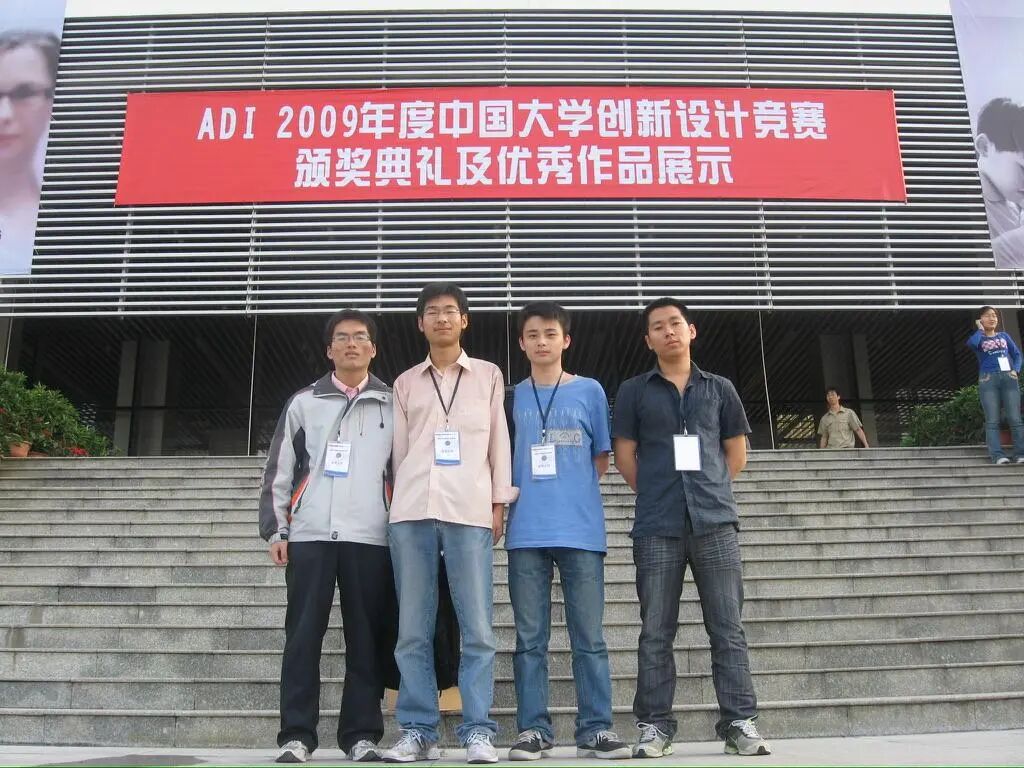
Woan Robotics founding team with HIT classmates (second from right: Zhichen Li, Founder & CEO; far right: Co-founder & CTO) in Shenzhen, 2009
Source Code Capital: How did you connect with Source Code? What made you willing to have us as a long-term partner?
Zhichen Li: A mutual founder friend in Shenzhen introduced me to Source Code's investors — his company was also in Source Code's portfolio.
What struck me about Source Code was, first, that MaHui brought together outstanding post-80s entrepreneurs like Yiming Zhang and Xing Wang, plus fellow travelers like myself. Second, Source Code itself represents VC 2.0, and Lao Cao (Yi Cao, Founding Partner of Source Code — ed.) is a deeply farsighted investor. I came in wanting to befriend China's best entrepreneurs, and joining the Source Code family felt like it would give us more support.
Through deeper conversations, I found our understanding of entrepreneurship, core decision-making judgments, underlying values, and long-term vision were highly aligned — and that's been crucial to our enduring partnership.
Source Code Capital: Through your collaboration, what impressed you most about Source Code? As Woan grew from dozens to hundreds of people, and from Shenzhen to global markets, were there moments when you thought, "These are our people"?
Zhichen Li: "Fast, and big-picture." Source Code's decision-making is remarkably fast, never wishy-washy. Whether in fundraising or IPO processes, the response is immediate — truly putting the company's interests first, saving us time, and never getting bogged down in trivialities. That's rare. Time windows matter enormously for startups in fundraising or going public; miss the optimal moment, and opportunities vanish.
What I appreciate most: Source Code never interferes with company decisions just because it's a major shareholder. They trust my judgment as the founder, respecting our frontline "combat" rhythm. Lao Cao also gave me tremendous encouragement and guidance. Before Source Code invested, we already had decent profits. Lao Cao strongly supported reinvesting those profits into the future. We stopped obsessing over single-year profit and instead pre-invested all available resources, securing an excellent position at the technology inflection point.
Source Code's post-investment services are among the best in the industry. When they saw we had no PR bench, they immediately provided resources and strategy. They helped us recruit key talent for core positions. I've attended countless Code Brain sessions and courses — hugely beneficial. My shelves are stacked with books from Source Code; I can't read as fast as MaHui sends them... The post-investment team truly helps without getting in the way, filling valuable gaps.
The Real Hard Barrier to Break Is Organizational Culture
Source Code Capital: You've repeatedly mentioned Woan as an engineer-founded company, yet your financials are unusually strong — EBITDA growing explosively. While many robotics companies struggle with profitability, Woan achieved high-quality profit. How?
Zhichen Li: We didn't reverse-engineer from "financial budget targets" — what engineer team understands that? What we focus on is maintaining healthy gross margins. Gross profit is real, deployable cash. Only with enough deployable cash can we fund continuous product iteration, frontier technology exploration, and new R&D. So our annual growth and EBITDA explosion are more outcomes than targets.
But as engineers, we're certainly data-sensitive. Every year we set clear efficiency OKRs: continuous cost reduction on the supply/production side, continuous sales efficiency improvement on the revenue side. This isn't for pretty books — it's to force the team to "improve a little every day, a lot every year." If costs keep falling and efficiency keeps rising, financials naturally improve year after year. We focus on the core parameters of our team's core capabilities.
Source Code Capital: Woan's Acemate tennis robot was named one of TIME magazine's Best Inventions. Why "tennis" as the entry point? How did you refine it into a success?
Zhichen Li: The choice was simple: first, our team has long-standing interest in sports; second, it's an excellent embodied intelligence closed-loop scenario.
One colleague loved tennis but couldn't find a matching partner. Anyone who plays tennis knows: the learning curve is long, and if your level isn't there, you're just picking up balls all day — exhausting. He said: "Build me a robot to play with."
He used our vision model to recognize the ball and predict landing points, McNam wheels for movement and return — that was the initial prototype. Then came data validation. We found over 100 million tennis enthusiasts globally; if even 1% wanted a robot sparring partner, that's 1 million units. At $2,000+ per robot, even 1% market penetration is substantial.
Finally, user feedback iteration. A coach told us: "That buzzer needs to be loud — give emotional reinforcement when they hit well." Real feedback like this drove countless product iterations.
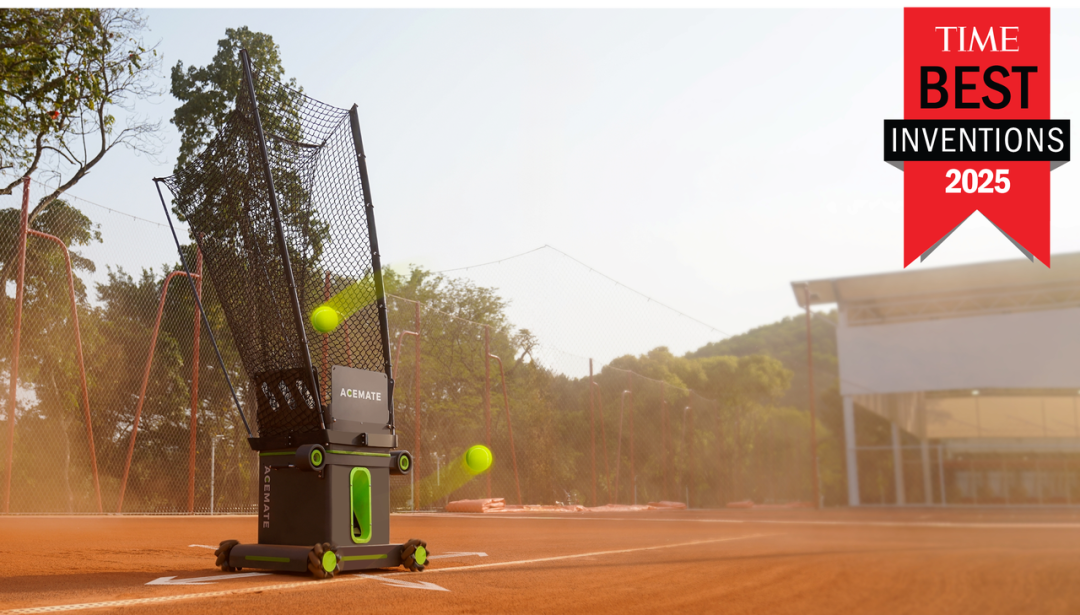
Acemate, the world's first tennis robot capable of real-person rallying
Source Code Capital: Outsiders consistently recognize Woan's exceptional product definition capability — many products are category firsts, like the tennis robot, AI companion robot, humanoid household robot. How was this "zero-to-one" product-building ability developed? Is there a systematic methodology?
Zhichen Li: I believe zero-to-one isn't sudden inspiration — it's systematic methodology plus long-trained judgment. Our approach resembles the "modeling" I mentioned earlier: first build scene understanding through massive inputs (physical intuition, data, user conversations), then write product decisions as a value function — what's the objective, what are key variables, which are first-order must-achieves.
We also don't worship "category logic." What matters more: can old scenes and old needs be better served by new technology? We use more advanced technology to create experiential gaps, let market feedback validate whether it works, then fine-tune through user feedback — like model fine-tuning — making products more approachable, stable, and aligned with real user expectations.
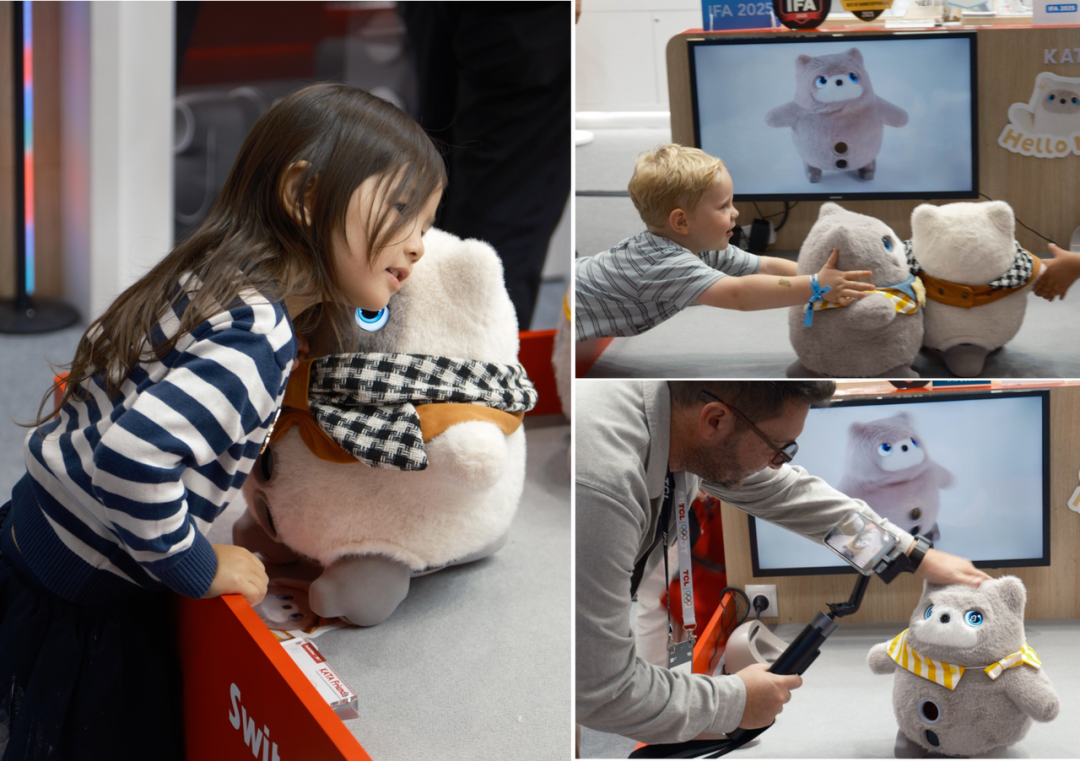
Kata Friends, the world's first AI companion robot with locally deployed large models
Source Code Capital: A defining trait of Woan is "blooming at home, fragrant abroad" — you've captured global market share leadership. What allows Woan to build moats? What core competencies are truly hard to replicate?
Zhichen Li: Some moats are causes, some are effects; some are visible, some invisible.
Woan's visible moat is first technological advantage. Our founding team all did R&D at HIT — technology is always our foundation. The three technical pillars of embodied AI — distributed neural control networks (multi-module coordination and distributed execution), AI machine vision control (visual perception and closed-loop control), and robotic positioning and environment mapping (localization, mapping, and environmental modeling) — all represent our first-mover advantages.
Second is brand mindshare. With technological advantage and our PMF methodology, we've developed new categories from zero to one; many products were invented by Woan itself. Among global middle-class consumers, mention a category and Woan comes first to mind. Overseas e-commerce search keywords are largely our brand name — brand mindshare is established. We haven't done heavy brand marketing, but the brand effect from our products is already evident.
Third is channel moats. Once you've established brand mindshare with users, getting into channels becomes smooth, and gradually Woan builds its own channel barriers. The more you sell through channels, the more that feeds back into supply chain and production scale — costs keep dropping, creating supply chain moats. This ultimately forms a positive flywheel, with each link reinforcing the next, making our barriers increasingly difficult to "breach."
The invisible moat is organization and culture. As I mentioned earlier, we're a team that highly values efficiency and pragmatism. We don't think from "adjective philosophy" — we solve problems practically. When a new technology emerges, we use benchmarks to see if it's genuinely better than the old; when we build a feature, we check if users will actually pay for it or if it's just our own excitement and illusion. This efficient, pragmatic organizational culture keeps us following the latest technology and hearing the truest user voices.
Source Code Capital: How did this organizational culture form? The question is, how do you ensure this invisible advantage can be sustained?
Zhichen Li: This culture existed from day one of founding. Woan's founding team was just a few engineers, and this was how we communicated. Internally, we emphasize "let the data talk" — you run things, see how the benchmark looks, and we want to be able to point out problems directly in meetings, so our core value is pragmatism.
Of course, I do worry this invisible advantage will get diluted as the team scales. With three people, twenty people, a hundred people, you can still ensure efficient, smooth communication. But as headcount grows, maintaining invisible advantages actually becomes harder than maintaining visible ones — this is homework we need to do over the long term.
I lean toward natural selection. Under this organizational culture, people who don't like or can't adapt to this style will leave on their own. We can only continuously filter this way, so that people who identify with us become more numerous and those who don't become fewer, allowing the organizational culture to keep sedimenting.
In our current team, many are Woan "veterans," including the entire founding team, so new forces can hardly make an impact on the organizational culture. I've always believed that maintaining efficient, steady team development is important.
Source Code Capital: How many core patents does Woan currently hold? In the humanoid robot field, which key technologies have you achieved breakthroughs in?
Zhichen Li: In IP database searches for embodiment-related patents, Woan is among the highest in volume. We've done systematic patent and engineering layout. But patent count isn't what I care about most, because many patents are defensive arrangements. What matters more is whether Woan's key capabilities have formed a "deliverable, replicable, scalable" technical system. We don't do technology to "tell stories" — productization落地 and user value are our ultimate检验 standards.
For humanoid household robots, we focus breakthroughs on three capability categories: first, robust perception and localization in home environments — home scenes are far more complex than factories; second, multimodal understanding and task planning — making robots able to hear, see, and reason; third, execution and safety — household scenarios fear uncontrollability most, so reliability, safety, and maintainability are essential.
Global Layout: "Win-Win" from Day One
Source Code Capital: You've said before: "Companies of our generation should be international from day one." What choices does this entail? If a company doesn't do this, where is it most likely to pay the price?
Zhichen Li: "International from day one" isn't a slogan to me — it's making choices with a global perspective from the very first day of founding: product definition doesn't fixate on one country's habits; compliance and quality systems are built to higher standards; channels and partners are designed for "win-win" from the start; supply chain and delivery must support cross-regional stability.
More important is mindset: every country has its unique charm and resources, and we shouldn't stereotype that "this country is lazy, that country is poor." Looking globally, we can find the optimal solution for market and supply side — where demand is most urgent, where the partnership ecosystem is best, where long-term compounding can form.
If you don't internationalize from day one, the cost is often "path dependency": product and organization get locked into a single market, and when you want to go overseas later, you find product experience, compliance, and channel relationships all need to be rebuilt — higher cost, smaller windows, and possibly missing the most critical early users.
Source Code Capital: But Chinese companies "going global" isn't easy. Woan chose the counterintuitive "Hard Mode" from founding, even choosing the independent site model. What supported you in firmly making this strategic choice?
Zhichen Li: I personally don't think this was a counterintuitive choice — rather, it was a natural choice.
What we saw was the massive demand from overseas middle-class markets. For example, Japan has nearly 100 million middle-class consumers, and the US and Europe need no introduction — they're the main force of global consumption. Because I previously worked in Singapore and was essentially an overseas white-collar worker, I could understand this group's needs. Meanwhile, China has significant advantages on the supply side. I felt that if one place has a strong supply-side高地 and another has vigorous demand that local enterprises haven't well satisfied, then we happen to have the capabilities and resources to fill that gap.
Why start from independent sites and crowdfunding? Because at the very beginning of founding, we could communicate directly with users, unaffected by platform algorithms, receiving high-density, high-quality, most authentic user feedback to help us quickly validate product direction and narrative logic. Later as we grew, we also expanded platform partnerships.
Source Code Capital: Woan's products currently cover over 90 countries and regions globally. User characteristics and consumption cultures vary enormously across these regions. What strategies do you use to ensure success in each market?
Zhichen Li: Japan, North America, and Europe are all "easy to defend, hard to attack" markets — "hard to attack" means companies can build high moats. And my previous experience working and living overseas gave me deep understanding of this consumer group's lifestyle. The demographic where robots can penetrate earliest is precisely these middle-class families with spending power but without "full保姆 teams."
In different overseas regions, we use a "three-step closed loop" method to maximize落地 success — it's the same process as training a large model.
Step one is embodied experience, like a pre-trained model collecting corpus. As product developers, you need to experience local life. When I was overseas, I'd stay in different houses daily, experiencing different housing structures and real scenarios. Only with enough accumulated "corpus" can you imagine what these people might need.
Step two is data validation, the reasoning phase. With initial embodied experience, use various methods to collect consumer data. This helps validate whether this demand has already formed a certain market scale, and why it hasn't grown bigger — is it just that existing products aren't strong enough, or are there other reasons.
Step three is communication, similar to RLHF for large models. Communicate with locals — partners, distributors, end users — to continuously iterate the product. Because some needs are just what you think are needed, but consumer feedback may diverge. This step helps you fine-tune the entire model to ensure increasing accuracy.
Basically, all Woan products go through this three-step closed-loop validation. With this methodology, different countries and regions can be handled consistently and replicably. Strategically, breaking through the hardest markets first forces organizational capability upgrades — product definition, quality systems, delivery capabilities, and channel partnership standards all get pulled higher. Simply put, when you can satisfy Japanese users' requirements, entering other markets becomes more从容.
Source Code Capital: Woan plans to launch the humanoid household robot H1 overseas next year. This is a highly anticipated product. What's the overall market layout plan? Will you布局 for aging scenarios, given that aging is already an irreversible global trend?
Zhichen Li: H1 will be released in Q1 2026, then begin in-home delivery. It definitely hasn't reached the point of entering millions of households as a nanny yet, but we hope to first launch a low-cost general-purpose body. H1's cost may be the lowest among all humanoid robot products, because everything from joints to torso to the complete machine is self-developed by us.
Early on, we'll first sell to more "structured" scenarios and demographics: for example, DIY/Maker communities, research institutions, and some commercial scenarios. The ultimate goal is definitely entering thousands of households, entering every family. So early on we'll be more conservative and steady, penetrating key scenarios, stabilizing product capabilities and safety boundaries, then gradually expanding, including nursing homes — we'll definitely布局 there in the future.
In fact, we already have specialized robot products in the elderly care sector, though not through主动 effort. We discovered that middle-aged and elderly people's interest in Woan products is higher than young people's, because elderly people have mobility difficulties. Many people with mobility impairments use Woan products — for example, a user with cerebral palsy used our product to control home devices and even wrote us a thank-you letter. Unexpectedly, because of "laziness," our products gained more social value.
Source Code Capital: As a representative of successful overseas-expanding technical entrepreneurs, what advice do you have for young entrepreneurs still on the journey?
Zhichen Li: The most important thing is respecting real local market demands and doing PMF well. Every country and region differs greatly — local national needs differ, household environment needs differ greatly too.
Another suggestion is sharing benefits with local partners — this is key to sustainability. Moving from self-interest to altruism is important for long-term business model development. I've always believed that the most important thing in overseas commercial activity is "cooperating" with overseas partners, letting local partners also get an important share of the benefit chain. That model of pursuing unilateral short-term profit maximization has no benefit for Chinese companies' globalization.
Finally, have a long-term mindset. Entrepreneurship is a marathon, not a 100-meter sprint. Find a goal worth pursuing for a lifetime, advance拱一卒 daily, move forward a bit each day.
Robots Must Know What to Do and What Not to Do
Source Code Capital: You've mentioned that "specialized robots achieve commercialization earlier." Woan started from specialized robots; your future humanoid household robots — does this mean expanding toward general-purpose robots? Would you consider building an open robot ecosystem like Tesla opening patents?
Zhichen Li: I do believe "specialized robots commercialize earlier" because their scenarios are clearer, value functions more defined, and delivery more controllable.
Humanoid household robots are somewhat expanding toward more general-purpose directions, but general-purpose doesn't mean capable of everything. We'll gradually expand capability boundaries along real, high-frequency tasks in the home, making every step verifiable, deliverable, and scalable.
We definitely hope to open-source our technology and build a robot ecosystem. For humanoid robot bodies, we'll do extensive open-sourcing, hoping to promote industry-wide progress. I believe this market is large enough to accommodate multiple players, and every enterprise can find its ecological niche. Though early on it may feel like competition, if the market is large enough, everyone can coexist in the future.
But ecosystem openness presupposes safety, standardization, and controllability. We prefer gradual openness in interfaces, platform capabilities, and toolchains, letting partners and developers create more scenarios within compliance and safety frameworks. The openness principle I've always adhered to is: openness should serve ecological efficiency, not create new uncontrollable risks.
Source Code Capital: Woan launched the world's first AI Hub in 2025, combining large models with edge computing to achieve autonomous decision-making. What do you think is the core technical breakthrough for the GPT moment of home robots?
Zhichen Li: The core challenge in home environments is the long tail and distribution shift: the same task can produce countless edge cases across different households, lighting conditions, and object geometries.
Relying solely on rules or manual enumeration can't cover these indefinitely, so we need the generalization capabilities of learning-based models, combined with traditional control and safety constraints at the execution layer to form an engineering closed loop.
I believe the key to the industry truly approaching its "GPT moment" — or rather, the most exciting "GPT-3" moment — lies in whether we can establish a scalable data flywheel and validate the continuous generalization of learning-based models in real home environments, demonstrating Scaling Law in embodied AI. The critical factor here isn't "stacking parameters." It's that sustainable data flywheels, reusable task representations/interfaces, and aligned evaluation benchmarks must converge first — only then will the returns from scaling stabilize.
Source Code Capital: Where do you see the ceiling for the home robot market?
Zhichen Li: I'm firmly convinced that home robots will be one of the world's largest end-consumer markets, on par with the automotive and smartphone industries. Globally, there are over 50 automotive companies valued at 100 billion dollars or more. If we equate home robots with cars, we're talking about that same order of magnitude.
In the future, every household will likely need a nanny robot to handle the dirty, tedious work. At least personally, I don't enjoy housework, and I suspect many others don't either. And as global aging intensifies, demand for elder care and companionship will only grow — these types of robots will become increasingly prevalent.
Source Code Capital: What's your take on the future form factor of home robots? Will we see a super-terminal equivalent to the smartphone?
Zhichen Li: I don't think a single omnipotent robot will dominate the home. There will definitely be specialization. A household will resemble a luxury hotel, with roles like butler, nanny, security guard, and cleaner.
Why specialization? If one super-general robot served as butler, nanny, security guard, and assistant all at once, people might worry it could replace humans. But if each robot has a specific role — a nanny robot, a security robot — you eliminate that concern. Humans remain the masters of the home. This touches on the future of human-robot relationships.
And from a pure effectiveness standpoint, specialized robots are the optimal solution. Derived from first principles, every human need has a product form that satisfies it best. For emotional value, a general-purpose robot can't compete with a cat or dog. That's why Woan's product matrix is designed this way: pet robots provide emotional value and butler functions, nanny robots (like H1) handle household labor, exercise robots serve as training partners, and other specialized robots each perform their own role. Every robot serves you better within its own domain.
Put simply, the future home won't be managed by a single do-everything robot. It will follow the division of labor that human societies have developed over millennia. In real households, butlers, nannies, security, assistants, and pets each have their place. This division isn't merely about efficiency optimization — it's shaped by social development alongside safety and emotional needs. A general-purpose body isn't technically impossible, but in the home — a highly intimate, long-term cohabitation environment — it doesn't constitute the optimal human-robot relationship. Robots need clear role boundaries: knowing what to do, and equally important, what not to do.