Code View | Booster Robotics: When the Starting Gun Fires, Stand Shoulder to Shoulder with the Robotics Giants


Recently, the World Robot Conference opened in Beijing, where humanoid robots became the undeniable star of the show. The emergent capabilities of large language models have given us a glimpse of what true intelligence might look like — and this promise won't remain confined to the digital world. What happens when large models meet industrial machinery? Could an entirely new species emerge? Right now, numerous startups are charging toward that very goal.
It won't be easy. Before robots can truly be intelligent — or even competently perform human tasks — there are still knotty problems to solve across algorithms, motion control, manufacturing, and production.
An ideal humanoid robot needs to interact with its environment: perceive and understand surroundings, engage with humans. It requires a high-level planner to tell it what to do, breaking complex instructions into concrete, executable actions. Then the robot must execute commands demanding two distinct capabilities: local movement and object manipulation. Every step in this chain is fiendishly complex.
But startups are accelerating. Boston Dynamics, the pioneer in humanoid robotics, released a video in the first half of this year showing a robot twisting to stand up — exceeding human physical limits and capturing widespread attention. Just three days later, a domestic company's robot replicated the feat: rising from a prone position by folding its legs backward underneath itself.
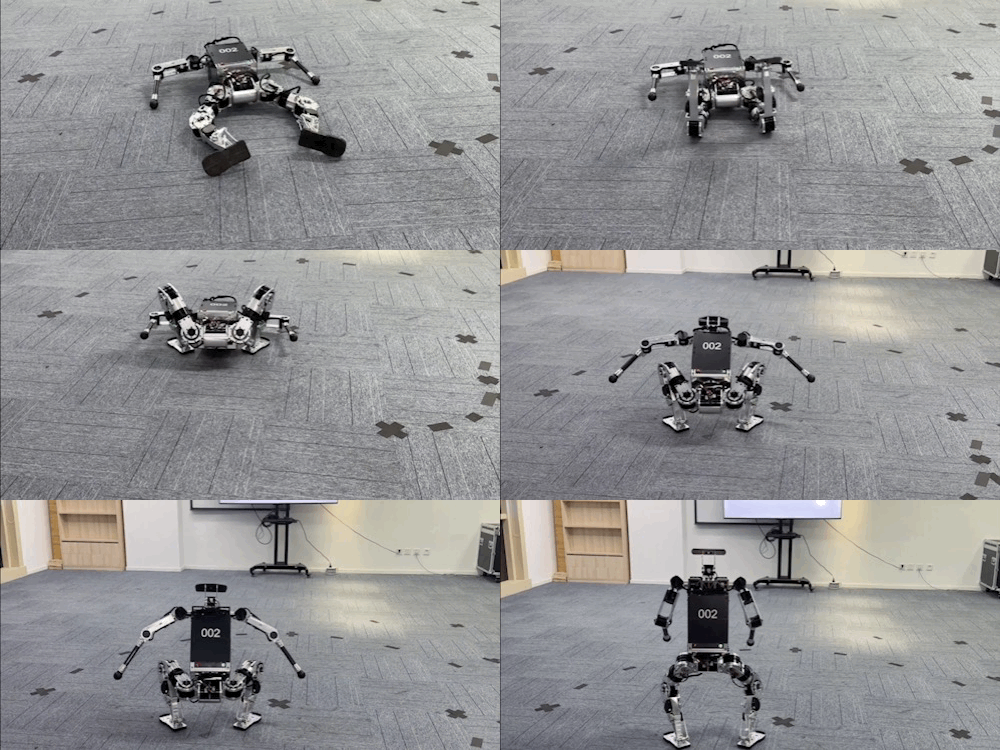
The robot that pulled off this complex maneuver came from Booster Robotics — a team with rare, specialized expertise in bipedal and humanoid development, with deep accumulated experience in motion control algorithms and humanoid hardware. The company's founder and CEO, Hao Cheng, graduated from Tsinghua University, where he studied under Professor Mingguo Zhao, a researcher in the Department of Automation and director of the Robot Control Laboratory and the Brain-Inspired Robotics Center at the Unmanned Systems Research Center. Cheng was also a ByteDance executive with experience managing large-scale R&D teams and commercializing complex businesses.
At last week's World Robot Conference, Booster Robotics unveiled its latest embodied intelligence robot — Booster T1. It can effortlessly perform push-ups, ball tossing, and kicking, and runs ModelBest's MiniCPM edge-side model, operating efficiently even under resource constraints.
On the exhibition floor, Booster T1 not only competed with visitors in push-up contests but also executed a "carp jump" to stand up, followed voice commands to toss balls, and played soccer with fellow robots.
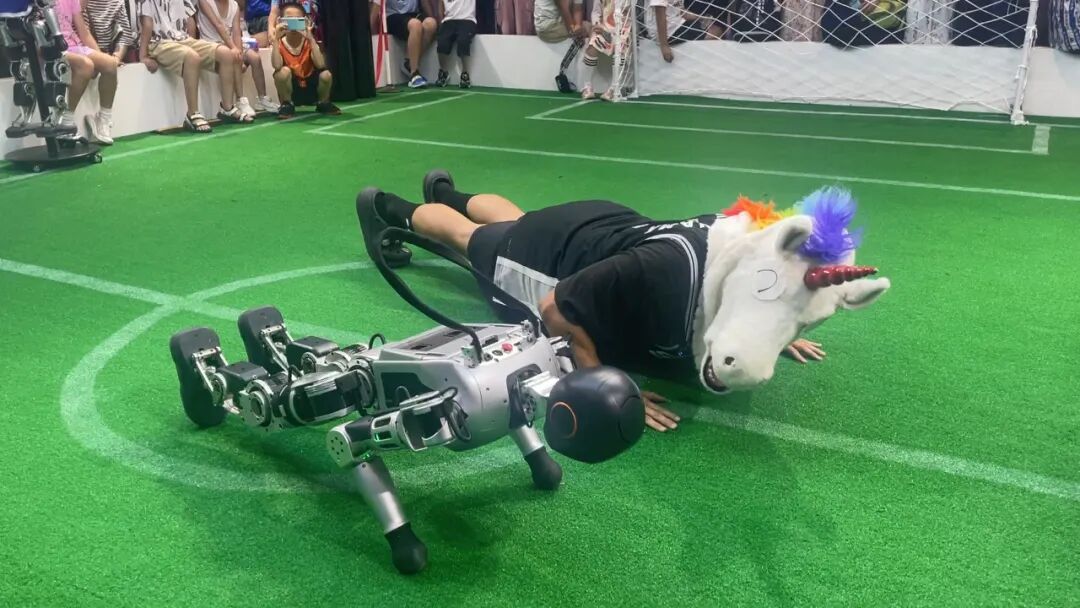
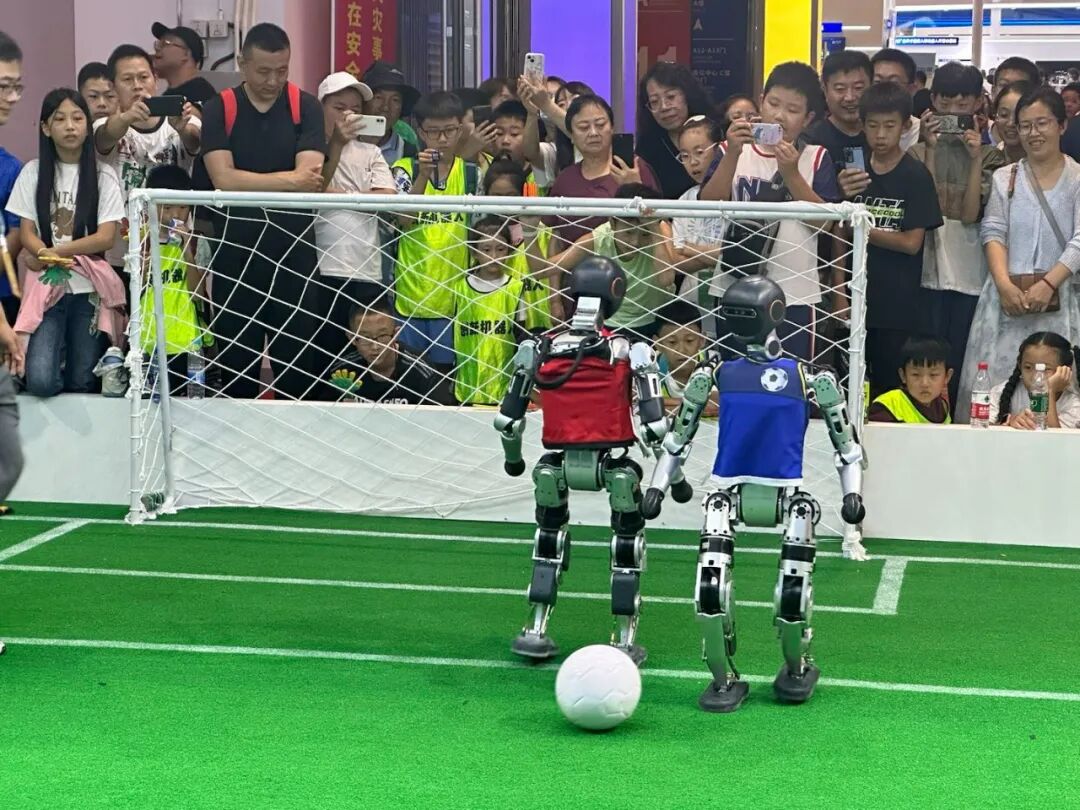
Booster T1 offers developers a flexible, user-friendly research platform, pushing robotics technology toward broader applications across multiple domains.
China's humanoid robot entrepreneurs believe that super-robots resembling humans will one day enter daily life. But how will this unfold? Looking back from the endpoint, what problems need solving first? In the fierce AI-plus-robotics race, how can startups break through? How do they secure their ecological niche?
Source Code Capital led Booster Robotics' Pre-A round and has made consecutive investments in multiple robotics companies including Galaxy Universal and Unitree, continuously betting on embodied intelligence. Recently, we invited Hao Cheng for a conversation about the many problems currently constraining robot development. He believes that with the emergence of AI capable of emergent abilities, better carriers are needed — and robots are the best option. The effort of startups is to ensure that when the starting gun fires, they can stand at the same starting line as the giants.
1
Replicating Boston Dynamics
Judgment and Technical Capability
Source Code Capital: Let's start directly with replicating that Boston Dynamics robot video — it attracted considerable attention. What does this replication signify?
Hao Cheng: Our configuration adopts a similar approach to Boston Dynamics' electric-drive robot. Boston Dynamics is a world-class robotics company, and our design philosophy happens to align with theirs. Before their release, no other company besides us had published this configuration. Many companies opt for relatively simplified configurations, for which open-source motion control algorithms exist. We believe in designing for the endgame — this configuration can carry us all the way into factories and homes. It's a forward-design process.
Source Code Capital: What do you mean by forward design?
Hao Cheng: Forward design means original design driven by requirements. There are only so many ways to arrange robot joints, but confidently choosing one layout, weighing advantages against disadvantages — that's the crucial part. Even with the same layout, each joint's position matters.
Source Code Capital: What's difficult about this configuration?
Hao Cheng: The challenge is that unlike simplified legs, there are no mature algorithms for it. But we believe the final form of humanoid robots will definitely have heavy legs, because robots need stable lower bodies for concrete manipulation tasks. Also, this configuration's range of motion is enormous — it can do full front and side splits. When a robot falls, greater range of motion helps it recover from various positions. Boston Dynamics' recent demonstration, for instance, showed a very unique recovery method. I think Boston Dynamics is an incredibly creative company — we hadn't thought of promoting it that way.
Source Code Capital: Boston Dynamics is indeed formidable.
Hao Cheng: Previously, when friends asked what was good about our configuration, we'd need lengthy explanations. But after Boston Dynamics' demonstration, this configuration instantly went viral. We replicated it because their configuration happens to match ours — a convergence. We chose this configuration based on Professor Zhao Mingguo's direct decision; he has extensive humanoid robot design experience.
Source Code Capital: What other configurations exist?
Hao Cheng: Bird-leg configurations, dog-leg configurations, Tesla's configuration, and so on. Bird-leg and dog-leg configurations are relatively mature and can produce impressive demos, but the problem is they must keep stepping to maintain balance — which won't work in future factory or home applications. Tesla's configuration is also good, but its range of motion is limited; it can't do large splits and similar movements.
Source Code Capital: What exactly differs between configurations?
Hao Cheng: It's about how the joints are arranged. But this isn't some insurmountable moat, and motion control for this configuration still presents challenges — though I believe these will be solved soon.
Source Code Capital: Replicating Boston Dynamics in three days — were there other difficulties?
Hao Cheng: First, the matching configuration; second, motion control. Actually, Boston Dynamics' maneuver was quite complex. One, standing up; two, while walking, the leg also rotates. The 180-degree leg rotation employed our entire suite of motion control algorithm accumulations, including MPC, WBC, reinforcement learning, and more. However, walking while rotating the leg is very difficult to achieve with reinforcement learning — humans don't even move like this in reality.
We have an internal development toolkit that can rapidly accommodate different configurations. Because our lab builds a new robot every year, trying various configurations, this forces everyone's motion control to be highly compatible. Second, to ensure development continuity, we layer all our algorithms, so we've accumulated many layered motion control methods that let us quickly develop this maneuver.
With this toolkit, we ultimately took only three days to replicate the action while maintaining balance: one day for simulation, one day for real-machine tuning, one day for overall integration, and half a day for filming.
Source Code Capital: Your previous accumulation was indeed extensive.
Hao Cheng: We have an exceptionally wide range of motion control algorithm options — a library of various algorithms that can be mixed and matched to realize entirely new movements. For example, one of our software engineers had never studied motion control, yet he could tune various robot movements.
Source Code Capital: Why is the heavy-leg configuration more suitable for algorithm iteration than others?
Hao Cheng: For example, previously locomotion and manipulation were separate — legs were legs, arms were arms, two distinct systems. But going forward, we believe they must be coordinated as one, because robots need to perform various operations while moving. Simplified-leg configurations have unstable bases; their legs are light, so they can achieve good results on uneven ground, but if they really need to operate while walking, they tend to wobble — unsafe in practical applications. Heavy legs provide better balance and stability.
Source Code Capital: Will you make Tesla-style dexterous hands?
Hao Cheng: We'll first be compatible with third-party dexterous hands; the challenges there are actually substantial. As an early-stage team, we need to stay focused — nail hardware reliability, get motion control and systems right, achieve small-batch production first, and solidify commercialization.
Source Code Capital: Is there a big difference between making robot dogs and humanoid robots?
Hao Cheng: Robot dogs and humanoids have different hardware and algorithm requirements, but robot dogs are the closest to humanoid robots among all robot types. There are some reusable elements in joints and algorithms.
2
Commercialization
From Smart Device to AI Carrier
Source Code Capital: Why start a robotics company now? Beyond large models attracting resources and capital to this field, why did you personally feel this was the moment?
Hao Cheng: The core factor is large models — they enable robots to make autonomous decisions, and decision-making is strongly connected to perception and other capabilities. Previously, every task a robot performed required extensive reprogramming of decision-related code. With large models, all of that can be handled automatically. So why start now? I'll use an analogy: if you're building large models in China, the best time was a few years ago. Embodied intelligence is certain to be one of the biggest future tracks — on the level of the information revolution. For opportunities this massive, tech giants will definitely enter; giants are platforms that seize big opportunities. Small companies need to get in early, secure a position on this track, develop and grow, so they're unafraid when giants truly enter.
Source Code Capital: If you don't enter now, there's no chance.
Hao Cheng: At this point in time, our judgment is: if we don't enter now, there won't be an opportunity. Giants can afford to enter a few years late because some technical paths aren't fully clear yet — like how to solve bipedal robot walking stability approaching human levels. Those robots that don't fall no matter how hard you kick them, you'll notice they walk with a wobble. In real work scenarios, that's quite alarming — you watch and feel like it might crash into you. But Tesla's robot walks elegantly, giving you a better feeling. This is really an algorithmic gap before true commercial viability; giants can wait until these problems are solved before pouring in massive resources.
Source Code Capital: Giants always have more room for error. You mentioned large models are critical — do their breakthroughs cleave the robotics industry into two distinct phases?
Hao Cheng: Let me describe it from another angle. Previous robots were more like smart devices. But this wave of humanoid robots isn't fundamentally about making smart devices — it's about finding new carriers for AI. AI has already emerged; it needs new carriers, and we need to build them.
Source Code Capital: So robots become a new carrier for AI, essentially a new operating platform where people develop various software and applications?
Hao Cheng: I think the biggest buyers of robots in the future will be AI developers, applying their algorithms to robots to explore new scenarios. There are far more people doing AI than those who previously worked on foundational robotics algorithms.
Source Code Capital: Your thinking about commercialization is quite pronounced among this wave of entrepreneurs — everyone hopes to achieve positive cash flow as early as possible.
Hao Cheng: I think this correlates with the economic environment, but embodied intelligence itself still has strong funding interest, so some companies are focusing on algorithm breakthroughs. Our logic is: everything we're doing now is to be ready when humanoid robots truly take off — when there are real B2B scenarios to deploy into. Because when robots can actually land in B2B, there will be comprehensively new demands for hardware, software, and systems. We believe that's when robotics companies can truly begin rapid growth. Everything we do now is preparation for that moment.
Source Code Capital: What kind of B2B scenario do you envision?
Hao Cheng: We lean toward simple physical labor scenarios — responding to human needs, flexibly moving things around; not fixed point-A-to-point-B movement in factories, which is for AGVs. For example, delivering packages in residential compounds — from the gate to someone's door. This is complex: you need to climb stairs, open unit doors. Overseas homes require crossing lawns, climbing steps, leaving packages at doorsteps. These are tasks wheeled and quadruped robots handle poorly — humanoids are needed.
Robot development actually resembles PC development. Before personal computers, there were industrial computers. From supercomputers to PCs: first schools, then computer rooms, then workplaces, then homes — an evolutionary process. Humanoid robots are currently expensive, but before 2030, prices should drop to around 150,000 RMB.
Source Code Capital: Unit prices will come down.
Hao Cheng: The core is that beyond CPU and GPU, humanoid robots don't have expensive components. Current high costs are purely due to low volume. Everyone is producing one by one, which is expensive. Once real demand emerges and technology matures, costs will drop very fast.
Humanoid Robot Supply Chain Will Be in China
Source Code Capital: Will the supply chain for humanoid robots be in China once the industry takes off?
Hao Cheng: Currently CPUs and GPUs are still foreign; everything else is domestic. I believe excellent domestic core chips will emerge.
Source Code Capital: It requires continuous iteration?
Hao Cheng: Production capability only becomes truly understood after building thousands of units. We see embodied intelligence as having two pillars supporting the AI Agents ecosystem above. One pillar's foundation is the robot hardware itself, then CPU/GPU, then operating system and development tools. Robot hardware is relatively mature now — not many fundamental scientific bottlenecks. The other pillar is foundation models, then robot-specific large models, then learning. Currently foundation models are relatively mature here, though some scientific problems remain.
Source Code Capital: Is the main problem now that production isn't ready?
Hao Cheng: Notice how Wei Xiaoli were all founded in 2014-2015 — who then would have thought Chinese consumers would spend 300,000-400,000 RMB on domestic new energy vehicles? But the entire new energy industry was gradually rising by 2020. Huawei and Xiaomi could enter late because certainty had increased. For startup teams, going out to build cars now is unrealistic.
Source Code Capital: Build your own production lines? Or partner upstream?
Hao Cheng: Definitely partnership; long-term we lean toward supply chain, but it must be deep collaboration.
Source Code Capital: The task now is to refine production lines together with factories?
Hao Cheng: Now the core is still making the product. We need to oversee it; production has many challenges. For example, a parts set arrives, and you find a hole wasn't drilled here, or a hole was drilled but not threaded — how to work through these pitfalls? And some factories have larger tolerances, some smaller — how to reconcile these? These problems must be tackled one by one. Though none seem individually difficult.
Source Code Capital: What's the plan?
Hao Cheng: Now it's about moving from engineering prototypes to real products. Q3 will bring a sellable version. Capacity will ramp up gradually; we need to control that well. It's somewhat like building Lark — there was an initial co-creation period. No matter how much we test ourselves, handing to customers reveals all sorts of unexpected issues. We need to document and optimize these. We see this as a very necessary phase.
Source Code Capital: Can't let logistics drag down the war effort. What's the scale this year?
Hao Cheng: We're not pursuing massive revenue at this developer stage — that's not our goal. The goal is to be at the same starting line as top competitors when B2B opportunities begin. After all, we've been developing for a shorter time.
Source Code Capital: Is finding buyers a big problem?
Hao Cheng: This circle isn't large; many people know each other. The market is small now, but not so small that only one can survive. Plus there's much differentiation space in the product itself. We judge the research market will grow larger, because previous robot buyers mostly did locomotion. Going forward, those doing manipulation and embodied intelligence will start buying humanoid robots — as the embodied intelligence industry develops, the market itself is expanding.
Source Code Capital: Is cost a limiting factor?
Hao Cheng: A major industry change is that previously there was no mature supply chain. Our opportunity now is that robot supply chains are maturing. As this direction heats up, more people are entering component manufacturing. Previously costs were hard to reduce; now with benchmarks, pricing becomes negotiable.
Source Code Capital: There are also new breakthroughs in robot motion control.
Hao Cheng: Reinforcement learning algorithms are often used now, but the problem is their effects aren't ideal yet — which is why we say locomotion still needs several years to truly break through. Current reinforcement learning walking produces loud sounds and a somewhat meandering gait. Algorithms need iteration to make robots walk like humans — stable, light.
Source Code Capital: What's the most obvious change in humanoid robot production supply chains over the past two years?
Hao Cheng: Robot mass production heavily depends on joint mass production; joints are crucial compositional units for legged robots. The biggest change in recent years is the major improvement in joint production capability, consistency, and reliability. But we're finding servo control on joints is generally still insufficient. Robot dogs don't need to consider balance much — four legs, easy to balance. So their tracking precision requirements aren't as high, backlash requirements aren't as high. But humanoids have higher requirements, so we need to do secondary development on joints ourselves. In recent years, many suppliers can make quasi-direct-drive joints; suppliers have multiplied, quality is gradually improving.
Source Code Capital: Why is this?
Hao Cheng: I think first, many manufacturers entering robot dog production helped upstream supplier development. Then for humanoids, I think the core is that after giants like Tesla and Xiaomi announced their entry, many suppliers also moved in that direction, creating healthy competition and driving prices down.
Source Code Capital: Competition has intensified upstream and downstream.
Hao Cheng: Two years ago, buying a joint with over 100 Nm torque, 8,000 or 10,000 RMB was common. Now you can get one for over 1,000 RMB.
Source Code Capital: Price drops are significant.
Hao Cheng: Very obvious. Most directly, Xiaomi's CyberGear micro motor sells for 499 RMB — reaching the hundred-RMB level.
Half Tsinghua, Half ByteDance
Seeking Directions with Sufficiently High Ceilings
Source Code Capital: Before this venture, you had both startup experience and big-company experience. Did these leave any lessons or warnings you particularly heed now?
Hao Cheng: My first startup made me realize commercialization matters; ByteDance reinforced this further.
Source Code Capital: ByteDance people have commercialization in their blood.
Hao Cheng: My first startup lasted four years — no revenue for the first three, nearly unable to pay salaries by the end. We thought advertising was sinful, bad for users. Until we had no choice, tried advertising, then commercialization — profitable that very month. And users were quite happy, unaffected. Once commercialized and profitable, decision-making becomes more confident, more composed.
At ByteDance, I saw why it succeeded: I think it's strongly related to figuring out the business model early and pushing commercialization early. Including why Lark was possible — many big companies wanted "Lark-like" products, but ByteDance had the best chance because its business model was sound, capable of sustaining businesses requiring persistent investment.
I believe robots aren't a pure hardware business; they must combine software, hardware, and algorithms. At ByteDance I developed complex business systems and low-code tools, and I found the robotics field also needs powerful, user-friendly development tools. Current robotics practitioners either deeply understand robot hardware or deeply understand robot algorithms, but few focus on development tools.
I have many ideas here — I even believe without good tools and systems, this industry cannot rise. For example, if someone wants to transition into robotics development now, it's very hard. Setting up the development environment takes one to two weeks, which probably discourages 90% of developers because they simply can't figure it out. Everything is Linux-based with various version dependencies; you need someone guiding you for a long time. This won't work. The future must be: I install software on my Windows computer, and I can develop robot applications.
Source Code Capital: Yes, that's the ideal state.
Hao Cheng: Right — what's missing here? Not algorithms, not hardware, but software engineering. This is also what I developed at ByteDance: product definition and technical refinement for complex software. We also incubated aPaaS — using this tool you could directly build complex business systems. This connects to our current goal of providing tools for convenient robot development; many elements are similar.
Source Code Capital: This perspective really requires diverse experience to bring.
Hao Cheng: And this isn't easy to build. Take Lark — it doesn't look hard, but truly achieving Lark's level is very difficult.
Source Code Capital: And different products have their own distinct problems.
Hao Cheng: What does lowering barriers mean? Easy to use, easy to get started. Currently to develop robots, you need to piece together multiple open-source small tools. After installing them, you still need to install and configure various compatibilities and dependencies, then after opening you don't even know what to click. But developers have no choice. I think there's huge opportunity here, and our team is relatively strong in this.
Source Code Capital: What's your current team composition?
Hao Cheng: Some from Tsinghua's Machine Control Laboratory — fellow students and alumni. The other half from internet software industries.
Source Code Capital: When do you expect the commercialization inflection point?
Hao Cheng: I think around 2026-2027, B2B opportunities will emerge — scenarios not depending on fine manipulation, but requiring robots to move around and complete rough tasks.
Source Code Capital: What problems need solving in the interim?
Hao Cheng: Solving the problem of robots not falling — walking well. Not trembling-but-not-falling, but truly stably walking various terrains, and getting up when they do fall.
Source Code Capital: At controllable cost.
Hao Cheng: Controllable cost, sufficient mobility, sufficient stability — that's enough. I previously spoke with the real estate industry: construction industry workers are hard to recruit under 40; post-80s generations generally won't do pure physical labor. And this work doesn't need fine manipulation at all, but construction site terrain is extremely complex — small vehicles can't pass directly. So either full modularization with future automated machines, but that's far off; or humanoid robots; or finding cheaper labor. Which young person now wants to move bricks on construction sites?
Source Code Capital: Indeed, they don't.
Hao Cheng: Highly repetitive, purely physical, not-great-environment scenarios will break through first. Places like auto factories will actually come later, because they involve too much fine manipulation.
Source Code Capital: Tsinghua feels quite like the "Whampoa Military Academy" in this wave of AI and embodied intelligence.
Hao Cheng: I think Tsinghua has always emphasized technology, doing both hardware and software. In the PC era, China's overall technological foundation wasn't strong. The internet era was dominated by pure software and market innovation — more about model innovation, about ideas. But now, it's a more integrated and cutting-edge combination of hard tech and software, where Tsinghua excels more. Tsinghua has deep accumulation in hard tech.
Now I feel it's like the 1970s PC era. Unlike phones — smartphones had feature phones as transition; new energy vehicles had automobiles before them; robots have humans before them. Before PCs, there were supercomputers. This era indeed favors Tsinghua's accumulated strengths.
Source Code Capital: Previously, the barrier to entry wasn't this high.
Hao Cheng: Our first startup: three people, started the company in a dorm room, users kept coming, eventually over 10 million users. Thinking back, the barrier to entry was really low then. Now it's different — for robots, teams need at least 20-30 people minimum, because building robots itself requires over a dozen roles. Another reflection: my first startup's core success was catching the mobile internet wave, plus WeChat's红利 — we were among the earliest to put our product, like scheduling, on WeChat, riding WeChat's user growth红利 period.
Source Code Capital: And that carried you.
Hao Cheng: A reflection from my first startup: in such a magnificent mobile internet赛道, we actually built a calendar — something with a very low ceiling, and it wasn't any easier. We went through all sorts of challenges. But similarly, ByteDance also emerged in the mobile internet era, doing information distribution — a big direction — and became enormous. So I feel that when a major industry is just rising, choosing a direction with a sufficiently high ceiling usually leads to decent outcomes.