Source Code Capital View | Technological Innovation for Carbon Neutrality in Sustainable Development

#MaGuan
Source Code Capital invests in technology-driven innovation,
and in the creation of lasting, real value.
July 11 is World Population Day. In China, the "Heihe-Tengchong Line" serves as a dividing line for population density. First proposed by Chinese geographer Hu Huanyong in 1935, it is also known as the "Hu Huanyong Line."
To the southeast of this line, 36% of the country's land area holds 96% of its population; to the northwest, population density is extremely low. This line not only represents geographic imbalance in national macro-level development, but also reflects differences in socioeconomic development levels across China.
Since reform and opening up, the government has promoted coordinated regional development, particularly through projects like "West-to-East Gas Pipeline" and "West-to-East Electricity Transmission." The Hu Huanyong Line was once a boundary for energy distribution; now it is increasingly a boundary for renewable energy distribution. Going forward, against the backdrop of "dual carbon" goals, rational resource allocation, optimized energy structure, and promotion of sustainable development in China's social economy carry significant importance.
I. The Development Environment for "Carbon Neutrality"
NASA observational data shows that current global greenhouse gas concentrations have risen by 1.2°C compared to the 19th century, with CO2 concentrations up 47% over the past 170 years. This rapid change has drastically shortened adaptation time for species and ecosystems, leading to global warming, rising sea levels, reduced crop yields, and increased cardiovascular and respiratory diseases in humans. Against this backdrop, the sustainable development goal of "carbon neutrality" has been proposed.
In this broader context of "carbon neutrality," China first explicitly proposed "carbon peaking" and "carbon neutrality" on September 22, 2020, at the 75th session of the UN General Assembly. President Xi Jinping committed to the world that China would strive to peak before 2030 and achieve "carbon neutrality" before 2060 — a grand goal subsequently reaffirmed at multiple international meetings as the "3060 target."
Currently, approximately 73% of global carbon emissions come from the energy sector. In 2019, global energy-related CO2 emissions totaled roughly 33 billion tons, with developed economies accounting for about one-third. By 2020, 54 countries had already peaked their carbon emissions, representing 40% of global emissions. "Carbon reduction" in the energy sector has become the most critical theme.
Tight Timeline, Heavy Task, Intense Pressure
Globally, 29 countries and regions have made "carbon neutrality" commitments through policy or legislation. Compared with the US and Europe, China is still in an economic ascent phase, with a relatively short interval between carbon peaking and carbon neutrality. Achieving the "carbon neutrality" vision can be described as having a "tight timeline, heavy task, and intense pressure."
Over the past decade, China's CO2 emissions have consistently ranked first globally — in 2020, China emitted nearly 9.9 billion tons of CO2, accounting for 30.66% of global emissions. By 2030, China's total carbon emissions are projected to peak at between 10.4-11 billion tons. Looking at emission structure, China's power/heat sector and industrial sector far exceed global averages. Reducing absolute emissions and adjusting energy consumption structure represent major challenges for China in achieving carbon neutrality.
China's "coal-rich, gas-poor, oil-scarce" energy resource characteristics have determined its coal-dominated energy structure, a key reason for China's high carbon emission intensity. Sustaining economic growth while adjusting energy structure will be a critical hurdle for achieving "carbon neutrality." Meanwhile, secondary industry — particularly manufacturing — remains a primary driver of China's rapid economic growth. As the "world's factory," China produces over half of global steel (56.5% in 2020) and cement (55.7% in 2019); calculations show secondary industry's share of final energy consumption reaches 67%. Clearly, adjusting China's economic and industrial structure is a necessary measure in the carbon neutrality process.
Economic development requires energy consumption. Carbon emissions and economic development are closely linked; economic growth inevitably brings increased energy demand. China's energy consumption per unit of GDP is 1.5 times the world average, indicating high energy dependence in China's economy. As a developing country, China's industrialization and urbanization — driven by high-carbon energy — will push the carbon peak higher, creating greater "slope" pressure for achieving carbon neutrality.
The funding gap in the "carbon neutrality" sector has also become a major challenge. According to a 2020 Tsinghua University report, achieving carbon neutrality in China would require approximately 138 trillion yuan in new investment. Yet from the pilot launch of carbon trading through end-2020, trading volume was only slightly over 10 billion yuan, with roughly $215 million in funds raised. Bank of China estimates that achieving carbon neutrality requires several hundred trillion yuan in funding support, with an annual funding gap of nearly 2 trillion yuan — particularly large gaps in renewable energy and soil pollution remediation. Green low-carbon technology remains in a breakthrough phase; carbon sinks, carbon capture, and carbon sequestration technologies still lack sufficient applicability and commercial viability.
II. Industry Trend Assessment Under "Carbon Neutrality"
Supply-Side and Demand-Side
China's technical pathway to achieving "carbon neutrality" requires coordinated effort from both supply and demand sides. On one hand, fossil energy with high carbon content — particularly coal — faces supply-side reform; controlling total fossil energy use, improving utilization efficiency, and continuing to enhance the conversion from fossil energy to electricity. On the other hand, on the demand side, energy conservation and emission reduction through technological transformation is core.
From the supply side, renewable energy's share is rising. With increasing installed capacity, solar and wind power's share in the energy mix will grow substantially, projected to exceed 70% by 2050. Renewable energy-based generation (primarily wind and solar PV) will increase 7-fold between 2020 and 2060, accounting for roughly 80% of total generation.
From the demand side, electrification of end-use is increasing. Replacing direct use of coal, oil and other fossil fuels with electricity in end-use consumption can effectively reduce CO2 emissions at the end-use sector and whole-economy level. China's electricity share of final energy consumption was 21.3% in 2015, will exceed 30% by 2030, and reach roughly 70% by 2050 — playing an important role in CO2 emission reduction.
According to IEA data, in 2019 the residential sector accounted for 3% of China's total carbon emissions; end-use electrification and low-energy appliances are primary methods for consumer-side emission reduction. Main pathways include new energy vehicles (end-use electrification), low-energy smart home products, waste sorting, and circular economy approaches like reuse of recyclable, valuable materials.
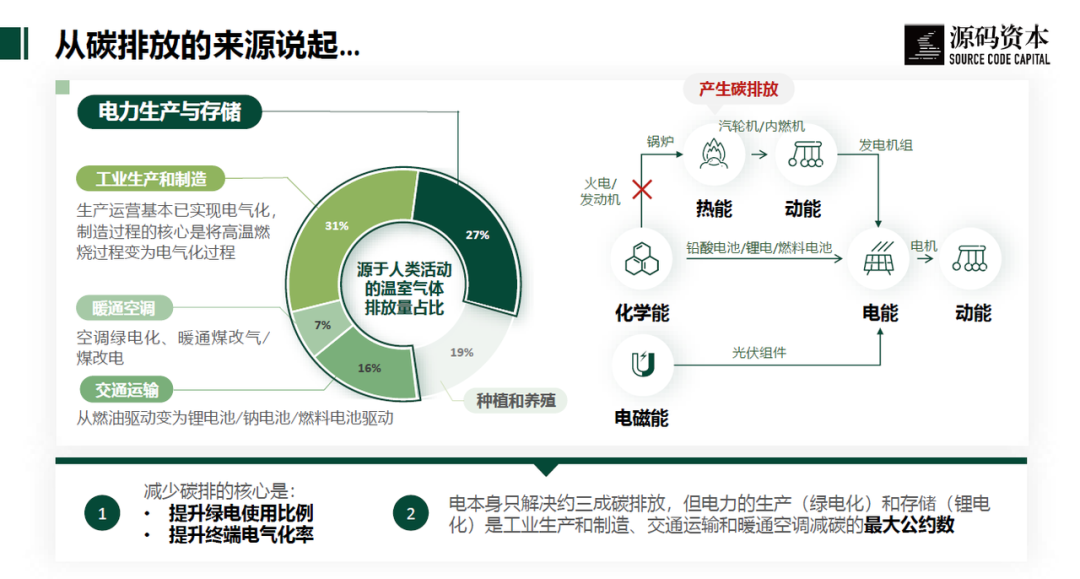
Image source: Source Code Capital
Regional Structure and Industrial Structure
From an energy regional perspective, energy centers will disperse toward western and eastern coastal regions. Currently, China's energy relies primarily on coal, with raw coal production concentrated in central regions. Going forward, as solar and wind power's share increases substantially, China's energy centers will shift from central regions toward western and eastern regions rich in solar and wind resources.
From an industrial structure perspective, the hard constraint of "carbon neutrality" targets will rapidly drive traditional industries toward low-carbon transformation in two directions. On one hand, to reduce carbon emissions, new capacity additions in traditional high-energy-consuming and heavy chemical industries must be controlled, driving energy efficiency retrofits while accelerating development of new energy and environmental protection industries. On the other hand, increasing carbon absorption through forest, ocean and land carbon sinks will further raise the share of carbon sink-related industries like forestry.
III. Technological Innovation in Energy Supply
Zero-carbon technology is the key technology for transforming energy supply structure, encompassing both zero-carbon power technology and zero-carbon non-electric energy technology. Starting with zero-carbon power technology — new energy generation technology — to reduce carbon at the source, achieving large-scale substitution for fossil energy. Through zero-carbon non-electric energy technology — generation-side and user-side energy storage technology — to improve utilization of new energy power. Innovating and promoting hydrogen production technology to help build a diversified clean energy supply system.
Innovation in New Energy Generation Technology
Large-scale offshore wind development and intelligent O&M technology: Offshore wind entered a rapid development track in 2018, with provinces accelerating project approvals and entering a rush installation period in 2019. Following the 2019-2021 rush installation period, China's offshore wind may enter a brief downturn, but rapid electricity demand growth and national development goals will drive annual new grid-connected offshore wind capacity to remain above 4-5 GW over the next decade. Far-shore wind foundation technology and supporting technologies, marine geotechnical survey technology merit attention.
BIPV: Building Integrated Photovoltaics (BIPV) is a technology integrating solar power generation products into buildings. BIPV falls into two categories: one is combining PV arrays with buildings; the other is integrating PV arrays into buildings, such as photovoltaic tile roofs, photovoltaic curtain walls, and photovoltaic skylights. Of these two approaches, combining PV arrays with buildings — particularly with building roofs — is commonly used. Technology is not the decisive factor; channels for rapid connection and expansion with target customers, and models for integrating resources are key — similar to distributed PV.
MaHui member company Unisun Energy Group is a leader and innovation driver in China's distributed PV industry, and the only company in China with distributed PV power plant investment and construction as its main business that has entered industrial-scale development. The group owns three major business segments: Unisun Power, Uper O&M, and Aopu Energy Technology. It is among domestic leaders in distributed PV investment and construction projects, installed capacity, and O&M scale, with operations across nearly 300 cities and over 2,000 power plants nationwide, with total operating scale approaching 5 GW — making it China's first clean energy power plant operator with distributed PV as its main business at industrial development scale.
Advanced solar thermal power generation technology: Perovskite (CaTiO3) solar cells use perovskite-type organic metal halide semiconductors as light-absorbing materials, belonging to third-generation solar cells. Compared with traditional conversion methods, perovskite solar cells can improve sunlight utilization levels, and also offer advantages of low price, small investment, and simple preparation. Going forward, stability may become the decisive factor for commercial application prospects of perovskite PV technology.
Solar thermal power technology: Solar thermal power is currently the only renewable energy technology with both clean generation and large-scale energy storage. As a regulating power source, it will become the main technology replacing thermal power in central and western regions, better addressing seasonal power shortages from wind and hydro power, while coordinating with PV for intra-day regulation. By end-2021, China's cumulative installed solar thermal power capacity was 538 MW (including MW-scale and above generation systems); global cumulative installed solar thermal power capacity was approximately 6,800 MW (including retired plant capacity).
Exploration of New Energy Storage Technology
China is currently in a phase of short-duration grid fluctuation smoothing, with energy storage projects mainly paired with wind and solar to increase absorption and reduce grid fluctuations. At this stage, lithium battery storage still dominates. Once other storage costs decline and new energy generation reaches a certain proportion, long-duration storage will enter a fast development track — the key is suitable application scenarios.
For example, MaHui member company Ace Battery has deep expertise in lithium battery products, focusing on R&D of lithium-ion and lithium iron phosphate battery packs, holding a leading position in the lithium battery field — particularly in 192V lithium iron phosphate high-voltage UPS battery packs, where it holds the top market share industry-wide.
Meanwhile, in battery safety, MakeSens — with the mission of "More Secure Green Energy Living" — has assembled top global research teams, combining over 60 patented technologies with production and research. It is not only among the earliest globally to launch commercial lithium battery safety fault early warning application platforms and digital battery management systems, but also a leading domestic advocate for green energy.
At the application scenario level, Poweroak is a world-leading new energy storage technology and complete energy storage battery application solution provider. Its portable energy storage brand BLUETTI currently holds a global TOP 3 market position. It leads globally in research on PV-storage integration, on/off-grid bidirectional inverters, and energy internet management systems, with products exported to over 70 countries.
Other technologies include, for example, new liquid metal batteries and "hot rock" energy storage technology as revolutionary storage technologies. New all-liquid metal battery systems can operate at lower temperatures, with longer service life and lower cost. Testing found that after 10 years of daily charging and discharging, this battery still maintains 85% of initial conversion efficiency (initial conversion efficiency approximately 70%). "Hot rock" energy storage technology is also a frontier long-duration storage technology. Compared with battery storage technology, its raw materials are easily obtained, with tremendous cost advantages; more importantly, this storage technology is more environmentally safe.
Hydrogen energy technology: In March 2022, the Medium- and Long-Term Plan for Hydrogen Energy Industry Development (2021-2035) was issued. System integration of hydrogen energy with electric and thermal energy will be an important direction. Emphasizing cross-sector application potential, with diversified application according to local conditions (the key remains on the application side and demand side, closely centered on application demonstration projects). At energy consumption terminals in transportation, industry and other sectors, achieving energy consumption transformation and green development in high-energy-consuming, high-emission industries to reduce greenhouse gas emissions. Hydrogen fuel cells have enormous development space; the commercialization technology pathway for fuel cell vehicles, and breakthroughs in key materials and core components represent important opportunities for domestic substitution.
IV. Energy Conservation and Emission Reduction on the Demand Side
Steel, construction, transportation, and agriculture sectors are rapidly developing energy conservation and emission reduction.
From the steel industry perspective, in the long term, using hydrogen instead of coal to reduce iron ore to iron is the most sustainable and technologically promising alternative for the steel industry. Currently, a representative advanced low-carbon technology is Sweden's breakthrough HYBRIT (Hydrogen Breakthrough Ironmaking Technology) project. Compared with existing steelmaking processes using coke and blast furnace systems, the HYBRIT technology combining hydrogen reduction with electric arc furnaces can significantly reduce CO2 emissions.
From the construction industry perspective, over half of cement's carbon emissions come from release during production. China is a major cement producer; reducing cement usage or lowering cement clinker factor are primary carbon reduction measures in the concrete field. Canadian startup CarbiCrete developed cement-free carbon-negative concrete technology, using mineral waste from steelmaking to replace cement and using CO2 to cure concrete mixtures. This "carbon-negative" concrete technology saves 2 kg of CO2 by avoiding cement production for every standard 18 kg concrete block produced, while locking in 1 kg of CO2 during curing. Blue Planet, inspired by biological evolution's approach to limestone formation, developed permanent carbon capture concrete technology from the aggregate angle; every ton of Blue Planet's CaCO3 aggregate achieves 440 kg of permanent CO2 capture and sequestration — even when buildings constructed with Blue Planet aggregate concrete reach end of life and are demolished, the CO2 remains locked as mineral in the aggregate.
Meanwhile, in building energy efficiency applications, the power of technology is even more prominent. According to IEA data, space cooling equipment led by air conditioning already accounts for over 10% of global electricity consumption, with further growth expected. As the most energy-consuming component of air conditioning, linear magnetic compressors open new possibilities for air conditioning energy efficiency. Simultaneously, a group of companies using algorithmic control of air conditioning to achieve energy conservation and emission reduction has emerged.
MaHui member company, DeepWise is a smart energy innovation service provider, offering capabilities beyond energy savings in multiple scenarios. Through AI data-driven + mechanistic model optimized control algorithms, DeepWise enables CATL, BOE, National Supercomputing Center and other factories and data centers to achieve 10%-40% additional energy savings on top of mainstream energy-saving control systems. At one large factory, DeepWise saved the client over 8 million kWh of electricity in one year through system control software optimization.
In building energy efficiency technology, water heaters are among the most commonly used energy-consuming equipment during building operation phase. Energy-efficient water heaters reducing heat loss and intelligently controlling heating time can maximize energy utilization, reducing energy consumption by up to 20%. Meanwhile, smart windows can reduce air conditioning and lighting energy consumption, achieving energy conservation and emission reduction.
MaHui member company, Hangzhou Cloud Valley Technology has developed a series of products and services, using innovative technologies including "source, network, station, household" full-domain management, full-process digital twin, artificial intelligence and IoT smart products, to solve technical challenges in low-carbon heating system optimization dispatch and full-domain coordination. Currently, Cloud Valley Technology simultaneously masters core technologies including network-wide balance, flow sensors, integrated meter-valve, room temperature soft measurement, and room temperature regulation. With globally leading intelligent measurement and control terminals, heating network balance technology and cloud data platform, the company provides ENGRID smart heating overall solutions for heating enterprises. Its developed balanced heat meter (integrated meter-valve electromagnetic heat meter) ranks at global leading level, with over ten national invention patents.
In the transportation sector, pure electric passenger vehicles have substantial lifecycle carbon reduction potential, achieving reduction to 17% by 2060 (benchmarked against 2020). Over time, the role of power battery carbon emissions in pure electric vehicle carbon reduction becomes increasingly significant. MaHui member, Li Auto recently launched its new model L9.
In the agriculture sector, the technical points of vertical farming are lighting (specialized LEDs for specific electromagnetic spectra) and soilless cultivation systems, eliminating long-distance transport and location/time constraints while substantially reducing carbon emissions.
V. Carbon-Negative Technology
Carbon Capture, Utilization and Storage (CCUS)
Using green plants (crop stalks, etc.) as fuel, supplemented by carbon capture technology, holds promise for net reduction of atmospheric CO2. China's current ecosystem carbon sequestration rate is approximately 1-4 billion tons of CO2 annually, offsetting roughly 10%-40% of anthropogenic carbon sources.
From the capture perspective, some technologies have reached or are approaching commercial application stage, at roughly 300 yuan per ton of CO2, or about 500 yuan including storage. From the transport perspective, CO2 road tanker transport and inland waterway transport technologies are mature. From the utilization perspective, chemical utilization has made substantial progress, generally at pilot scale; high value-added application scenarios need to be identified (energy storage, concrete, biomass, microalgae, etc.). Natural gas-to-plastics, ethylene plastics (currently petrochemical derivatives), synthetic wax (high value-added cosmetics, building exterior wall thermal storage materials, food additives), and synthetic oil have large market space, currently past pilot stage; economic viability is promising and will vary with application scenarios. Requirements for CO2 concentration are also decreasing, from high to low concentration; capture and utilization integration technologies are emerging, reducing costs and improving economics. Overall it is a state of "hundred schools contending," similar to early-stage PV. As carbon prices rise, combined with carbon asset development (allowances and certified emission reductions), economic viability is promising. From the storage perspective, China has completed assessment of national CO2 theoretical storage potential; Bitmain is researching and advancing CO2 subsea storage technology.
Forest Carbon Sinks, Cropland Carbon Sinks, Ocean Carbon Sinks
The term "carbon sink" originates from the Kyoto Protocol signed by parties to the UN Framework Convention on Climate Change, which defines carbon sink as: the process, activity or mechanism of removing CO2 from the atmosphere. Forests, cropland and oceans are currently important carbon sinks for humanity, and important links in the carbon cycle.
Forests are the largest carbon pool in terrestrial ecosystems, playing a very important and unique role in reducing atmospheric greenhouse gas concentrations and mitigating global warming. Farmland soil carbon sinks convert farmland soil from carbon source to carbon sink through conservation tillage measures, expanded paddy field planting area, increased straw return, increased organic fertilizer application, crop rotation systems and land use approaches. Oceans are the largest carbon pool in the Earth system; the ocean carbon pool is 50 times that of the atmosphere and 20 times that of terrestrial ecosystems. Global oceans absorb approximately 2 billion tons of CO2 from the atmosphere annually, accounting for roughly 1/3 of global annual CO2 emissions — the largest sink for atmospheric CO2.
On June 13, 2014, President Xi Jinping proposed the "Four Revolutions, One Cooperation" energy security strategy, which has always been the highest guidance for energy workers. The "Four Revolutions" refer to: promoting energy consumption revolution, curbing unreasonable energy consumption; promoting energy supply revolution, establishing diversified supply systems; promoting energy technology revolution, driving industrial upgrading; promoting energy system revolution, opening fast tracks for energy development. "One cooperation" refers to comprehensively strengthening international cooperation to achieve energy security under open conditions.
Two key points — integrating energy supply side, storage/transport and consumption side, with full-chain industry-university-research-application innovation elements; using policy orientation and pain points/demands on the demand side as traction, firmly grasping application scenarios and markets, leveraging Source Code Capital's advantages as a professional investment institution, to achieve integration of industry chain, innovation chain and policy chain.


MaGuan | Is 41 the Optimal Age for Innovation?
MaGuan | Source Code Capital: Focusing on Energy Cleanization and End-Use Electrification
MaGuan | Yungang Huang: Maintaining Long-Term Stable Technology Investment Rhythm Through Peaks and Valleys
MaGuan | Source Code Capital: Technology Changes Reshape Moats, Technology Entrepreneurship Breaks Boundaries
MaGuan | Xingchen Zhang: Technology-Driven Innovation from 0 to 1
MaGuan | 2020, First-Tier Funds Enter Robotics
MaGuan | Yungang Huang: What Entrepreneurs Need Most Is the "Exploratory Spirit" of Resilience and Bold Action
MaGuan | The "Technology + Biomedical" Cross-Disciplinary Intersection: A New Consensus on Convergent Innovation
For more MaHui members, click "Read Original" to view