Code View | Power Laws — Understanding Complexity in a Non-Random World

#MaHui Insights
Source Code Capital invests in technology-driven innovation,
and in the creation of lasting, real value.
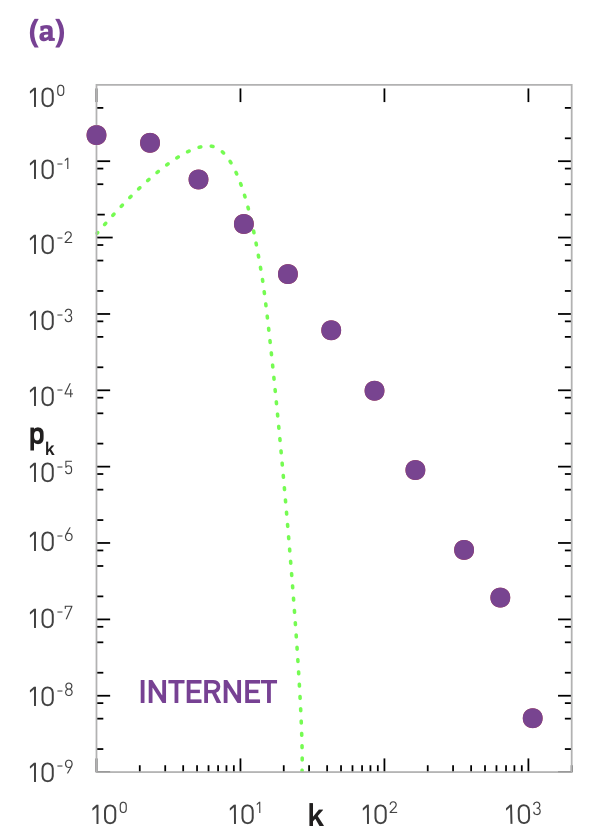
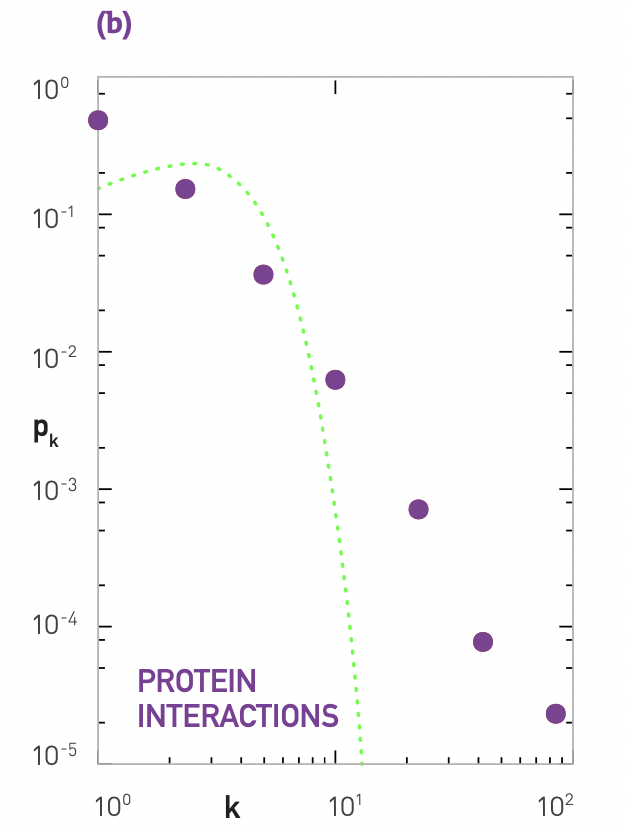
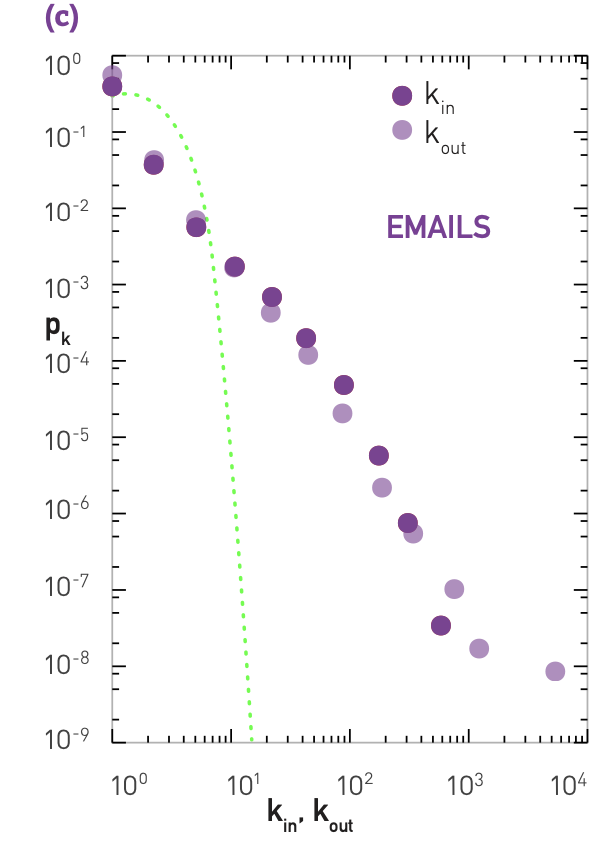
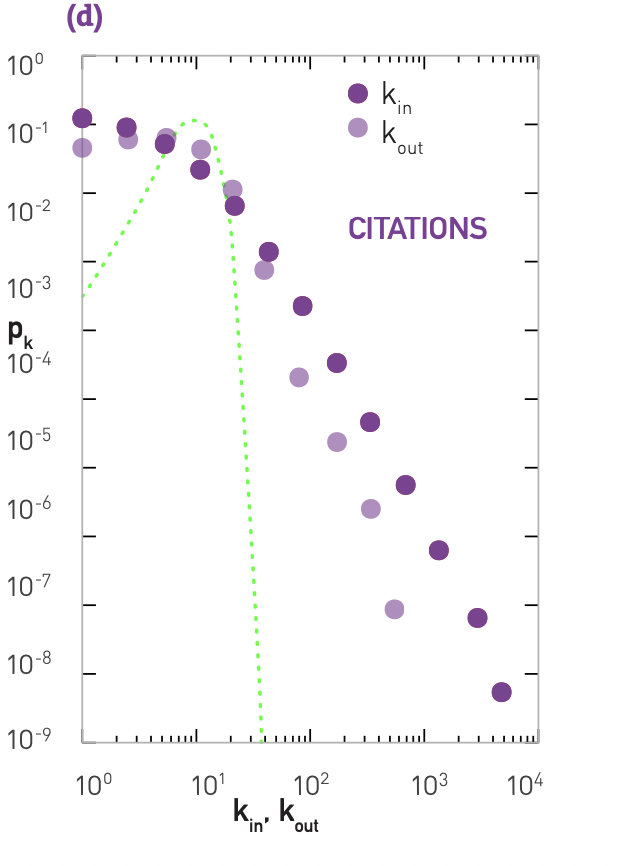
Infrastructure networks (the internet), biological networks (protein-protein interaction networks), communication networks (email networks), academic exchange networks (paper citations) — if all of these networks followed the same rules, wouldn't that seem counterintuitive?
Swipe left or right to see more
(The above shows degree distributions of real-world networks with corresponding Poisson fits. The degree of a node is the number of edges connected to it, and the degree distribution describes how these degrees are spread across all nodes in the graph. The green line represents the Poisson distribution fit.)
These networks, formed in vastly different domains with completely different timelines, driving forces, and forms of participation, nevertheless reveal striking topological similarities when we map their internal connection patterns. Specifically, mathematical fitting reveals a power law distribution.
Poisson Distribution vs. Power Law Distribution
In everyday life, people are more familiar with the Poisson distribution, which describes the probability distribution of the number of random events occurring within a fixed interval of time.
A power law distribution describes a variable where the probability density function follows a power function. On a log-log plot, a power law appears as a straight line with a negative slope equal to the power exponent. For most power laws identified in nature, the mean is well-defined but the variance is not — meaning they are susceptible to black swan events.
Take major US cities as nodes and connections between them (highways or flight routes) as links. In this network of nodes and links, we can observe two fundamentally different distribution patterns.
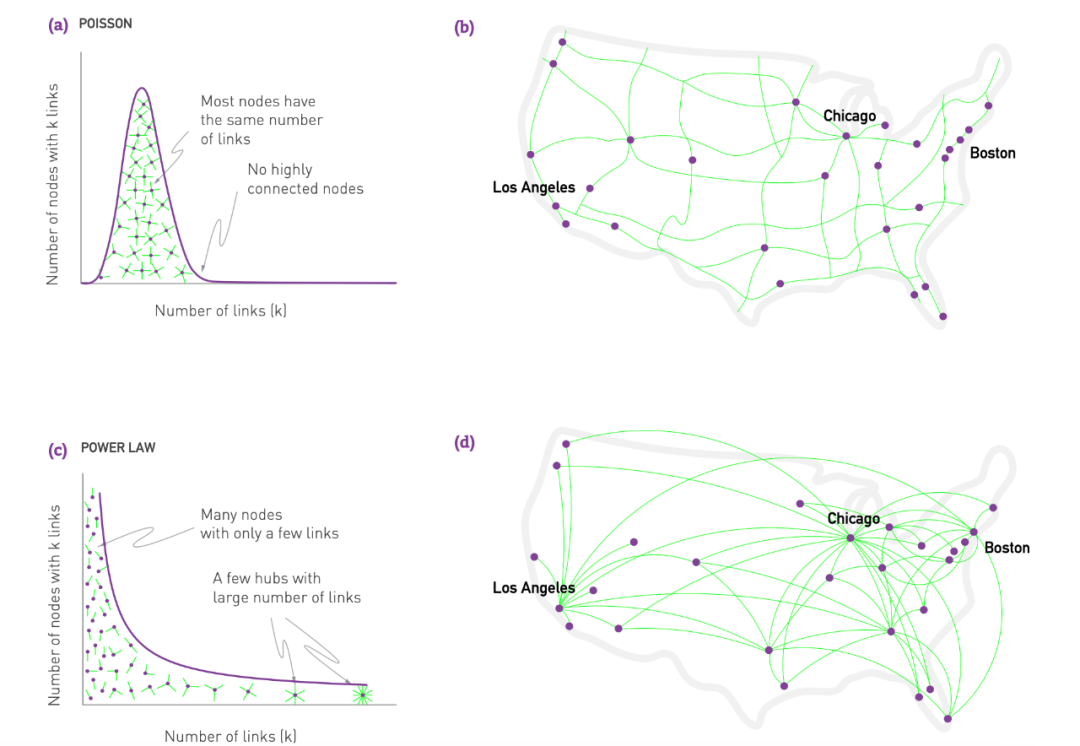
In panel (b), the highway network, each city has a relatively balanced number of highways. No city has hundreds of highways, and no city has none at all. Most cities look quite similar.
The histogram shows a bell curve (a). This relatively uniform distribution is the Poisson distribution, an inherent property of random networks.
The Poisson distribution has a clear peak, indicating that most nodes have roughly the same number of links as the average. On both sides of the peak, the bell curve drops off exponentially, making outliers far from the average virtually nonexistent.
In panel (d), the air traffic network, nodes are city airports and links are direct flights between them. Most airports are small, with only a handful of flights. Meanwhile, a small number of very large airports — like Chicago or Atlanta — serve as hubs connecting to hundreds of smaller airports. This distribution corresponds to a power law (c).
The power law has no peak; its histogram is a continuously decreasing curve that can extend infinitely in both directions. The most distinctive feature of power laws is the coexistence of vast numbers of tiny events alongside a handful of extraordinarily large ones.
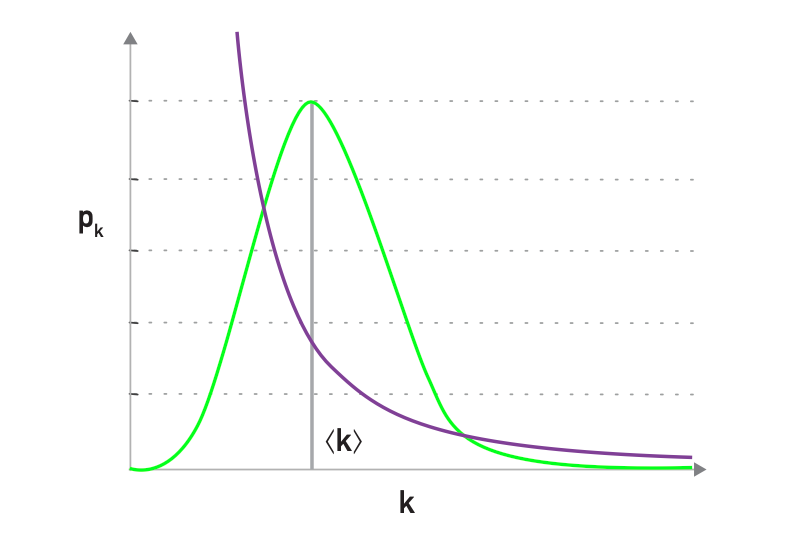
(Green: Poisson distribution; Purple: Power law distribution)
In business, power laws mean playing in mainstream markets; they mean Pareto distributions and Sturgeon's Law; they mean a handful of products or customers generating most of a company's profits, or a few salespeople contributing the bulk of total sales. In many business activities, a limited number of things can produce outsized value.
For early-stage investing, being governed by power law dynamics means that a small number of wildly successful investments generate most of the returns, while the long tail produces a mass of below-average or losing projects. A spray-and-pray investment strategy simply doesn't work.
How Are Star Companies Born?
This question is equivalent to asking: How do super-hub nodes emerge? Hub nodes are the result of power laws. Networks are the product of growth. All large-scale networks reach their size through continuous addition of new nodes. The key question is: How do these new nodes form links with existing ones?
The random network model assumes nodes connect to other nodes randomly. If this were true, the real world would be remarkably average.
Yet just as we tend to pick the movie everyone says is best, in most real-world networks, new nodes prefer to connect to nodes that already have many links. This process is called "preferential attachment."
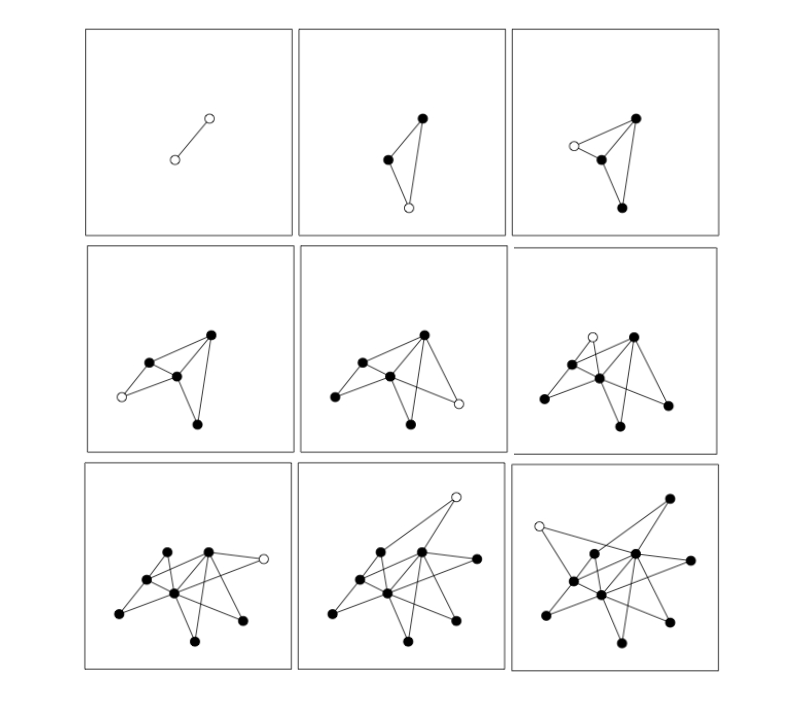
(Barabási-Albert model, simulating network growth and the evolution of node emergence. Initially, the network contains only two connected nodes. In each subsequent step, a new node (shown as an open circle) is added to the network. When deciding where to connect, the new node tends to attach to nodes with higher degrees. Due to growth and preferential attachment, some highly connected hub nodes emerge.)
When entrepreneurs seek partnerships, they gravitate toward established companies with strong reputations, not unknown ones. When directors cast actors, they prefer well-known names who fit the role, not amateurs or newcomers... The connections we tend to form aren't with ordinary nodes, but with hub nodes. The more famous they become, the more links point to them. The more links they attract, the easier they are to find, and the more familiar people become with them. Eventually, we unconsciously follow a bias, connecting with higher probability to nodes we know — nodes that already have many links in the network.
How representative was the marriage of David and Victoria Beckham? If 7 billion people randomly matched with dates, a football superstar might never connect with a pop culture icon. But in reality, one super star is far more likely to meet another; hub nodes preferentially connect with other hub nodes.
E-commerce giants more easily partner with logistics giants, and with offline retail giants. In VC investment patterns, one successful bet on a unicorn company leads to other unicorns in upstream and downstream related sectors.
Hub nodes keep growing; already successful companies become even more successful.
Whether startups or established companies, pouring substantial budgets into brand marketing is precisely about competing for "preferential attachment." Through brand building, companies increase their "visibility" in the business world, attract business, and gain advantages from non-randomness.
Yet preferential attachment also readily leads to a "rich get richer" dynamic. In this model, nodes compete for links, with older nodes having advantages over newer ones in gaining connections, eventually becoming hub nodes.
So how do latecomers succeed?
The business world is full of examples of later entrants overtaking incumbents. Google, founded in 1997, defeated AltaVista and Inktomi, which then dominated the market. Taobao's battle with eBay established Alibaba's position in e-commerce. Douyin, launched only in 2016, ultimately defined short video...
The common thread among these successful nodes: they possessed some intrinsic attribute that made them stand out — organizational culture, management approach, operational mechanisms, technical capabilities... This intrinsic attribute is called fitness.
Nodes with higher fitness gain degrees faster. Given enough time, high-fitness nodes will eventually outpace low-fitness ones.
Measuring node fitness can help us identify websites about to trend, actors about to become stars, startup teams about to become unicorns.
Yet how do we judge fitness? When evaluating an app, some find the interface refreshing, others are indifferent, still others find certain features unusable. Different people may have vastly different assessments of the same node's fitness, and this is unavoidable.
One certainty: high-fitness nodes are extremely rare.
People intuitively assume that different software products should vary enormously in fitness. But in reality, node fitness is bounded — different nodes' fitness varies only within a relatively narrow range. The enormous gaps we observe are actually the result of tiny differences being amplified by network growth mechanisms and preferential attachment, compounded over years.
Viewing reality through this lens leads to a striking conclusion: there is a disproportionate relationship between the products and services star companies deliver and their success. This means marginal advantages can ultimately produce extraordinary success, even creating divergent outcomes between industry leaders and companies that remain obscure or go bankrupt.
Some argue that star companies block other market participants. But research shows that hub nodes dramatically improve overall network connectivity.
The well-known "six degrees of separation" doesn't arise because everyone knows roughly the same number of people, evenly balanced in a social network. Rather, a tiny number of super-connectors link multiple fragmented social networks; through them, people can connect to someone on the other side of the planet.
When a university hires a Nobel-level superstar professor, the entire department's research output increases by 54%. When a star company connects upstream and downstream industry players, new industrial chains are forged.
Hunting for Super Champions
Investment firm Horsley Bridge invested in 7,000 startups between 1985 and 2014. Just 5% of these investments — a tiny sliver — generated 60% of all returns.
In 2012, Y Combinator, which invests in emerging tech startups, calculated that three-quarters of its returns came from just 2 of the 280 companies it had backed.
A few companies succeed spectacularly and unstoppably; most stumble and fail. Without unfortunately hitting those rare, high-return unicorns on the curve, a VC's performance will likely underperform the market.
British journalist and author Sebastian Mallaby, through his book The Power Law, traced a history of VC and Silicon Valley's rise under VC's influence and support. These stories repeatedly illustrate that early-stage investing is about pursuing high-risk, high-reward possibilities that most consider beyond reach — hunting for the extremes of power law distributions. Therefore, venture capital's methodology is disruptive: true transformation cannot be "predicted"; transformation is "discovered" through iterative experiments supported by VCs. These experiments in transformation often stem from radical dreams — discarding all established assumptions and envisioning from scratch.
"We can cure cancer, dementia, and all diseases of aging and metabolic decline. We can invent faster ways to move between points on Earth's surface; we can even learn to escape Earth's surface entirely and pioneer new frontiers." Peter Thiel represents the venture capitalist who rejects incrementalism.
Capital chases power laws; VCs bet on super champions. Venture capitalists are always somewhat crazy and ambitious. They believe most social problems can be solved through technology and business; the seemingly impossible is what matters, or becomes enormously valuable once breakthroughs occur. The crazier the dream, the bolder, the more impossible it looks — the more valuable it is in their eyes. Because pursuing average returns almost guarantees failure.
Vinod Khosla embraced the internet in the mid-1990s, passionately believing that routers with data processing capabilities 1,000 times greater than telephone lines would become mainstream. His investment in Juniper Networks, which built such routers, helped Kleiner Perkins turn $5 million into $7 billion.
From the domain of Poisson distributions to the realm ruled by power laws — from a world where things change very little to one filled with extreme contrasts. "Once you've crossed the dangerous boundary, you'd better start changing how you think."
The venture capital principles that underpinned Silicon Valley's rise deserve a hopeful study to close with today:
Researchers randomly selected 200 new crowdfunding projects on Kickstarter with zero funding history. They donated small amounts to half of them; the other half were left alone as a control group. Then they observed the fates these projects would unfold.
The results were intriguing: projects that received the researchers' initial donations were more than twice as likely to attract further contributions. After researchers provided random donations four times consecutively, only 13% of these projects ultimately failed. Among projects that never received researcher donations, 68% failed.
Multiple rounds of initial support virtually guaranteed success.
A VC's earliest capital injection into a project does more than merely invest in that project — it triggers preferential attachment, propelling the project onto a power-law-driven path to success.

References
[1] Source Code Capital Research Team Internal Report
[2] Network Science, Albert-László Barabási / Cambridge University Press / 2016-8-5
[3] The Power Law, Sebastian Mallaby / Penguin Press / 2022-2-1
[4] Introduction to Power Laws, https://www.youtube.com/watch?v=RfV_yVEp3bY
[5] Field Experiments of Success-Breeds-Success Dynamics, PNAS 111, no. 19 (2014): 6934–39
[6] "Why Stars Matter," by A. Agrawal, J. McHale, and A. Oettl, published in March 2014 by the National Bureau of Economic Research
[7] The Formula: The Universal Laws of Success, by Albert-László Barabási, published in November 2018 by Little, Brown and Company

- MaHui Insights | Source Code Capital's Dual-Carbon Investment: Exploring New Species Through Full-Chain Layout
- MaHui Insights | China Electric Power News Interview with Source Code Capital's Wang Di: Industry Inflection Point Arrived, Vast Market Space Ahead
- MaHui Insights | A Day of Green Power Living
- MaHui Insights | Yungang Huang: How Does AI4S Land in Different Stages, Industries, and Markets?
- MaHui Insights | Yungang Huang: "Cross-Disciplinary Intersection" Driving Innovation in Healthcare
- MaHui Insights | Source Code Capital's Wang Di: The Most Essential Capability for Investing in Carbon Neutrality Is Multi-Level Cognition
- MaHui Insights | Source Code Capital's Wu Fan: Opportunities and Advantages — China's New Energy in a New Cycle
- MaHui Insights | "Carbon Neutrality" Technological Innovation in Sustainable Development
Click "Read Original" to view more MaHui members