Code View | Source Code Capital's Wu Fan: Opportunities and Advantages — China's New Energy in a New Cycle

#CodeView
Source Code Capital invests in technology-driven innovation,
and in the creation of lasting, genuine value.
Recently, Wu Fan, an investor at Source Code Capital focused on the dual-carbon sector, was invited to speak at Jazzyear's 2022 "Jazzyear Gravity X" Tech Industry Investment Summit, where he shared his perspectives on the current state of China's new energy development, how to analyze the new energy industry from an investment standpoint, and the differences between China and overseas new energy markets. The conference also released the 2021-2022 China Tech Industry Investment Rankings, with Source Code Capital receiving honors including Top 20 Best Carbon Neutrality Investment Institutions of 2021-2022.
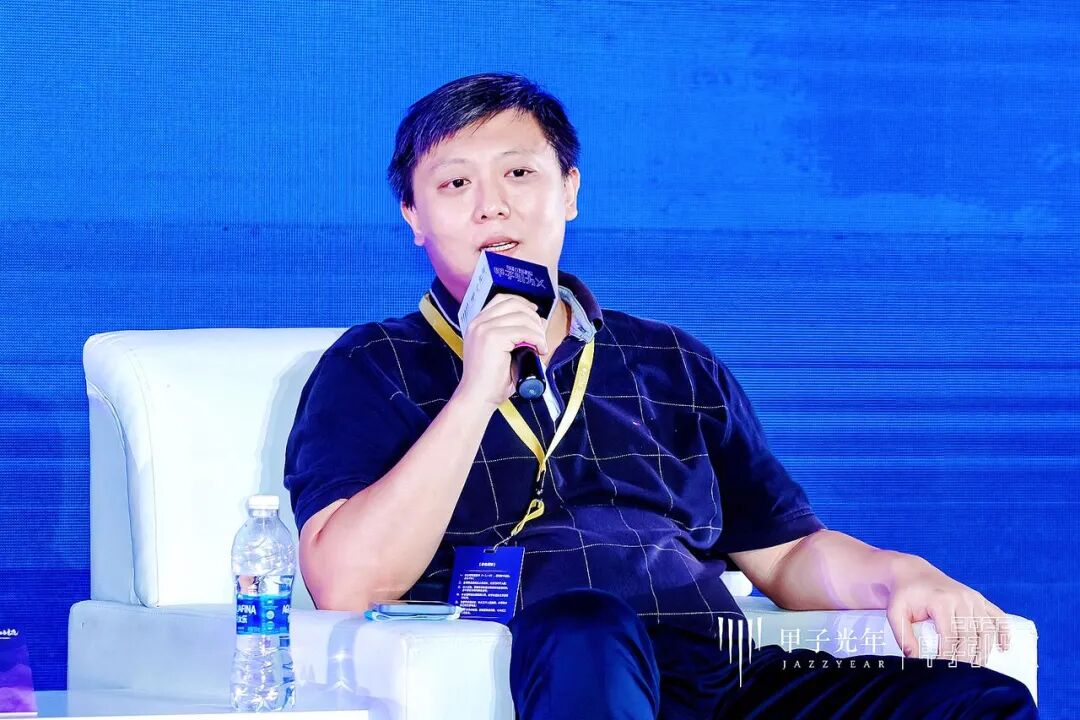
Wu Fan, Managing Director, Source Code Capital
Mr. Wu Fan joined Source Code Capital in 2022, focusing on green new energy, intelligent manufacturing, and other sectors. He previously worked at Cathay Capital and GF Xinde Investment Management, and has led investments in CATL, NIO, SVOLT Energy Technology Co., Ltd., Sunwoda Power Battery, Kangpeng Technology, JOYNEXT, Refire Technology, Jovo Energy, and Huace Navigation, among others.
Key Takeaways Q1: What is the current state of China's new energy development? Based on the national dual-carbon strategy, how should different types of investment institutions break down new energy development strategies, and how should we view the current new energy investment market strategically?
Wu Fan: Source Code Capital was among the earlier VC 2.0 funds to focus specifically on new energy investments. In terms of investment stages, we cover the full spectrum from our Yisu seed fund through early-stage and growth-stage investing. At the same time, Source Code places great emphasis on post-investment services, having established the Momentum Entrepreneur Service Center to fully dedicate our resources to serving founders.
For new energy investments, Source Code's strategy is full-industry-chain deployment. Through our understanding of the industry, we combine top-down macro analysis with bottom-up industry insights, cross-verifying both approaches to identify investment areas and outstanding companies.
From a market perspective, the photovoltaic industry started in China with Wuxi Suntech, but overall demand grew from overseas markets, where demand remains enormous. The main reasons are: first, insufficient infrastructure. China's State Grid Corporation of China and China Southern Power Grid have built comprehensive, well-developed power infrastructure, so people's awareness of electricity shortages is relatively low; whereas in some European and American countries, incomplete infrastructure leads to frequent power outages in certain regions. Second, cost factors. Overseas electricity prices are already relatively expensive in normal years, and this year, influenced by geopolitics and international developments, the high cost of electricity and energy shortages have become even more pronounced. As the photovoltaic industry chain has matured and the cost of solar power generation has fallen below that of coal-fired power, overseas users are increasingly considering new energy generation from a cost perspective. Third, closed-loop application scenarios. Overseas homes have more space to install solar panels, so you can see that abroad, from power generation to energy storage to new energy vehicles, these form a very effective closed loop in application scenarios.
Looking ahead, the entire new energy sector will enter a more virtuous, higher-margin, and more brand-value-driven development phase by leveraging overseas markets. Brand effects will become increasingly important, providing products with greater added value.
In terms of Source Code's investment advantages, building on our past strengths in technology and internet investments, Source Code can better help Chinese brand companies and supply chain companies expand overseas, establish effective and extensive channels, and build higher brand barriers — helping traditional Chinese manufacturing companies transform into global brand enterprises. This is both our investment thesis and our core advantage.
Q2: From an investment institution's perspective, what is the real situation of current investment in China's new energy sector? Are there cases where some tracks are overheating, with capacity expanding rapidly and leading to overcapacity, while other tracks remain relatively cold?
Wu Fan: Regarding overcapacity, we can see that the photovoltaic industry has gone through several cycles, experiencing overcapacity and technological iteration, and is now entering new technological and development cycles. When I invested in CATL back then, the first question asked at the investment committee meeting was: will this industry face overcapacity? To assess whether overcapacity will occur, we need to return to the essence of the problem.
Providing value and experiences that exceed user expectations is the essential and underlying logic of future capacity concentration in the new energy industry. Entrepreneurial companies will increasingly invest their resources in meeting user demands. The reason for past overcapacity was that capacity could not be absorbed. Now, as new energy vehicles replace traditional gasoline vehicles and new technologies emerge continuously, with Li Auto, NIO, and Xpeng Motors deeply loved by consumers, what consumers are actually buying is not electrification itself but the massive difference in experience. Therefore, the new energy vehicle industry now revolves around user experience, rather than the traditional automaker logic of operating around subsidies.
In the current new energy environment, China's industrial chain has historical opportunities and absolute advantages in technology, products, brands, and services. For manufacturing itself, there are two core elements: cost and quality. From the development of the traditional gasoline vehicle industry chain, we can already see that users choose high quality rather than absolute low prices.
With both China's new energy industry and new energy vehicle industry ranking among the global top ten, companies that provide core products and continuously create value suitable for industrial chain development are investment-worthy and capable of generating high returns. At the same time, companies that grow alongside industry leaders — when end-user companies become Fortune Global 500, trillion-level companies, their upstream and downstream supply chain partners will unquestionably also become Fortune Global 500 companies.
For Source Code, the new energy sector is one of the largest and most certain investment areas for the next 30 years. The energy revolution, technological revolution, and economic transformation arising from these developments will become the most important changes over the next three decades. So returning to the essence of manufacturing, we hope to find good companies driven by technological strength and innovation that can create new products.
Q3: From an investment opportunity perspective, Chinese new energy companies have already begun sweeping internationally, and our share of global sub-sectors is already very high. What are the differences between overseas and Chinese investment directions in new energy's main markets, and what opportunities might be found in these differences?
Wu Fan: In the traditional internet era, Chinese investment institutions learned from Silicon Valley. In the mobile internet era, Silicon Valley investment institutions began learning from China. In today's new energy era, China leads the world in battery, electric vehicle, and charging pile stock; has the most ambitious future construction plans; and leads globally in new energy technology, such as battery technology, photovoltaic technology, and future hydrogen fuel technology. Chinese consumers also have the highest acceptance of new energy. At this point, the world needs to come to the Chinese market to invest; not doing so means risking being left behind.
Q4: We can now see that the new energy battle is a global war, with investment institutions and new energy companies closely linked. As an investment institution facing intense industry competition and very high valuations, what changes can we still make?
Wu Fan: Source Code has a slogan called "Full Momentum for You." We hope to accompany entrepreneurs for the long term, becoming partners on the entrepreneurial journey. Whether from 0 to 1 or from 1 to 100, we hope to be there with them. This companionship is not simply about time; we hope to accompany them in organizational structure, legal structure, and core business. When they need to go overseas and face different countries' conditions, laws, and cultures, Source Code and the MaHui ecosystem have experienced experts from CGN, ByteDance, Meituan, Alibaba, Xiaomi, KE Holdings, Huawei, and many others. Through various forms of entrepreneurial services, we can empower new energy entrepreneurs and create value.
According to China's "3060" dual-carbon strategy, the new energy endeavor will last at least 40 years. In 40 years, most of us here will probably be retired, and our lifespans certainly won't outlast new energy's. So in our limited time, we hope to create lasting, genuine value together with our portfolio companies and ecosystem partners.
2021-2022 China Tech Industry Investment Rankings
Chinese tech industry think tank Jazzyear released the 2021-2022 China Tech Industry Investment Rankings. As a leading Chinese tech industry think tank, Jazzyear has continued to focus on investment institutions and tech enterprises that genuinely promote technological progress and industrial development. Upholding an objective and impartial attitude, employing scientifically rigorous data processing and analysis methods, and applying fair and transparent evaluation criteria, the rankings produce annual lists of standout tech industry investment institutions and tech enterprises.
In this year's selection, Source Code Capital received: Top 20 Best Carbon Neutrality Investment Institutions 2021-2022, Top 20 Best Intelligent Manufacturing Investment Institutions 2021-2022, and Top 20 Best Enterprise Service Investment Institutions 2021-2022. MaHui member Mech-Mind was named: Most Investment-Worthy Company in Intelligent Manufacturing 2021-2022.
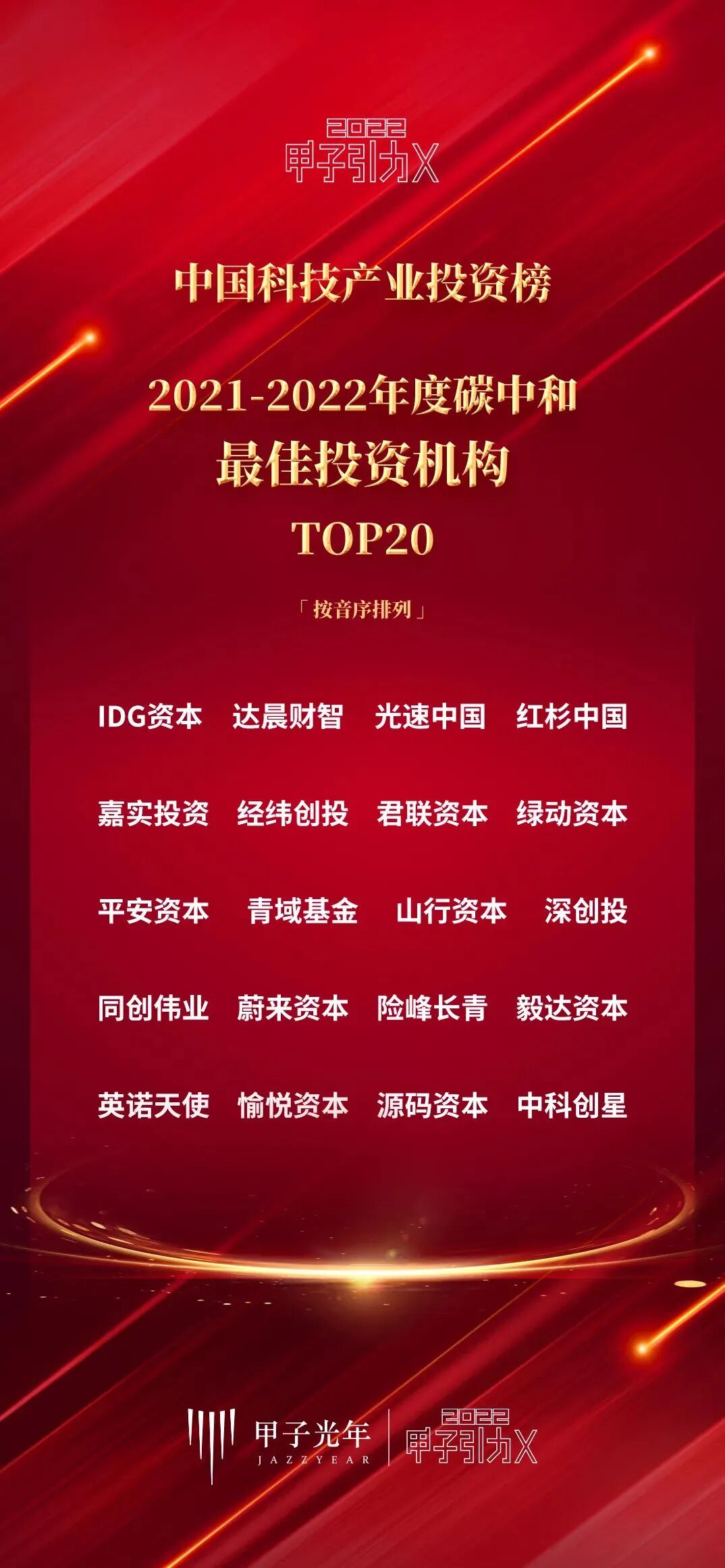
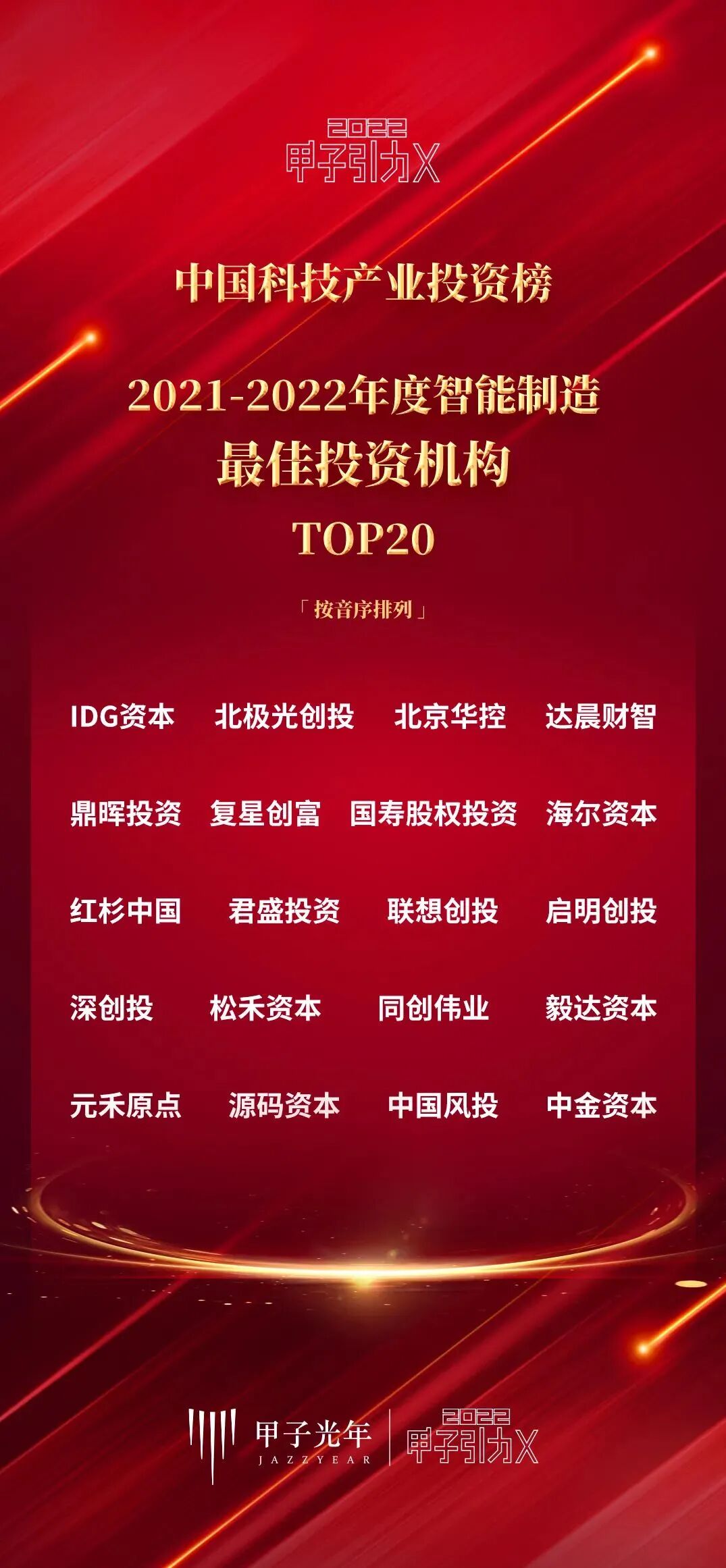
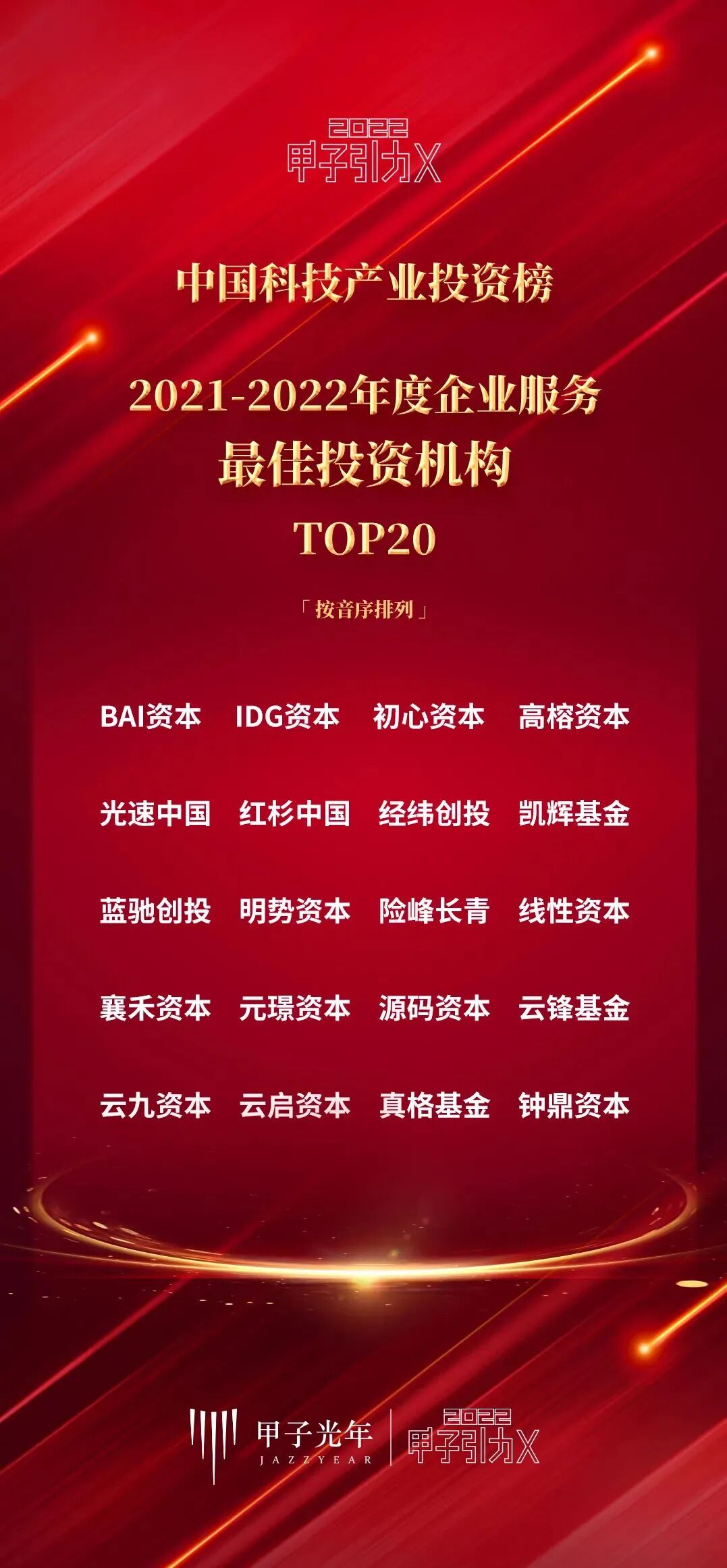
Complete "Jazzyear—2021-2022 China Tech Industry Investment Rankings" list (click to view)

- CodeView | "Carbon Neutrality" Technology Innovation in Sustainable Development
- CodeView | Is 41 the Optimal Age for Innovation?
- CodeView | Source Code's Wang Di: Focusing on Energy Cleanization and Terminal Electrification
- CodeView | Source Code's Yungang Huang: Maintaining a Long-Term, Stable Tech Investment Rhythm Through Peaks and Valleys
- CodeView | Source Code's Kaikai Chang: Technological Change Reshapes Barriers, Tech Entrepreneurship Breaks Boundaries
- CodeView | Source Code's Xingchen Zhang: Technology-Driven Innovation from 0 to 1
- CodeView | 2020: First-Tier Funds Enter Robotics
Click "Read Original" for more MaHui members