Code View | Making a Foreign Land Home: Investment Reflections on Industrial Basics and Manufacturing Going Global


Drive 24 kilometers southeast from downtown Shenzhen and you'll reach Yantian Port, on the north shore of Dapeng Bay and northeast of Shatoujiao — the world's third-largest container port and the most important logistics hub in South China. Deep waters and broad berths handle over 10 million TEUs annually. Backed by the Pearl River Delta, Yantian's terminals shoulder more than one-third of Guangdong Province's foreign trade volume and over a quarter of China's total exports to the United States.
And now, the owners of these containers are sailing deeper into global supply chains.
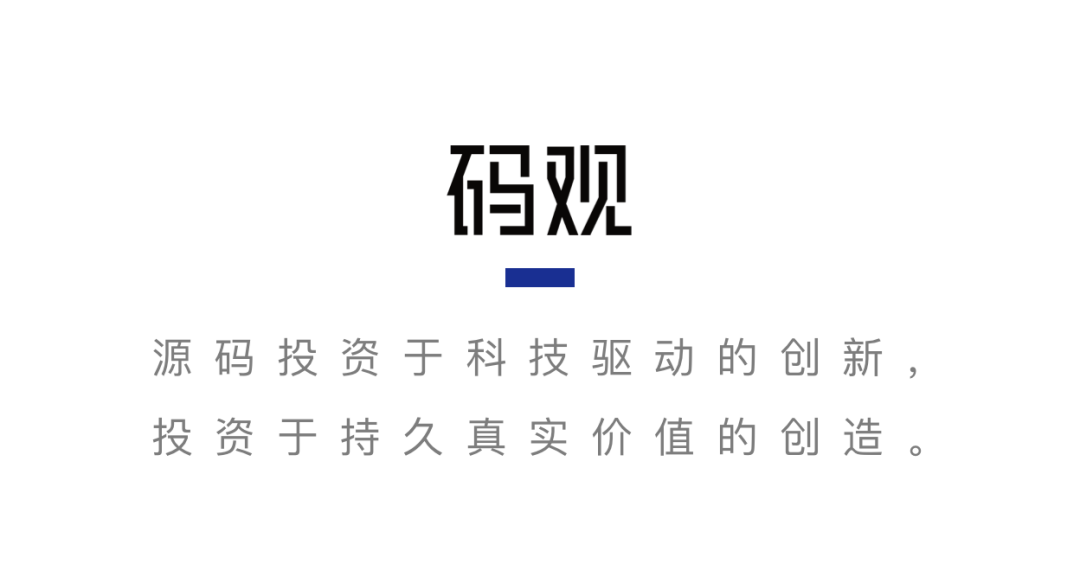
"Exporting used to be just one link in the global supply chain — I'd supply the customer, provide them with solutions. But once a Pearl River Delta company loads its goods into a container on a Yantian ship, what happens next? Product definition, brand building, channel management, local teams overseas — Chinese suppliers actually know very little about any of this," said Di Wang, Managing Director at Source Code Capital.
Today, Chinese companies want to build their own brands overseas, run their own operations, handle their own delivery. The core logic behind this: China's manufacturing capabilities have earned global recognition, and Chinese products are competitive on the world stage.
"It used to be sixty or seventy percent of the performance at thirty percent of the price. Now it's eighty or ninety percent of the performance at thirty percent of the price — and in some emerging categories, Chinese products represent the world's best standard, yet we still deliver better pricing and efficiency. Plus, domestic suppliers offer higher responsiveness and greater R&D agility to customer needs," Wang said.
Behind this shift lies a fundamental transformation from export to global expansion — one that highlights the deepening and breakthrough of Chinese manufacturing value.
From Export to Global Expansion
Shenzhen's export sellers are increasingly talking about "going global."
The biggest change is that Chinese companies now want to build their own brands, run their own operations, and handle their own delivery overseas. Drilling down, every national market has its own playbook, and every product has its own playbook too. That's the first dimension.
The premise for this shift: Chinese manufacturing has reached a level of global recognition where its products are competitive worldwide. That's the second dimension.
Looking at manufacturing history, inventory cycles tend to run roughly every 36–48 months. Despite the massive domestic market, most industries have been in destocking mode these past two years, with most high-end manufacturing entering inventory accumulation phases. Compounding this, many Chinese high-end manufacturers over-invested in capacity between 2021 and 2023 during the pandemic, intensifying the inventory cycle. So at this juncture, going global is particularly urgent — that's the third dimension.
Meanwhile, on the supply side, new technologies and new supply continue to emerge. "Silicon spawning everything" is becoming reality. A considerable number of early-stage industrial technology companies are pioneering globally-first explorations, attempting to iterate devices using semiconductor-like processes. That's the fourth dimension.
Chinese manufacturing has long been tagged with "cost-performance ratio," often serving as a second choice for certain brands. Just as people used to discuss import substitution as primarily policy-driven — where domestic penetration depended mainly on government direction.
But the situation has changed. Import substitution in many categories no longer relies on policy; domestic product quality has improved dramatically. The old consensus on domestic goods was: "sixty or seventy percent of the performance, thirty or forty percent of the price." Now performance is broadly comparable to overseas alternatives, sometimes even better in new application scenarios, while the 30–40% price advantage remains. And leveraging China's industrial ecosystem, Chinese companies offer higher customer responsiveness, open R&D pathways, and greater agility.
Manufacturing has always been China's "calling card."
After decades of development, manufacturing has secured its position not just in breadth but also in breakthroughs across high-end sectors: ultra-high-voltage power transmission equipment, refining and petrochemical equipment, rail transit equipment, photovoltaics, new energy vehicles, and more.
Today, China possesses the world's most complete manufacturing industrial structure and supply chain — from raw materials to equipment, from fundamentals to processes. Across 41 major industrial categories, 207 medium categories, and 666 minor categories, China maintains the only complete chain globally, with greater comprehensiveness than all other industrial nations combined.
In high-end manufacturing: the "new energy trio" of batteries, motors, and electronic controls; in ICT, Huawei; in EVs, Wei Xiaoli; in photovoltaics, LONGi and Sungrow; in lithium batteries, CATL — domestic industries now serve the world's most demanding customers. Their substantial needs for industrial control, automation, and components provide fertile ground for quality industrial fundamentals companies to grow.
These domestically-led high-end manufacturing markets offer a rare foundation for the rise of domestic supply chains, and an opportunity to birth "Chinese versions" of industrial giants like Bosch, Mitsubishi, Siemens, and Murata.
Domestically, high-end industrial fundamentals companies are thriving. Internationally, Chinese manufacturing is setting sail with a new posture — global expansion is becoming the defining keyword of the era.
In the lifecycle of going global to achieve import substitution, two underlying logics prevail: first, the shift from policy-driven to market-driven; second, the progression from substituting into the supply chains of China's downstream giants to penetrating global markets and securing positions in overseas majors' supply chains. Import substitution refers not just to origin, but to efficiency and quality. Strong iteration speed, combined with flexibility and efficiency — these traits are compelling not just for Chinese customers, but for top global customers as well.
An increasingly broad and complete industrial chain, increasingly specialized and upward-moving industrial momentum — these collide within China's unified all-factor market, brewing multiplier-effect development potential and a quiet industrial upgrade.
A Panoramic View of Industrial Technology Investment Today
On one hand, within the industry, Chinese industrial technology is moving further upstream, completing an internal upgrade of deepening value. On the other hand, internationally, manufacturing globalization represents Chinese manufacturing breaking through trade barriers to achieve value breakthrough — offering developed markets superior efficiency and better products, and offering Global South countries higher-quality, more affordable industrialization opportunities. These two domains represent the primary expressions of Chinese manufacturing's first derivative and advantage spillover, with high-end industrial fundamentals as their important intersection.
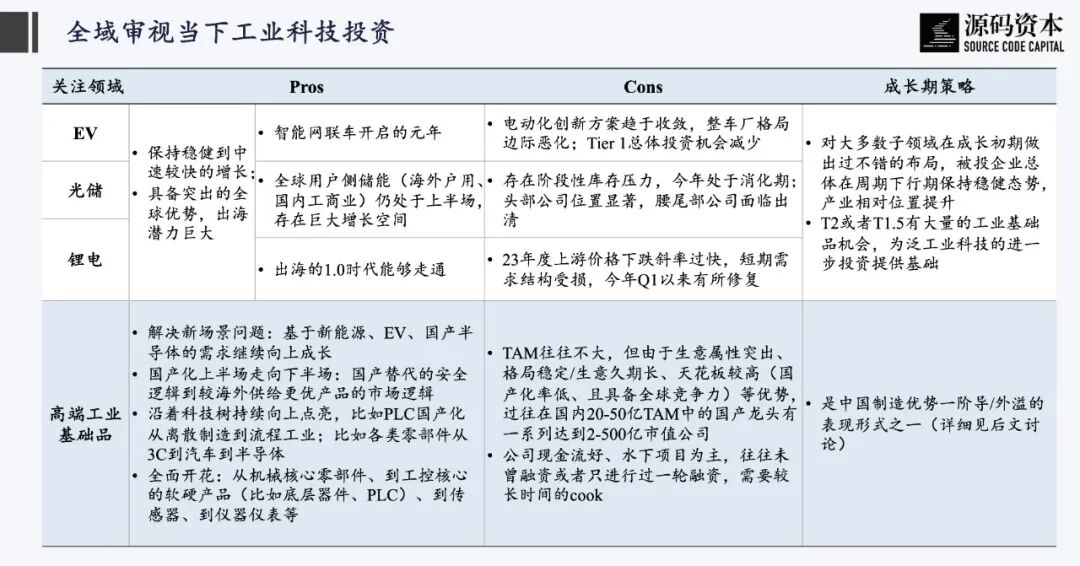
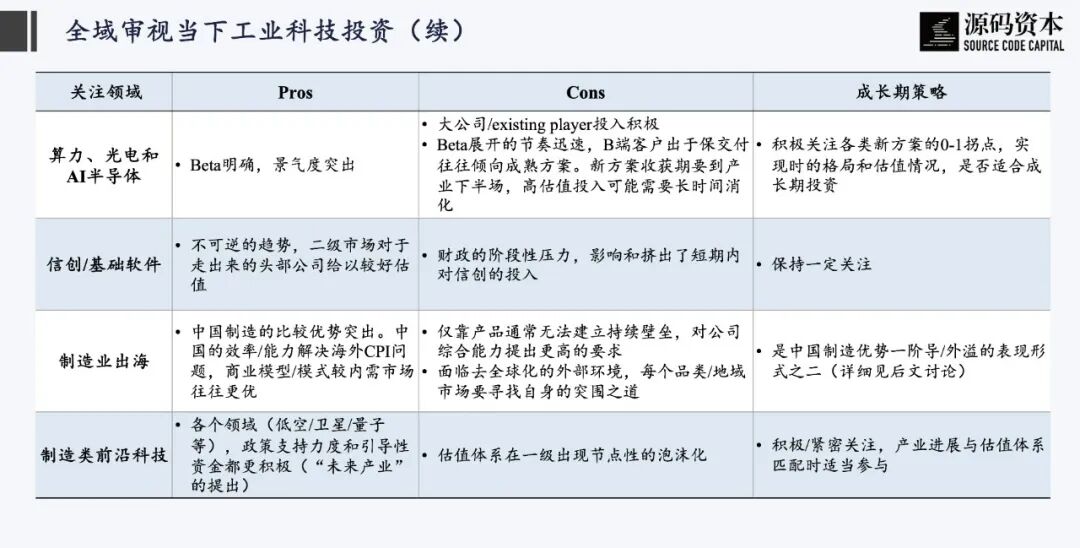
Source Code Capital has been closely tracking the development and transformation of Chinese manufacturing. Within each sub-sector, substantial time, effort, and field research have been invested to enable a panoramic assessment of industrial technology investment at this moment in time.
From last year to this year, Source Code conducted field visits to dozens of primary-market companies in the industrial fundamentals space, seeking to answer why high-end industrial fundamentals can grow rapidly. Our answer: they solve problems in new scenarios.
Some industrial fundamentals grow out of supply chain needs — because at that point in time, the supply chain itself was a new scenario. In new energy vehicles and domestic semiconductor development, new demands, new scenarios, and new products are constantly emerging.
The manifestation is China's continuous industrial upgrading. Where China previously only had small PLCs, now medium and large PLCs are seeing domestic supply emerge; semiconductor component import substitution continues to rise.
In such niche segments, business characteristics are exceptionally pronounced and competitive dynamics relatively stable. Products that have long been absent from the domestic market typically imply high market barriers and technical barriers. Meanwhile, each industry's internal market is not large — domestic market size for fundamentals/components often runs only RMB 2–3 billion.
So how to value them?
We believe two factors largely determine the valuation framework: growth rate and stability of competitive dynamics.
Using a secondary-market concept: in industries long left vacant, once a player succeeds, business "duration" becomes very long and market share ceiling relatively high. Even if the total domestic market is only RMB 3 billion, and currently you can only capture RMB 500 million, with only 1–2 effective domestic players, that one company may eventually dominate the RMB 3 billion market. Given time, as long as the company possesses global competitiveness, it can expand into larger global markets.
Even historically, numerous mid-to-large cap listed companies have emerged from markets of just a few billion RMB. EDA in semiconductors, CAD in industrial software, DCS in petrochemicals, and motion control — pioneers in these fields, standing on TAMs of just a few billion, achieved market capitalizations in the RMB 20–50 billion range.
These companies typically generate excellent cash flow. For investment window construction, long-term empowerment, co-creation, and strategic mapping are required.
From a growth-stage perspective, Source Code tends to focus more on the 0-to-1 evolution of new solutions — for instance, when clear inflection points emerge within a technology cycle. These are often periods where growth-stage valuation better matches progress. If competitive dynamics are relatively clear and business characteristics protect the competitive structure, the probability of companies further expanding capital investment while maintaining relative returns also rises.
In short, some industrial fundamentals may not yet form ultra-large domestic markets, but based on business characteristics and competitive dynamics, large companies can still emerge. Long-term tracking and cultivation of investment opportunities, and timing of investment entry, are all critical to ultimate outcomes.
If immersed in this space, we could easily be overwhelmed by the vast array of choices. Entering this domain, how to choose? This becomes a highly worthwhile topic for discussion.
Two Dimensions of Value Chain
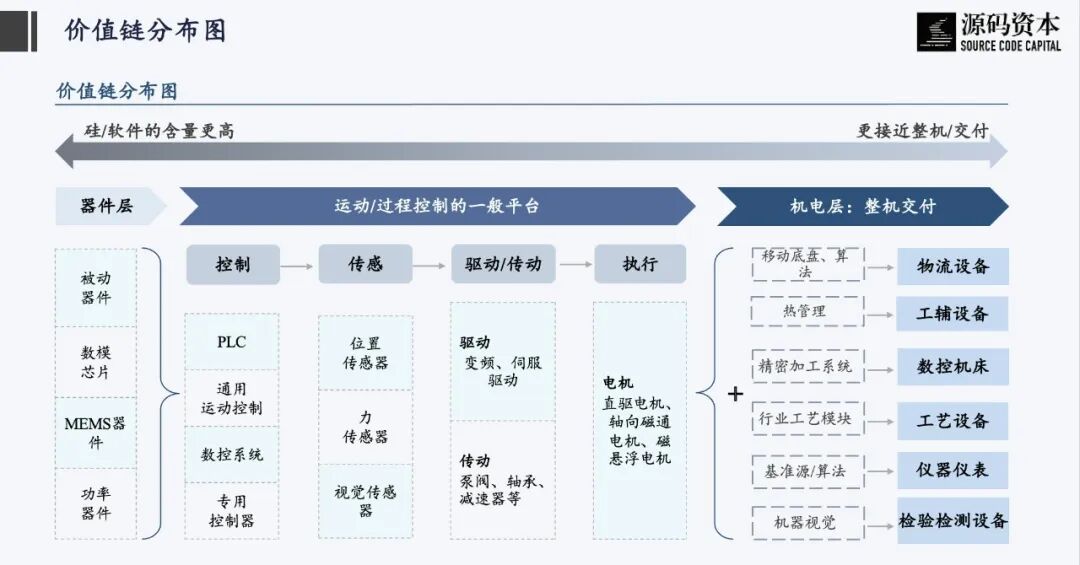
In value chain selection, we generally summarize two dimensions.
First dimension: actual distance from control. The closer to control, the better. Control is the core of industrial control systems — from control to drive to execution to final equipment. Across this entire chain, control sits at the top-level design, holding advantageous position in both business characteristics and knowledge intensity.
Second dimension: higher software content is better. Many underlying software-oriented elements are more readily transferable across industries, whether manifested as control algorithms or calibration algorithms.
In the industry, the technical composition of good businesses tends to combine optics, mechanics, electronics, and computing — composite structures generally have better characteristics. Once complexity increases, demands on management capability and product-formation ability build deeper moats. Within Source Code's investment team, three to four knowledge domains are represented, collectively constructing thicker barriers.
Of course, at the fundamental level, breakthroughs in basic physics are typically valuable.
Additionally, in category selection, business model choice matters. To quote a golden line that appears perennially in Inovance's annual reports: "What industrial companies want to do: first customization, then platformization; first localization, then globalization." Looking back, in this first customization phase, industry selection is particularly important. Once you enter customization, for a considerable period you're basically serving only that industry. The customization choice determines two things: in phase one, whether the company can get off the ground; and when entering horizontal growth, whether dimension-reducing expansion is possible. Neither can be missing. The vertical field chosen at the outset actually reflects team capability to a considerable degree — success from selection is no accident.
Breakthrough
Looking again at going global — it's not driven by desperation, but rather a natural process. Fundamentally, Chinese manufacturing efficiency and capability match perfectly with many overseas problems. One, it can address inflation challenges abroad. Two, China genuinely offers overseas markets better products and business models.
First, the best choice is markets priced by external demand, not by Chinese supply.
The marginal price corresponding to China's efficiency and costs differs enormously from equilibrium prices in most global categories. Take the US equilibrium price as example — while the numerical price stays the same, the unit switches directly from RMB to USD. Every category has typical examples: something costing RMB 10 to produce sells abroad for $70, which consumers see as quality at good value; domestically, it might only sell for RMB 12. Ultimately, there's a massive gap between domestic cost structure and equilibrium prices in overseas supply chains.
When overseas supply faces pricing pressure from China, a concern arises: will overseas suppliers be completely wiped out? Complete elimination would be extremely damaging to Chinese global expansion — with overseas supply missing, domestic companies lose their pricing anchor. The new anchor becomes China's marginal cost, and prices get cut again and again.
Take inverters as an example. Currently, SMA still exists in the global market, so when Chinese inverters go global, they only need to price below international levels — at such price levels, companies can still achieve relatively healthy gross margins.
Second, seek markets where demand has substantial variables.
This partly determines the breakthrough point for domestic companies going global. For example, electrification of garden tools — originally non-electric, non-smart, this technology overlay creates opportunity for Chinese companies. Or auto parts: overseas, auto repair is a massive industry, but purely offline — the online transition of this industry represents another business opportunity. Or industrial instruments: for emerging countries in Central Asia and Southeast Asia, as Chinese manufacturing spillover enters new infrastructure cycles, workers urgently need affordable, portable instruments. Buying from established foreign companies like Siemens is prohibitively expensive, but turning to Chinese supply chains? Good quality, low price.
Finally, recognize that going global involves absolute difficulty in product and channel cognition/execution.
Going global is actually not a low-cost proposition. Previously, many Shenzhen companies went to Africa, assuming low costs — RMB 500 monthly salary might hire excellent graduates from University of Nairobi, and labor costs were indeed low. But many companies later discovered that running the business required factoring in warehousing, logistics, and delivery costs, while local infrastructure remained quite primitive. After accounting for these, doing business in Africa might cost about the same as in Europe — counter to our usual intuition.
If doing business in any overseas country is not cheap, and there's no room for trial and error, how to get it right?
First: timing selection. While operational costs can be supported, find your suitable market as quickly as possible, more compactly and flexibly. Risk tolerance and error margins for global expansion businesses are increasingly low — delay in important markets and missed timing represent the greatest opportunity cost.
Second: each individual national market somewhat resembles evaluating an investment target, requiring compound and multidimensional thinking, management methods, and decision-making philosophy to adjust and adapt to overseas markets.
Third, master three success factors: defining suitable product forms, identifying and solving key marketing problems, and finding frontline teams adapted to this execution approach.
Going global must build upon domestic supply chain completeness and high-level management capability, with headquarters providing complete and substantive support to overseas subsidiaries. Meanwhile, elite frontline special forces for achieving PMF in specific countries or markets need the determination and courage to scale boldly, maintain presence in promising markets, and cut losses promptly when discovering seeds of error.
5
Making Foreign Lands Home
In the 1990s, after Japan's asset price bubble burst, the pace of going global accelerated. Through the long process of global expansion, Japanese enterprises followed a sequential rhythm: "first Asia and America, then Europe; first manufacturing then services; first large enterprises then small enterprises." By 2021, Japanese enterprises' overseas net assets relative to GDP reached approximately 75%. This massive scale of overseas assets and rapid corporate globalization pace allowed Japanese companies to expand their overseas balance sheets, effectively hedging against profit pressures from domestic balance sheet contraction — ultimately maintaining surprisingly stable growth through Japan's "lost three decades."
China possesses complete conditions for transformation and upgrading. In recent years, increasingly more industries have completed the shift from debt-driven to industry-driven growth, helping high-end manufacturing replace real estate as a new economic pillar.
Looking now, various manufacturing globalization companies have emerged across different sectors — a gratifying development. Domestically, teams willing to anchor in these domains and dare to strive and contribute are springing up like bamboo shoots after rain. Truly new multinational platform companies are still en route; from development to maturity, this will certainly be a process full of challenges.
Finally, a quote from Midea Group's annual report, to share and encourage: "The foundation of internationalization is localization; internationalize headquarters, make foreign lands home. Continue increasing investment in overseas after-sales service, logistics, brand and other infrastructure construction. Dare to act, dare to do."
This article is based on research and sharing by Di Wang, Managing Director at Source Code Capital.