Code View | Yungang Huang: "Cross-Disciplinary Convergence" Drives Innovation in Healthcare

#MaGuan
Source Code Capital invests in technology-driven innovation,
and in the creation of lasting, genuine value.
Recently, the "Steady Development, Seizing the Future: Reflections on the Post-Pandemic Healthcare Industry" event, co-hosted by Peking University's Guanghua School of Management, the Zhongguancun Talent Association, and others, was officially held in Beijing. Attendees — scientists, entrepreneurs, and investors — discussed core topics around the transformation of the healthcare industry in the post-pandemic era.
Yungang Huang, partner at Source Code Capital, gave a presentation on "Technological Innovation in Healthcare from an Investment Perspective." He noted that the healthcare industry has low concentration, leaving ample room for innovation; that cross-disciplinary convergence will generate breakthrough opportunities, such as "AI + Science"; and that healthcare is a perennial sector that transcends cycles. Source Code will continue to support it and remain committed to creating lasting, genuine value.
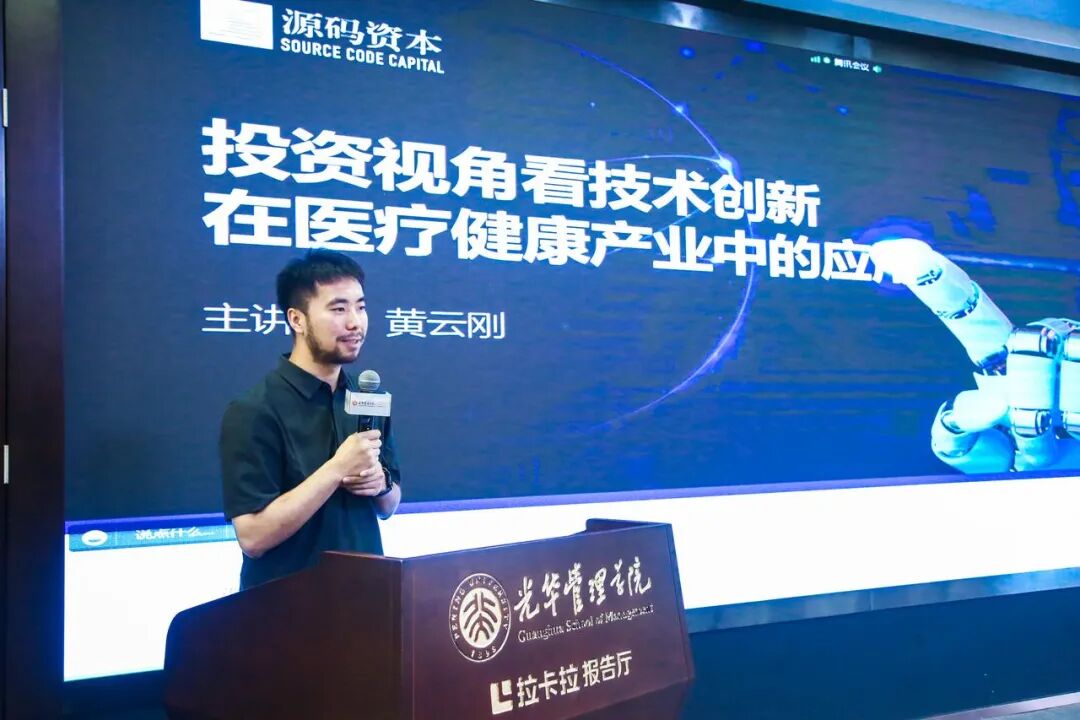
Yungang Huang | Partner, Source Code Capital
The following is the full text of Yungang Huang's speech:
Hello everyone, I'm from Source Code Capital. Founded in the spring of 2014, Source Code Capital has been operating for nearly nine years. We specialize in technology investing and participated in the early-stage investments of companies including ByteDance, Meituan, KE Holdings, and Li Auto. Since then, our investment scope has gradually expanded into artificial intelligence, robotics, intelligent manufacturing, life sciences, and green development. Source Code Capital currently manages both RMB and USD funds, with assets under management equivalent to approximately 35 billion RMB and a team of nearly 150 people.
I have been in the investment industry for 13 years. Previously, I focused on research and investing in computer science and artificial intelligence. In recent years, I've been exploring healthcare investments and built Source Code's healthcare investment team.
Today, I'd like to discuss technological innovation in healthcare from an investment perspective. I'll share our ongoing thinking and research on the broader capital markets environment, the characteristics of the healthcare industry, China's domestic healthcare landscape, the relationship between knowledge-driven and industry-driven innovation, and what we see as the trends in cross-disciplinary convergence and data-intelligence-driven research and commercialization paradigms.
As we all know, geopolitical tensions this year have created a complex international situation, triggering significant volatility in capital markets and posing substantial challenges to the healthcare industry. The sector is currently in a relative downturn. Looking at the secondary market, the healthcare segment has been on a downward trend due to earlier bubbles in the industry combined with broader risk-averse sentiment and capital flight from riskier assets.
That said, this situation has also highlighted some ways in which healthcare differs from other industries. First, medical R&D requires substantial capital investment and sustained funding support. This is because the foundation of healthcare R&D lies in breakthroughs in basic scientific research. Only when deep research in fundamental disciplines achieves breakthroughs can applications in healthcare follow, enabling true innovation. Therefore, sustained funding is needed to support basic and foundational research.
Second, the healthcare industry's low concentration is favorable for innovation. Healthcare is an enormous field where monopolies are difficult to establish. With low industry concentration, the gap between leading companies is not particularly large. Whether large or small, companies are highly dependent on the overall ecosystem. Large companies can capture market share through brand, distribution channels, clinical capabilities, and M&A, while smaller companies can achieve breakthroughs through innovation and cross-disciplinary integration.
Third, cross-disciplinary convergence will generate innovation opportunities. Looking back, great companies at every stage have exhibited certain forms of innovation — from disruptive and applied technologies early on, to product innovation, platform innovation, and marketing innovation. Different stages call for different innovation models. Chinese companies are particularly adept at applied innovation once a disruptive technology has emerged, and Chinese teams have significant advantages in meeting customer needs. In healthcare, we believe that cross-disciplinary convergence and data-intelligence-driven R&D and commercialization represent the major directions for future innovation. From Science, to AI + Science, to Business — this is inherently an interdisciplinary process of mutual integration and reinforcement.
Turning to the characteristics of the Chinese market, we believe that the "low-hanging fruit" in China's biopharmaceutical industry has already been picked. Research progress in both China and developed countries is slowing, and new research paradigms and breakthroughs are needed to push the biopharmaceutical industry to its next stage.
And it is precisely in areas of current deficiency that the greatest opportunities for innovation lie. First, leading breakthroughs in scientific research. We've seen many forums on foundational technology research recently, but there remains a lack of Nobel-caliber research. Original scientific breakthroughs are extremely difficult — yet it is precisely this difficulty that underscores their leading value. Second, dependence on imported scientific instruments and tools. Most of our research instruments and tools are imported, and any "chokepoint" scenario could bring research to a halt. Third, a shortage of industry leaders. China's economy still lacks major industry leaders in healthcare. While some are beginning to emerge in certain areas, they remain small in scale and few in number compared to overseas giants. This shortage affects the vibrancy of industry collaboration and M&A activity. Fourth, startups lack sound corporate governance. There is substantial room for improvement in management practices, governance structures, equity allocation, organizational capability building, and strategic capability building. Fifth, providing fertile ground for talent. Scientist-entrepreneurs need to strengthen their organizational and talent capabilities, bringing in professional managers to participate in governance while also providing talent with development opportunities and commensurate rewards.
Finally, we have always believed that only through innovation can we transcend cycles. Pursue original innovation, apply it in commercial settings, and enable more people to enjoy the healthy lives that medical innovation brings. We have committed ourselves to working hard in this industry, and we look forward to innovating and transcending cycles together with each and every one of you in this field.
Thank you all!


-
MaGuan | Source Code Capital: The Most Critical Capability for Carbon Neutrality Investing is Multi-Level Cognition
-
MaGuan | Source Code Capital: Opportunities and Advantages — China's New Energy in a New Cycle
-
MaGuan | "Carbon Neutrality" Technology Innovation in Sustainable Development
-
MaGuan | Is 41 the Optimal Age for Innovation?
-
MaGuan | Source Code Capital: Focusing on Energy Cleanization and End-Use Electrification
-
MaGuan | Yungang Huang: Maintaining a Stable, Long-Term Technology Investment Rhythm Through Peaks and Troughs
-
MaGuan | Source Code Capital: Technological Change Reshapes Moats, Tech Entrepreneurship Breaks Boundaries
-
MaGuan | Xingchen Zhang: Technology-Driven Innovation from Zero to One
For more MaHui members, click "Read Original" to view