Code View | Allen Zhang on Going Global: Hunting for Tech-Driven International Enterprises

Going Global: The New Startup Frontier

In the post-pandemic era, the competitive landscape remains complex and multifaceted. On one hand, China's economy is gradually recovering and regaining vitality, with consumer confidence and spending appetite steadily strengthening. On the other hand, China's demographic dividend is fading, and overall economic growth is decelerating.
Against this backdrop, going global has emerged as a new entrepreneurial frontier and a critical direction for companies seeking to extend their business into a second growth curve. So how exactly should companies approach international expansion? What common challenges await? How should they balance regional and cultural differences? What preparations are necessary? To address these questions, we're sharing insights from a previous interview that Genghua Zhang, Executive Director at Source Code Capital, gave to Yiou on the topic of going global — in the hope that it proves useful for businesses.
Zhang holds a bachelor's degree from the London School of Economics and a master's from the University of Cambridge. He previously worked at CDH Investments. Since 2015, he has focused on investment opportunities in international markets and technology-driven world-class enterprises. Beginning in 2015, he has tracked overseas markets and built a portfolio spanning global tech and internet, international software, cross-border e-commerce, international product companies, and overseas infrastructure, with a geographic focus on North America and emerging markets in Southeast Asia. His investments include Zomato, Grab, Unity, PatPat, Urbanic, XpressBees, Style3D, and Keeway.
01
The "Tech Going Global" Wave Is Coming
Q1: What are your key focus areas when it comes to going global? What shifts are happening in the North American market?
Zhang Genghua: From 2015 to 2017, I mainly tracked mature overseas models being copied to China and overseas unicorns. From 2017 to 2020, as many proven domestic models spread to emerging markets, I focused on "Copy From China" opportunities in those regions. Between 2020 and late 2021, the pandemic accelerated e-commerce growth, so I paid more attention to cross-border e-commerce and vertical international expansion.
I've covered both mature and emerging markets, but North America has been the highest priority in the past two years. From a market perspective, 2022 saw a pronounced trend of consumer behavior returning to offline channels in North America. On one hand, online traffic entered a transitional phase — costs on established platforms like Google and Facebook kept rising, while new platforms like TikTok remained in the early stages of monetization. By comparison, entrepreneurs found that offline channels offered better returns on investment. On the other hand, large-format retail stores still represent the most natural fit for North American consumer habits. Shopping had briefly surged online during the pandemic, but as COVID's impact waned, it gradually migrated back offline.
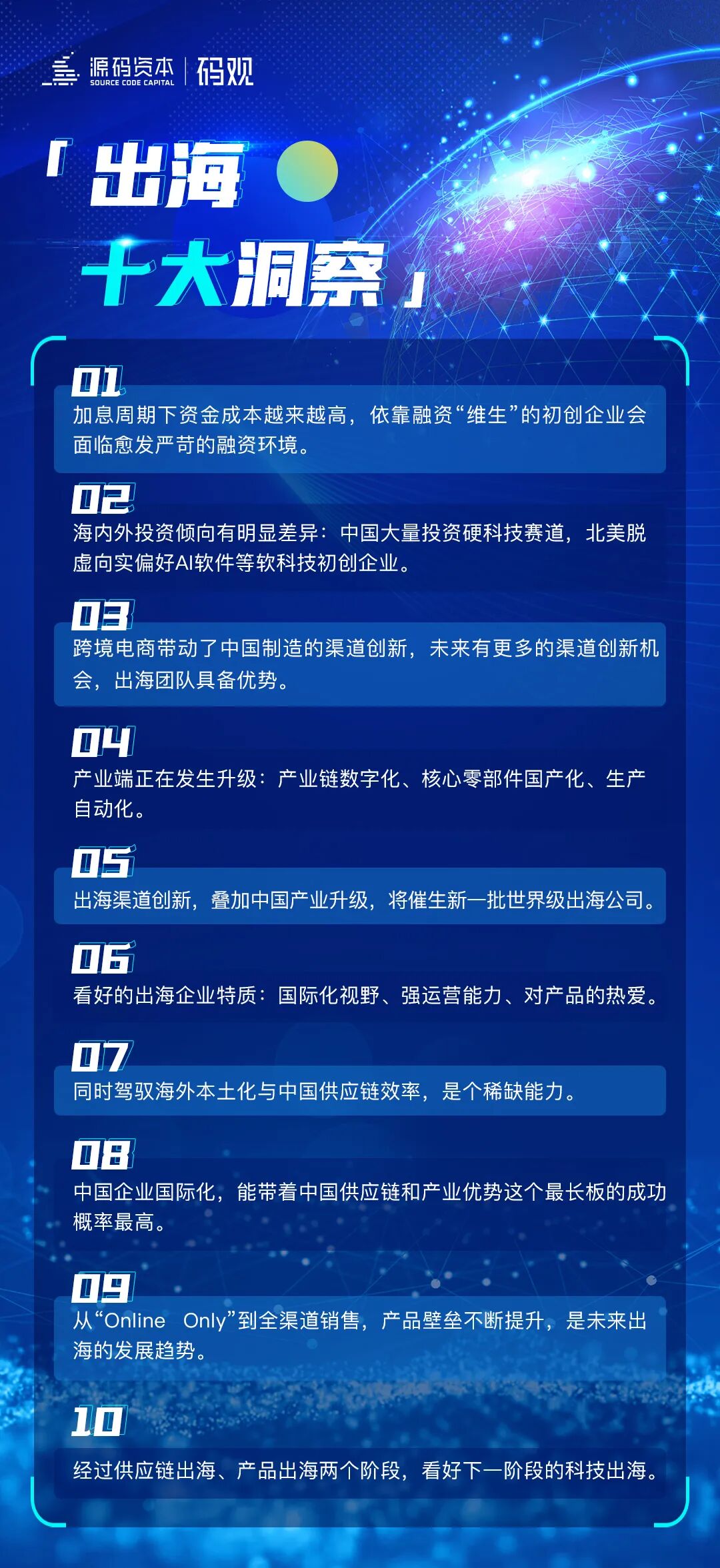
From an investment standpoint, since the United States entered its rate-hiking cycle, the cost of capital has risen significantly. Many startups that previously generated no profits and relied heavily on fundraising to survive now face an increasingly harsh financing environment — the recent Silicon Valley Bank collapse was a concentrated eruption of this tension. The "funding crunch" will likely persist for some time, and investors are paying closer attention to the profitability of potential deals.
Comparing investment tendencies at home and abroad, while China has poured massive resources into hard tech, overseas investors — particularly those in North America — have increasingly moved in the opposite direction, favoring soft tech startups such as AI software. They've realized they simply can't compete with China when it comes to hardware mass production and supply chain infrastructure.
Q2: What structural changes are occurring in the going-global space?
Zhang Genghua: The first phase was "supply chain going global," where companies leveraged China's supply chain advantages and cheap overseas traffic to sell abroad — exemplified by the "Bantian Five Tigers," "South China City Four Young Masters," and "Amazon Three Heroes." Starting around 2020, as more companies joined the going-global wave, the old approach of simply sourcing from 1688 and reselling became unsustainable amid intensifying competition.
The second phase is "product going global," where companies don't just focus on scaling sales from 1 to 10, but also participate in product design and production from 0 to 1. Companies making new energy products, tech consumer goods, or robotics, for instance, are all moving in an international direction — a trend that should continue for several years.
Further out, we'll see "tech going global," with more companies competing on the basis of technological leadership or moats. This "tech" encompasses both hard and soft tech — with hard tech further breaking down into materials technology, space technology, biotechnology, and new energy technology, among others.
02
The Growth Logic and Business Innovation of Cross-Border E-Commerce
Q3: How do you view the development of the cross-border e-commerce industry?
Zhang Genghua: Looking at the industry backdrop, we see several long-term theses.
First, enormous room remains for overseas consumer migration online.
In the global e-commerce market, China leads with $2.5 trillion in volume; the United States follows at $800 billion. This suggests the U.S. still has roughly double its current scale to grow. In other developing countries, cross-border e-commerce penetration sits at just 5-10%. Overall, the overseas e-commerce market has 2-3x growth potential.
Second, China's supply chain flexibility is a distinct advantage.
The past decade was about China's supply chain serving Chinese consumers; the next decade will be about China's supply chain serving six billion global consumers.
Third, infrastructure is steadily improving.
Logistics, payments, and other infrastructure are maturing, enabling cross-border e-commerce delivery experiences to gradually approach those of domestic shopping overseas.
Fourth, favorable policy tailwinds.
Domestic policies are actively encouraging and promoting cross-border e-commerce as a new business format, cultivating fresh momentum for foreign trade.
Fifth, China's unique e-commerce know-how.
China leads globally in e-commerce penetration, model diversity (self-operated, platform-based, social, content, livestream, and other formats), and e-commerce talent.
Q4: What's the underlying logic driving the rapid growth of cross-border e-commerce?
Zhang Genghua: Specifically, there are several layers:
The first layer is the large gap in overseas e-commerce penetration. There's substantial room for overseas e-commerce penetration to grow — potentially doubling. Many industries, once they reach trillion-dollar scale, see growth rates converge with GDP growth. But cross-border e-commerce, already a trillion-dollar market, still maintains 20% annual growth — quite remarkable.
The second layer is continuously improving fulfillment efficiency. Better fulfillment drives more cross-border orders. In the United States, for example, a market with 60 million daily e-commerce deliveries, direct-from-China orders account for only 10%. As fulfillment becomes more efficient, the share of Chinese cross-border e-commerce in the U.S. market can rise further.
The third layer is the large growth potential from channel expansion. Many product companies that started online will move toward omnichannel models in the future.
Q5: How do you view business categories and innovation in cross-border e-commerce?
Zhang Genghua: Cross-border e-commerce combines front-end traffic and back-end products in a 2x2 matrix, yielding four models. Front-end traffic splits between platform-based selling and self-built channels; back-end products split between off-the-shelf sourcing and self-developed products. This produces four e-commerce models: 1.0 is platform-based selling plus off-the-shelf sourcing — the large reseller model; 2.0 is platform-based selling with self-developed products — the product-centric company; 3.0 is self-built channels with self-developed products — the independent cross-border site; 4.0 is self-built channels with off-the-shelf products — the platform-style e-commerce model.
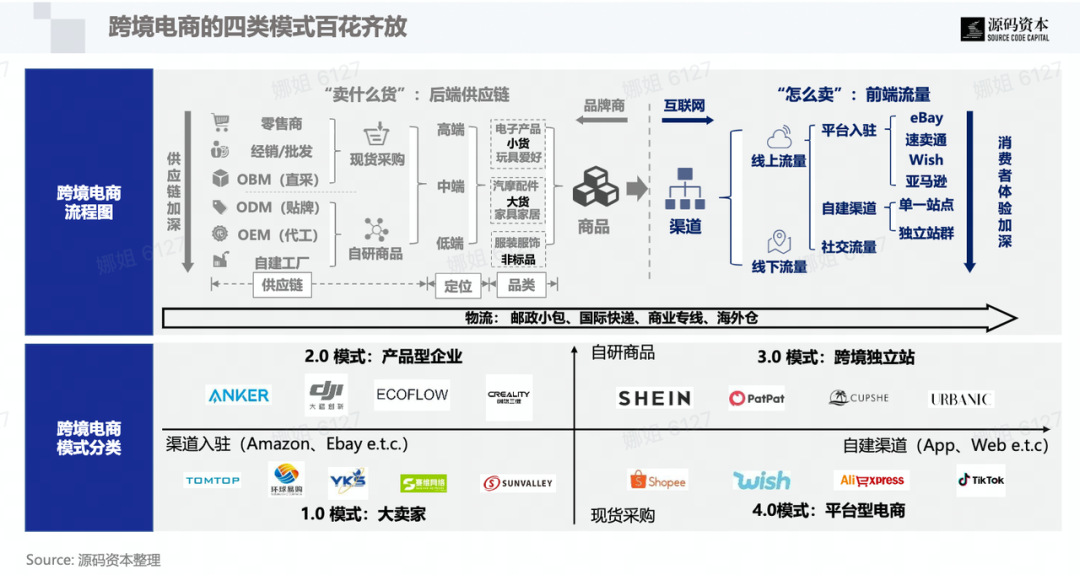
Cross-border e-commerce has driven channel innovation, which combined with China's industrial upgrading has propelled high-quality industrial development. China has long been a manufacturing powerhouse, but R&D, marketing, and capital were largely out of its hands. Through cross-border e-commerce and channel innovation, Chinese companies now have leverage in distribution and branding. On the user side, companies have moved from layered distribution models where they didn't know who their end customers were or what they liked, to understanding consumer preferences directly through independent sites and Amazon.
Going forward, we believe further upgrades will emerge — such as building stronger connections with users to increase repurchase and referral rates. Private-domain e-commerce, recommendation-based e-commerce, social e-commerce, and content e-commerce are all relatively mature models in China. In the future, global channel innovation will be a core strength of Chinese international teams.
Q6: What dimensions of industrial innovation are happening on the supply chain side?
Zhang Genghua: The value curve shift driven by cross-border e-commerce — when channel innovation occurs in marketing and branding — happens to coincide with industrial innovation at home:
First, industrial digitization, domestic substitution, and automation.
Industrial digitization, exemplified by SHEIN, uses industrial software and internal information systems to enable better cross-regional coordination.
Second, domestic substitution of core components.
Third, production automation.
Source Code has also invested in numerous robotics and digital twin companies. Combined with digitization, domestic substitution, and automation, even when manufacturing moves offshore, it remains within the Chinese sphere of influence.
03
Opportunities and Challenges for Companies Going Global in 2023
Q7: What comparative advantages do Chinese companies and entrepreneurs demonstrate collectively? What aspects of overseas business culture are worth learning from?
Zhang Genghua: First, Chinese entrepreneurs tend to be hardworking and capable, able to take things further on the same task.
Second, Chinese entrepreneurs have stronger supply chain management experience and operational capabilities compared to their overseas counterparts.
Third, Chinese teams have mature e-commerce operational methodologies.
Conversely, overseas business civilization has evolved over two centuries, producing numerous business schools and systematized management methodologies. Local entrepreneurs abroad demonstrate stronger capabilities in cross-border management. Chinese entrepreneurs' management styles, by contrast, resemble "each showing their own magic" — workable domestically but encountering friction overseas. Meanwhile, local entrepreneurs abroad are more adept at brand-building.
Regarding the impact of the recent funding environment: historically, overseas entrepreneurs — particularly in the United States — held advantages in technological innovation from 0 to 1. But in recent years, as the international environment has shifted, domestic policies and government guidance funds have created a more favorable environment for technological innovation, including support for longer R&D-cycle projects. This also benefits more "technology-driven" enterprises in their international expansion.
Q8: What common challenges do companies and entrepreneurs currently face in going global? How should they respond?
Zhang Genghua: Every company faces distinct challenges, but the most common one we see is localization in overseas markets. Localization itself isn't that difficult, but decision-makers need to invest sufficient time and energy on the ground overseas — otherwise they lack real feel for the market. An alternative is finding an excellent, well-matched "number one" for the overseas market, but this requires the right timing, place, and people.
Q9: What do you think are the necessary conditions for a going-global company to succeed?
Zhang Genghua: I believe three elements are essential.
First, international vision.
When a company reaches sufficient scale, it will inevitably need to mobilize global resources and manage global teams.
Second, strong operational capabilities.
Cross-border e-commerce itself involves a long chain — from fulfillment in China to delivery in overseas consumers' hands. Excelling at each link creates a genuine operational moat.
Third, passion for product.
We observed that early going-global efforts benefited from industry tailwinds, so many companies easily fell into the trap of low-price, high-volume selling. To build a truly great company over the long term requires passion for the product itself. Only with genuine product passion can you attract like-minded teams, endure through cycles, and generate consumer value while driving industrial and social value.
Q10: In 2023, what trends or opportunities should Chinese companies and entrepreneurs going global pay particular attention to?
Zhang Genghua: Different regions and even different countries present differentiated opportunities. Speaking generally, as going-global competition intensifies, companies should expand from "online only" to omnichannel sales on the front end, while continuously deepening product moats on the back end — evolving from supply chain going global to product going global and ultimately tech going global.
As Chinese companies expand globally, they should first leverage domestic supply chain and industrial advantages. We're particularly focused on emerging categories and supply sources such as new energy products, tech consumer goods, and robotics. From an investment perspective, these three sectors have attracted substantial capital in recent years, resulting in strong domestic supply capabilities and validated business models. Going international, they will be highly competitive.