Code View|How AI Products Build Moats: Certain Growth Flywheels? Uncertainty Protection?
Is There No Moat in AI?
There's a belief in startup circles that if you have the best team, the best product, and the fastest growth — if you're simply building something people want — you don't need to worry about a moat.
Not so.
Moats matter most precisely for those companies with the best products, the most talented teams, and the fastest growth.
These companies might withstand some losses. But they're constantly vulnerable to being crushed by larger, better-resourced incumbents and ambushed by smaller, faster-moving upstarts. The faster they succeed, the fiercer the competition they face.
So how do you deepen your moat? Especially today, when AI is going open source from data to models, what does a moat even mean? We've rounded up several prevailing perspectives, hoping to spark a broader conversation about building moats in the post-AI era.
1
The Moat: A Data-Product Flywheel Fueled by First-Mover Advantage
First, what is a moat? In The 7 Powers, Hamilton Helmer defines it as "a barrier that protects a business's profit from competition." He identifies seven types: scale economies, network effects, counter-positioning, switching costs, branding, cornered resources, and process power.
In Zero to One, Peter Thiel argues for four types of moats: proprietary technology, network effects, economies of scale, and branding.
A moat won't help founders achieve product-market fit. Founders should focus on finding PMF first, then figure out how to shield their product from competitive threats. The ultimate goal for a VC-backed startup is to go public or be acquired for $1 billion or more — not to have its valuation inflated by other VCs. That takes a long time, typically seven to ten years. Even if a startup sparks interest before competitors realize what it's doing, it needs to protect that flame from going out and find ways to fan it into a blaze until a successful exit. For a company where everything is going right, the presence or absence of a moat can determine whether it becomes an IPO success story or a cautionary tale. A moat isn't a shortcut to success, but its absence can lead to failure.
The topic of moats has been coming up frequently lately among generative AI startups — companies built on top of OpenAI's APIs that have been ruthlessly dubbed "GPT wrappers." On one side are VCs and analysts who believe GPT wrappers have no moat. On the other are founders who argue that building a great product and growing fast is what matters most, and that moats will form naturally over time.
Brandon Gleklen, who covers cloud services investments at Battery Ventures, believes that generative AI companies will eventually develop moats because they can, like cloud services companies before them, leverage first-mover advantage to capture user data and feedback, then continuously refine their products based on that input — ultimately building a moat.
Because the marginal cost of serving additional users is negligible, cloud services companies can pour more money into R&D. But R&D spending alone isn't a moat, since any competitor can match that investment. What can't be easily replicated is the learning that comes from user feedback on the product experience — that takes time, and more importantly, timing.
Very few products are flawless from the start. The best products are built through relentless iteration and improvement based on user feedback. The accumulated insight into user needs and experiences becomes a powerful advantage.
This is the model most expected of AI startups today — large models are powerful, but AI hallucinations are no joke, and perhaps many domains don't require such powerful models to begin with. Vertical models and fine-tuning on top of foundation models may be better approaches for hitting user needs directly — not just because they're cheaper, but because they incorporate industry experience and substantial know-how that may never exist on paper.
Perhaps many current AI applications can't escape the "GPT wrapper" criticism. But through sustained R&D investment and customer-driven iteration, a company can cultivate a core user base and a distinctive value proposition.
And if a company fails, the cause likely won't be "OpenAI released a new version" or "a tech giant copied the product." The more probable reasons are that the company never found PMF to begin with, or even if it did, the team failed to actively listen to market feedback and build what users actually wanted.
2
The Moat: Uncertainty Beneath Complexity and Novelty
But we can just as easily cite the counterargument.
The Information reported that two generative AI companies, Jasper and Mutiny AI, are laying off staff. Before this wave of AI hype, Jasper — founded in 2021 — had been growing rapidly, with projected revenue of $75 million this year. Last October, it rode that momentum to a $1.5 billion valuation. Nine months later, facing intensifying competition, it began cutting jobs. Apparently, the company hadn't built a deep enough moat to protect its rapidly growing gains.
If first-mover advantage alone could create a positive data-product flywheel, Jasper might have lasted longer. Perhaps we need another way of thinking about "moats."
Venture capitalist Jerry Neumann argues: "The only moat that emerging companies can create to capture excess value is uncertainty," because "uncertainty keeps competitors at a distance and gives you time to build a moat."
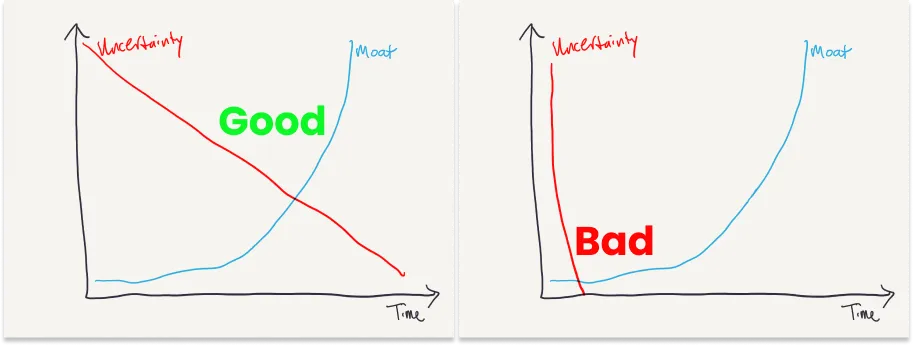
Jasper lost the protection of "uncertainty" before it could build a real moat.
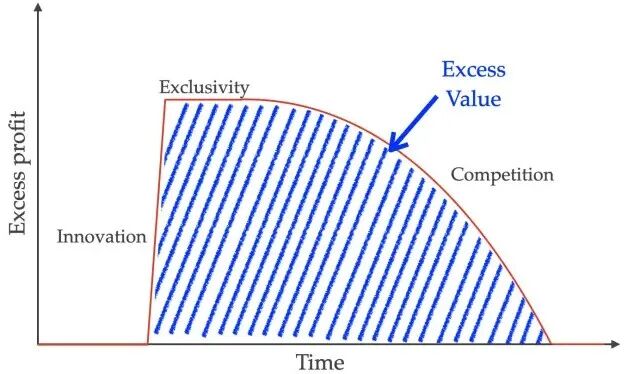
The clearer the startup idea and the easier it is to build, the faster you need to construct a moat — and vice versa.
Whether a startup should spend all its time on product or allocate some to strategy even in early stages depends on how much uncertainty exists in the business.
Neumann identifies two types of uncertainty: novelty uncertainty (technical risk) and complexity uncertainty (market risk). Novelty uncertainty is whether a company can actually build what it claims it will build. Complexity uncertainty is whether, even if you build it, there's a large enough addressable market and whether it's profitable enough.
Under uncertainty's protection, emerging startups have a window to dig their moat. If they fail to do so before others catch on, excess profits will be divided among competitors, and the road ahead becomes much harder.
This can be written as a formula:
Required Moat Depth = Obviousness of Idea − Ease of Building
The variables in this formula change over time. Non-obvious ideas can become obvious as the market catches up to your insight and customers vote with their wallets to prove you right. Once something hard to build becomes easier as infrastructure improves, one company's core technology can become another company's API. For founders and investors, it's crucial to update the formula as ground conditions shift.
This formula explains startup truisms like "great companies are built in bear markets!" and "you need to be contrarian and right." In both cases, increased uncertainty provides more time to build defensive capabilities.
Some analysts argue that Twitter is a company that found PMF first, then built its moat. Investor Packy McCormick believes Twitter was lucky that people used it and treated it as a toy-like product. Competitors didn't take seriously a product for posting what you ate for lunch, and by the time they wanted to compete, the moment had passed. Seventeen years later, the network effects Twitter built under complex uncertainty remain powerful.
Others argue that Airbnb also focused on product rather than building barriers in its early days. In Airbnb's seed round deck, the competitive advantage section listed six product features, with no real moat (unless you count brand, which is negligible before it's established).
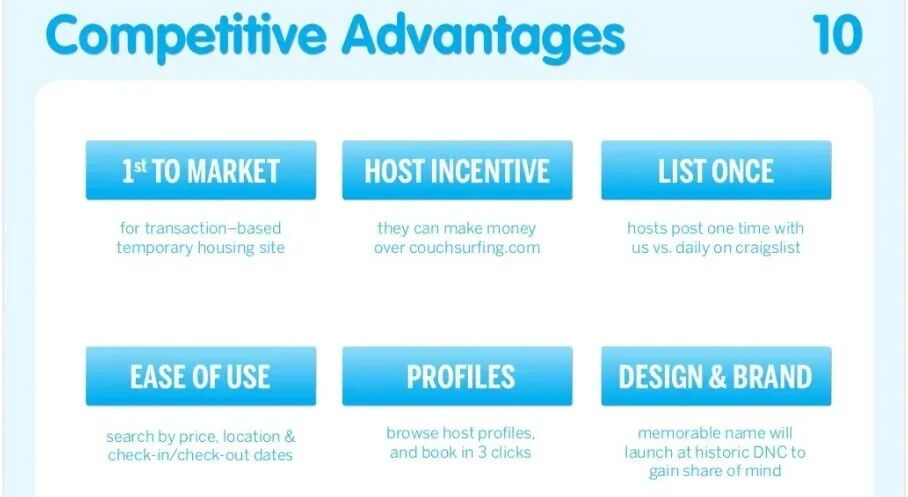
Packy McCormick similarly points out that their success wasn't due solely to product excellence — it was also that Airbnb looked like a terrible idea at the time! Airbnb faced extreme difficulty raising funding. The team met with seven investors in 2008 and walked away with nothing.
Today Airbnb's market cap exceeds $80 billion. Complexity uncertainty gave Airbnb time to develop the brand and network effect moats that now protect it. Ultimately, Airbnb spent enormous time, money, and effort building these moats — it hired a team to meticulously balance supply and demand, and partnered with The Walt Disney Company to showcase user stay stories, just to name two examples — but given the uncertainty around whether anyone would pay to sleep on someone else's couch, their focus on proving the product before worrying about moats was defensible.
3
No Uncertainty in AI
This is why VCs and commentators are so concerned about the lack of moats in generative AI. There's almost no uncertainty here.
Building on top of ChatGPT eliminates novelty uncertainty. And the early wild success of many generative AI products removes complexity uncertainty! If you build an emerging AI product and start gaining traction, you'll face fierce competition from other startups, bootstrapped companies, indie developers, and incumbents eyeing your users. Competition is inevitable. In a slower-changing or technically novel domain, competition might be tolerable because you'll have time to build foundational moats and customer loyalty. In a fast-moving field like generative AI, your chances of building a strong enough moat before competitors emerge are slim.
Setting aside the GPT wrappers and looking across the broader AI landscape at companies that still have substantial revenue — Hugging Face and Runway — these two examples illustrate how important it is that moats dug during periods of uncertainty can protect you once that uncertainty disappears.
When Hugging Face was founded in 2016, AI wasn't yet hot. Its product was an AI chatbot based on its own NLP model. The following year, Google's paper "Attention Is All You Need" introduced the Transformer architecture, and the Hugging Face team created the Transformers open-source library on GitHub, which became wildly popular in the open-source community.
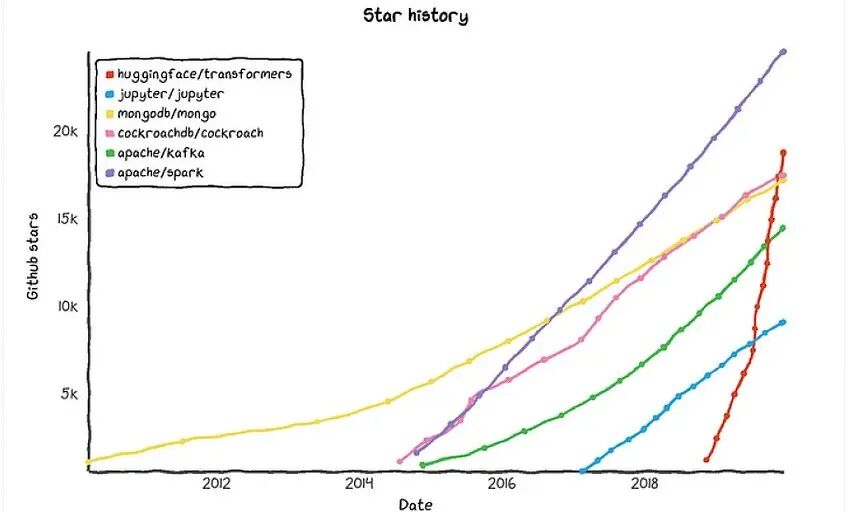
Hugging Face went all-in on becoming "the GitHub of machine learning," hosting open-source models and datasets, building tools for users to work with these models, and cultivating a developer community. For five years before AI became an obvious bet, Hugging Face operated under complexity uncertainty, digging its moat — the most powerful being network effects. According to a July report this year, its revenue is likely between $30 million and $50 million, and it's raising a new round at a $4 billion valuation.
If Hugging Face is an example of successfully using the time that complexity uncertainty provides to build a powerful moat, then Runway is a case of something still unfolding: can it dig its moat before its novelty uncertainty expires?
Runway was also founded before the AI boom, in 2018, with the goal of building "the world's first all-in-one AI generation platform." It faced novelty uncertainty — in 2018, AI could barely generate images, let alone video. It raised $2 million at a $9 million post-money valuation from Lux Capital, a humble price.
Over the past five years, it has built state-of-the-art video models based on its own applied research. Recently, it announced Gen-2, the best video generation engine on the market. In June this year, Runway raised $141 million from Google, Nvidia, Salesforce, and other giants at a $1.5 billion valuation.
What Runway is trying to do is extremely difficult, and only recently have people realized it's viable, so until now it has been protected by novelty uncertainty. They've also shipped products rapidly to stay ahead. But I'm not sure whether the company has a real moat yet. If not, it should be digging one quickly before uncertainty runs out.
This is why building fortifications is so important for startups, even if it's not cool. The simplest early-stage startup strategy is to direct limited resources toward building a moat before serious competition arrives.
Admittedly, not all startups need a moat from day one. If success is already obvious and rivals are still fumbling, start digging. If they're fortunate enough to have obvious traits that attract fierce competition, then the moat becomes critical.
Start building your moat now!
References:
https://www.notboring.co/p/when-to-dig-a-moat
https://reactionwheel.net/2020/11/productive-uncertainty.html https://batteryventures.substack.com/p/generative-ai-companies-have-moats