Code View | *China Electric Power News* Interview with Source Code Capital's Di Wang: Industry Inflection Point Arrived, Vast Market Space Ahead

#MaHui
Source Code Capital invests in technology-driven innovation,
and in the creation of lasting, real value.
Originally published in: China Electric Power News Reporter: Yang Na
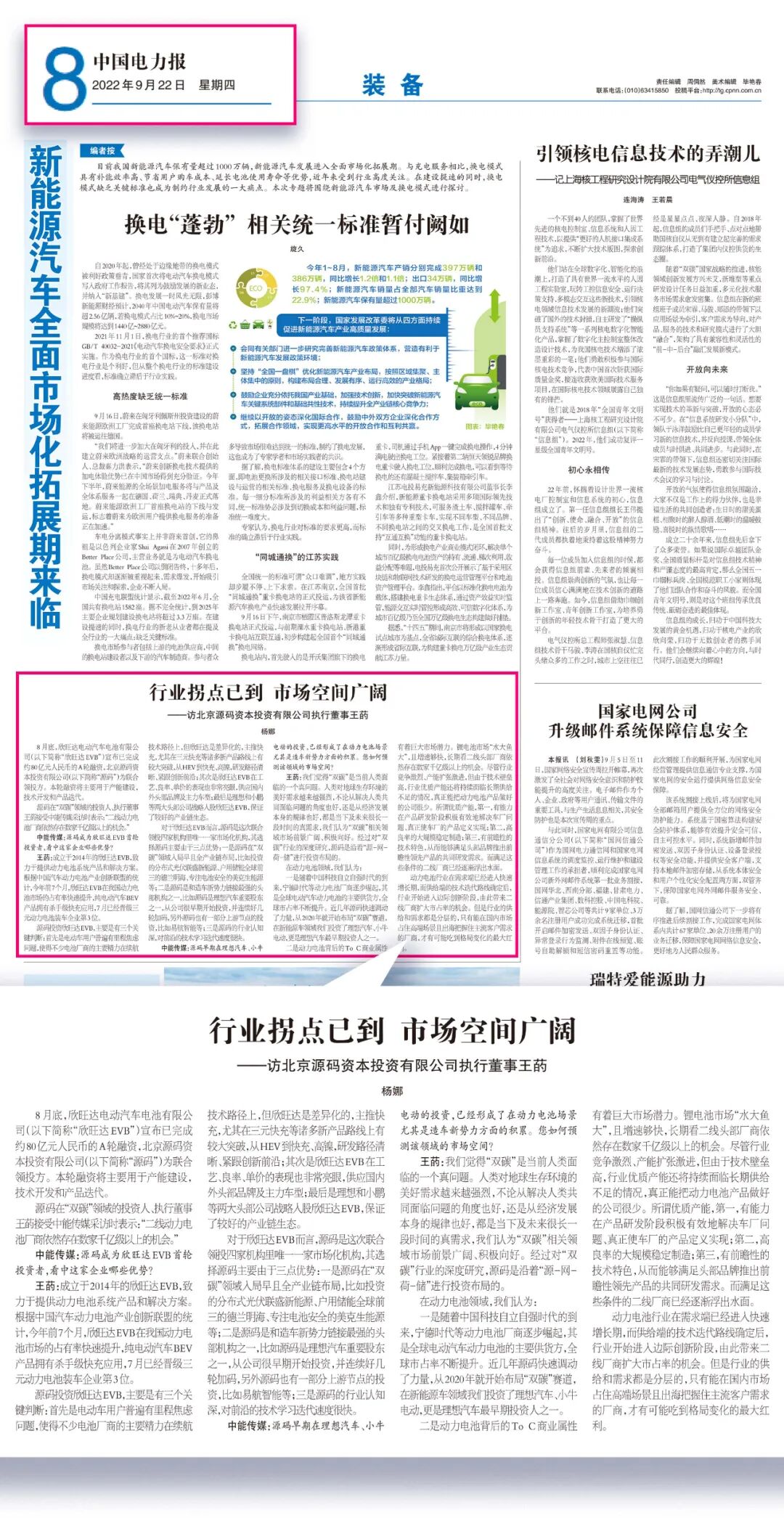
At the end of August, Sunwoda Electronic Battery Co., Ltd. (hereinafter referred to as "Sunwoda EVB") announced the completion of its Series A funding round of approximately RMB 8 billion, with Beijing Source Code Capital Investment Co., Ltd. (hereinafter referred to as "Source Code") serving as co-lead investor. The proceeds will be used primarily for capacity expansion, technology development, and product iteration. Di Wang, investor and executive director at Source Code covering the "dual carbon" sector, told China Energy Media: "There remain several opportunities worth over RMB 100 billion among second-tier power battery manufacturers."
China Energy Media: As a first-round investor in Sunwoda EVB, what advantages did Source Code see in this company?
Wang: Founded in 2014, Sunwoda EVB is dedicated to providing power battery system products and solutions. According to statistics from the China Automotive Power Battery Industry Innovation Alliance, Sunwoda EVB's market share in China's power battery market has risen rapidly in the first seven months of this year. Its BEV products feature a killer fast-charging application, and by July the company had advanced to third place among ternary power battery installation enterprises.
Source Code's investment in Sunwoda EVB rests on three key judgments. First, EV users commonly suffer from range anxiety, leading many battery manufacturers to focus their main efforts on range-extending technology paths. But Sunwoda is differentiated — it prioritizes fast charging, with significant breakthroughs in new product lines such as ternary fast charging. Its R&D path is clear, from HEV to fast charging and high-nickel, keeping pace with the innovation frontier. Second, Sunwoda EVB's performance in process, yield rate, and unit cost is also impressive, supplying leading domestic and international brands and their flagship models. Third, two leading companies, Li Auto and Xpeng Motors, have made strategic investments in Sunwoda EVB, ensuring a favorable industrial chain ecosystem.
For Sunwoda EVB, Source Code was the only market-based institution among the four co-lead investors in this round. Its choice of Source Code was based on three advantages: First, Source Code entered the "dual carbon" field early and has deployed across the entire industrial chain — for example, its investments in distributed solar company Unisun Energy Group, residential energy storage company Poweroak (ranked among the global top three), and battery safety specialist Maxwell Energy. Second, Source Code is one of the leading institutions with the strongest connections to new car-making forces — for instance, it is one of the important shareholders of Li Auto, having invested from the company's earliest stages and added to its position across several consecutive rounds. Source Code also has investments in certain upstream nodes, such as Ehang Intelligent. Third, Source Code possesses deep industry knowledge and learns and iterates on frontier technologies rapidly.
China Energy Media: Source Code's early investments in Li Auto and NIU have already built up expertise in power battery applications, especially among new car-making forces. How do you forecast the market opportunity in this sector?
Wang: We believe "dual carbon" is a genuine problem currently facing humanity. People's desire for a better living environment on Earth is growing stronger. Whether from the perspective of addressing problems common to humanity or from the laws of economic development itself, this is real demand for the present and for a considerable period into the future. We believe "dual carbon"-related fields have broad market prospects and positive momentum. Through in-depth research on the "dual carbon" industry, Source Code has made investment deployments along the "generation-grid-load-storage" framework.
In the power battery field, we believe:
First, as China enters an era of technological self-reliance and strength, power battery manufacturers such as CATL have gradually risen to become the main suppliers for global electric vehicle power batteries, with continuously increasing global market share. Source Code rapidly mobilized resources in recent years, beginning to lay out the "dual carbon" track from 2020. In the new energy vehicle field, we invested in Li Auto and NIU, and we were among Li Auto's earliest investors.
Second, the underlying consumer-facing commercial attributes of power batteries hold enormous market potential. The lithium battery market is "vast waters, big fish" — large in scale and growing fast enough. In the long term, several second-tier leading manufacturers still present opportunities worth over RMB 100 billion. Despite intense industry competition and aggressive capacity expansion, the high technological barriers mean that quality industry capacity will continue to face long-term supply shortages. There are very few companies that can truly make power battery products well. So-called quality capacity means, first, having the ability to actively and effectively solve automakers' problems during the product R&D phase, truly enabling automakers to realize their product definitions; second, high-yield-rate large-scale stable manufacturing; and third, forward-looking technical characteristics that can meet the co-development needs of leading brands launching forward-looking, leading products. Second-tier manufacturers meeting these conditions are gradually emerging.
The power battery industry has entered a rapid growth phase on the demand side. Once the technology iteration path is determined on the supply side, the industry begins to enter a stage of marginal innovation, creating opportunities for second-tier manufacturers to expand market share. However, both supply and demand in the industry are stratified. Only manufacturers that can secure a foothold in high-end domestic market segments and capture mainstream customer demand in overseas markets can capture the greatest benefits from structural shifts.


-
MaHui | Yungang Huang: How Does AI4S Land in Different Stages, Industries, and Markets?
-
MaHui | Yungang Huang: "Cross-Disciplinary Intersection" Drives Innovation in Healthcare
-
MaHui | Wu Fan: Opportunities and Advantages — China's New Energy in a New Cycle
-
MaHui | "Carbon Neutrality" Technology Innovation in Sustainable Development
-
MaHui | Di Wang: Focusing on Energy Cleanization and End-Use Electrification
-
MaHui | Chang Kaisi: Technological Change Reshapes Moats, Tech Entrepreneurship Breaks Boundaries
-
MaHui | Xingchen Zhang: Technology-Driven Innovation from Zero to One
For more MaHui members, click "Read Original" to view