DeepCode|The Lego Way

DeepCode | The Lego Way

In an era of paradigm meltdown and reconstruction, the center of gravity in business has shifted from efficiency-first to resilience-first. Companies that have withstood the test of time are no longer mere economic units — they are the "anchor stones" of civilizational ecosystems: they reshape industry value paradigms (Toyota spent fifty years honing its lean production system), build ladders for civilizational evolution (Android's open-source system spawned an ecosystem of millions of developers), and pour humanistic warmth atop commercial rationality (Starbucks' "third place"). These enterprises create economic value while continuously delivering "growable values" to society.
As practitioners of long-term value investing, Source Code Capital has always believed that the true power of great companies lies not only in the sharpness that cuts through eras, but in the weight that carries across cycles.
This year, Source Code Capital launches the 「DeepCode」 column, focusing on studying "good companies" that have crossed cycles and decoding the source code of their endurance: not any single perfect decision, but principles rooted deep in corporate DNA; not fleeting tactical success, but systematic thinking that withstands the test of time — when surface appearances change, what underlying logic remains constant? Through a WHY-WHAT-HOW three-dimensional lens, we will share our incremental understanding of these companies, seeking out the critical and concrete changes in their development journeys, to offer some reference and inspiration for Chinese entrepreneurs and strivers.
We look forward to exploring the business wisdom of "great skill appears clumsy" with entrepreneurs, searching for the long-term coordinates of commercial civilization. This inaugural installment focuses on LEGO.
LEGO — a family business born over 92 years ago, destroyed by fire multiple times, having weathered one world war and repeated global economic and financial crises; a witness and victor at the twilight of the industrial age, amid the rise of the information wave and consumerist diversification — its commercial development history is not merely about innovation and persistence, but about how to maintain organizational resilience and strategic resolve in an uncertain business environment.
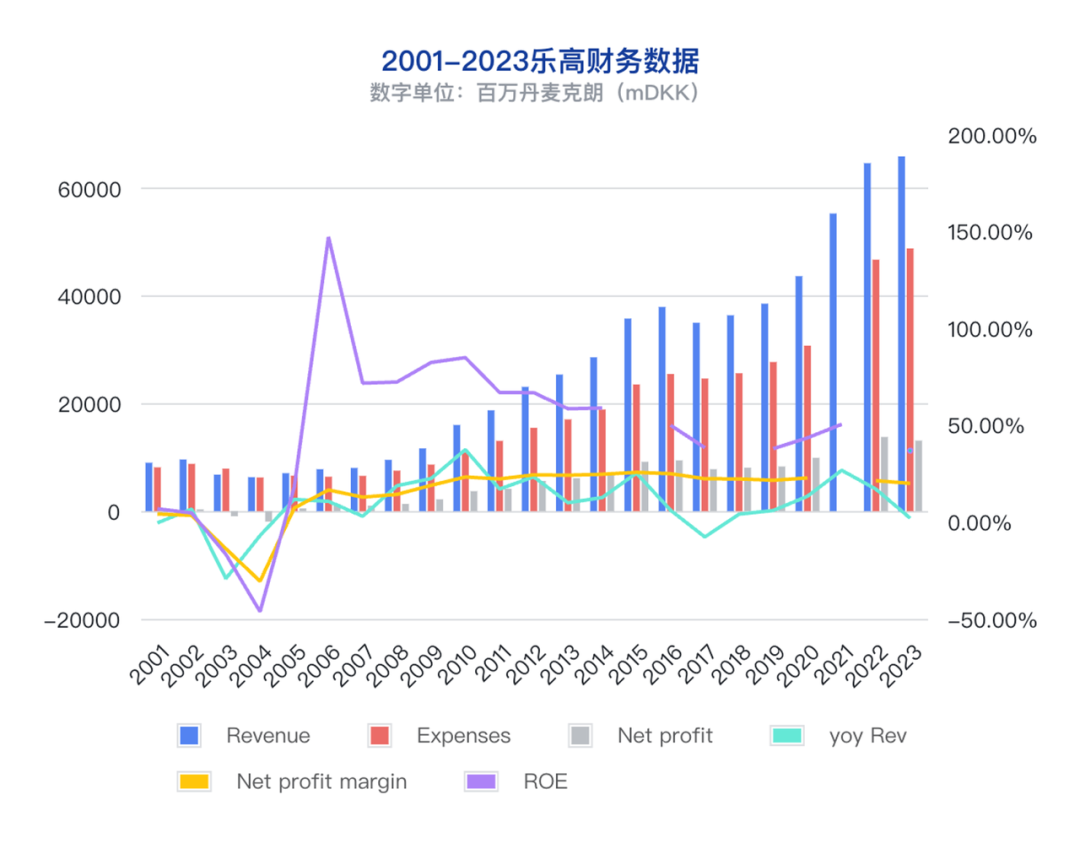
Data from LEGO annual reports. LEGO's financial disclosure standards underwent multiple adjustments; this chart applies the 2005 accounting standard for 2001–2005, the 2007 standard for 2006–2013, and the 2014 standard for 2014–2023. Chart by Source Code Capital.
The financial abyss of overexpansion, a product matrix blurred by innovation drift, organizational vitality eroded by big-company disease... Standing atop the world's largest toy empire and looking back, we will dissect LEGO's transformational choices across nearly a century, closely observe the most dramatic crises and turns in its history, explore how it rose from the ashes through multiple crises, how it redefined itself amid constantly shifting consumer environments, and how it embraced epochal change while preserving core values.
What truly accompanies you into the future is courage, sincere attitude and execution, and the fighting spirit to restart from where you stand. In LEGO's story, they are all present.
Crisis Moment: The Digital Torrent Breaches the Brick Empire
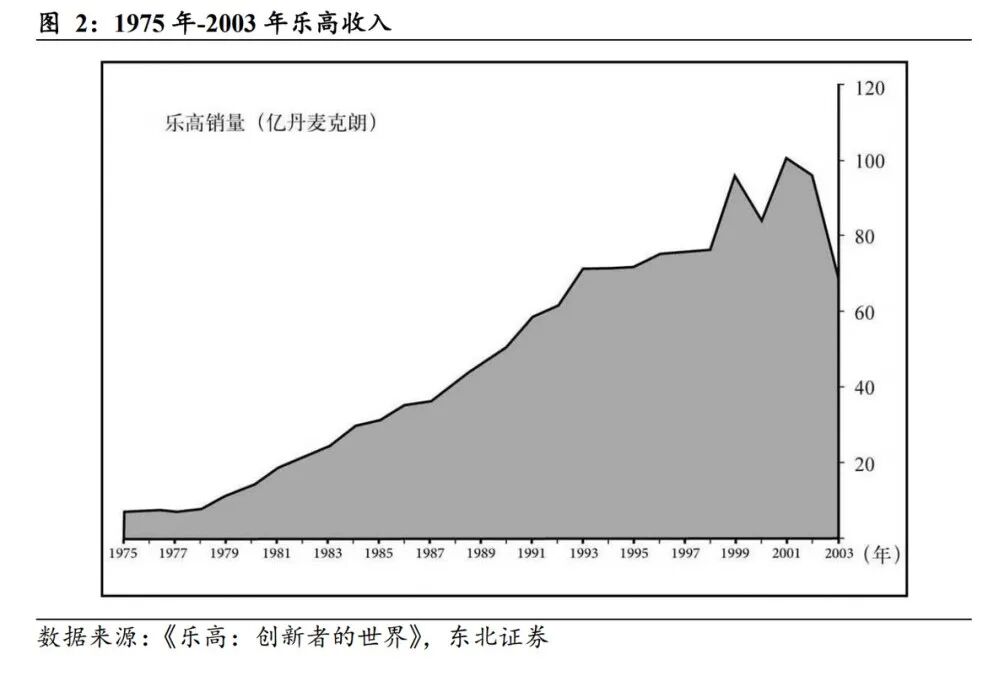
In 1994, the LEGO Empire appeared from the outside to stand at the pinnacle of construction toys: it commanded 80% of the North American market for building toys, and the dissolution of the Iron Curtain had sent its products flooding into households across Eastern Europe and the former Soviet Union. At this point, LEGO was not only the absolute hegemon of European toy manufacturing, but with annual revenue approaching $1 billion, it wielded the global toy industry's scepter alongside century-old establishments like Mattel and Hasbro.
Yet at headquarters in Copenhagen, third-generation leader Kjeld Kirk Kristiansen stared at the financial reports — sales growth had fallen below the double digits maintained for 50 years.
The crisis lay beyond sight, as the "digital torrent" came rolling in.
At the turn of the century, the way children played — and particularly what they played with — underwent a paradigm shift.
Reports showed that among North American children aged 8–14, spending on video games surged from 18% to 35% during the 1990s; during the traditional toy sales peak of Christmas, "PlayStation" replaced "LEGO sets" on gift wish lists; more fatally, an intergenerational cultural rupture occurred, as traditional toy makers collectively fell into panic over the "static entertainment apocalypse."
Superstars of the entertainment industry also joined the competition. Classic toys like LEGO bricks, Mattel's Barbie dolls, and Hasbro board games faced not only fierce assaults from Sega and Nintendo's electronic games, but also had to compete with entertainment giants like The Walt Disney Company, Warner Bros., and Apple for children's limited attention. These new entertainment forms, with their richer sensory stimulation, undermined the foundations of traditional toys.
Traditional toy companies worldwide found themselves in an unfair contest against the gaming and film industries. The latter two occupied most of Western children's free time. In just two generations, the duration of children's toy play had shortened by four years; researchers noted that children of the 1990s stopped playing traditional children's games by age ten, entertainment product boundaries began to blur, and the lines between children, teenagers, and young adults dissolved.
Facing multiple shocks, LEGO began to doubt: was holding fast to single-category bricks still the optimal product? Experts and consultants both inside and outside LEGO concluded that "LEGO bricks will eventually die; the 21st century no longer belongs to little plastic blocks, the digital world will replace them."
LEGO promptly launched a series of reactive, stress-driven rescue responses
Bringing in external professional managers
- Paul Plougmann was brought in as CEO; this "corporate doctor" had previously turned around the fate of audio-visual company Bang & Olufsen. Plougmann simultaneously closed factories, laid off employees, pushed production outsourcing, and deepened diversification strategy;
- Jesper Ovesen was brought in as CFO, previously chief financial officer at Novo Nordisk and Danske Bank;
- Jørgen Vig Knudstorp, a 34-year-old former McKinsey consultant, was promoted to design LEGO's transformation strategy.
Product line overload and expansion
- From 1994 to 1998, LEGO launched an average of 5 new themed toy series annually, with SKU count more than tripling. In 1998 alone, the company released 347 new products;
- It introduced the Belville girl series, Wild West themes, and other "non-brick" products, intending to compete with Barbie dolls;
- All products required new molds and new production lines, for which LEGO kept追加投资;
- The 1998 collaboration with Lucasfilm on the Star Wars IP initiated a "bricks + film/TV" cross-border dependency syndrome.
Brand asset透支式变现
- LEGO began rapidly monetizing brand assets, massively涉足 non-core areas. Game development (LEGO Island), theme parks (California Legoland), and derivatives (children's clothing/watches) were rolled out comprehensively;
- Non-core businesses accounted for 40% of profits, yet IP licensing fees consumed 25% of revenue.
The "reverse and reverse again" result of fast and slow
In the short term, these measures showed striking results: in 1999, company revenue surged 68%, with Star Wars and Harry Potter IP product lines selling strongly, helping LEGO achieve rapid "blood recovery."
However, long-term隐患 were accumulating. In 1998, LEGO posted its first loss since founding; 1999 profits were considerable, followed by decent profits in 2000 and 2001, then major losses in 2002, and record losses again in 2003. In 2004, third-generation leader Kjeld had to personally hold a press conference to explain what had happened to LEGO:
- Core and extension businesses lacked synergy: new businesses disconnected from the brick core product, brand image blurred
- Excessive dependence on external IP: Star Wars series sales were highly dependent on movie release cycles, plunging sharply during film off-seasons
- Cross-border risks amplified: the 2002 "Galidor" series cost $16 million in investment but quickly retreated
- Financial pressure intensified: theme parks brought $800 million in high debt, LEGO inventory turnover days soared to 126 days, 2003 revenue fell 34% year-over-year, and every $1 of product sold required $1.30 in costs
LEGO's mounting debt crisis reached the point of requiring a company sale. Even Kjeld began to lose direction. In 2004, LEGO's report used the word "survive"; the LEGO Group needed fundamental reconstruction. LEGO management,痛定思痛 with backs against the wall, finally recognized: LEGO's most powerful foundation remained the brick, and true value lay in providing the "building experience."
To focus on core brick business, LEGO shut down 14 divisions including LEGO educational software, children's clothing, and theme parks; compressed 12-level approval processes to 3 levels, establishing cross-departmental collaboration; reduced logistics centers from 14 to 5, and cut part varieties from 14,000 to 7,000; LEGO also decided to sell Legoland — the park dream that had寄托了几代人. LEGO, returning to its bricks, quickly recovered its vitality; by 2006, company profit margins returned to double digits.
Organization and management scholar David Robertson summarized in Brick by Brick: How LEGO Rewrote the Rules of Innovation and Conquered the Global Toy Industry: "LEGO ultimately discovered that their core competitiveness wasn't the bricks themselves, but making users believe that 6 bricks could create 900 million possibilities... When LEGO returned to its roots, they found plenty of money there, and fans were waiting for them."
Nobel Economics laureate Daniel Kahneman proposed the "fast thinking and slow thinking" theoretical framework: LEGO's crisis response exemplified a typical stress reaction mechanism, relying on intuition for rapid action, skilled at quick止血 but prone to falling into the "action trap" — the illusion that "doing something is always better than doing nothing" — this is fast thinking at work. Only later, through deep复盘, did LEGO recognize that "only bricks can carry the brand soul," and rebuild its core moat.
Notably, LEGO's diversification困境 was not an isolated case. Competitors of the same period made similar attempts:
- Mattel opened "Mattel Children's World" theme parks and content production businesses in the 1990s, both of which were adjusted due to high investment and low returns
- Hasbro tried WIZARDS OF THE COAST game centers and children's education businesses, similarly failing to achieve scale effects
But this is insufficient to explain LEGO's entire recovery process.
Crisis Point: Patents as Both Moat and Achilles' Heel
In 1988, LEGO's brick patent expired in every country. For decades, this patent had protected the company's iconic stud-and-tube coupling system, ensuring absolute dominance in the construction toy market. After more than 20 years of double-digit growth, the empire's core defensive line suddenly collapsed.
In 1953, Godtfred, the second-generation leader who was gradually taking charge of the company, spotted the potential of colorful self-locking plastic bricks among the company's 265 products. Within a few years, he developed the standardized stud-and-tube structure — two rows of four studs on top, three tubes underneath — and the modern LEGO brick as we know it was born.
This patent revolutionized plastic construction toys, increasing clutch power from less than 2 Newtons to 12.8 Newtons. Different shapes could now lock together firmly, achieving the structural miracle of "lifting a ten-story building with one hand without it falling apart." This opened entirely new possibilities for combining and building with LEGO bricks. From that point on, LEGO bricks combined differently from any other plastic bricks in the world. The patent also built LEGO's technical moat — when a single 2×4 base module offers 900 million combination possibilities, the toy has transcended into a creative operating system.
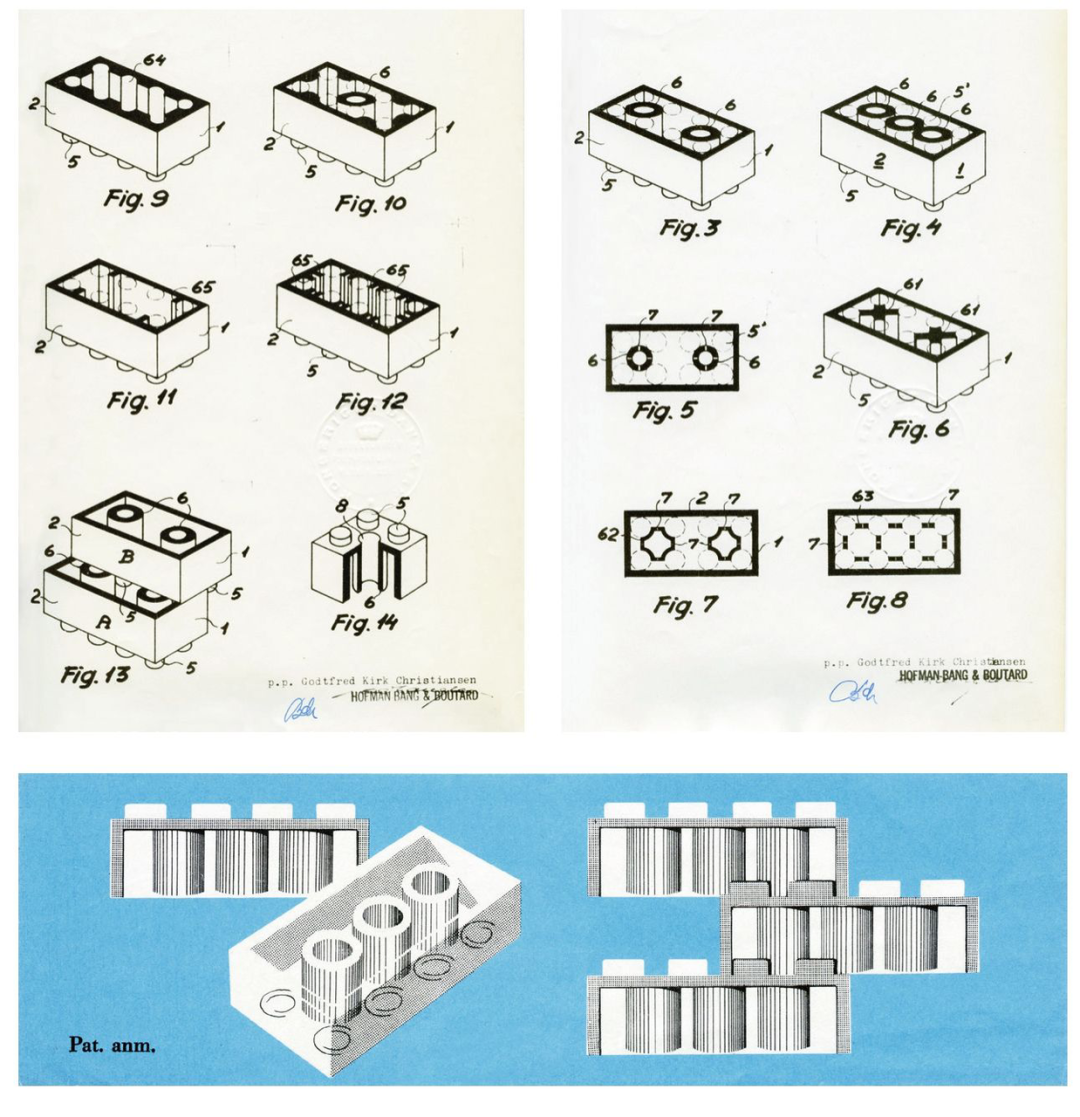
In 1958, the modern LEGO brick was patented, characterized by its many tubes and studs. This allowed bricks to connect perfectly with each other, expanding the possibilities for what could be built. As other diagrams show, LEGO also developed several alternative solutions to improve brick coupling strength. All alternative solutions were patented in many countries worldwide. Image from The LEGO Story by Jens Andersen [Denmark]
After patent expiration, LEGO attempted to extend protection through litigation. But a string of defeats threw the market gates wide open. Mattel and other major toy companies quickly launched knockoffs priced 20-30% lower. A flood of cheap brick manufacturers emerged, even exporting back to the streets of Denmark.
Copycats attacked the market directly with "compatible with LEGO bricks" claims, launching theme scenes similar to LEGO's own. Construction toy values steadily depreciated. Once unrivaled, LEGO now faced enormous homogenization pressure. Growth momentum visibly slowed; the pricing system took a severe hit.
LEGO needed to find new differentiation advantages
Responding to Patent Expiration
The first thing LEGO did was obsess over product quality. Kjeld told reporters: "Our products are simply the best, and we deliver on that promise. So we'll beat them in the marketplace, not the courtroom."
LEGO produces over 7,000 different brick shapes and colors annually, with extraordinarily high quality standards. Plastic toys touch children's skin directly, so the company dedicated a single manufacturer exclusively to producing LEGO materials. LEGO plastic granules must withstand 250°C temperatures and 120 tons of pressure just to complete basic processing. Every brick achieves inhuman levels of precision — not only must it fit perfectly within its own toy set, but it must also interlock with every brick produced since 1958. Molds are disassembled every three weeks for maintenance, with each component inspected.
Ultimately, LEGO won the war of attrition. Its unwavering commitment to quality, its heavily invested systematic management, and its refined high-precision supply chain produced the best toys — and won back consumers' hearts.
Beyond this, LEGO drew on the innovative courage it had shown when facing fires earlier in its history, formulating a global expansion strategy:
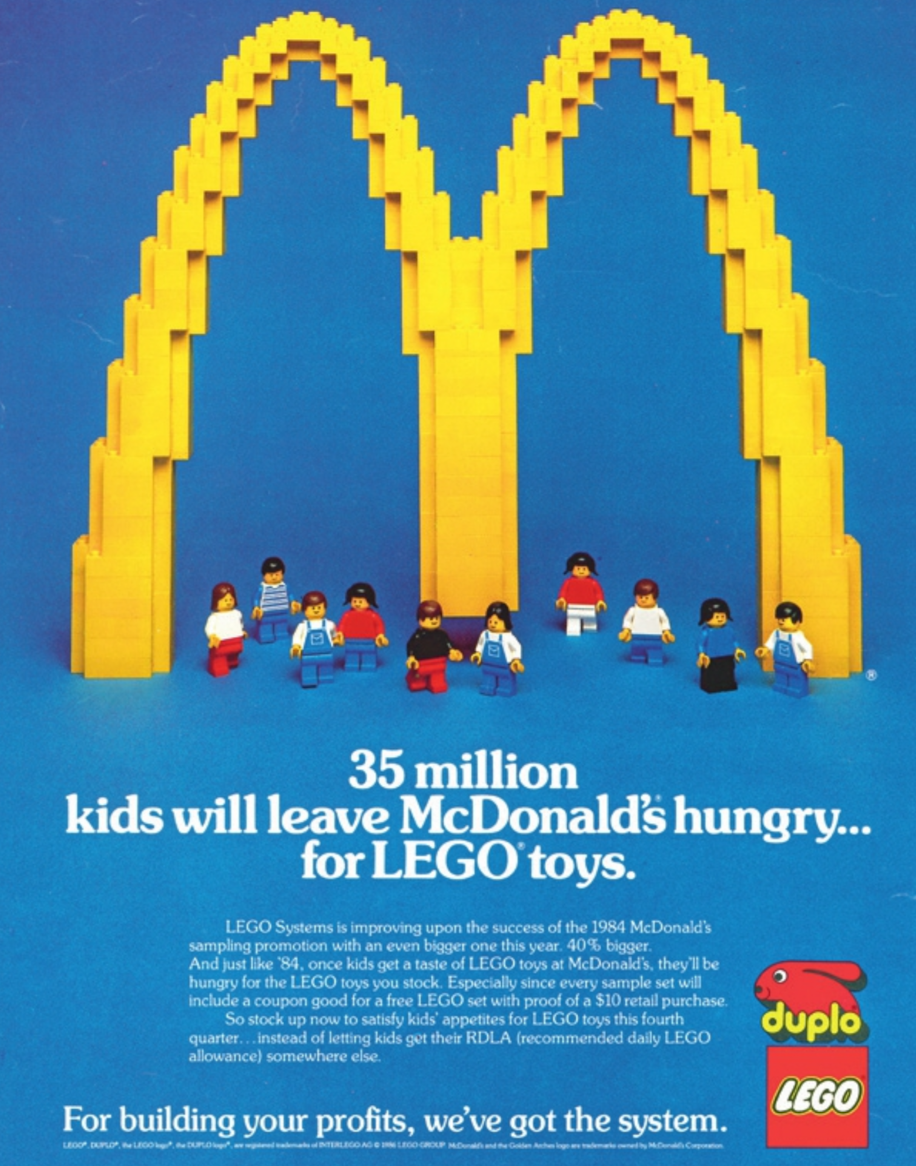
In spring 1981, the world's largest restaurant chain, McDonald's, opened its first location in Denmark. LEGO included its bricks as toys in McDonald's Happy Meals. McDonald's core customers were families with children — perfectly aligned with LEGO's goal of becoming a family entertainment hub. Six thousand five hundred McDonald's restaurants across the United States and Canada became where millions of North American families first encountered this new type of colorful construction toy.
These families became LEGO's best ambassadors. This entirely new marketing model gave LEGO a shortcut into the lucrative American market. In the 1980s, LEGO produced nearly 100 million bags of bricks for McDonald's. Subsequently, LEGO partnered sequentially with Kellogg's cereals, Colgate toothpaste, and Pampers diapers — using these brands to enter households worldwide.
Especially after the Cold War ended, in winter 1989, LEGO orchestrated a global "Tear Down the Berlin Wall" marketing campaign that won enormous acclaim. Groups of varied LEGO minifigures leaped high, vaulting over a Berlin Wall built from bricks. More minifigures on the wall swung hammers at this hated barrier. In the background, the Brandenburg Gate was recognizable, and from afar, the Doric-column-supported gate prominently displayed the words "The Best Christmas Present." All built from LEGO bricks.
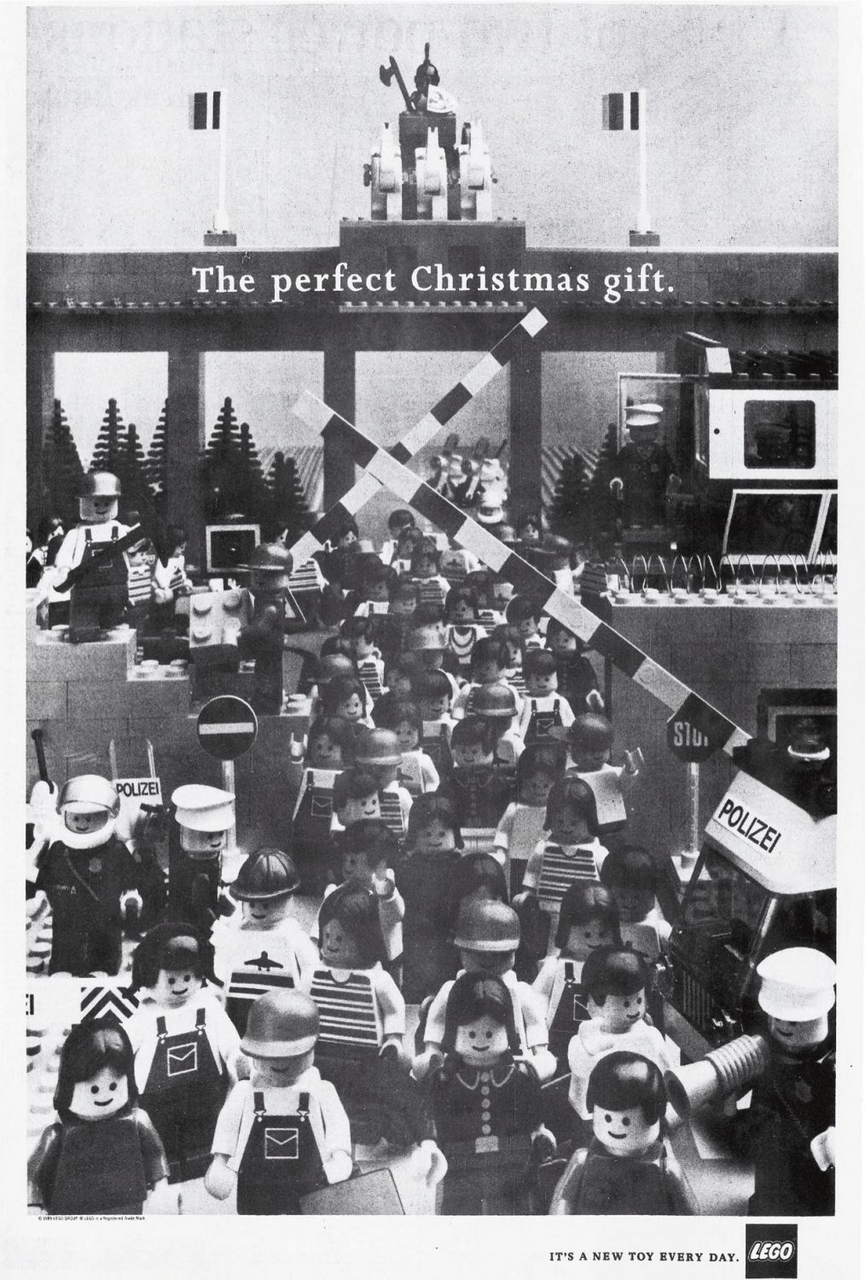
Sunday, November 12, 1989 — LEGO advertisement in The Sunday Telegraph
In the years that followed, borders across Eastern Europe opened one after another. LEGO sales surged dramatically after the Iron Curtain lifted.
By this point, LEGO's standardized modules had reduced SKU count by 80% and boosted production efficiency by 400%. Theme sets (farm/city) extended average playtime from 17 minutes to 2.3 hours. The North American market became LEGO's largest overseas market, accounting for 40% of total sales.
From Individual Product to System
During this period, LEGO completed its transformation from single bricks to a complete "LEGO system," establishing a three-tier product architecture of basic bricks, theme sets, and licensed IP products. Consumers were willing to pay premium prices for LEGO's unique creative experience and quality reliability. Through thematic series and differentiated product experiences, LEGO rebuilt its brand premium capability. This systematic thinking allowed LEGO to maintain product system integrity and uniqueness even after patent protection expired.
True innovators always see stars in the ruins.
Crisis Point: Creative Bloat Causes Blindness
From 2002 to 2007, LEGO adjusted its financial data compilation methodology four times.
Using the 2007 methodology as the final standard, LEGO's business experienced sharp decline in 2003 and 2004. In 2003, revenue fell from 9.6 billion Danish kroner ($1.46 billion) to 6.8 billion ($1 billion), a 30% year-over-year drop, with losses exceeding 900 million ($140 million). But 2004 was worse — revenue continued falling, and losses hit a record 1.9 billion Danish kroner ($290 million). That year, LEGO Group's ROE plummeted to -46.3%.
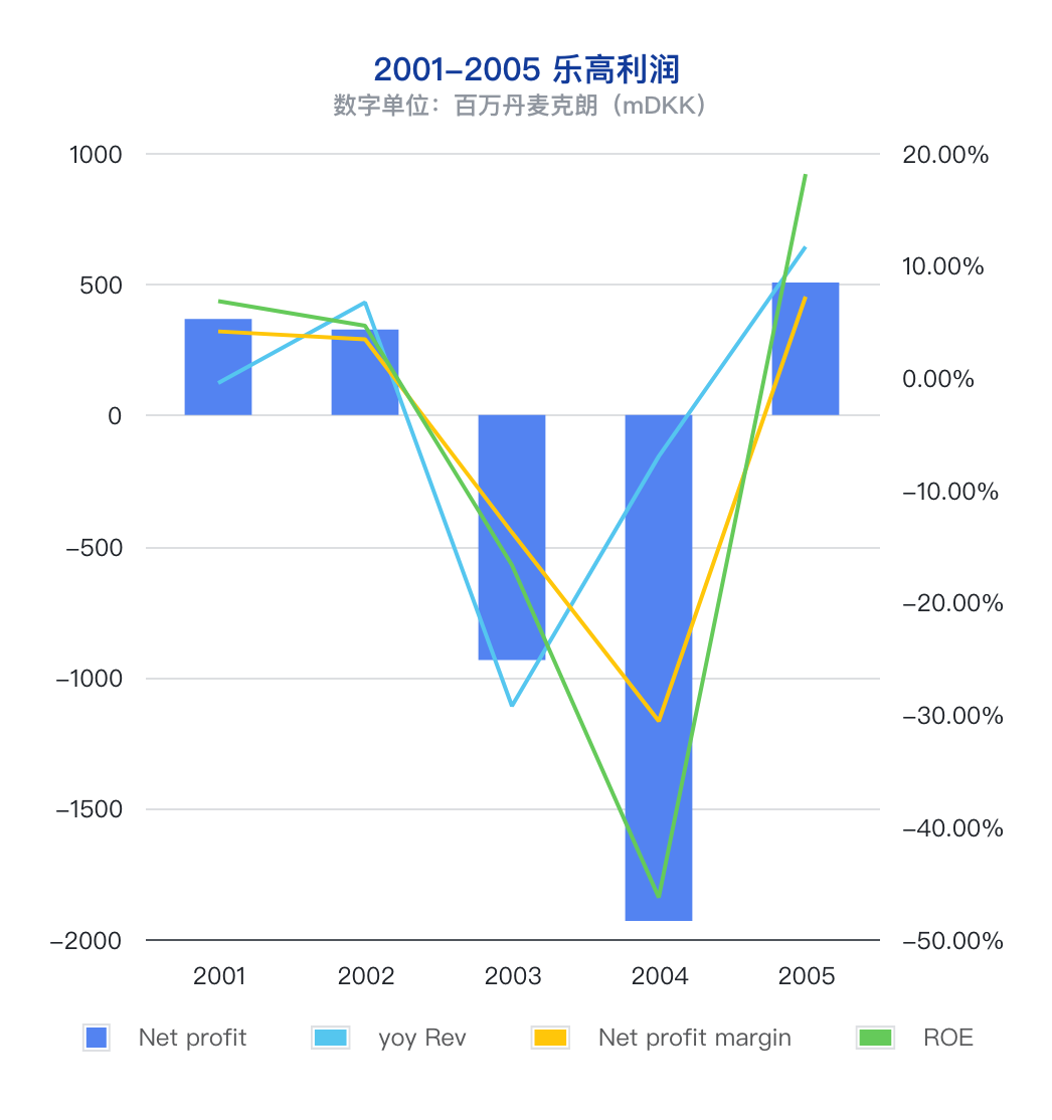
Data based on 2005 LEGO annual report accounting standards. Chart by Source Code Capital
During the 1990s expansion wave, LEGO's basic components had ballooned to nearly 14,000 — more than double the original count. Many new components developed for standalone scenes couldn't integrate into the existing product system, failed to trigger consumer purchase desire, and became pure R&D showing-off. Design waste was enormous, inventory management chaotic, R&D costs uncontrolled. And the series of "de-brickification" diversification innovations had actually blurred the LEGO brand.
What is LEGO? What is it not?
What is LEGO? What does LEGO want to achieve? What value does LEGO want to provide society? What would society lose without LEGO? LEGO needed to answer these questions.
Jørgen Vig Knudstorp, the young CEO who took office in 2004, led LEGO to rethink the company's core values. He proposed "innovation through constraint" as the reform direction, and placed "user-centricity" at the core of the revival plan.
In post-mortems, Knudstorp posed a counter-question to the design department: If six bricks can already build dozens of duck variations, satisfying players' exploratory urges, was expanding basic components beyond 10,000 truly necessary? "It is precisely because of limitations that creativity is born. Innovation emerges from constraints." This represented the reform direction.
The reforms triggered intense dissatisfaction. Designers had been the great heroes of LEGO's past success; the company had built high trust with them. Designers held absolute authority from product concept to market, with virtually no cost or time constraints. Now everything changed.
Knudstorp hung a "Children's Research Laboratory" sign at Copenhagen headquarters, assembling a cross-disciplinary observation team: anthropologists recorded children's emotional experiences during play; psychologists analyzed the cognitive pathways of brick combination.
What interests children cannot be guessed. Knudstorp made designers reconnect with their customers, using children's suggestions as product development references. This organization fundamentally changed previous methods. In short: "Observe, don't research."
— "What kind of lives do children lead each day? What do they eat? How do they live? We must closely observe their daily lives to deepen our understanding of them." This honest attitude toward users stopped LEGO teams from assuming they knew better than their customers. Instead, they started from children's real lives and thoughts, rekindling creativity.
The same approach was extended to the adult market. When Knudstorp and Kjeld made surprise appearances at an American fan convention, the AFOL (Adult Fans of LEGO) community was recreating iconic Empire Strikes Back scenes using Star Wars sets. Architect Adam Tucker's model of Chicago's John Hancock Center, built entirely from standard pieces, directly spawned the "LEGO Architecture" series — priced at a 2.5x premium — and opened sales channels in art galleries and museums for LEGO.
By this point, LEGO had formed a double-helix user system: children's needs drove foundational innovation, while adult creativity expanded the boundaries of value.
User insight reconstructed LEGO's commercial DNA
After grueling adjustments, LEGO Group's net profit margin rebounded to 16.5% in 2006 — its best performance since 1993. From then on, LEGO's global revenue returned to stable growth, entering an ideal state of "high revenue + high profit margins."
The collaborative model that connected multiple products, departments, and phases was distilled into the "LEGO Product Development Matrix," which was further expanded and applied. Innovation targets were no longer limited to products but extended to planning, organization, marketing, and revenue-sharing models. Incremental innovation and accumulating success stories mattered equally — true creativity could emerge within constraints.
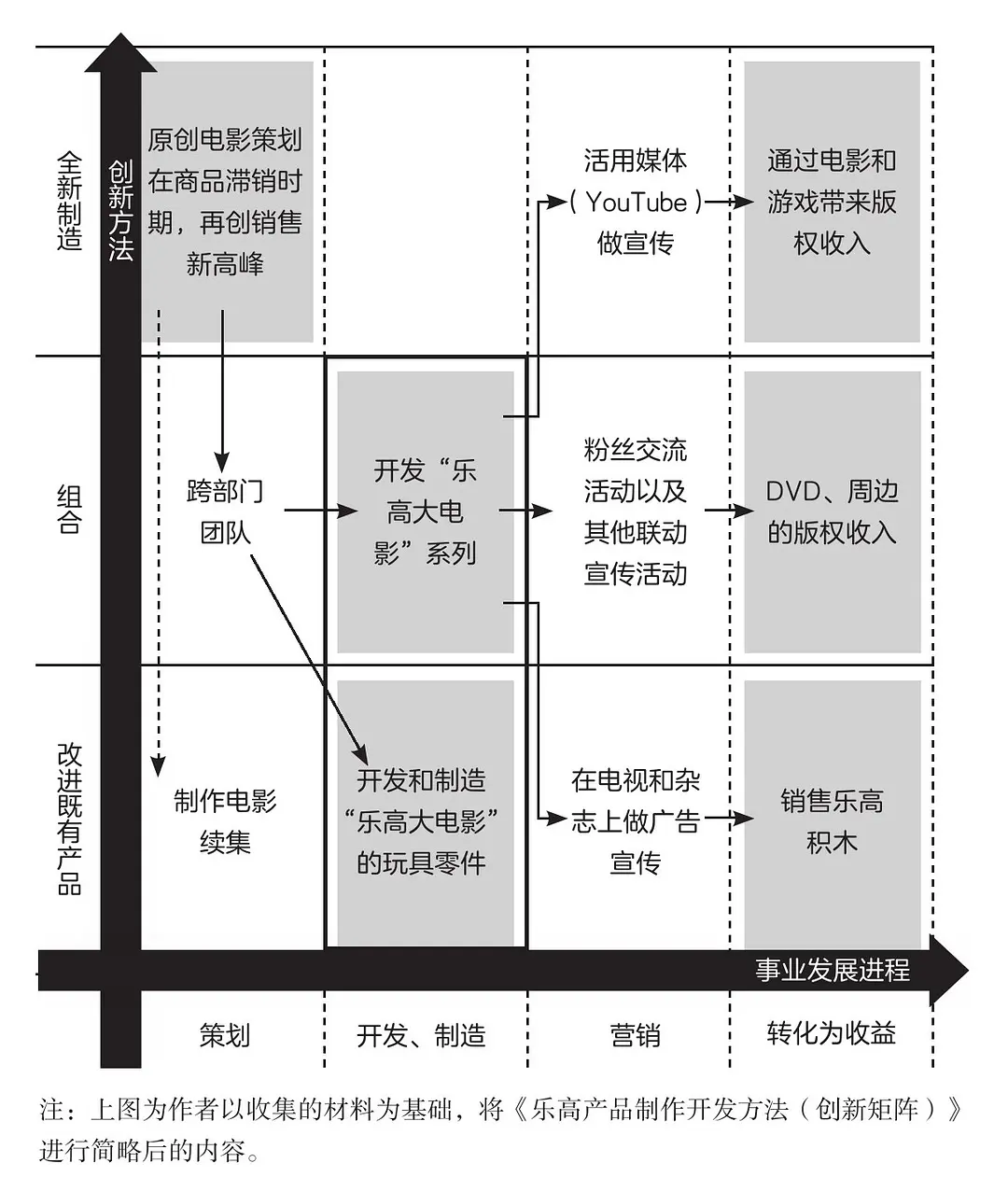
Based on this matrix, LEGO developed the "Bionicle" series, which became one of the most successful product lines in LEGO history. In the case library of the Wharton School at the University of Pennsylvania, this series is regarded as a classic example of user-driven collaborative innovation:
- Content innovation: Emphasis on product themes and compelling storylines
- Diverse marketing: Promotion of original stories through web comics, novels, and other media
- Technical breakthroughs: Introduction of innovative gear joints and ball joints
- Market positioning: Precise targeting of the mainstream American action figure market
- User participation: Integration of genuine children's feedback into product evaluation
- Accelerated R&D: Reduction of product development cycle from two years to six months
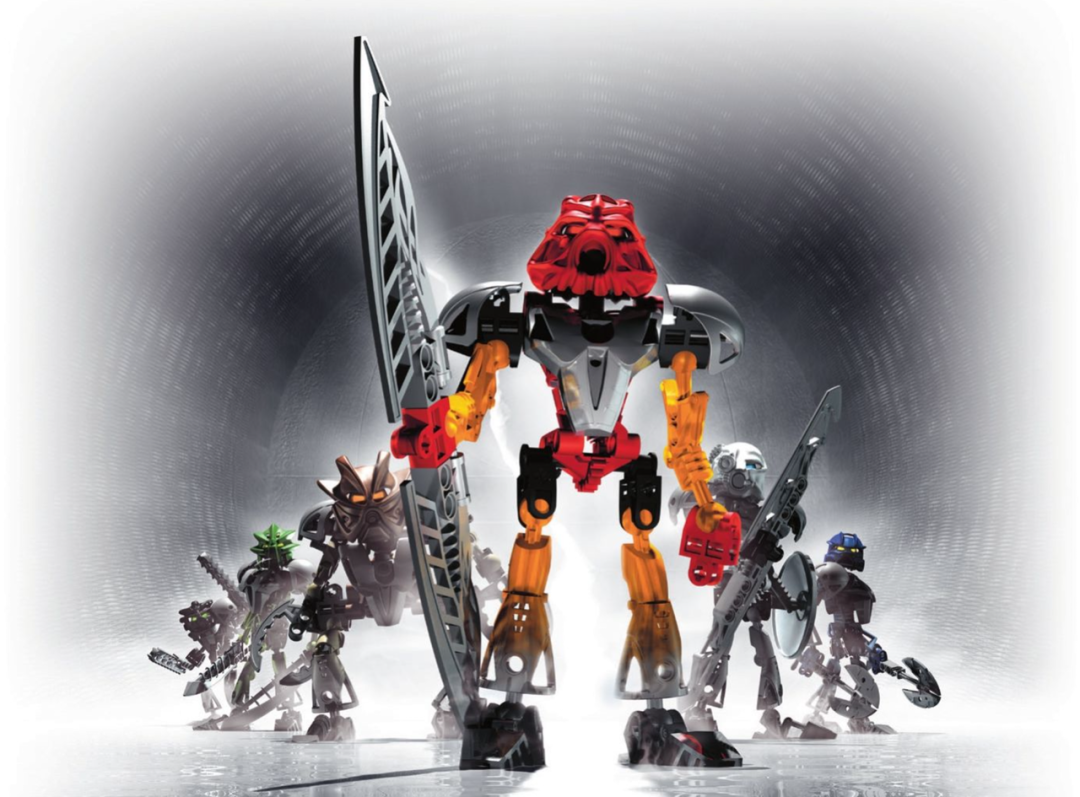
The emergence of LEGO Bionicle meant that LEGO had stepped into the world of action figures in the early 21st century. It was a "biological chronicle" blending technology and mythology. On the fantasy island of Mata Nui created by LEGO, heroes and villains were everywhere, and their stories could be told through LEGO bricks as well as LEGO comics, books, movies, and online games. In this image, you can see Tahu Nuva's magma sword, which can transform into a surfboard. Image from The LEGO Story.
However, this innovation matrix had its drawbacks. Namely, the process was premised on developing products that could achieve a certain sales volume.
But overall, by extending the innovation matrix across products, planning, organization, marketing, and revenue-sharing models, LEGO was no longer just a toy brand. It had formed a complete, sustainable business ecosystem, redefining its value and position in the digital age — a truly user-centric global cultural phenomenon that unleashes infinite creativity within constraints.
Moment of Crisis: Big Company Disease
Business scholar James Collins, in How the Mighty Fall, describes five stages of corporate decline: arrogance born of success, undisciplined pursuit of more, denial of risk and peril, grasping for salvation, and finally capitulation to irrelevance or death. At the turn of the 21st century, LEGO went through almost all of the first four stages in near-complete fashion, teetering on the brink.
With global expansion, LEGO ballooned from a "small but beautiful" family business into a massive multinational conglomerate. Employee numbers surged from 3,000 in 1980 to 8,000 in 2003. Large numbers of new hires struggled to assimilate into the original "LEGO spirit"; many joined simply because LEGO was Denmark's "national enterprise," adopting a "don't seek merit, just avoid blame" mentality. Decision-makers reacted sluggishly to market changes, refusing to acknowledge strategic errors. Excessive diversification once fostered a "de-brickification" trend.
At Danish headquarters, numerous positions were "coordinators" who merely relayed information without decision-making authority; global subsidiaries operated independently without unified coordination; product development cycles stretched from six months to 24 months, requiring approval from 12 departments; in 1998, five incompatible robotics kits were developed simultaneously, severely wasting resources; parts mold costs accounted for 40% of total costs while gross margins fell below 10%; global logistics centers expanded chaotically from four to 14, yet inventory turnover actually dropped by 30%...
Third-generation heir Kjeld attempted to push "modernization" through professional managers, but fell into the trap of "growth for growth's sake." LEGO stopped asking "why we started" and began chasing short-term market share, even launching children's clothing unrelated to bricks. Founder Ole Kirk Christiansen's quality commitment of "Only the best is good enough" and the enterprise spirit were severely diluted.
During the expansion period, LEGO's founding spirit of persistent pursuit of quality and innovation gradually faded, replaced by bureaucracy and conservative inertia.
Founder Mode Organizational Reconstruction
What ultimately resolved all this, beyond Knudstorp's sweeping organizational restructuring described earlier, was the reconstruction of LEGO's corporate culture — a return to Founder Mode. As Airbnb founder Brian Chesky said about the problem with "Manager Mode": the more I let go, the more problems arose, and the longer it took to solve them.
Professional managers excel at "stopping losses," but struggle to define "what we're fighting for." When LEGO cut redundant businesses, professional managers focused on financial statements, while founders focused on "which businesses are connected to our soul." For a company, you can't directly manage a 2,000-person company the same way you manage 20 people, but during critical reform periods, only founders on the front lines can maintain authentic dialogue with employees, users, and markets — focusing on the future rather than short-term profits, and bearing risks for themselves rather than for others.
Kjeld ultimately realized that only founders can serve as the "anchor" of corporate culture — when LEGO faced sale risks, extreme financial distress, and the need for layoffs and organizational change, it was Kjeld who personally explained to the world and to employees "why change was necessary."
LEGO ultimately succeeded in avoiding the "fifth stage" fate Collins described. In 2006, LEGO Group achieved its best performance since 1993, with net profit margin rebounding to 16.5%. After this, LEGO entered the ideal state of "high revenue + high profit margins," creating a rare V-shaped turnaround in business history. In 2012, LEGO surpassed Hasbro to become the world's second-largest toy manufacturer; in 2014, it reached the top of the industry.
More importantly, this reform re-established LEGO's corporate DNA and cultural foundation:
- Manageable complexity: Organizational flattening, shortened decision chains, product development cycles restored to reasonable levels
- Return to core competencies: Focus on the brick business, abandoning unrelated diversification
- Values-driven leadership: The founder's "Only the best is good enough" quality commitment once again became the core of corporate culture
- Balance of innovation and constraints: Stimulating creativity within clear rule frameworks, not chaotic innovation
This transformation became a classic case studied by the global business community, proving that even century-old enterprises facing crisis can find renewed vitality by returning to Founder Mode, rethinking the original intention of "why we started," and using culture-based consensus as soft management — more powerful than any management system.
LEGO, famous for its plastic bricks, was burned down four times before transforming into a toy manufacturer monomaniacally devoted to plastic bricks. The Kristiansen family rebuilt the business from ashes four times.
When society still considered toys trivial trinkets, founder Ole Kirk Kristiansen already saw the sharp decline in furniture demand during wartime and the toy market stimulated by parents' desire to protect their children. While peers debated whether "plastic toys were low-end," Ole bet 50% of the company's annual profits (roughly 300,000 Danish kroner at the time, approximately equivalent to $60,000 at wartime exchange rates) on British injection molding machines, completing LEGO's product standardization and scaling. While toy manufacturers exhausted themselves launching new products every quarter, LEGO had already gone all-in on brick production, eliminating the need for repeated mold-making. It was this repeated courage and determination in the face of crisis that built today's LEGO.
In LEGO's most recently published annual report, LEGO wrote that "our brand has never resonated more deeply." In 2023, LEGO revenue reached a record 65 billion Danish kroner (approximately $9 billion), with net profit exceeding 13 billion (approximately $1.9 billion). Growth has slowed, but we don't seem particularly worried. In uncertain times, the code for crossing cycles lies within the enterprise itself.
References: [1] The LEGO Story [M]. By Jens Andersen. Translated by Zehui Li.
[2] The LEGO Story: Rising from the Ashes of Crisis [M]. By Toshio Ebisuya. Translated by Wenhuai Zhang.
[3] Brick by Brick: How LEGO Rewrote the Rules of Innovation and Conquered the Global Toy Industry [M]. By David Robertson and Bill Breen. Translated by Qinhua Tian.
[4] Thinking, Fast and Slow [M]. By Daniel Kahneman. Translated by Aimin Li, Mengying He, and Xiaojiao Hu.
[5] How the Mighty Fall: And Why Some Companies Never Give In [M]. Collins J.
[6] "How the LEGO Group Built Culture Change From the Ground Up" [J/OL]. MIT Sloan Management Review, https://sloanreview.mit.edu/article/how-the-lego-group-built-culture-change-from-the-ground-up/
[7] "How LEGO Broke Through Mental Constraints to Innovate Within the Brick" [J/OL]. Forbes, https://www.forbes.com/sites/knowledgewharton/2013/08/26/132013/.
[8] "At LEGO, Growth and Culture Are Not Kid Stuff" [J/OL]. Boston Consulting Group, https://www.bcg.com/publications/2017/people-organization-jorgen-vig-knudstorp-lego-growth-culture-not-kid-stuff
[9] "LEGO CEO Jørgen Vig Knudstorp on Leading Through Survival and Growth" [J/OL]. Harvard Business Review, https://hbr.org/2009/01/lego-ceo-jorgen-vig-knudstorp-on-leading-through-survival-and-growth