Code Brain | How to Build a Sales Forecast (FCST) Management System

#Code Brain — Ecosystem Connection, Cognitive Resonance
This edition of Code Brain examines how to build a sales forecasting (FCST) framework within a company from three perspectives: frontline sales reps, frontline sales leaders, and sales department/company management. It aims to provide practical, actionable tools and professional sales guidance for B2B enterprises, further empowering startups in sales management strategy, business planning, process development, and team management.

Zhao Lei | VP of Sales at a Pre-Unicorn Company
Former General Manager of Oracle North China Region
Zhao Lei is VP of Sales at a pre-unicorn company and former General Manager of Oracle's North China Region. He is a Code Brain instructor with 20 years of experience in enterprise services sales and sales management.
The following is his presentation:
01
Common Problems Companies Face in Performance Forecasting
It's that time of year again — the turn of the calendar when companies conduct year-end reviews and formulate strategy and plans for the coming year. The execution of sound strategy and tactics requires both frontline sales performance and leader-driven process management, making this an ideal moment to sharpen frontline sales skills and elevate process management capabilities.
In the practice of sales management, the following problems often arise: At the beginning of a management cycle (month, quarter, or half-year), leaders and management struggle to estimate performance completion, or when they do produce estimates, actual results deviate significantly from projections. Sometimes the numerical variance is small, but the direction of execution and specific customers diverge substantially from expectations. Or, at the start of a cycle, leaders assign specific directions and targets to each frontline rep, yet in practice reps still feel at a loss, unable to grasp priorities, leading to slow project progress and results far below expectations.
These problems typically stem from managers and frontline reps not knowing how to conduct business forecast management or use forecasting for process management. So today we'll discuss how to implement business forecast management.
02
Understanding and Actioning the Sales Forecasting (FCST) Framework
Business forecast management is one of the most important means of achieving sales targets. Forecast management isn't just about making a clear assessment of current business; it also requires developing response measures and action plans for identified risks and blind spots, with periodic tracking of these risks and blind spots to see whether they've been resolved or whether new ones have emerged. To accomplish this, every level of the sales team should be a participant and practitioner — each with different perspectives, corresponding concerns, and distinct actions. We can divide the sales team into three levels: Level 1 is sales reps, Level 2 is frontline leaders, and Level 3 is sales/company management. Let's break down the focus areas and action items for each level.
2.1 For Frontline Sales Reps
For frontline reps, the primary focus should be on the progress of individual deals, with win/loss outcome and close date as the critical points. In B2B sales, winning isn't enough — closing on time matters just as much. A sure thing that turns into a loss, a current-quarter deal that slips to next quarter, or a deal from this fiscal year that unexpectedly lands in the next — all of these significantly impact business forecasting. To avoid lost or slipped deals, reps should objectively analyze the risk points and blind spots of each deal. However, sales reps' subjective judgments tend to be optimistic, and identifying project vulnerabilities and blind spots is inherently uncomfortable. Therefore, we use forecast reporting to compel each rep, at the beginning of the assessment cycle, to examine every deal thoroughly — analyzing risk points and expected completion timelines at each step according to business logic and process — then holistically evaluate the deal's ultimate win probability and projected close date. Deals we're confident of winning are marked as Commit; risky deals as Upside; impossible deals as None.
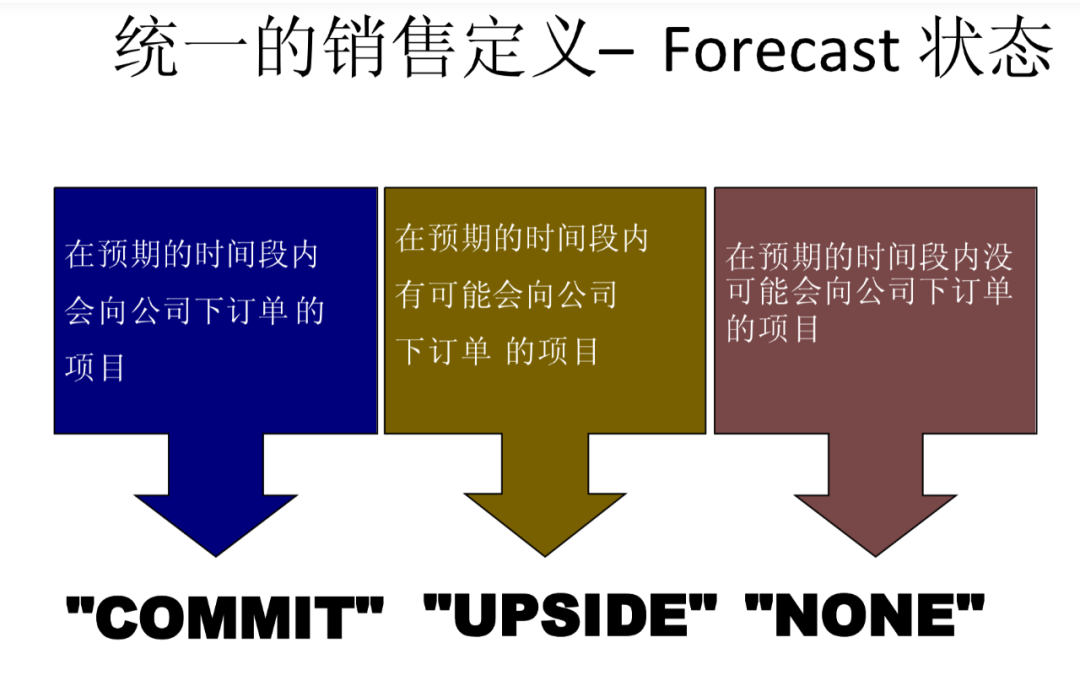
Sometimes the total value of deals fully within the cycle is less than our quota, so each rep must identify the risk points of Upside deals and develop response measures and action plans. Through focused effort within limited time, they convert Upside deals to Commit status and ultimately close them on schedule. Therefore, for reps within the assessment cycle: Forecasted Revenue = Commit Deals + (Upside Deals × Probability). This value should be roughly equivalent to their quota for the rep to be in good shape. What reps monitor weekly is whether Upside deals are systematically progressing toward Commit status, and whether Commit deals remain stable without new risks emerging. As for the probability in this formula, there's often no standard value — it should relate to the business's inherent attributes and historical data.
2.2 For Frontline Leaders
Frontline sales leaders are a particularly critical link in the sales forecasting (FCST) management framework. Whether this system operates effectively depends largely on them.
What frontline leaders must do in this framework:
- At the beginning of the assessment cycle, leverage their experience to review every deal with reps, identify risk points and blind spots for each, and verify whether the status reps have assigned to each deal is appropriate.
- At the beginning of the assessment cycle, develop response measures and action plans with reps for identified risk points and blind spots, and review implementation of these plans weekly.
- If a rep's Commit Deals + (Upside Deals × Probability) falls short of their quota, it indicates insufficient pipeline or overly slow deal progression. The leader must then develop an action plan with the rep to generate supplemental opportunities. The earlier this action is taken, the more proactive the leader's management becomes.
- Make their own assessment of all team deals and report the team's total Commit and Upside deals with corresponding values. Based on current conditions, allocate and deploy resources appropriately and align with cross-functional departments. If significantly off-target from quota, the leader must act immediately.
- FCST is a dynamic management process — don't pursue numerical alignment with frontline reps' forecasts. Make independent judgments. Focus more on weekly deal reviews with reps, maintaining thorough knowledge of deal changes and clear understanding of action plan results. Respond immediately to anomalies.
- Use FCST to test each rep's business proficiency and working style, identify weaknesses, and provide targeted coaching.
- Identify relatively high-potential employees through the FCST process for focused development.
2.3 For Sales Department/Company Management
The FCST management framework ultimately serves the goal of achieving revenue targets and enables management to anticipate risks earlier and prepare to act. It is therefore crucial for managers.
What management must do in this framework:
- At the beginning of the assessment cycle, analyze forecast data, estimate padding and risk, and maintain clear awareness. For major risks, discuss response measures and plans with the team.
- Continuously monitor whether overall data changes are following a healthy rhythm; if not, warn and intervene early.
- Verify whether sales strategy and execution tactics are correct, and correct course promptly if deviations exist.
- Assess team maturity. FCST is the ultimate litmus test — greater FCST accuracy indicates better business control by the team or individual. Here, accuracy means not just final numbers but also the degree of change in deal composition. If forecasted deals differ substantially from actual results, even with matching numbers, significant problems exist.
- Identify common team weaknesses and shortcomings through the FCST process — these indicate improvement directions to address promptly.
The above covers the understanding and actions required at each level of the FCST framework. In practice, 100% accuracy is rare; variance of ±10% represents good performance. This involves not merely a forecast number but, more importantly, the specific deals behind that number. Through this framework, companies can identify risks, manage deals, allocate resources, surface problems, and spot talent. It is an essential vehicle for sales process management. Most foreign enterprises use this model to manage sales teams — some on quarterly cycles, some monthly, and some, like Dell, require weekly FCST reporting. Of course, this depends on business attributes and management style, which also demonstrates the maturity and effectiveness of this framework.
03
Steps to Establish a Sales Forecasting (FCST) Framework
First, establishing a sales forecasting (FCST) framework within a company doesn't happen overnight — it's a process of continuously elevating understanding, gradually building according to business attributes, and ongoing refinement. Second, this framework isn't the responsibility of one person or one team; it requires sustained investment and development at all company levels.
For startups initiating this framework, I recommend beginning with the following:
- Instill relevant concepts at all levels, elevating understanding of the framework among all personnel.
- Map your business end-to-end, dividing it into reasonable stages, and identify risks and milestones for each stage.
- Adapt your CRM system according to your business attributes and characteristics, along with this framework, so that every individual and manager can execute business forecasting within the CRM.
- Initially, don't blindly pursue FCST numerical accuracy. Focus more on deal status and risk, helping reps improve deal control, and gradually raise accuracy requirements.
- Framework development is a top-priority initiative. Management must lead by example, helping every participant develop good working habits through practice, with attention to both numbers and their underlying deal composition.
- Conduct reviews — quarterly, monthly. Continuously identify gaps and fill them, especially coaching individuals and specific leaders with large forecast variances or significant adjustments. At its core, the framework is about people; improving people's understanding and skills is what matters.
- Ultimately, integrate the sales forecasting framework into the entire sales team's culture, making every member treat forecast accuracy as a source of pride and a goal to pursue.
The above offers several rough recommendations for establishing a sales forecasting (FCST) framework.
There's a saying: Clear despair is better than vague hope! The FCST framework is the finest practical embodiment of this spirit.
May every sales team build steadily and achieve enduring success!


Issue 40 — Code Brain | Business-Finance Integration: Achieving a Unified Internal Data Language
Issue 39 — Code Brain | Studying the 20th Party Congress: Grasping Economic Trends and Entrepreneurial Opportunities for the Next Five Years
Issue 38 — Code Brain | Welcoming the First Wave: 10 Guidelines for Entrepreneurs
Issue 37 — Code Brain | Compensation Incentives: Both Science and Art
Issue 36 — Code Brain | The Essence of Performance Management Is Unlocking Human Potential
Issue 35 — Code Brain | The First Step in Identifying and Deploying Talent: How to Interview Scientifically
Issue 36 — Code Brain | How Far a Team Goes Depends on These 6 Points
Issue 33 — Code Brain | An Entrepreneur's 11,626.5 Hours
Issue 32 — Code Brain | Leadership Is Guiding People to Places Unvisited
Issue 31 — Code Brain | Amazon's Ten Compliance Lessons for Going Global
More MaHui members can click "Read Original" to view