Flowtica Unveils Verso, an AI E-Ink Device Aiming to Master Meetings

Source Code Capital led J&T Global Express's Series B round.

The following content is republished from GeekPark for your reference.
(Author: Zihua Su | Editor: Jingyu)
GeekPark has learned that AI hardware brand Flowtica's e-ink product — Verso — has officially opened pre-orders with deposits overseas and will deliver its first batch in December.
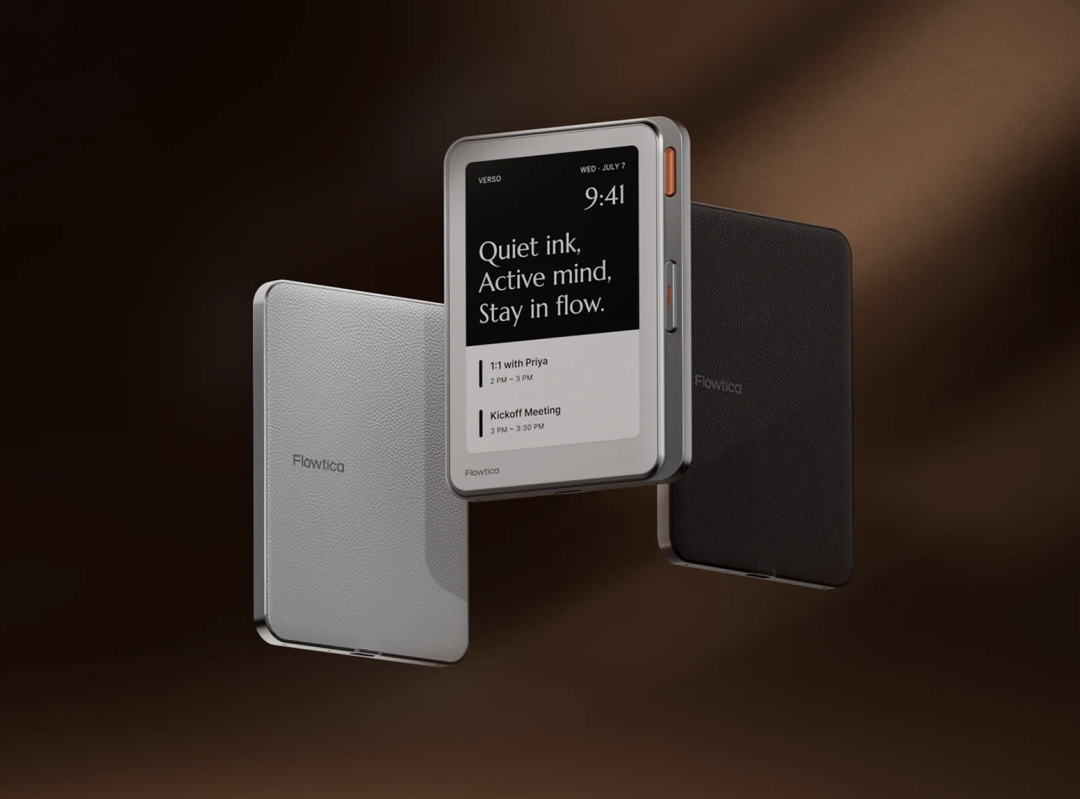
Verso is a 78-gram, 6.5-millimeter-thick magnetic e-ink screen that attaches to the back of your phone. Tap once to start recording during meetings; it transcribes and summarizes in real time, then automatically generates to-dos when you stop. Single-click to mark key points, double-click to create tasks — all viewable live on the e-ink display. Press the Ask button to query anything about your context, or directly assign it tasks.
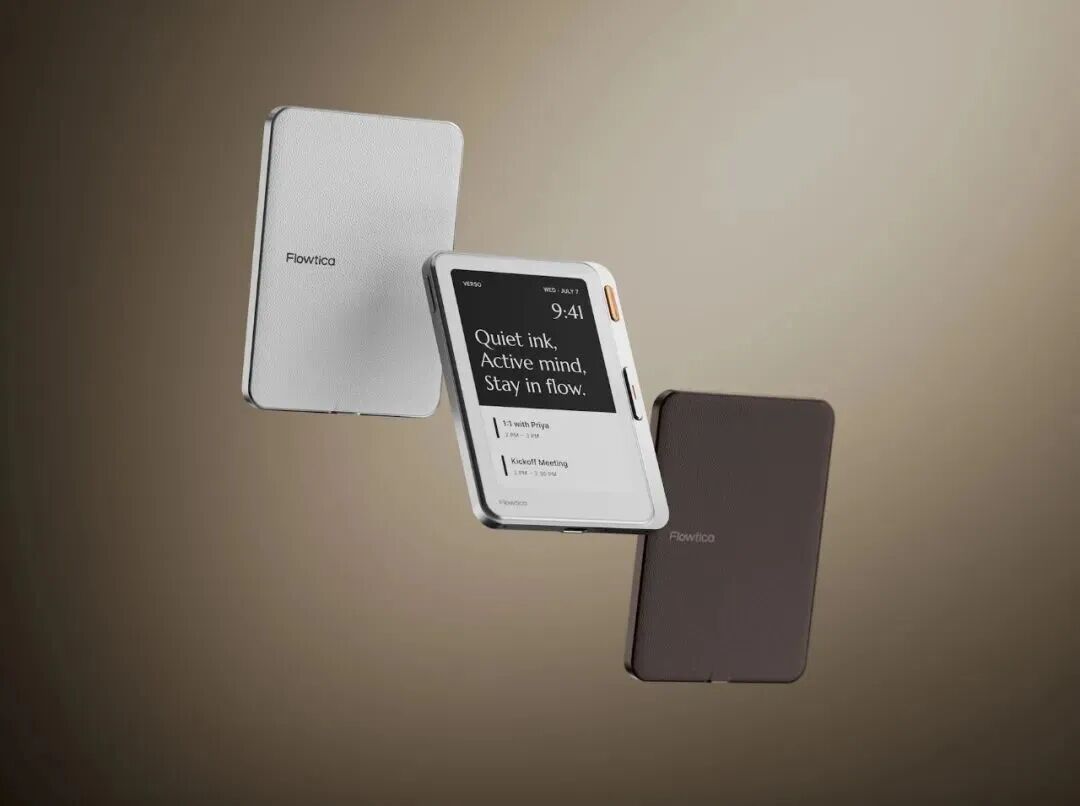
The top-right button is the first function key; the second is the AI button for one-tap recording of ideas and to-dos, or to Ask AI | Image source: Flowtica
Flowtica co-founder Rian told GeekPark that Verso is positioned as an "e-paper work sidekick" — a Watson to your Sherlock Holmes, a deeply attuned supporting role. The team has zeroed in on enabling users to complete the full loop of pre-meeting, during-meeting, and post-meeting tasks on a single e-ink screen.
In other words, their ambition may be to become the AI hardware best at "handling meetings."
Rian graduated from The Hong Kong University of Science and Technology, where he studied under renowned entrepreneurship mentor Zexiang Li. He is a serial entrepreneur with a cross-disciplinary background spanning algorithms and hardware.
His entrepreneurial track record reads almost like a catalog of hardware categories: in 2016, he built the world's first smartphone handheld gimbal, Vimble, which raised over $1 million on Kickstarter and shipped more than 300,000 units before being acquired outright by a major domestic manufacturer; in 2017, as co-founder, he developed a smart cat litter box that used machine learning to solve multi-cat identification, raising over $1.3 million in overseas crowdfunding; in 2018, he pivoted to agricultural technology, applying high-precision control algorithms and computer vision to fruit sorting, becoming the industry's number-two player.
Starting in 2024, Rian returned to the consumer space with Flowtica. On their latest product, Verso, their answer runs counter to the era's dominant narrative. While all AI hardware is racing to "collect as much context as possible," he made a decision that investors repeatedly pressed him on: cutting Always-on continuous listening.
We spoke with Rian about why a standalone e-ink screen deserves to exist when phones are already powerful enough and large models can handle ever more — and how to build a moat.
01
Why does the back of your phone need a "non-glowing" card?
The back of phones is getting crowded. AI recording cards, e-ink screens, AI digital badges — all want that real estate. But why would users need a standalone e-ink screen instead of a phone secondary display, foldable screen, or smartwatch?
Rian believes that if it were just a color LCD screen, it would at best be an extension of the phone display, destined to be swallowed by the phone's high refresh rate and rich ecosystem. The value of e-ink lies in being the opposite kind of screen — it can stay there, quietly displaying, consuming virtually no power. "What's next today?" — visible at a glance, anytime.
But the more fundamental difference lies in the interaction logic.
"Voice is the most efficient input method, but it's not an efficient output method." Rian walked through a concrete thought experiment: if an Agent responds with 50 words via voice, it might take 30 seconds to listen through; the same information on a screen is absorbed in a single glance. Voice's linear nature means it cannot be quickly scanned, skipped, or structurally presented.
"We treat the hardware as a fully packaged physical entity of UI and physical interaction — essentially an app for the user. Open recording, check schedule and to-dos anytime, with far more directness than fumbling to unlock your phone and tap through layers."
In high-stakes, high-pressure knowledge work where hourly rates are steep, users' most precious resource is "flow." By contrast, traditional phone interaction is disruptive: to check your next appointment, you must pick up the phone, unlock it, push through a barrage of notifications, and all too easily get lost in the information ocean of social apps and short videos like Xiaohongshu, Douyin, and WeChat.
"The phone is essentially a super terminal for complex computing and communication, but highly immersive productive work demands its own dedicated physical载体." In Rian's view, Verso is not a phone replacement, but a low-distraction visual feedback panel and a small control device for keeping tabs on everything at all times.
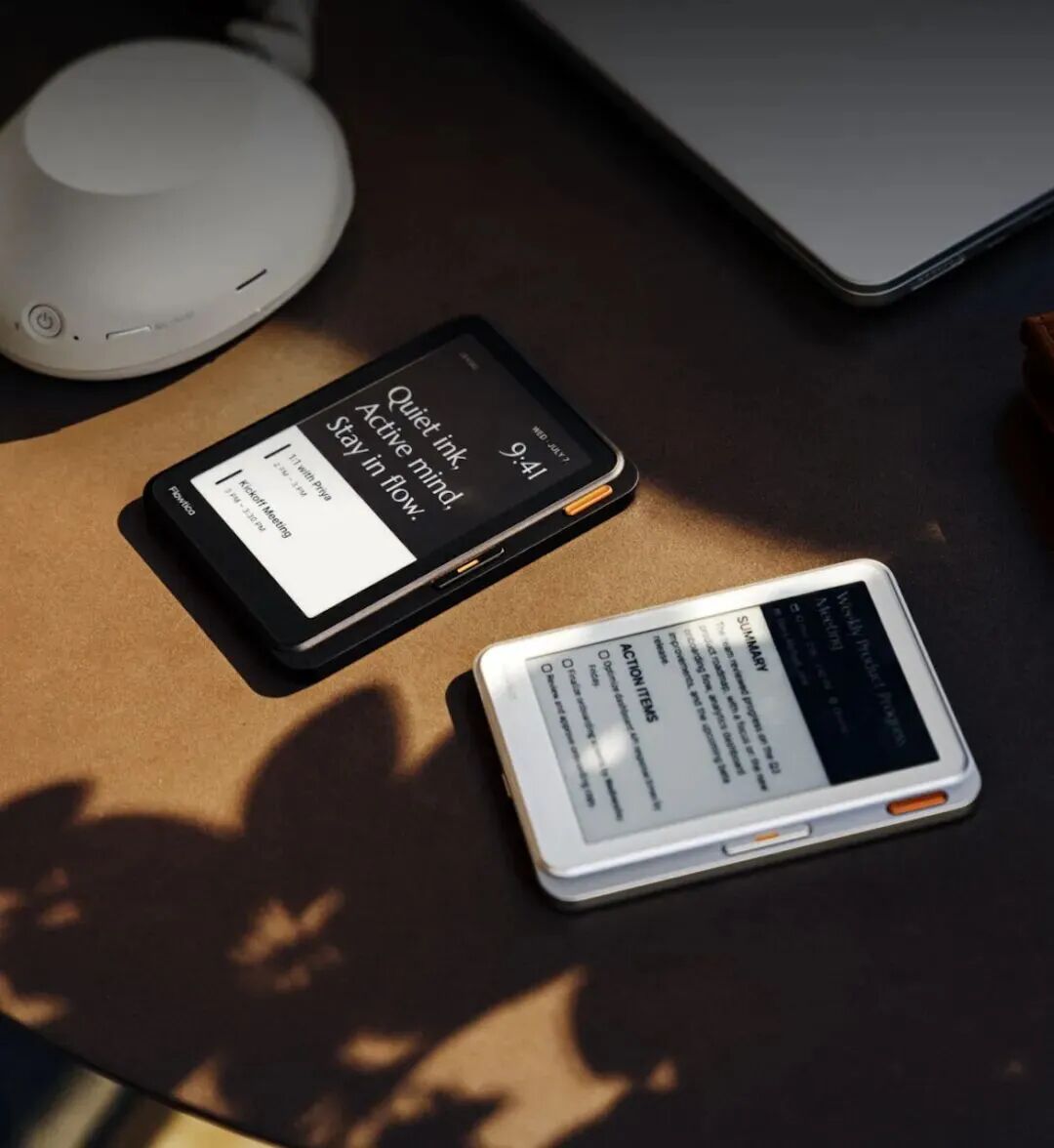
Rian believes the phone ecosystem itself is being shaken: as AI capabilities strengthen, many of the phone's traditional functions are being taken over by Agents. But from an ecological niche perspective, Verso avoids direct confrontation with smartphones on the "universal terminal" battlefield.
"What we're doing doesn't step outside the existing ecosystem — we're still friends with the Apple and Android systems: connecting calendars, connecting established habit systems. At the same time, we're doing something very vertical, very incremental."
Flowtica also evaluated headphones and watch form factors before ultimately abandoning them. The reasoning: headphones have too narrow a bandwidth; tasks assigned to AI take time to complete, and you need to see how they turned out. "Screens give people a sense of security because they're there, and they facilitate structured display."
As for watches, the fatal flaw is the small screen — too narrow a visual information bandwidth to provide the sense of security that comes from visually structured summaries.
02
Focused on work: Closing the loop across pre-meeting, during-meeting, and post-meeting
Verso's positioning is "e-paper work sidekick." In building AI hardware, the team's approach is precise focus, concentrating on high-frequency, high-pressure office meeting scenarios.
Rian stated that the team firmly believes that for knowledge workers, meetings are never aimless chatter — they are the starting point and decision hub for the vast majority of actual work. "A lot of high-value context happens in communication."
This judgment has already been validated on Flowtica's first product, the AI recorder Scribe — in user onboarding scenario selection, "internal meetings" and "client meetings" ranked first and second; and Scribe's average recording length approached 40 minutes, essentially the length of a standard meeting. In their view, this is the scenario most capable of driving user willingness to pay.
Therefore, they prioritized embedding Verso across the full lifecycle of pre-meeting, during-meeting, and post-meeting.
Pre-meeting: Leveraging deep binding with the user's calendar and historical interaction memory, Verso proactively surfaces on the e-ink lock screen before meetings begin. It automatically generates a minimalist pre-meeting brief based on previous communications with that contact, helping users seamlessly enter negotiation or decision-making mode.
During meetings: In face-to-face or phone meetings, press the record button to activate high-quality recording and real-time transcription. Meanwhile, single-click to "mark key points," double-click to "generate Todo," accompanied by subtle haptic feedback — since the first-generation Scribe, this has been Memory's earliest active input, and the first step for AI to understand the user.
Post-meeting: Verso extracts highly structured core resolutions, seamlessly exporting action items or follow-up email drafts. These to-dos sync in real time to the e-ink dashboard, letting users clear tasks one by one in little squares like completing game levels.
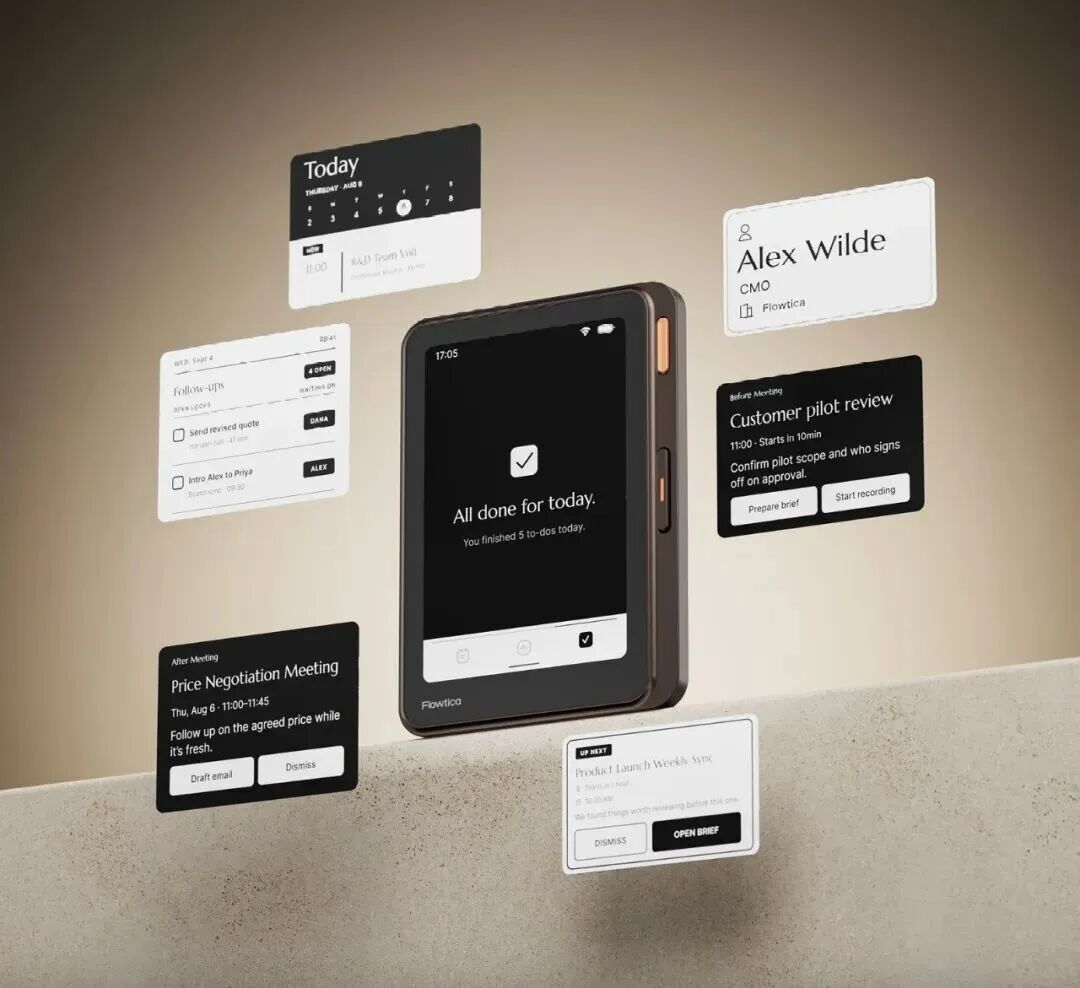
At day's end, it tells you "what you accomplished today." All notes, meetings, to-dos, and calendars are part of the knowledge base — also material for subsequent Agent deliverables.
Additionally, Verso integrates personal calendar, email, inspiration summaries, e-book reading, and NFC-based digital business card functionality.
03
Against industry consensus: Why abandon Always-on
In today's venture capital discourse, Always-on continuous listening is practically the default narrative for AI hardware: more context is always better, the more the Agent understands you. Verso goes the opposite direction.
Rian noted that Flowtica actually proposed the Always-on concept back in 2024. "Technically, achieving Always-on is not difficult." However, as they developed it, they themselves discovered that among their target users, this might not be the right answer.
The team's research found that, first, users dislike context contamination. "High-earning professionals don't want work-external context mixing in — for them that's context corrosion, not enhancement."
Second, overseas users are extremely privacy-sensitive, and Always-on is unavailable in many regions. The European Union has restrictions on Apple's Siri AI, on Amazon doorbells. "It's not just a feature issue... there are privacy and regulatory concerns."
In testing, the Flowtica team discovered that when users carried the device from high-density business meeting scenarios to coffee shops with passerby gossip or intimate home settings, indiscriminately stuffing all unordered, meaningless dialogue into the large model's memory context actually caused the entire Agent memory system to collapse, producing output flooded with noise and nonsense.
In Rian's view, this was a classic case of technology being ready while consumers weren't.
"Those who desperately want Always-on are the tip of the pyramid, eager for human-machine symbiosis. But for the broader population, regulation, habits, social acceptance, and psychological acceptance all need to align before things can move forward." He also acknowledged that in five years, over 60% acceptance of Always-on is entirely possible — "by then people will have experienced that more context means better Agent service. But right now there's strong conflict."
Therefore, Flowtica's products currently still require manually pressing the record button to start.
04
The next high ground
Verso is not Flowtica's first product. At the end of 2024, Flowtica soft-launched two products simultaneously: a recorder, Scribe, and an e-ink card, Verso. The team ultimately decided to stage their approach, doing the pen first — at that time, there was no Agent yet.
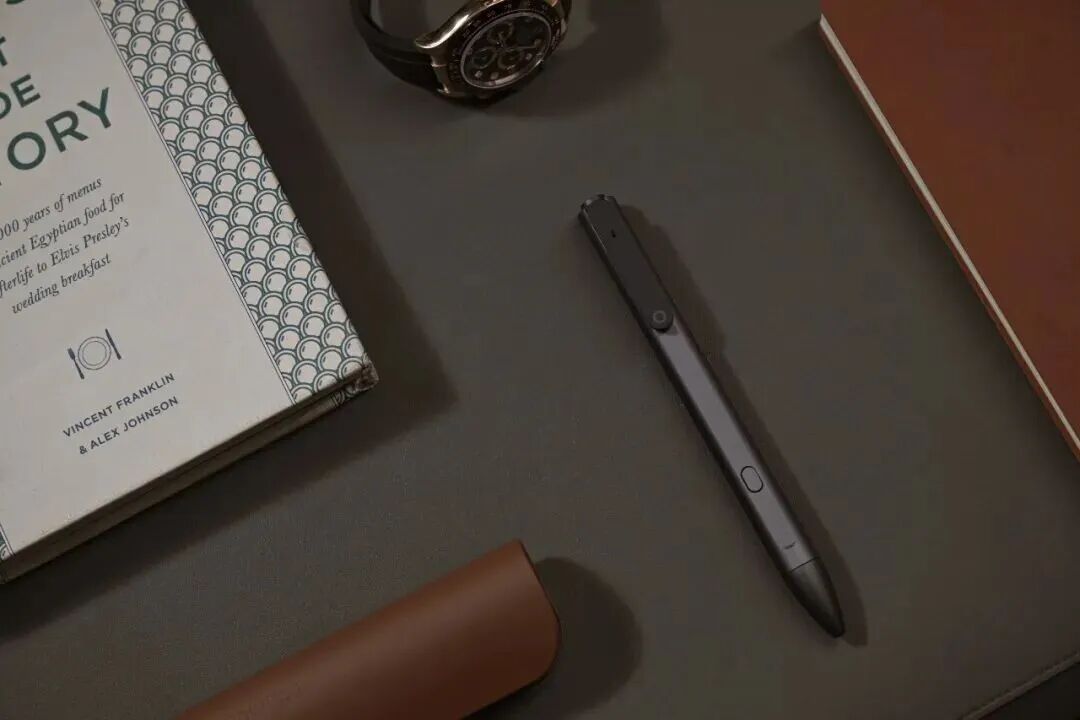
Flowtica's AI recorder Scribe | Image source: Flowtica
"When the Agent hadn't arrived yet, telling everyone about Agent-native hardware, people didn't get it; once the Agent arrived, hardware with a screen, direct voice interaction, carrying context, always understanding you, able to assign tasks — that made complete sense." Rian recalled that the true launch moment for Verso came in late 2025.
The Flowtica team maintains its own aesthetic standards, even investing substantial cost to custom-design exclusive fonts for the e-ink screen, and calibrating the technically challenging "asymmetric" casing and side blind-operation buttons.
"On our team, good looks are the baseline. Making something ugly or unusable — everyone would feel physically uncomfortable."
However, from AI recording cards to AI e-ink screens, this category is visibly homogenizing. Rian is well aware of this; pure "voice transcription" and "text summarization" are rapidly losing premium pricing power.
He believes the next competitive high ground lies in Agent Memory and deliverable production. "How recorded content transforms into subsequently useful value, how it gets productized — that's critical."
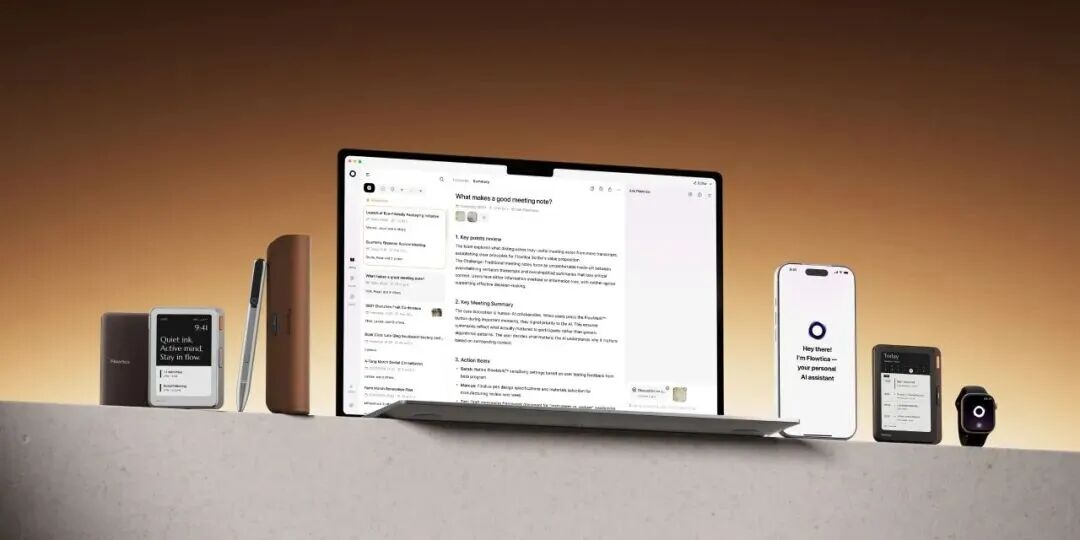
The multi-device ecosystem Flowtica is building, the blueprint for "personal productivity hardware" | Image source: Flowtica
Therefore, Flowtica is building deep Context Engineering and multi-device linkage systems, enabling AI to penetrate across time. In cross-timeline connection, it can automatically associate several meetings with the same client or project over the past six months, accurately extracting mindset evolution and project development threads, allowing AI to truly break free from "hallucinations."
In substantive work deliverables, combined with Flowtica's software-hardware integrated layout across Mac, Watch, and Web, the Agent can directly generate HTML reports, PPTs, and more based on accumulated communication. "The end of communication is the true beginning of work. Whoever can help users actually push post-meeting matters forward and achieve business results will command extreme premium pricing," Rian emphasized.
In this crowded赛道, the true possibilities of this e-ink screen are only just beginning to unfold.