HAI ROBOTICS, a logistics and warehousing robotics technology company, announced it has completed a financing round exceeding 100 million yuan, led by Source Code Capital in its Series B.

It has been deployed across 3PL, footwear and apparel, e-commerce, electronics, electric power, manufacturing, pharmaceuticals, and other industries.
Warehouse robotics company HAI ROBOTICS announced the completion of its Series B financing round, led by Source Code Capital, with existing investors Walden International and Lingyi Venture Capital participating. Combined with its Series A round last year — led by Walden International with BEST Inc also participating — the two rounds raised over RMB 100 million in total. Scheme Capital served as exclusive financial advisor for both transactions.
Founded in Shenzhen in late 2016, HAI ROBOTICS focuses on the R&D and system design of tote-to-person warehouse robotics. Its flagship goods-to-person system comprises the HAIPICK robot, HAIQ software, and workstations, enabling picking, transport, and sorting operations for logistics warehouses and factories seeking flexible automation upgrades.
The company deployed its first single-tote robot system in 2017, followed by multi-tote commercial applications in 2018. The HAIPICK line has since expanded from tote robots into a full range of container-based warehouse robotics, now supporting double-deep shelf picking, carton handling, and other tasks across industries including 3PL, apparel, e-commerce, electronics, power, manufacturing, and pharmaceuticals.
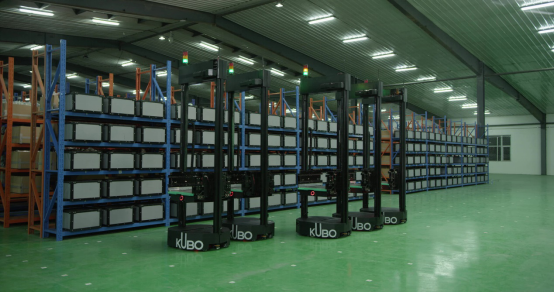
2017: Single-tote HAIPICK A2 robot at a Beijing warehouse
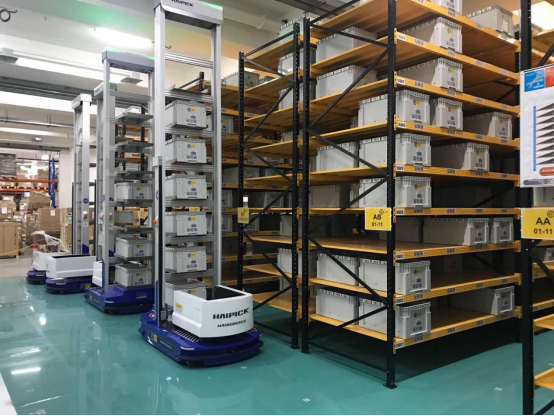
2020: Double-deep tote HAIPICK A42D robot at a Hong Kong warehouse
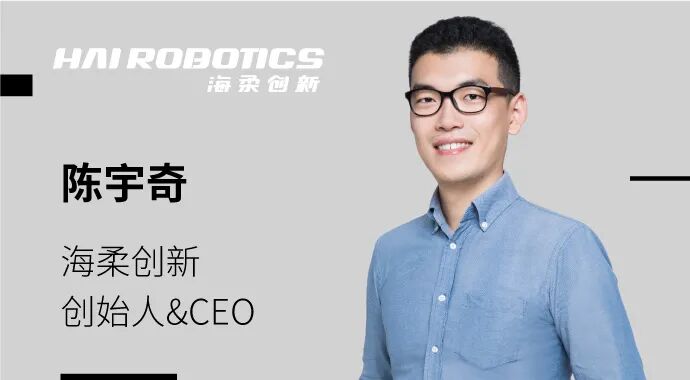
Yuqi Chen, CEO and founder of HAI ROBOTICS, explained that the HAIPICK system was designed around two core principles: "affordable" and "easy to use." With HAIPICK, a warehouse can complete automation retrofitting within one week, with full system go-live in roughly one month. The robots pick and transport multiple totes or cartons in a single trip, boosting worker productivity by 3-4x. The robots can handle shelves up to 5 meters high, increasing vertical storage density by 80-130%. Their ease of deployment and scalability also make upgrades and modifications straightforward.
In HAI ROBOTICS's solution, the shelving remains fixed — which aligns with most existing warehouse configurations and minimizes retrofit complexity. The only basic requirement for a warehouse undergoing transformation is a level floor. For uneven floors, localized grinding suffices at minimal cost: "For a 4,000-square-meter warehouse, grinding runs about RMB 10,000," Chen said. This flexible automation approach is acceptable to many customers, with overall payback periods shortening to 2-3 years.
One driver behind the smart warehousing industry's growth is rising labor costs. However, China's current labor costs remain less pressing compared to developed countries. Chen believes the gradual decline of the demographic dividend is inevitable. Even now, certain customers face very high labor costs — such as factories running two or even three shifts — where automation becomes a rational choice.
Yiwen Hao of Source Code Capital, lead investor in the Series B, commented: "HAI ROBOTICS has deep expertise in tote-to-person solutions, and HAIPICK has gained recognition from industry-leading customers over the past two years. We believe tote robots offer strong overall value across storage density, outbound efficiency, and retrofit cost. We also have confidence in the team's continued innovation and ability to deliver greater value to customers."
Going forward, HAI ROBOTICS plans to establish multiple regional sales and technical service centers, partnering with global system integrators and distributors to build a worldwide marketing and service network. Beyond container-based warehouse robotics, the company will also integrate technologies including robotic arms, packaging robots, laser-guided forklifts, and conveyors to design flexible, efficient, customized solutions for diverse warehousing customers.
Chen believes the industry remains in an early stage of development, with many customer pain points still unsolved — such as automating 10-meter-high shelves. The company will continue focusing on technological innovation centered on meeting customer needs.
On the team front, engineers currently comprise 60% of HAI ROBOTICS staff. Chen holds a bachelor's degree in electronics from The Hong Kong Polytechnic University and a master's in robotics from ETH Zurich, where his thesis project was on tote robots. He previously founded Hong Kong-based Precision System Ltd. before establishing HAI ROBOTICS.
This article originally appeared on 36Kr. Author: Xiaoyun.

Robotic Hand-Eye Coordination Technology Company "XYZ Robotics" Announces Close of Nearly $20 Million Series A+ Round, Led by Source Code Capital

AI-Assisted Drug Discovery Company "Galixir" Announces Close of $10 Million Pre-A Round, Co-Led by Source Code Capital

Cloud-Native Distributed Messaging System "StreamNative" Announces Close of Multi-Million Dollar Pre-A Round, Led by Source Code Capital

Fragrance Brand "Scentooze" Announces Close of 8-Figure Pre-A Round, Source Code Capital Sole Investor
Source Code Capital Portfolio Company "ZNLH" Announces Close of Series C1 Round, Source Code Capital Led Series B
More Source Code Capital portfolio companies available via "Read More"