Hongjiang Zhang: AI Is the Next Big Opportunity for Chinese Startups

The world is experiencing a third wave of artificial intelligence, and this AI wave differs significantly from the internet boom. The internet was primarily driven by business models, whereas AI is propelled by technology itself.
"The world is experiencing a third wave of artificial intelligence. This new AI wave is fundamentally different from the internet wave. The internet was driven by business models, whereas AI is driven by technology."
At the 2017 New Business Summit, Hongjiang Zhang, investment partner at Source Code Capital, shared his insights on the essence of this AI wave and the challenges and opportunities it would bring.
Zhang argued that the core of AI technology — machine learning — had shifted from traditional mathematical modeling to big data-dependent learning. This wave of AI would unlock far more possibilities. Thanks to the industry's massive data reserves and AI talent pool, China had a chance to lead the world technologically — a significant opportunity for Chinese startups.
On how AI would impact human life, Zhang cautioned that we should prepare for a future where AI would not merely assist humans, but replace or even surpass them. New AI algorithms had already acquired a "God's-eye view." For now, anything perception-related — speech recognition, image recognition — AI had already exceeded human capability. But anything involving comprehension and cognition still had a long way to go.
Zhang also warned entrepreneurs and investors on site: right now, any company can claim to be an AI company, so the bubble is severe. If a company only has algorithms, only has a few talented people, but lacks data or access to data, and has no application scenarios, that company won't scale.
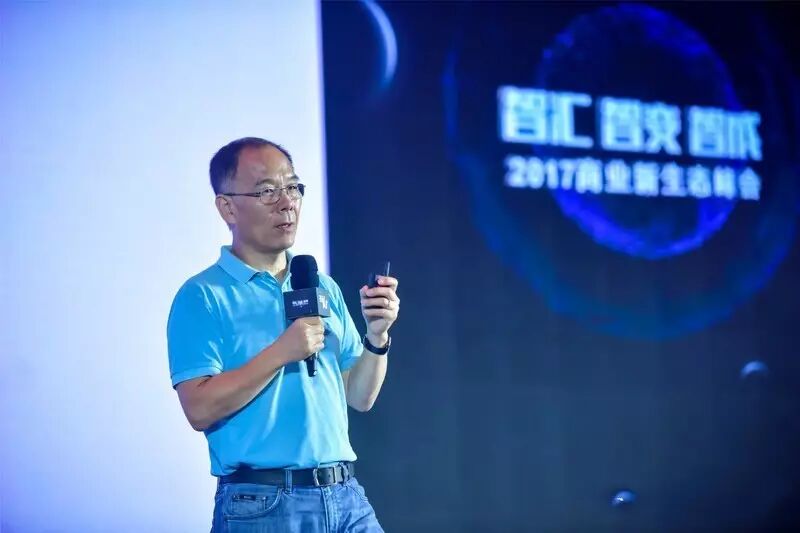
The following is a transcript of Dr. Zhang's speech:
Mr. Feng, distinguished guests, good morning. I'm very glad to participate in this forum organized by 36Kr today. I'd like to spend some time discussing the essence of this AI wave and what challenges and opportunities it will bring us.
1 Data Becomes the New Religion
How is this wave of AI different from previous ones? I believe China's current AI fervor is more intense than anywhere else in the world. Perhaps the reason is that AlphaGo's first victory over a human in Go made us see AI in a new light.
But looking at AI's 60-year development history, what we call AI today is actually a branch of artificial intelligence — machine learning, and more specifically, machine learning using neural networks, that is, deep learning.
The mid-1980s to early 1990s marked AI's second wave, which disappeared so quickly that for a long time we were embarrassed to admit we studied AI. The important reason was that neural networks were extremely hot then, but cooled down rapidly. There were two causes: first, neural networks at that time lacked big data support; second, they lacked massive computing resources.
Today, we not only have very new deep learning algorithms, more importantly we have high-quality labeled big data and very powerful computing resources. From a technical perspective, today's deep learning is fundamentally different from previous AI methods, especially expert systems.
Our algorithms today are actually data-driven, rather than relying merely on empirical rules.
Let's look at the two major drivers of this AI wave: First: computing resources have advanced by leaps and bounds over the past 30 years. Over past decades, we've seen exponential growth in supercomputer performance and exponential decline in unit price. Second: another crucial AI pillar — data — has begun to explode.
According to IDC research, total human-created data will grow tenfold between 2013 and 2020, equivalent to roughly 40% annual growth. The data we generate daily already exceeds 10^19 bytes.
Today, massive amounts of data are generated by the internet. This data is not only voluminous but also labeled — for example, your phone records the time and location of photos you take. It is precisely this data explosion that enables us to provide better training data for artificial intelligence.
Let me share a personal experience. Today's smartphones can take photos and recognize faces — not just beautify them, but tell you how many people are in a photo and who they are. This was my dream 20 years ago: a mobile device that could tell you who was in your photos.
After 20 years of development, this is now possible on phones. Why can we do this today? Mainly because of the two points just mentioned: computing resources and big data, plus the latest learning algorithms. When we started working on this problem in the 1990s, the entire database contained only a few hundred photos of just over 100 people.
Five years ago, when industrial giants like Google, Facebook, and Microsoft began using millions or even hundreds of millions of photos to train deep neural networks, using deep learning methods for recognition, we truly improved recognition rates to accurately identify people among hundreds of millions of photos. So what I want to emphasize is: as your training data scale grows, your learning accuracy also improves dramatically. The greater the resources and data used for training, the greater the training accuracy improves linearly.
Today, the training data behind AI company products is no longer tens of millions, but hundreds of millions, covering very broad scopes including different scenarios, environments, and angles. This is also why companies like Megvii are not only Chinese leaders in facial recognition technology, but world leaders.
So I'd like to summarize here: the core of this AI technology lies in machine learning, and machine learning has shifted from classical theoretical modeling to big data-driven approaches.
In the history of human technological development, there have always been prophets. Today I'd like to introduce an outstanding scholar from Microsoft Research Asia, Jim Gray, who proposed a concept ten years ago: "The Four Paradigms of Scientific Research." From initial pure observation, to Newton's mathematical theoretical description of the world, to computational methods for simulating the world beginning fifty or sixty years ago, to today's fourth paradigm using data to drive overall research.
Precisely because of these technological developments and the proliferation of big data, we now see that in companies worldwide, a large portion have begun building their businesses on big data foundations, including IT companies and traditional manufacturing companies.
Data has become our new religion. This is why chip companies like Intel have made massive acquisitions of AI companies in recent years — because data is the new fuel.
2 "God's-Eye View"
Having just discussed the two major drivers behind this AI wave — computing and data — let me share some thoughts on how AI's future will impact our industries and our lives.
The first perspective is that AI can do what humans can do, but at the fastest speed and greatest scale. Can humans play a million games of Go like AlphaGo? Impossible.
Can humans learn from data generated by hundreds of thousands of cars on the road every day, like Tesla? Can humans instantly compare facial recognition data from all cameras? Obviously, we cannot match machines. So whether in terms of speed, group learning capability, or scale, we cannot compare to the machines we create.
AI machines in the future will not merely assist humans, but replace or surpass them. We should not doubt this.
We used to say machines might quickly exceed and replace humans in logical, mathematically expressible applications. But what about things humans can do but cannot describe with mathematical formulas — like driving a car, riding a bicycle, painting? Today, AlphaGo's performance has made it clear that even in these scenarios that cannot be explicitly described mathematically, machines are beginning to surpass humans.
In fact, machines have already demonstrated remarkable capabilities in both autonomous driving and painting. After his match with AlphaGo, Ke Jie said something profound: "Human Go has developed for thousands of years, but we've only seen the tip of the iceberg. AlphaGo has a God's-eye view." After years of training, AlphaGo has climbed much higher mountains than we have, so it sees the overall layout far more comprehensively, while we humans see only a tiny fraction — it possesses a "God's-eye view."
When we consider what AlphaGo represents for the future — intelligent systems, intelligent machines that will exceed and replace humans — we can look to human history, or even Earth's history, where we see many species that were far surpassed when humans evolved from early apes to Homo sapiens. Turing said many years ago that after God created humans, many animals must have felt their fate was tragic.
Today, as we see artificial intelligence surpassing humans, perhaps we should consider how those advanced animals felt after God created humans. In fact, we have already reached this turning point.
Clearly, many industries will be replaced by AI in the future — translation, journalism, investment banking analysts. The US government is already organizing a team to address the impact on American employment rates over the next decade, when autonomous driving replaces truck drivers. Over 8 million Americans work in truck-related jobs, out of a total US workforce of 120 million. We can see how enormous this impact will be.
In the future, we hope to move from artificial intelligence to intelligence augmentation — but this is human wishful thinking. We hope to create machines that assist us, rather than replace us. In reality, what we see is that AI will replace us in many, many scenarios.
If you've read Sapiens, and like the author, you might look at his other book, Homo Deus. He proposes that future AI development may create two kinds of people in the world: "gods" and "the useless."
The frightening thing is that the gods may be only 1%, while 99% are useless. When 90% of the world's jobs are replaced by computers, this will bring a series of social problems.
Some say there are three types of people who can withstand AI's impact: capitalists — those of you here doing investment and VC, obviously you needn't worry, as long as you can raise money and pick the right projects. Also celebrities and craftsmen. But none of these three groups will exceed 1% of the population. So the acceleration of technological progress brings not only impacts on work, but deeper effects on culture, values, and ethics — things that are difficult to predict today.
Deep learning has another problem: as its performance continually improves, especially when driven by big data, we may have to accept a reality that in many cases, the decisions made by deep learning cannot explain themselves.
We should also soberly recognize that what we discuss today is intelligent machines, not machine intelligence — or rather, machine intelligence still has a great distance from human intelligence. Today we see the Chinese market full of fantasies about AI, with many bubbles in investment. The fundamental issue is that people haven't clearly recognized where AI is strong today, and where it cannot yet deliver.
However, I want to tell you: anything perception-related — speech recognition, image recognition — today's AI algorithms in many cases already exceed humans. But anything comprehension and cognition-related, AI still has a long way to go. So if anyone tells you they've created an AI system that can simulate human thinking, you should heavily discount that claim.
3 Bubbles and Opportunities
Since this AI wave is different from previous ones, how should we as practitioners and investors judge AI opportunities and investment prospects?
Internet Queen Mary's report summarized this very well: before the 18th century, in agricultural society, people survived by planting and harvesting, by manual labor. In the 19th and 20th centuries, during the Industrial Revolution, people relied on machines and industry. In the 21st century, people rely on the combination of computing power and human capability.
When we invest, we must think about which aspects of AI can enable human potential to be more fully realized. In each wave of technological change, there have always been platform companies.
We need to identify which applications have massive scale and can generate large amounts of data. When you have data and scale, artificial intelligence can naturally be introduced to improve overall efficiency, thereby increasing productivity, creating new applications, and enabling the emergence of scalable enterprises.
One thing we must clarify when judging AI investments: this new AI wave is very different from the previous internet wave. The internet was driven by business models, while AI is technology-driven. AI begins by disrupting existing industries — not eliminating them, but making them vastly more efficient — so it must be tightly integrated with vertical applications.
Those of you in investment know very well: right now, any company can say it's an AI company, so the bubble is extremely severe. There are several things we must grasp: if a company only has algorithms, only has a few talented people, but lacks data and application scenarios, or will find it difficult to obtain data in the future, such a company won't scale and won't last.
When evaluating these AI companies, you must consider whether this company has data today, whether it can continuously produce, acquire, and control data, whether it can achieve higher data ownership than others — these are the most fundamental questions. Only when technology is combined with data acquisition capability does it have a very strong moat.
Let me give an example. Everyone knows Toutiao's rapid growth over the past five years. What's behind it? Actually, the reason is that it solved a very fundamental human need — connecting people with information. Thousands of years ago, we recorded events by tying knots in ropes. After the invention of movable type and papermaking, information transmission became more convenient. In the PC internet era, we know the internet actually connected all information together, presenting it in an internet-based way.
In the smartphone and mobile era, we know that your information terminal is always in your hands. People accessing information became much more convenient than before, while simultaneously creating an information explosion. Information is generated far faster than you can consume it. At this point, PC internet-era search could no longer satisfy people's needs — you could no longer have people searching for information. Instead, when you know someone needs information, you push it to them. This is precisely Toutiao's core business model, with technology at its core. Through AI algorithms, through big data algorithms, through data generated on your phone, Toutiao knows what information you need and when you need it, thoroughly.
Toutiao's big data capability is also formidable: over 200 million monthly active users, over 100 million daily active users, with average usage exceeding 76 minutes per person. Through technology and data, Toutiao has established a natural barrier. Among all mobile internet applications worldwide, only one application exceeds it in time spent: WeChat, at 90 minutes.
When we recognize this wave of AI's potential, when we understand the value it can create, we must remember three points in entrepreneurship: First, artificial intelligence is undoubtedly a core competitive advantage for our future. Second, the AI industry currently has three models: self-development, technology sales, and AI-as-a-service.
Currently, most companies fall into the second category — basically they have technology, have a few people, these people are very strong, but they have no data, and the application scenarios don't belong to them, so they're essentially doing consulting services. This cannot achieve very large scale.
Finally, AI is an opportunity for Chinese startups, an opportunity for China to lead world trends. In the mobile internet era, China's WeChat and Toutiao were already leading global trends. In the AI arena, the two competitive barriers — data and talent — China lacks neither. In all academic publications worldwide, Chinese machine learning authors, especially in deep learning and neural networks, surpassed the United States in 2014. Moreover, China's volume of labeled data is the largest in the world — large base, and large data volume. Thank you.