Hongjiang Zhang: How Large Models Will Drive the Scaled Development of the AI Ecosystem

Hongjiang Zhang's panoramic observations and deep reflections on the current evolution of global AI development.

Recently, Hongjiang Zhang, Investment Partner at Source Code Capital and Founding Chairman of BAAI (Beijing Academy of Artificial Intelligence), shared his panoramic observations and deep reflections on the current evolution of global AI at multiple public events, offering four key judgments:
-
In the future, scaling laws will not be limited to pre-training and inference. We will see more new scaling laws continuously driving model performance improvements.
-
Sustainable scaling laws will also demand higher computing power. The ceiling of model development is necessarily proportional to computing power. In a fully open market, bubbles and overinvestment are inevitable, but AI development is still far from reaching a "bubble peak."
-
The relationship between humans and tools is changing. We are entering the era of "agent swarm," where vast numbers of agents interact with one another, execute tasks, exchange data, exchange information, and even exchange tasks. Human interaction with these agent swarms will constitute what we call the "agent economy."
-
While new technologies always create new jobs and eliminate old ones, these new jobs may not necessarily be for humans, but for agents — and that is the concerning part.
Source Code Capital is republishing this article for AI entrepreneurs' reference. Below is Hongjiang Zhang's speech in full:
- Reprinted from: Luohan Academy Perspectives
My speech will cover several main areas. First, I will discuss whether the "scaling law" underpinning large language model development is sustainable. Then, I will talk about how large models are driving the scaled development of the entire AI ecosystem, particularly in terms of computing power and electricity infrastructure investment. Finally, I will address core technical directions, especially AI agents and the agent economy, and spend a few minutes imagining future possibilities.
1
Sustainable Scaling Laws
For large language models or AI foundation models, we must understand that a key driver of their progress is the "scaling law." The essence of today's large AI models lies in capabilities that emerge from scale — abilities that suddenly appear when models reach a certain threshold of scale and performance parameters, a kind of inflection point. We observed this phenomenon with GPT-3, and it has been evident in ChatGPT and other rapidly developing models over the past two years. Generally speaking, more parameters mean better performance — and this still holds true today. Although there is a widespread feeling in the industry that scaling laws for pretraining models are gradually slowing, they remain critically important: as training time and model scale increase, model accuracy improves, just at a slower pace than before. The good news, meanwhile, is that with the release of OpenAI's o1 model, we saw an important inflection point: scaling laws can be extended to reasoning models. This means that during the inference phase, the more time a model has, the better it performs and the more accurate its results. We call this phenomenon "reasoning scaling" or "test-time scaling." This has been an important force driving model performance improvements over the past six months, and also a major factor pulling computing power demand rapidly upward.
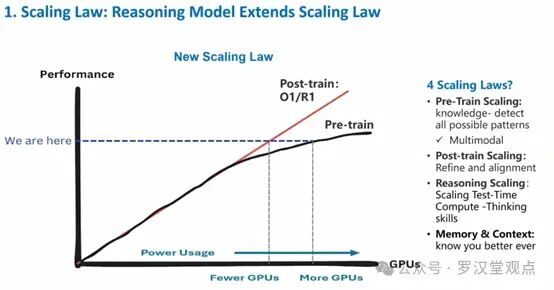
This leads us to a new path for improving model performance. We previously relied mainly on transformers for pre-training; now we have entered the reinforcement learning stage. I would venture to predict that in the future, scaling laws will exist not only in pre-training and inference stages — we will see more new scaling laws continuously driving model performance improvements, while also placing higher demands on computing power. That is to say, although pre-training scaling laws have slowed, scaling laws in the post-training stage and reinforcement learning stage are beginning to emerge, further improving model performance and continuously increasing demand for computing power. Another piece of good news is so-called "LLMflation": the price of using models (i.e., price per token) has fallen very rapidly over the past three years. We have seen basically a 10x decrease in token prices each year, totaling roughly a 1000x decrease over three years. At the same time, looking at mainstream model releases, each generation launches with lower token prices but better performance. So I want to emphasize: scaling laws remain effective, token prices continue to fall, and we can therefore view this as a new "Moore's Law" — model capabilities continuously improve while usage costs continuously decline.
2
AI Industry Scaling Up
My second point is that AI is industrializing at massive scale. This is not just about model scale-up itself, but the scaling of the entire industrial ecosystem. We see OpenAI, Anthropic, and other startups offering "Model-as-a-Service," while large platforms and cloud computing companies continue providing "Platform-as-a-Service." We should recognize that AI models are not just models — they will become platforms, and platforms will further build their own ecosystems: more and more applications will emerge at the platform layer, with cloud computing below, and computing hardware below that, with GPU being the most critical. This is why GPU has held absolute dominance in AI over the past two years. People have finally recognized that from a scaling law perspective, whether for model training or model usage, although token prices have fallen, there are more users and richer application scenarios, all of which will consume increasing amounts of computing power. Therefore, we are seeing AI infrastructure construction expanding at an unprecedented pace. For example, OpenAI announced the Stargate project, planning to invest approximately $100 billion and deploy thousands of workers to build a data center in Texas, with potential future investment scaling up to $500 billion, expecting to deploy 100,000 — or even expand to 500,000 — GPUs. Additionally, Elon Musk's Colossus project deployed 100,000 GPUs in its first four months, with plans to eventually include 200,000 GPUs. I did the math: 100,000 GPUs consume roughly 150 megawatts; if expanded to 1 million GPUs, that would consume about 1.5 gigawatts. What does this mean? Beijing's total electricity consumption is about 13 gigawatts. In other words, a single data center with 1 million GPUs would consume one-eighth of Beijing's total electricity usage. This shows the massive scale of AI infrastructure investment.
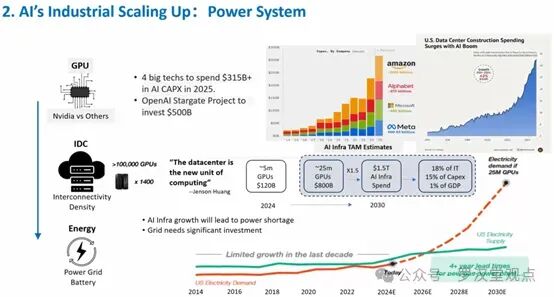
It is this massive demand for GPUs that has driven NVIDIA's stock price to continue rising. Beyond OpenAI and Musk, Google, Microsoft, Amazon, and others are all increasing investments, with projected AI-related capital expenditures exceeding $300 billion in 2025 alone. This will directly lead to electricity shortages in the United States. If this pace continues, the U.S. power grid will be overwhelmed next year. This also explains why over the past year, people have begun paying attention to nuclear power again — particularly small modular reactor technology — with related stocks also rising strongly. The entire AI data center industry chain has experienced a massive construction boom over the past year, and this will continue. This includes not just GPUs and data centers, but also energy. This is what we mean by AI industry scaling.
3
Core Technical Directions
I want to delve deeper into technical directions. The first stage of the technology development path is still primarily "pretraining" — this is the core. If a company lacks the ability to build powerful foundation models, it cannot develop excellent reasoning models, let alone build high-quality agents. The entire roadmap going forward is very clear: pretraining → fine tuning → reinforcement learning → agent → specific domain. This is why we see OpenAI, after releasing GPT-4, then releasing o1, and in the future launching GPT-5 after integrating GPT-4.5 and o3. In this way, their pretraining models and reasoning models are converging, and other large model developers will all follow this path. When AI models possess both pretraining capabilities and reinforcement learning capabilities, they move toward "test-time reasoning models." That is, AI models are no longer just "fast thinking" (rapid knowledge retrieval); they now also have "slow thinking" (rational reasoning) capabilities. The enhancement of "slow thinking" capabilities is key to AI solving more complex problems. In other words, today's AI models are no longer static, no longer just knowledge bases, no longer static networks. Previously, we would say that if we didn't train new knowledge into the model today, the model made no progress. But now, models themselves possess continuous learning capabilities — they can continuously learn from networks based on data we provide. We are already beginning to see the kind of machine that can learn from experience, as envisioned by computer science and AI founding father Alan Turing.
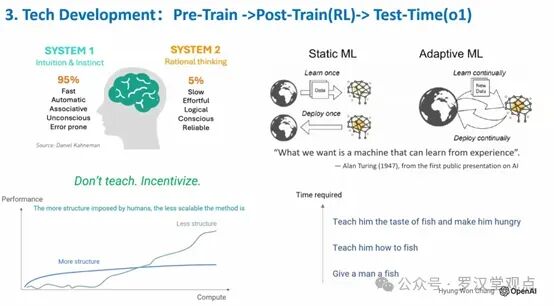
In the past, during pretraining, the main way to train models was for humans to provide data for them to learn from — for example, AlphaGo learned from data of human Go games. Currently, the mainstream method for training foundation models — especially reasoning models — has shifted to reinforcement learning. In the reinforcement learning stage, we don't directly provide data; instead, we provide rules and objectives, and teach the model how to learn from data. This is not just "giving a man a fish," but "teaching a man to fish." Next, we will not only teach the model how to fish, but also give it "hunger," letting it understand that fish are delicious, then letting it feel hungry itself, so the model will actively go find fish to eat. (The so-called "hunger" means setting higher-level objective functions for the model, so it is not merely satisfied with completing single tasks, but continuously self-optimizes to avoid "starvation." Only with goal-driven, continuous iteration can models truly break through.) That is to say, the model must learn to fish on its own, no longer needing humans to teach it; it will not only use data, but know where to obtain data, even how to build datasets itself. This is the stage we are currently at — we are entering a brand new AI agent era. People often discuss the relationship between reinforcement learning, pretraining, and reasoning. In the past we talked a lot about pretraining (such as GPT), but now we have entered the post-training, reinforcement learning, and reasoning stage. Reinforcement learning used to be just a small part of overall model training. But starting from OpenAI's o3 model, reinforcement learning became a significant component, and its proportion will further expand in the future. One could say that reinforcement learning and reasoning were like the cherry on top of the cake in the past; in the future, they will become the main drivers of model performance, and also the main consumers of computing resources. Today we already have models capable of extended thinking, like Go masters — they take longer to make a move, and solving a complex problem may require even very smart people to spend a long time. You might ask: is longer always better? My view is that when a reasoning model spends more time thinking, it is actually asking itself more questions, proposing more hypotheses in its thinking, searching more paths, even building its own tools in the process. In the future we will see a model that, like a scientist, can spend days or months thinking about a specific problem and finding a solution.
AI Agents and the Agent Economy
Now everyone is talking about "agents." If we borrow Sam Altman's five-stage framework for artificial intelligence, we are currently between the second and third stages, but will soon enter the third stage — the so-called agent stage. At this stage, AI systems can take action and can self-learn.
From this perspective, the relationship between humans and tools is changing. Previously we regarded computers and AI as human tools. Now we already see AI as assistants or copilots. And in the near future, humans and tools will enter a new symbiotic stage: symbiosis between humans and machine networks. There will be more autonomous AI agents, controlled by humans — hopefully we become the controllers, otherwise we may become their slaves, or be assimilated by them.
For example, one of OpenAI's frontier projects, Deep Research, is an agent built on top of reasoning models. You give it a task, it first analyzes the task, then realizes it needs some data, and searches for it itself. Then it realizes it needs some analytical tools, and goes to find them. It may also realize some tools don't exist at all, so it programs and develops the tool itself, then uses these tools to complete the task. So you can see, it can both use existing tools and build its own tools to complete tasks.
Today we already have agents capable of executing tasks and working in complex workflows. In the future, every task and every workflow could potentially be completed by agents. These agents will form a system, creating a complete closed loop for enterprise decision-making, running entire operational processes. This day will come soon. We are entering a stage called the "agent swarm" era, where vast numbers of agents interact with one another, execute tasks, exchange data, exchange information, and even exchange tasks. Human interaction with these agent swarms will constitute what we call the "agent economy." Imagine: today's large models are composed of massive numbers of neurons. In the future, these agents will be like individual neurons in today's neural networks, and future social and economic systems will be composed of large numbers of agents, just like today's neural networks. That will be our future.
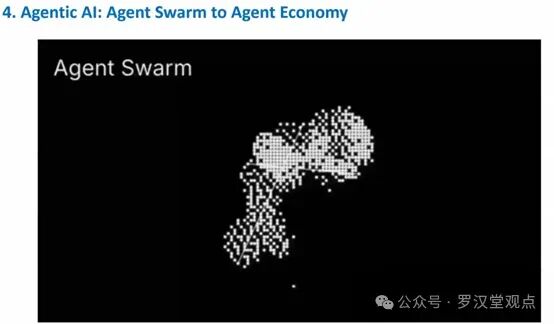
Image source: AI's Trillion-Dollar Opportunity: Sequoia AI Ascent 2025 Keynote
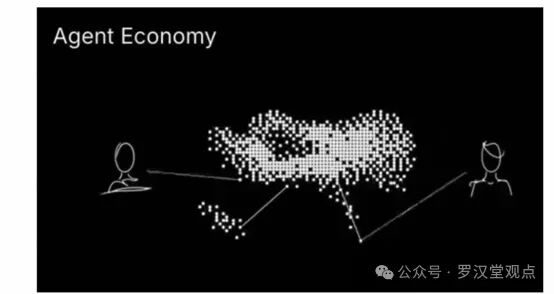
Image source: AI's Trillion-Dollar Opportunity: Sequoia AI Ascent 2025 Keynote
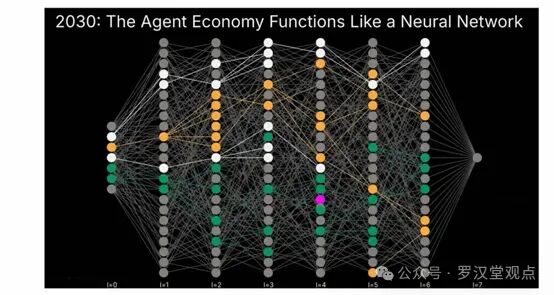
Image source: AI's Trillion-Dollar Opportunity: Sequoia AI Ascent 2025 Keynote I want to say, the future is autonomous: autonomous agents, agent swarms, and the agent economy. If we look purely at IQ test results for models, many large language models today already fall on the right side of the human IQ distribution curve — that is, their IQ test scores are already above human average. What does this mean? We remember the moment when AlphaGo defeated the human Go master, especially how its playing style was unprecedented — only then did we suddenly realize that AlphaGo had achieved what we call "God's angle": humans had played Go for two thousand years, but were merely standing on a small hill looking at the scenery, while AlphaGo saw the entire landscape.
This is the potential we see in large language models. When we talk about whether the singularity has arrived, we are really asking whether two curves intersect: one is human adaptability or learning ability, a curve that is nearly flat; the other is technology or machine learning ability, a curve that is growing very fast. When these two curves intersect, it means machines have become smarter than humans. Everything humans can do can ultimately be done by machines, and machines learn faster. This may mean that although new technologies always create new jobs and eliminate old ones, these new jobs may not necessarily be for humans, but for agents. This is the concerning part.
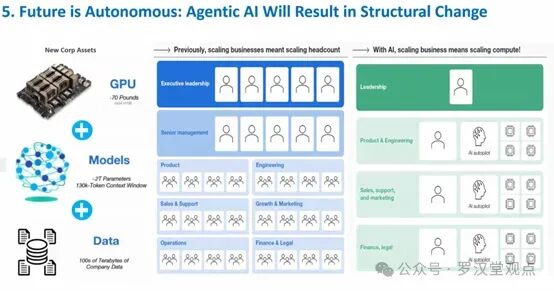
Therefore, the core assets of future organizations will be completely different. GPU, that is computing power, will become a core asset. Models, that is intelligence, will also become assets. In the future we will continuously train models, rather than continuously train employees. Today, to expand business, we recruit new employees, build new organizations, construct new offices. In the future, we only need to acquire more computing power, improve models, obtain more data. This is a massive structural transformation, unprecedented, previously seen only in science fiction.
Finally, a joke I saw online. A company has three C-level executives. The CFO cares about money: "What if we spend a lot of money training employees and they leave?" The CEO says: "What if we don't train them and they stay?" Then the CTO says: "Robots never quit." This may be the scenario we are about to face, requiring us to formulate response plans and take action to address possible structural transformation and its risks.
Thank you all!