Impact of Asset Management Rules on Institutions and Response Strategies | A New Era for Asset Management

A Detailed Look at Development Opportunities Under the Asset Management New Rules for Banks and Wealth Management, Securities Firm Asset Management, Public Funds, Private Funds, Trusts, and Robo-Advisors
Source Code Capital Policy Research
Issue 3
New regulatory rules will affect different types of asset management institutions to varying degrees and in different forms. Some institutions may see their business focus shift, but the overall trend is consistent: returning to their respective areas of expertise and specialization, focusing on core competencies, and serving the real economy. In the short term, the new rules will create turbulence in financial markets, but with regulators working to contain the impact, the disruption remains within acceptable bounds. Over the longer term, the rules will effectively curb unchecked growth in the financial sector and play a role in standardizing the market.
1
Banks and Wealth Management
By comparison, the commercial banking system faces the largest impact from the new asset management rules, as the separation of on- and off-balance-sheet activities primarily targets commercial banks. At the same time, commercial banks will also face the greatest implementation challenges once the rules take effect. Based on current regulatory provisions, some changes are inevitable, while others remain open to discussion.
Specifically, the separation of on-balance-sheet business and off-balance-sheet wealth management, the shift to net-asset-value (NAV) products, the breaking of implicit guarantees, the "three separations" requirement for product management, and alignment with overall public fund standards are all inevitable trends. However, many details still need to be clarified, leaving some uncertainty around the impact on bank wealth management operations and financial statements. Whether strict enforcement of look-through requirements for qualified investors—both upstream and downstream—will apply to bank wealth management may become a balancing act and point of negotiation between risk control and implementation.
Overall, the impact on bank wealth management business falls into four main areas:
- Scale: The issuance of these rules will create short-term disruption to banks' wealth management business, and the growth rate of off-balance-sheet wealth management may slow significantly due to various regulatory constraints.
- Spreads: Requirements for NAV-based management, look-through provisions, separate bookkeeping and accounting, and prohibitions on multi-layer nesting will compress some arbitrage opportunities. Wealth management spreads are expected to narrow going forward.
- Product investment side: The proportion of bond assets may increase; the duration of non-standard assets may shorten.
- Emerging financing constraints: Equity-related investment and financing activities currently rely on wealth management funding. The new rules restrict wealth management investments in non-standard debt, unlisted company equity, and structured leveraged products, which will constrain banks' emerging financing activities.
In the near term, commercial banks' asset management business development will face three major adjustment pressures: first, the pressure of NAV transformation; second, the pressure of investment scope adjustment; and third, the pressure of profit model adjustment.
Response Strategies and Recommendations
First, from the liability side, banks need to ensure adequate supply of competitive products to capture investment capital diverted from wealth management funds, continuing to stabilize and meet customer needs. On one hand, regardless of valuation methodology, NAV transformation is an inevitable path. On the other hand, banks should reasonably control product issuance pacing and flexibly determine product pricing levels, providing standardized investment products to smoothly absorb various types of returning capital after the new rules take effect.
Second, from the asset side, strictly control non-standard investments and focus on "fixed income plus" strategies. Going forward, how to handle non-standard assets—including nominally equity-based but effectively debt-like assets—poses a significant challenge. Against this backdrop, commercial banks need to increase allocation to standardized debt and equity assets while accelerating "non-standard to standard" conversion work.
"Non-standard to standard" conversion will become a key focus area for banks and is critical to NAV-based asset management. It is expected that some non-standard demand will shift toward standard assets: bond investments, ABS, bank-traded asset conversions, on-balance-sheet loans, etc. Among these, asset securitization represents the main compliant channel for "non-standard to standard" conversion, improving asset-liability structure and asset turnover efficiency, and serving as the primary off-balance-sheet channel for banks to achieve this transition.
Additionally, banks should focus on "fixed income plus" strategies. Deep expertise in "fixed income plus" approaches should form multi-tiered product systems encompassing pure fixed income, fixed income plus equity/quantitative, mixed stock-bond, and pure equity products.
Third, promptly initiate preparations for establishing asset management subsidiaries. Under strengthened corporate governance and risk isolation requirements, establishing dedicated asset management subsidiaries to operate asset management products can enrich wealth management functionality, drive product innovation, separate operations, and facilitate risk isolation. The new rules also explicitly state that after the transition period, commercial banks' investment and wealth management activities must operate independently through asset management subsidiaries.
Overall, the transformation of banks' asset management business should neither continue the inertial thinking of the past "off-balance-sheet bank" model nor simply become a replica of public funds. Instead, it should find its own positioning, value, and development space within the broader framework of China's financial system reform. "Non-standard to standard" conversion, strengthening direct financing intermediary functions, and exploring integrated development models combining financial market operations with investment banking should all be directions for bank asset management transformation.
2
Securities Firm Asset Management
The Guiding Opinions will have a significant impact on securities firms' asset management business scale. Currently, over 70% of securities firms' asset management scale consists of channel and funding pool businesses, and growth rates may decline sharply after the new rules take effect. However, because these businesses carry low fee rates, the overall revenue impact on securities firm asset management will be relatively small.
In fact, securities firms appear more prepared for compliant operations than other financial institutions. As early as 2016, securities firm asset management was placed under tighter constraints, beginning the de-channeling process. Securities firms' channel business has been steadily contracting, and funding pool businesses were already restricted earlier. The new rules therefore do not represent a major shock. According to Asset Management Association of China data, as of year-end 2017, securities firms' asset management business totaled RMB 16.88 trillion, down RMB 1.89 trillion from RMB 18.77 trillion at end-Q1 2017. Of this, directed asset management plans totaled RMB 14.39 trillion, down RMB 1.67 trillion from RMB 16.06 trillion at end-Q1 2017. Last year's directed asset management contraction accounted for roughly 80% of the overall securities firm asset management contraction, with the reduction coming primarily from channel business.
The specific impacts of the new rules on securities firm asset management include:
- Channel business faces further constraints, and directed business scale is expected to continue declining.
- Structured product issuance by securities firms will be somewhat affected.
- Active management business scale will also be impacted. The new rules explicitly prohibit providing channel services to help other financial institutions' asset management products circumvent investment scope, leverage constraints, and other regulatory requirements. Asset management products may invest in one additional layer of asset management products, but the invested product may not further invest in asset management products other than publicly offered securities investment funds.
- Non-standard financing constraints. The new rules require that for asset management products investing in non-standard debt assets, the maturity date of such assets must not be later than the maturity date or final open date of the asset management product. This provision is expected to somewhat dampen demand for non-standard financing by securities firms, which will need to rely more heavily on longer-term bond financing going forward, placing greater demands on timing of bond issuance.
Positive Impacts
Asset securitization business is expected to welcome development opportunities. The new rules' definition of "asset management products" excludes ABS, so ABS is not subject to leverage and nesting restrictions, creating substantial opportunities for rapid growth.
Additionally, after breaking implicit guarantees and eliminating regulatory arbitrage, asset management business may flow back to regulated financial institutions. Once implicit guarantees are removed, the institutional dividend of bank wealth management's excess fixed returns disappears, and product NAV transformation benefits professional asset management institutions such as securities firms and fund managers.
Moreover, the new rules clarify that asset management business is a特许经营业务 (franchise business), and non-financial institutions may not issue or sell asset management products. Aside from private fund managers, who may fall under "exceptions separately stipulated by the state," various local financial asset exchanges, P2P companies, and online or offline wealth management companies are expected to be unable to continue asset management operations. Asset management business across various institutions may flow back to securities firms and fund subsidiaries.
Response Strategies and Recommendations
Before the new rules took effect, most provisions were already being implemented, and the industry had begun reducing or halting incremental channel business to adapt to the new regulatory direction. In this light, securities firms that had proactively prepared for channel business transformation may be positioned to capture opportunities, with transformation toward active management representing a relatively certain trend.
First, identify new sources of liability capital. Leverage investment banking relationships with enterprises for cash management and value-added services; collaborate with brokerage business units, utilizing branch offices' relationships with high-net-worth clients to both develop such clients and serve as distribution platforms for proprietary asset management products; utilize internet e-commerce platforms and third-party independent sales organizations to expand product distribution channels.
Second, strengthen investment research capabilities.
Third, securities firm asset management should proactively position in public ABS business. Under the policy orientation of economic deleveraging and financial support for the real economy, public ABS may become a policy-favored business area. It has considerable development potential and represents a new blue ocean. With non-standard funding pools and maturity mismatches prohibited, "non-standard to standard" conversion will also generate incremental demand for public ABS. Fourth, securities firms need to build competitive advantages in active management capabilities.
Notably, the new rules also point toward healthy development of asset management products: securities firm asset managers must focus on new technologies, new industries, and new ecosystems, identifying high-quality value investment opportunities, strengthening active management capabilities, and under implicit guarantee elimination, returning to serving the real economy and creating asset allocation value.
3
Public Funds
Public funds are relatively the least affected by the new asset management rules, as public funds already operate under relatively strict regulation on a NAV basis. However, this does not mean the Guiding Opinions have no impact on public funds.
First, from a product perspective, provisions on product classification, investment scope, investment ratios, product grading, and pledged financing affect public funds to varying degrees, including:
- FOF investment in a single public fund reduced from 20% to 10%.
- Public products may not have share classes/grading; graded products may face transformation or mandatory liquidation, with implementation depending on regulatory attitude toward such products.
- Public funds require approval to invest in unlisted equity; innovation by closed-end funds in such investments may be ended.
- The classification omits money market products while clarifying commodity and financial derivative products; product innovation in public funds with commodities and financial derivatives as underlying assets is expected to accelerate.
- Stock ETFs as margin trading collateral and bond ETF repurchase functionality may be affected—a point of controversy.
From a specific business perspective, certain businesses under public funds' existing licenses will be affected to varying degrees. Customized fund models face further restrictions; fund dedicated accounts and fund subsidiary businesses face differentiated impacts, with some leverage- and nesting-related models strictly constrained, and capital sources from public wealth management potentially reduced. On a positive note, publicly offered securities investment funds received exemptions on multi-layer nesting restrictions.
From an industry environment perspective, public funds may face a more complex competitive and cooperative landscape. Going forward, public funds, bank wealth management, and investment-linked insurance products—three NAV-based product categories—will compete head-to-head on management capability. At the same time, bank wealth management's demand for public funds may increase, though the scale is limited; individual banking business demand for public funds is also worth anticipating. Given constraints on commercial banks' asset management business advancement, some banks with weaker management capabilities may increase distribution activities, which relatively benefits high-quality public fund managers.
Response Strategies and Recommendations
After two decades of development, the public fund industry has achieved relative maturity and soundness in investment operations, risk management, and legal/regulatory frameworks. Going forward, all industries will compete on the same NAV-based product platform, and public funds will hold first-mover advantages. Public funds will certainly need to make corresponding adjustments in investment research and product offerings.
Regarding the future of existing graded funds, the industry holds two fundamentally different interpretations:
One view holds that the end of the new rules' transition period also means the end of graded funds' existence, with existing graded funds having only liquidation or transformation as options. The other view holds that most graded funds are perpetual products, and such products do not require renewal.
Currently, market interpretations diverge on how non-compliant existing products should be handled after the transition period ends. We believe that under strict regulatory enforcement, graded products face a higher probability of being transformed or forcibly liquidated after the transition period, and that a definitive resolution method "still awaits more detailed regulations."
4
Private Equity Funds
Private fund management firms have seen their assets under management surge in recent years. Data shows that private fund AUM was 2.13 trillion yuan in 2014, and had already reached 11.1 trillion yuan by the end of 2017. Compared to the draft for comment, the newly finalized rules clarify the unique positioning and legal status of private funds within the asset management industry.
The Guiding Opinions state that where specific provisions exist for private fund business operations, those provisions apply; where no specific provisions exist, the new rules apply.
Particularly benefiting from this are venture capital funds and government-backed industrial investment funds, whose business operations are explicitly governed by separate regulations. Although private fund managers and private funds are not considered "financial institutions" under the Asset Management Opinions, they are brought under the regulatory category of "asset management products."② In summary, the impact of the new rules on private funds is mainly reflected in restrictions on fund scale, financing, investment, and business models.
Note: ② Currently, whether private funds qualify as "asset management products" remains debated in the industry; subsequent regulatory implementation details will need to be consulted.
On fund scale, self-managed private fund AUM is expected to contract. The document states that "financial institution asset management products may only invest in financial institution asset management products." Currently, the more than 20,000 private fund managers registered with the association are classified as non-financial institutions, and their self-issued products are non-financial institution asset management plans. Banks, trusts, securities firms, fund management companies, futures companies, and insurers—these six categories—are unquestionably financial institutions, and their corresponding asset management products are the financial institution asset management products that these new rules aim to regulate. This severs the capital link between non-financial institution asset management plans, represented by private funds, and various financial institution asset management plans.
On private fund financing, the Guiding Opinions restrict or prohibit certain product share grading, asset management product layering, and guaranteed return arrangements, which may adversely affect private funds' financing capacity. Under the rules, bank-issued asset management products that invest in private funds through layered asset management plans or trust plans will face restrictions. Common market structures such as "bank wealth management + private fund," "insurance asset management + private fund," and "non-financial institution + private fund" will all be impacted.
Take the following structure as an example: in this arrangement, bank wealth management, trust plans, fund subsidiary asset management plans, and private funds each constitute separate asset management products. Therefore, bank wealth management investing in trust plans or fund subsidiary asset management plans constitutes the first layer of nesting, and trust plans or fund subsidiary asset management plans investing in private funds constitutes the second layer of nesting. Bank wealth management funds thus use two layers of asset management product channels to invest in Pre-IPO, listed company private placements, or listed company acquisition products. Under the "new asset management rules," this two-layer nesting of asset management products will be prohibited.
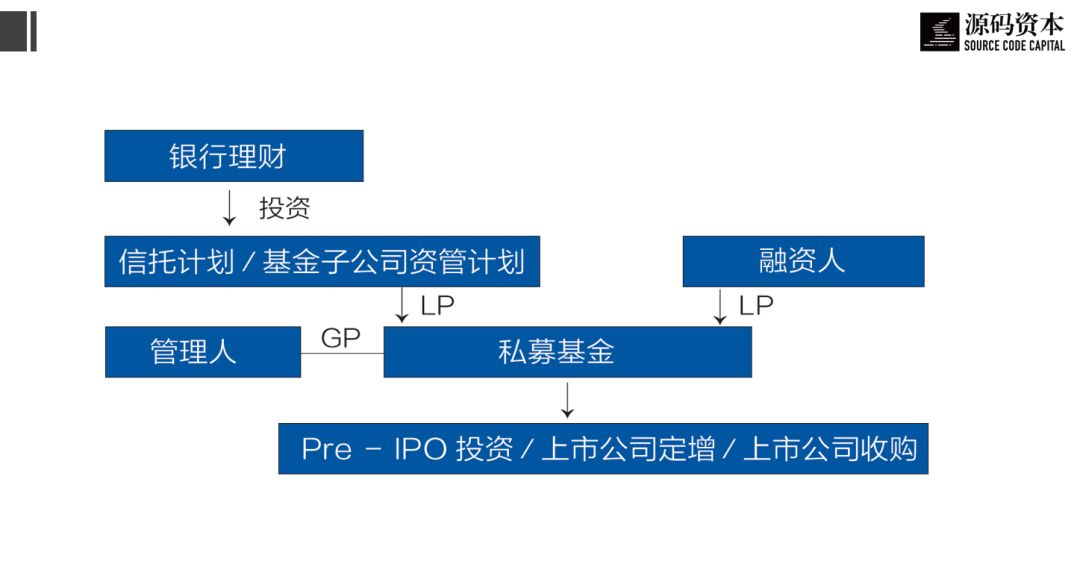
Image source: Source Code Capital
At the private product issuance level, according to the Guiding Opinions, if banks raise funds by issuing private products to high-net-worth clients, those funds may be invested in private funds; if funds are raised through public product issuance, they are subject to the restriction that "public products may not invest in unlisted company equity."
Additionally, common private fund financing models will also be affected by product grading restrictions. Under Article 21 of the "new asset management rules," product grading must meet the following requirements:
- First, public products and open-ended private products may not have share grading.
- Second, graded private products' total assets may not exceed 140% of the product's net assets, and grading ratios (senior tranche/junior tranche, with mezzanine tranches counted as senior) must be set according to the risk level of underlying assets. Fixed income products may not exceed a 3:1 grading ratio; equity products may not exceed 1:1; commodity and financial derivative products and hybrid products may not exceed 2:1.
Furthermore, the new rules raise the threshold for qualified investors. Compared to the Interim Measures for the Supervision and Administration of Private Investment Funds, the Guiding Opinions significantly raise the investor standards for private funds (see Table 1). This directly reduces the number of qualified investors, meaning private asset management products must also comply with the same investor qualification floor and subscription standards.
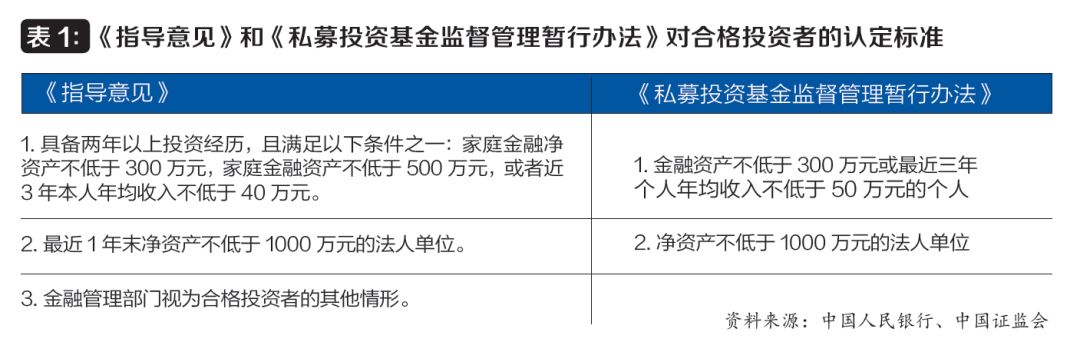
Regarding qualified investor recognition, the market remains somewhat confused. Compared to private fund management regulations, asset thresholds rise from 3 million to 5 million yuan, with a new requirement of household financial net assets of no less than 3 million yuan, while annual income drops from 500,000 to 400,000 yuan. The Investor Suitability Management Measures require professional investors to have household financial assets of no less than 5 million yuan and at least two years of investment experience. How these three standards will be coordinated may be clarified through specific implementing regulations after the asset management new rules take effect. Until the CSRC revises the Interim Measures for Private Funds, private funds should continue to comply with existing qualified investor regulations.
On private fund investment, the current impact of the "new asset management rules" on private fund investment mainly centers on whether they may invest in "non-standardized debt assets," or "non-standard" business. Private funds are already prohibited from investing in lending-type assets or engaging directly or indirectly in lending through entrusted loans or trust loans.
Going forward, whether regulators will prohibit or restrict private funds from investing in other "non-standard" business, and what standards private funds must meet to invest in "non-standard" business, remain unclear and await subsequent regulatory specification. If private funds employ share grading, multi-layer nesting, guaranteed returns, or similar arrangements when investing in other asset management products, they may likewise be subject to "new asset management rules" regulation.
It should be noted that if private funds serve as investment channels for bank or trust funds, primarily to help banks or trusts circumvent regulatory constraints on investment scope, interest rate controls, credit quotas, or capital adequacy ratios, they may face heightened scrutiny going forward.
On business models, because private funds maintain extensive business ties with various financial institutions, the Guiding Opinions' provisions on financial institution asset management business will directly affect private fund business models. Common structures such as "bank wealth management + private fund FOF / bank wealth management + private fund, insurance asset management + private fund, non-financial institution asset management product + private fund" will be impacted. Potentially viable models going forward include: first, "financial institution asset management product + financial institution asset management product (with private fund as investment advisor)"; second, "financial institution proprietary funds + financial institution asset management product (with private fund as investment advisor)"; third, "financial institution proprietary funds + private contractual fund." Beyond this, private funds may also explore self-originated FOFs—for private funds with accumulated individual and corporate client bases, self-originated FOFs represent an area permitted by the Guiding Opinions with relatively fewer restrictions.
Encouragingly, the new rules permit a business model in which private funds serve as qualified trustees and investment advisors in cooperation with other asset management products. The Guiding Opinions state that asset management products may reinvest in one layer of asset management products, and that "the trustee of private asset management products may be a private fund manager"—meaning that bank discretionary funds or other asset management products are explicitly permitted to invest in private funds. In the past, private funds mostly could only cooperate with banks through channel structures; the new rules open a window for direct cooperation between the two sides going forward.
On industry ecology, private fund industry differentiation is expected to intensify, and private funds may accelerate applications for public fund licenses. Smaller private funds may face funding gaps more easily after the Guiding Opinions take effect, particularly those highly dependent on financial institution incubation capital that cannot easily enter financial institution investment advisor whitelists in the short term due to scale or other factors.
Response Strategies and Recommendations
Given that the CSRC and the Asset Management Association of China may issue specific rules regulating private funds in line with the "new asset management rules," private fund managers need to plan ahead, adapt to the current regulatory environment, grasp future regulatory trends, and pay attention to compliance requirements under the "new asset management rules," particularly focusing on asset management product classification standards and qualified investor standards. They should specifically verify whether private products not yet completed with registration meet "new asset management rules" requirements.
Regarding financing after the release of the "new asset management rules," private fund managers need to review whether limited partners meet qualified investor standards under the "new asset management rules." If a limited partner is an asset management product, they must also examine whether that product complies with "new asset management rules" requirements. If not, they may need to alert limited partners to potential compliance risks. Regarding investments after the release of the "new asset management rules," private fund managers may need to review whether proposed investments exceed permitted investment scope, and whether multi-layer nesting or non-compliant grading structures exist.
On capital supply, insurance may become one of the main institutional investors for private funds going forward. Before the new asset management rules, apart from the CSRC's Interim Measures for the Supervision and Administration of Private Investment Funds and the Asset Management Association of China's Private Fund Manager Registration and Fund Filing Measures (Trial), Private Fund Raising Behavior Management Measures, and other self-regulatory rules applicable to private equity fund business, insurance institutions investing in private equity funds were mainly subject to insurance regulatory rules including the Interim Measures for Insurance Funds Investing in Equity. Because these were framed from different regulatory perspectives, the new rules have no substantive impact on the above insurance regulatory rules. The impact of the new rules on insurance institutions investing in private equity funds is mainly reflected in the application and reshaping of CSRC and Asset Management Association of China regulatory and self-regulatory rules on private equity fund business.
Private funds are an important component of insurance asset allocation, with good alignment to insurance funds' characteristics of long duration, large scale, and continuous stability. Private funds in the market can orient themselves toward this direction according to circumstances, and only by deeply exploring industries that the state vigorously promotes will opportunities arise.
Trusts
The Guiding Opinions will have far-reaching effects on capital trusts. Looking at trust fund sources, currently most trust industry funds come from banks. Single trusts, which are primarily channel business, derive virtually all their funds from banks and wealth management products, serving to circumvent regulatory restrictions. Among collective trusts, which are primarily actively managed, approximately 30% of funds come from retail investors, while 70% come from institutional clients led by banks, with wealth management funds accounting for roughly 50% of bank-sourced funds.
From the institutional client perspective, channel business contraction is the trend. The Guiding Opinions permit asset management products to reinvest in one layer of asset management products, but the invested asset management product may not reinvest in asset management products other than publicly offered securities investment funds, and require upward piercing to investors and downward piercing to underlying assets. If publicly offered bank wealth management funds cannot invest in privately offered trust products, while channel business is simultaneously blocked, this means an important source of trust funds from institutional clients will contract substantially, leading to channel business shrinkage. At the same time, under bank proprietary risk control mechanisms, acceptance of volatility in net-value products is limited.
From the retail perspective, the shift to net-value products creates contraction pressure. Investors still need time to warm up to net-value products, so short-term contraction pressure remains. The long-term outlook depends on how effective investor education proves. The Guidance clearly prohibits guaranteed returns across asset management products, and trust investors accustomed to "principal protection" will need time to adjust their mindset — meaning short-term shrinkage in retail trust product scale is unavoidable. Trust companies' existing client bases consist mainly of high-net-worth individuals with relatively higher risk tolerance, so they may adopt net-value products faster than average. Still, the retail end of trust products faces considerable contraction pressure overall.
From the investment side of trust products, regulatory constraints on maturity mismatching will severely limit trust companies' flexibility in selecting non-standard assets. The Guidance requires that product maturities align with investment target maturities, specifically mandating that for asset management products investing in non-standard assets, "the termination date may not be later than the maturity date of a closed-end product or the most recent open date of an open-end product." Non-standard assets typically run 1–2 years or longer. For trust products, this leaves two options: either issue long-duration products to match, or select non-standard projects with relatively shorter durations. The first approach currently appears quite difficult; the second would significantly narrow the pool of available non-standard investments.
Response Strategies and Recommendations
Under the new asset management rules, the vast majority of channel products currently in the market have compliance issues, and trust companies' future channel business will face substantial restrictions. We recommend that trust companies use this valuable transition period to reduce channel business dependence early, return to serving the real economy, strengthen active management capabilities, carefully select investment targets, identify business growth areas aligned with regulatory direction, and prepare talent development and reserves accordingly. Additionally, with rigid redemption strictly prohibited, trust companies will face heightened pressure around project compliance review and risk disposal — they should use this opportunity to prepare and position accordingly.
Once the Guidance is formally promulgated, commercial banks' principal-guaranteed wealth management products will face restrictions, and private investment capital flows may shift and change. Trust companies need to identify new funding sources early and strengthen their capital-raising capabilities.
Robo-Advisory
This marks the first time regulators have brought robo-advisory, as an emerging product form, under regulatory oversight, defining it as an investment advisory business distinct from product distribution. However, some market debate has emerged around the definition of robo-advisory and the scope of permitted activities. Domestic robo-advisory offerings have been primarily driven by product sales institutions or departments, with no clear or sustainable profit model. The Guidance's overall approach establishes unified regulatory standards based on asset management product types, and robo-advisory's specific mention indicates two things: first, regulators fully recognize the value of this product model; second, their understanding of robo-advisory broadly aligns with mainstream global asset management industry practice.
The new rules define and regulate robo-advisory, a recently developed asset management product operating model, establishing standards before further development — effectively preventing robo-advisory from becoming the next regulatory arbitrage loophole. For robo-advisory, still in its early development, this is a positive development.
On institutional management, the new rules require that "financial institutions using artificial intelligence technology to conduct investment advisory business must obtain investment advisory qualifications." Non-financial institutions may not use robo-advisory to operate beyond their permitted scope or变相 conduct asset management business.
On investor services, financial institutions must establish separate robo-advisory accounts for investors and fully disclose the inherent limitations of AI algorithms and usage risks. Advisory accounts differ from traditional asset management (which uses asset management products as vehicles) and from product sales — they represent an "advisory management model" using accounts as vehicles and charging account management fees. Requiring financial institutions to establish separate intelligent management accounts for investors references overseas financial institutions' practice, though there are limited domestic precedents.
On investment management, institutions must file the main parameters of robo-advisory models and the primary logic of asset allocation, and avoid algorithm homogeneity exacerbating the procyclicality of investment behavior. The industry typically distinguishes between "white-box strategies" and "black-box strategies" based on disclosure level, but the Guidance does not require comprehensive disclosure of product model strategy details. Regarding algorithm homogeneity's impact on financial markets, since comprehensive assessment is not yet possible, the Guidance provides responsive measures: financial institutions must implement human intervention measures to forcibly adjust or terminate AI business operations.
According to Huabao Securities research, regulators prefer that financial institutions holding banking, securities, fund management, and insurance licenses take the lead in robo-advisory practice. Specifically, robo-advisory business requires an independent, comprehensive business system, including obtaining "appropriate" investment advisory qualifications and establishing separate intelligent management accounts for investors. Additionally, the Guidance does not restrict "external institutions" from developing robo-advisory algorithms and cooperating with financial institutions, so independent fund sales institutions may shift their business focus from C-end retail to B-end financial institution services, occupying a subordinate position in future robo-advisory development.
During the Transition Period
Asset Management Institutions' Business Adjustment Directions
The essence of the new asset management rules is unified regulatory framework implementation. The rules break down sector boundaries between banking, securities, funds, and futures, instead classifying and regulating asset management products based on fundraising method or investment direction, substantially weakening the institutional foundation for regulatory arbitrage. The rules highlight four problems: rigid redemption, maturity mismatching, multiple layering, and non-standard investment. Solutions beyond investor education include: for maturity mismatching, shortening asset duration or issuing long-duration wealth management products; for multiple layering, cleaning up or restructuring违规 layered products; for non-standard investment, reallocating to standard assets or achieving standardized circulation of non-standard assets. Among these, issuing long-duration wealth management products and non-standard asset standardization will prove relatively difficult and unlikely to be achieved quickly during the transition period. Therefore, shortening asset duration, reallocating to standard bonds, and主动 restructuring layered products are more likely to occur first.
During the transition period, regulators permit banks and asset management institutions to continue issuing asset management products provided total balances do not increase, providing buffer time. During this period, banks and asset management institutions can hardly主动 adjust liability scale and structure, because whether through shrinking bank entrusted management, or issuing long-duration and net-value products, funding sources would be constrained and profit margins compressed. However, if banks and asset management institutions do not actively adjust their asset positions, once the transition period ends they may face situations where products mature but assets cannot be rolled over, and layered products and non-standard investments must be forcibly liquidated. This would directly trigger asset fire sales and financial market volatility pressure — an outcome banks and asset management institutions naturally wish to avoid.
The Transition Period and Beyond
Recommendations for Compliant Business Operations
Evidently, for financial institutions, gradually and continuously adjusting asset allocation structure may be a reluctant choice to avoid rapid liability contraction and collective damage amid market volatility. Moreover, only after experiencing slow, effective asset reallocation can gentle, orderly liability restructuring become possible. Therefore, financial institutions' business adjustments under the new asset management rules may proceed in two stages: first, slow asset-side reallocation; second, overall liability-side restructuring.
First, early in the transition period, banks and asset management institutions are more likely to begin gradually adjusting asset structure. This includes shortening asset duration, increasing standard bond allocation, reducing product leverage, and cleaning up layered investments. Considering the currently flat yield curve, non-standard assets' primary role in serving实体 financing, and leveraged funds' concentration in bond investment, the first phase of the new rules' impact may be: in financial markets, amplified liquidity friction and asset price volatility, with widening term spreads; in the real economy, intensified credit contraction and downward economic pressure. Of course, the relatively slow pace of asset-side adjustment during the transition period will moderate these effects.
Second, late in the transition period and beyond, banks and asset management institutions may face overall liability-side restructuring. This includes bank wealth management returning to balance sheets or experiencing outflows, ultimately breaking rigid redemption. Although the current new rules have made efforts to weaken regulatory asymmetry regarding investment direction, financing leverage, information disclosure, and valuation systems, institutional-level inequalities persist between bank asset management and non-bank asset management regarding subscription requirements, sales methods, and tax rules. For example, bank wealth management subscription minimums remain far above public funds; bank wealth management sales require "dual recording," face-to-face signing, and other procedures far more burdensome than public funds; and public funds are exempt from value-added tax while bank wealth management products became subject to VAT from 2018. Therefore, the second phase of the new rules' more certain impacts include: stalled expansion of bank wealth management, weakened financial arbitrage behavior, and repricing of low-rated credit spreads.
The Future of Non-Standard Business
The new rules impose strict restrictions on non-standard assets. First, public offering products may not invest in non-standard assets. Second, asset management products investing in non-standard assets must comply with financial regulators' standards on quota management, liquidity management, and other regulatory requirements, with strict maturity matching. Product investment restrictions and strict maturity matching will significantly impact existing non-standard products.
According to estimates, trust companies and bank wealth management hold approximately 23 trillion RMB in non-standard debt assets; including non-standard assets held by securities firms, fund专户, and insurance asset management, total scale likely exceeds 30 trillion RMB. Given that mainstream non-standard trust products have approximately 3-year duration, non-standard asset digestion paths include: first, natural maturity and redemption as the asset management rules' transition period is extended; second, converting non-standard assets to standard assets, vigorously developing direct financing, and building multi-level capital market systems; third, transferring to bank balance sheet holdings. Non-standard assets offer advantages in valuation methods and yield, and sacrificing some liquidity requirements, they remain attractive asset targets.
Like channel business, "non-standard" business is ultimately a product of specific historical circumstances — the broad context being that bank indirect financing, constrained by regulation, could not satisfy real economy financing needs, while standardized direct financing product supply was severely insufficient. Under policy guidance for finance to return to its origins, "non-standard" and channel business will eventually complete their historical mission and gradually decline, with substantial contraction in non-standard business volume in 2018 being highly probable. However, non-standard business will persist and有望 move toward规范化 development.
But achieving "non-standard to standard" conversion also requires regulators to further develop standardized direct financing products such as high-yield bonds, ABS, and equity financing.
Under the combined impact of various new regulations, what paths remain for non-standard business? We believe possible routes include:
- First, compliant trust loan channels. Trust loans currently remain a compliant path, but calls for trusts to return to their origins have never ceased, and with previous CBIRC policies restricting trust companies' non-standard business, regulating bank-trust cooperation, and controlling trust channel business, how long the trust loan channel path can continue, and what future policy may bring, remains uncertain.
- Second, debt or收益权 transfers. Under密集 new regulations, private fund managers' active management capabilities face greater tests, requiring more compliant transaction structure design — for example, constructing合法 creditor-debtor relationships to受让 debts or debt收益权, with repayment through repurchase by the financing party or third parties. Additionally, assistance from asset management companies or factoring companies can help with debt asset management and recovery.
- Third, tools such as financial exchange debt financing plans. For financing entities that have already identified qualified investors as funding sources, platforms like Beijing Financial Assets Exchange can be used to file and issue non-publicly listed debt-based fixed-income products.
- Fourth, limited partnership capital increases to factoring companies with shareholder loans extended, enabling factoring companies to conduct accounts receivable factoring business and受让 debt收益权.
Growth Opportunities Under the New Asset Management Rules
Under the new asset management rules, regulatory arbitrage opportunities will diminish going forward. However, this does not prevent asset management institutions from developing active products within a compliant framework — those with stronger active management capabilities stand to benefit most. In the medium to long term, it is an inevitable transition direction for all institutions to strengthen active management and return to the original purpose of asset management.
The Guiding Opinions explicitly support value investing in the technology and innovation sector, encouraging financial institutions to raise funds through asset management products to support national priority areas and major infrastructure projects, technological innovation and strategic emerging industries, Belt and Road Initiative construction, and coordinated development of the Beijing-Tianjin-Hebei region. It also encourages financial institutions to use asset management products to support economic structural transformation and reduce corporate leverage ratios.
Asset management institutions can actively expand into areas aligned with China's industrial upgrading, the Belt and Road Initiative, and free trade zone strategies — including national priority areas, major infrastructure projects, technological innovation, and strategic emerging industries. They should proactively collaborate with relevant industrial funds (industrial parks) to support economic structural transformation and reduce corporate leverage ratios through asset management products.
Summary
Once the rigid payment guarantee in the asset management industry is broken, the greatest "inequality" among institutions will also be eliminated, reshaping the competitive landscape of the industry. The direction of capital flows will determine who emerges victorious in this transformation. After unified regulation of asset management product types, all institutions will return to the same starting line. From an optimistic and proactive perspective, opportunities outweigh challenges.
That said, we cannot ignore that the real difficulty going forward lies in the gradual implementation of the new regulatory rules — implementation details still need further refinement and clarification. Overall, asset management business in 2018 still faces considerable uncertainty regarding additional regulatory compliance requirements. During the implementation of the new asset management rules, attention must also be paid to their specific impact on financial markets and the business development of financial institutions. By strengthening guidance on relevant issues that arise during implementation, we can achieve a smooth and orderly transition and implementation of the new rules without causing significant turbulence in the financial sector or markets.
We believe that after implementation of the new asset management rules, the growth rate of industry assets under management will slow significantly, achieving a transformation from quantitative to qualitative growth and promoting the development of asset management business toward a higher-quality stage. At the same time, competition among financial institutions' asset management businesses will intensify. Financial institutions will need to genuinely focus on enhancing core competitiveness; transformation and development will become more urgent; differentiation in operations will gradually increase; market competition structure will tend toward consolidation; and some weaker small and medium-sized institutions may become increasingly marginalized.

Note: The above content is excerpted from "Source Code Capital Policy Research 2018, Issue No. 1"
Read More Policy Research

Policy Research Issue 2 | New Asset Management Rules: Regulatory Approach and Arrangements
Policy Research Issue 1 | Reinterpreting the Guiding Opinions on New Asset Management Rules

Source Code Capital
Creating Lasting, Real Value

WeChat ID:
sourcecodecapital
More professional content
Follow our official WeChat