Source Code Capital | Congratulations to Edianyun, "the first listed office cloud company," on its successful IPO: Source Code Capital's steadfast partnership in creating lasting, real value


Do the hard thing, do the right thing. At 9:30 a.m. on May 25, the sound of a gong rang out simultaneously on electronic screens in Beijing and Hong Kong, marking Edianyun's successful IPO in 2023. As a leading comprehensive office IT solutions provider in China, Edianyun has been described by media as the "hidden giant" in a 200-billion-yuan blue ocean market. Since 2014, the company has been deeply rooted in serving China's small and medium-sized enterprises (SMEs) in office IT, commanding a market share in comprehensive office IT solutions equal to three times the combined total of the second- through fifth-ranked players. Currently, Edianyun's operations cover more than 100 cities nationwide, with over 1.1 million devices under management. Its listing on the capital markets, pioneering a path to the Hong Kong stock market, is welcome news for both the company's own development and its customers.
Behind Edianyun's growth and hustle lies the commercial rise of China's SMEs — a sector that has grown 2.7-fold over the past decade to 48 million enterprises. As the largest and most dynamic group of businesses, their subscription records with Edianyun trace the national DNA of entrepreneurship and innovation, weaving together organizational connections and combinations that generate Chinese efficiency across industrial ecosystems.
Those present at the listing ceremony included founder Pengcheng Ji, as well as Kaisi Chang and Wei Wang from Source Code Capital. Source Code Capital led three consecutive funding rounds in 2018, 2019, and 2020, serving as a steadfast companion and unwavering supporter along Edianyun's steady growth path. Twenty years ago, in the same dorm room at Tsinghua University, Pengcheng Ji and Kaisi Chang battled each other in video games; twenty years later, they walked onto a real-world battlefield together, securing their first milestone victory at the Hong Kong Stock Exchange.
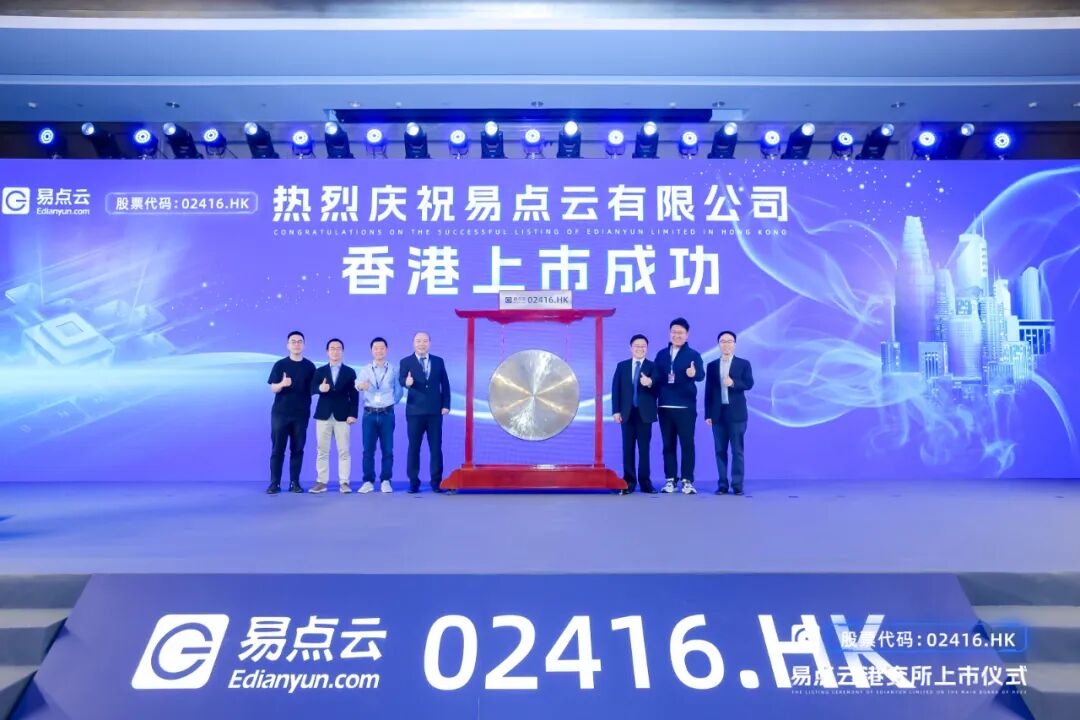
Source Code Capital Partners Kaisi Chang and Wei Wang with Edianyun founder Pengcheng Ji at the bell-ringing ceremony
01
Roommates Who Rang the Bell
Edianyun's journey to becoming a "hidden giant" began when Pengcheng Ji started offering secondhand computers to fellow students on the Shuimu Tsinghua BBS. Once the most popular university bulletin board system in China, Shuimu Tsinghua boasted over 500 forums at its peak, 300,000 registered users, and a record online population of 23,674. Here, Ji found his first customer and shipped his first secondhand computer. Kaisi Chang initially teased him about it: "A Tsinghua PhD student, out there selling computers every day."
During a lunch break, Pengcheng Ji told Kaisi Chang and Xingshi Wang: "You can't even imagine — we now have 50,000 computers out with customers." His eyes lit up: "You know how many 50,000 computers is? This room couldn't hold them, I don't think."
By 2014, Ji's SKS was China's largest secondhand computer trading platform.
No one expected him to take what everyone saw as a "distraction" and build it into something impossible to ignore. As a pure STEM-trained entrepreneur, Pengcheng Ji possessed something different from the rest, which Chang summarized as "business acumen" and Wang characterized as the rigorous thinking required to make the impossible possible.
This deep-rooted school friendship became one of the backdrops for Source Code Capital's steadfast support of Edianyun. Source Code Capital officially entered at Edianyun's Series C round in 2018, but their collaboration had begun even earlier.
From 2011 to 2014, Edianyun's annual revenue grew by 20% each year, reaching 20 million yuan. The company was profitable but had an obvious ceiling. At the end of 2014, Ji decided to do something new — tackle a bigger social problem, pursue a venture with a higher ceiling.
Moving from simply tinkering with hardware to enterprise-facing IT services: at the time, no one in China was offering comprehensive office IT solutions, and "subscription model" was still a novel term. But having long witnessed the real needs of SMEs firsthand, he trusted his judgment and resolved to walk a path no one had taken.
Among the friends he consulted was Kaisi Chang. "Would people actually rent? Computers aren't even that expensive?"
"In reality, a huge number of Chinese SMEs don't need high-performance computers, but they're very cost-sensitive. And because these businesses are so small — maybe two or three rooms — some have a little equipment room with iron racks packed with computers. Inventory costs pile up, and management is a headache," Ji explained. "If this model works, it can ease the burden for China's vast sea of SMEs."
Unlike domestic startups that simply copied trendy overseas concepts, this model was built one secondhand computer at a time, with customers won through relentless legwork. Only by seeing SMEs' struggles with his own eyes could he create a new business model based on human value rather than chasing concepts and trends.
True innovation always arrives cloaked in misunderstanding; from birth to acceptance and recognition takes time. It would be nearly another decade before they walked from their dorm room to the Hong Kong Stock Exchange.
02
Pragmatic Idealists
When Kaisi Chang pulled in Xingshi Wang to evaluate Edianyun, the first thing he helped with was validating the model.
At the time, Wang helped arrange a news article through mass media channels titled Starting from Deposit-Free Laptop Rentals, Edianzu Aims to Help SMEs Achieve Asset Lightness. Chang still remembers the numbers: "The test results were pretty good — 10,000 clicks in a few days, 200 visits to the website, 40 registrations." With no domestic company to benchmark against, Source Code helped analyze comparable foreign businesses, ultimately proving the model viable.
Meanwhile, Edianyun was growing with surprising smoothness. By 2016, enterprise customers purchasing its services had reached 10,000. Looking back, Chang would even laughingly describe its business stability as "boring."
The only slight turbulence came in 2017, when turmoil in P2P lending shook the entire funding landscape. Source Code Capital partner Jian Wu actively connected Edianyun with banks, debt funds, and other partners to broaden its financing channels. Subsequently, Source Code entered as the Series C lead investor, helping Edianyun steady its footing.
What followed were five years of accelerated growth.
Because they understood the company so well, Source Code rarely interfered in Edianyun's day-to-day operations. But whenever "Lao Ji" came to them with a problem, they threw their full weight behind it.
"From the very start of their entrepreneurship, I noticed the Edianyun founding team was extremely sensitive to data. They realized early on that the key to this business was cash flow management, and built a management model mapping business operations to physical assets to capital cash flows. How much does a computer cost to acquire? How to use external capital? At what cost of capital does it break even with the returns from that computer? They thought it all through very clearly," Chang explained. "And the team had its own pricing logic early on, reverse-engineering prices from capital costs. Edianyun is the definer and leading enterprise of this business model, with strong pricing power in the industry." Edianyun's financial clarity is exceedingly rare among startups.
To facilitate nationwide computing resource scheduling, Pengcheng Ji led his team to develop the in-house "Nebula System." From procurement through transfer, redeployment, retirement, and profitability, every device has its own clear "life trajectory." The Nebula System doesn't just schedule devices — it also efficiently coordinates over 3,000 engineers serving enterprises nationwide, with response speeds ten times faster than competitors, visibly distinguishing Edianyun from rental-centric businesses.
In 2017, Edianyun launched its SaaS project "Yi Pandian." After Source Code's investment, during regular conversations with portfolio companies, Source Code founder Yi Cao and capital markets lead Wei Wang worked with Pengcheng Ji to clarify the company's "cloud services" positioning, and the name Edianyun was formally established.
Source Code's various post-investment service teams set out to help this founder — who jokingly called himself a "straight guy with no stories," possessed of extraordinary mental resilience and meticulous attention to detail — understand and integrate into the world of capital. They wanted him to learn to tell his story from the perspectives of the public and investors, bringing more like-minded people along to accomplish difficult but worthwhile things together.
Shortly after the investment closed, Ji raised the issue of insufficient sales staff to sustain the company's rapid growth. The post-investment team took on the request and analyzed: "Sales roles have high demand and high frequency; optimizing recruitment capabilities for sales positions matters more." After deep investigation, Source Code helped establish unified screening criteria, clarify role profiles, summarize recruitment SOPs, and shift interview methods to a combined written-and-oral approach with dedicated face-to-face sign-offs and new-hire boot camps. The problem was resolved smoothly.
As Edianyun entered its rapid development phase, middle managers' responsibilities grew increasingly weighty. Given the business's particular nature, transforming from "finding people" on the market to "growing people" internally became crucial. In the transition from early-stage small-scale management to modern, efficient management models, Source Code became Edianyun's strongest supporting force through various means — such as jointly identifying leverage-type talent and regularly organizing Code Brain learning sessions for CEOs.
Later, as the organizational structure stabilized, IaaS coverage expanded, and SaaS services scaled up, Edianyun had prepared the objective conditions for going public.
03
Deep Mutual Trust Is the Foundation of Everything
Wei Wang was probably the most excited person at the bell-ringing moment after Edianyun's own internal staff — so much so that even Pengcheng Ji recalled: "Brother Wei probably came to our office more often than he went to Source Code's Beijing office." This "Brother Wei" is Source Code Capital partner Wei Wang.
With over a decade of capital markets experience, Wang is a seasoned expert with combined backgrounds in investment banking, investing, and listed companies. The capital markets team he leads began tracking Edianyun's IPO preparations two years prior. Even during the pandemic, he met with Pengcheng Ji almost every month, each conversation stretching from evening into the early morning.
"Our portfolio companies trust us deeply. Whatever we can do stems from the deep mutual trust we've built with them." This matters enormously to Wang.
Since 2022, under the impact of US dollar interest rate hikes and the global pandemic, Hong Kong IPO issuance faced obstacles. Many companies that had passed their hearings still struggled to find cornerstone investors and complete their offerings.
When Pengcheng Ji came to Wang to discuss concerns about Edianyun's IPO, Wang decided to take personal responsibility and see it through. There was no positional opposition between investee and investor, no concealment by the investee from the investor. On the foundation of candid mutual trust, everything from initial listing planning and team building to intermediary selection and listing challenges was resolved through the joint efforts of Edianyun and Source Code's capital markets team. Most critically, progress was clearly made on the most painful point — cornerstone investment for the IPO.
Along the way, Wang discovered local governments' clear industrial demands, as well as the natural information barrier between government and enterprises.
"Generally, local governments' 'three standard moves' for investment promotion are providing land and factory buildings, tax incentives, and talent rewards. But if these aren't a company's pain points, it's hard to win them over. Finding the right fit is key. For Chengdu Hi-Tech Zone and Edianyun, the fit lay in the fact that the digital economy is one of the district's pillar industries. Beyond corresponding industrial policies, the government was willing to provide strategic investment. An excellent company like Edianyun could form tight 'industry + capital' cooperation with the locality," Wang recalled.
Wang believes portfolio company listing and securitization has always been an indispensable part of investing: "Going public is a milestone for companies, not an endpoint — and the same holds for investment institutions. In a startup's journey to maturity, angel investors, VCs, and PEs typically get involved; this is the honeymoon period between companies and primary market investors. Once you enter the listing phase, the primary market is largely out of the picture — investment banks and other intermediaries come in to push the listing through, and after listing it's the interaction between secondary market investors and the listed company. The dividing line is very clear. Primary investors gradually distance themselves from companies starting from listing preparations; beyond divestment, their interaction with listed companies is very limited."
Wang's decade-plus in capital markets has given him deep feelings about this: "After a company goes public, the investor friends change — the root cause is that primary investors chose to let go during the listing phase. We hope and are able to bridge this gap at the listing stage. This is the nexus connecting primary and secondary markets, and the further extension of deep mutual trust in the capital markets."
This is no easy task. Between wanting to and actually doing it lies much running around, thinking, and boldness.
04
Doing Hard but Right Things Together
Getting to today has never been easy for Edianyun.
Because from the start, Edianyun set out to do something thoroughly innovative. Many companies in the market claim to be industry number one, but Edianyun is the only one whose comprehensive office IT solutions truly constitute its largest revenue contributor. Competitors are still transforming their revenue mix, while Edianyun chose the hardest but most valuable path from day one. Emphasizing "human value," emphasizing "making things easier for customers" — almost starting from zero, no one feels SMEs' pain more acutely than Edianyun.
From an initial idea to a successful IPO, from Kaisi Chang to Wei Wang, Source Code has accompanied Edianyun like a comrade-in-arms along the way, being "the first to eat the crab." Xingshi Wang, who is both Ji's junior schoolmate and a managing partner at Source Code Capital, witnessed nearly the entire journey. He said: "I think Source Code's values are quite distinctive — it's about finding people who want to change the world. Whether we invest or not, we want to support them in getting things done!"
Easier said than done — but this was almost as difficult as Edianyun's own journey to today. Yet this time, Source Code fought a beautiful battle: from monthly meetings with updated market situation presentations, to refining the company's SOP system, debt financing connections, strategic direction support, weekly meetings during the listing period, IPO team assembly, to the most critical cornerstone investor confirmation, and even public opinion monitoring analysis and media communication — Source Code was present at nearly every step.
Source Code has always sought out entrepreneurs with the potential to move society, accompanying them through nearly every stage of their companies' development. Source Code's LPs don't just focus on the main fund; they also value co-investment opportunities in good companies. At Edianyun's pre-IPO stage, OrizaFoFs, as a Source Code Capital LP, co-invested in Edianyun, offering support while also achieving solid financial returns.
In a sense, Source Code and Edianyun are alike — both "pragmatic idealists," using their greatest capabilities to push forward things that are "hard" but "right." Pengcheng Ji recognizes Source Code: "Beyond Edianyun, Source Code has invested in many excellent projects. I think Source Code's post-investment support ranks number one among all investment institutions."
Like the original intention from nine years ago — seeing small companies stack equipment in corner iron racks because they were so cost-sensitive when he was selling computers — Pengcheng Ji set foot on a road less traveled. But along this journey, he is no longer alone.
Now, Pengcheng Ji and his roommate Kaisi Chang rang the bell together. Twenty years in the making, they have arrived together at the beginning of a new story.