Code Moment | Moonshot AI K3 Officially Open-Sourced: Committed to Building an Open, Evergreen AI Ecosystem
Moonshot AI believes a broad, open ecosystem is the most suitable soil to sustain it.
On July 27, Kimi K3 was officially open-sourced. Moonshot AI released the model weights and technical report for Kimi K3, along with open-sourcing three key infrastructure technologies that underpin its training: MoonEP, FlashKDA, and AgentEnv. The goal is to accelerate the deployment and democratization of frontier intelligence and advance AGI research.
Kimi K3 Weights Released
Kimi K3 is Moonshot AI's most capable model: a 2.8 trillion parameter Mixture-of-Experts (MoE) model with native visual understanding and support for a 1 million token context window.
Kimi K3's parameter count is roughly 3x that of Kimi K2.5, but scaling isn't merely stacking parameters. Under constrained compute conditions, Moonshot AI achieved a 2.5x improvement in scaling efficiency through a series of technical innovations including Kimi Delta Attention, Attention Residuals, and MoonEP — meaning optimal compute utilization now yields approximately 2.5x the intelligence per unit of compute.
Now, anyone can download and deploy the Kimi K3 model — whether for internal R&D or embedding into end-user-facing products — with no restrictions (for other use cases, see the Kimi K3 License).
→ Download Kimi K3 Model Weights
K3 Technical Report Published
Alongside the Kimi K3 model weights, Moonshot AI is also releasing its training methodology — the Kimi K3 technical report is now live.
From the technical report, you can learn these technical details:
-
KDA + AttnRes: Mixes KDA with Gated MLA at a 3:1 ratio for efficient long-context modeling, with block-level attention residuals enhancing cross-layer information flow.
-
Stable LatentMoE: Each token activates 16 experts from 896 routed experts, maintaining training stability at extreme sparsity through SiTU-GLU and Quantile Balancing.
-
MoonViT-V2: A vision encoder trained from scratch using next-token prediction without contrastive pretraining, matching SigLIP-initialized baselines while achieving more stable optimization.
Post-training and evaluation: large-scale task synthesis across three domains — general reasoning, general agent, and coding agent — plus reinforcement learning infrastructure for million-token contexts, and complete evaluation results from nearly 20 internal benchmark sets.
The above is just an overview; detailed discussions and ablation studies are fully developed in the technical report.
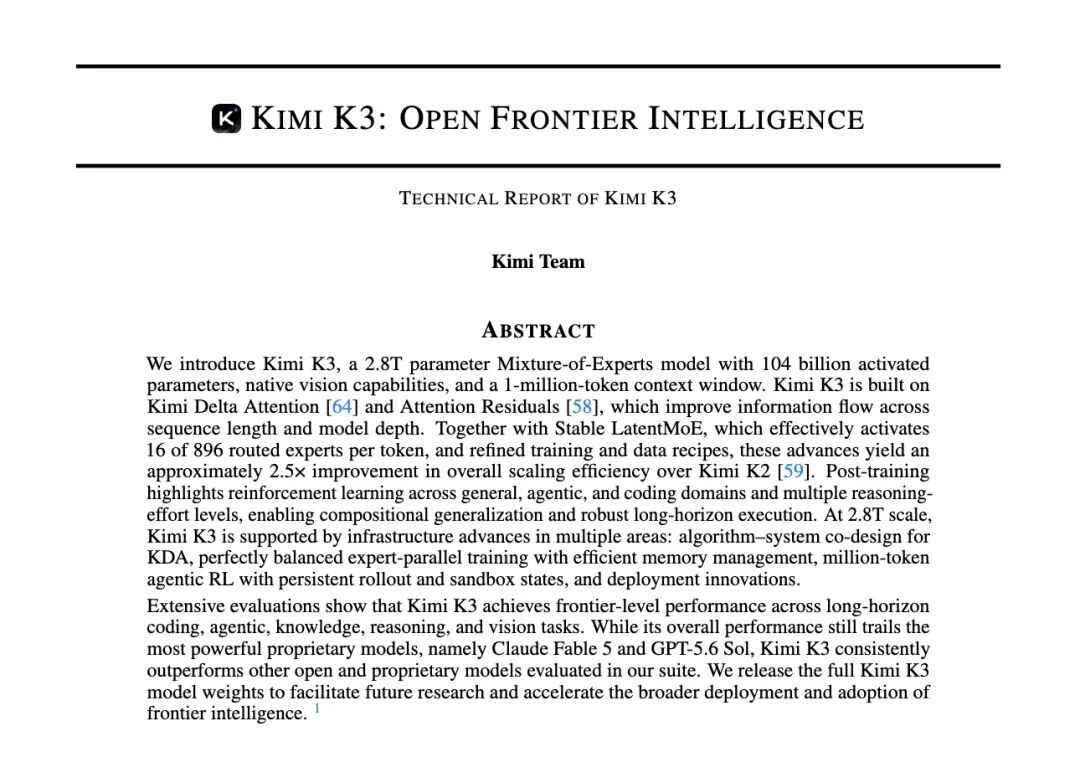
→ Download Kimi K3 Technical Report
Key Kimi K3 Infrastructure Technologies Open-Sourced
Model capabilities depend on stable support from training systems — the infrastructure layer. Moonshot AI is introducing three infrastructure technologies that underpin Kimi K3 training: MoonEP, FlashKDA, and AgentEnv, covering the critical chain from high-performance communication and kernels to distributed RL environments. FlashKDA was previously open-sourced, while MoonEP and AgentEnv are being officially open-sourced with this release.
-
MoonEP: A high-performance communication library built for ultra-large, fine-grained MoE, enabling expert-parallel communication to achieve peak efficiency even under imbalanced conditions.
-
FlashKDA: A high-performance kernel implementation of Kimi Delta Attention. On NVIDIA H20 GPUs, it achieves 1.72–2.22x faster prefill speeds compared to the flash-linear-attention baseline, and can directly serve as a drop-in replacement backend.
-
AgentEnv: A sandbox system developed in collaboration with KVCache.ai for running agent environments at scale. It provides high-fidelity, strongly isolated sandboxes for Kimi K3's post-training, with flexible support for rapid snapshotting, recovery, and forking — capable of handling large-scale parallel agent workflows and training tasks.
These three technologies are critical to Kimi K3's training efficiency and stability. By releasing them openly, Moonshot AI hopes to assist those who need to train next-generation models.
Why Did Moonshot AI Choose to Open Up?
Moonshot AI firmly believes in the value of open-weight models. They lower the barrier to accessing intelligence, drive innovation, and give users greater control over their data, privacy, and ownership. Over the past few weeks, the company has heard many supportive voices from the AI community and from technical leaders who share its vision.
For a technology as consequential as AGI, Moonshot AI believes a broad, open ecosystem is the most suitable foundation — and will continue contributing its part.