Li Yile of Source Code Capital: A Breakthrough in China's VC Model — The Era of Ecosystems and Value Creation Has Arrived

Technology reshapes business; capital empowers entrepreneurship.

By Li Yile, Managing Director of Source Code Capital
Drawing on the practice of China's VC industry, this article introduces the concept of the "China Ecosystem VC" and categorizes it into three types: Platform-based VC, Resource-based VC, and Composition-based VC. It argues that the ecosystem VC model improves upon traditional approaches across the entire investment cycle — from sourcing and due diligence to post-investment management and exit. The development of China's ecosystem VCs marks a significant evolution beyond Western traditional VC, representing a manifestation of China as a global power and paving the way for a new paradigm and breakthrough in the art of venture investing.
Technology transforms business; capital empowers entrepreneurship. After four decades of development, China's venture capital industry has secured a prominent position on the global stage. Its thriving VC hubs now rival Silicon Valley, yet the business models and academic research of Chinese VC remain underexplored. An ecosystem VC leverages its ecological advantages and resource networks to strengthen the full-cycle management of fundraising, investing, managing, and exiting. It actively promotes the growth of portfolio companies by unlocking the value of each "ecological soil," creating tangible, multi-dimensional value that benefits itself, its ecosystem, the enterprises, and society at large. Compared to the classic practices and traditional theories of American venture capital, China's ecosystem VCs exhibit innovative characteristics that have not only gained broad recognition from global limited partners (LPs) but also surpassed the long-standing conventions of Western venture capital.
Types and Characteristics of China Ecosystem VCs
The original "Venture Cycle" was proposed by Harvard University professors Josh Lerner and Paul A. Gompers. In the traditional model, VCs first raise capital from institutional LPs, then source deals, conduct due diligence, monitor investments, and distribute returns upon exit — with the cycle repeating as subsequent funds are raised. Meanwhile, venture investing has always faced fundamental challenges including "information asymmetry," "illiquidity," and "high risk." Based on observations in the Chinese market, ecosystem VCs can be divided into three categories: Platform-based VC, Resource-based VC, and Composition-based VC.
Platform-based VC
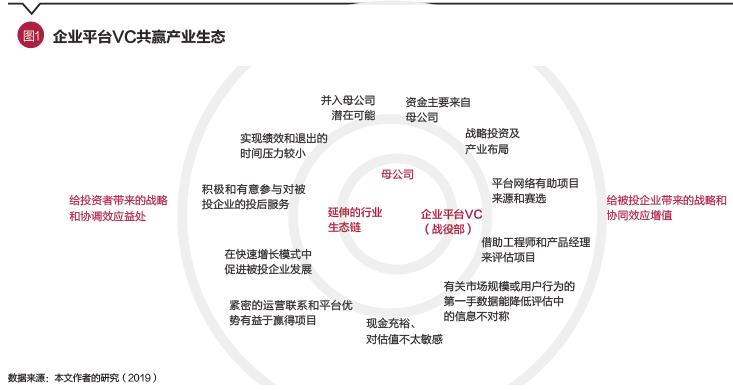
Platform-based VCs use platforms as their vehicle, with ecosystems formed by industry chains or multiple business units extending from enterprises. Through industrial layout, these VCs leverage their extensive business lines to provide portfolio companies with operational support, strategic partnerships, and new product lines and influence for the parent company. Generally, dedicated VC arms of Chinese internet giants or strategic investment departments of large enterprises fall into this category. They exhibit the following characteristics:
First, they enhance investment efficiency through platform power. When making strategic investments, platform-based VCs can better evaluate projects through their inherent industry knowledge. For example, Tencent, Alibaba, and DiDi all have product managers or engineers from various business units identify technologies, founding teams, and product appeal. This means such VCs possess certain information advantages over their peers, with deeper insights into technology, markets, customer attributes, or supplier preferences — helping to reduce the inherent "information asymmetry" and uncertainty of venture investing.
Second, they drive commercial technology development and promote synergies. Take Xiaomi's strategic investment department: its extensive IoT and smart ecosystem can accelerate customer acquisition for startups (for instance, access to 260 million Xiaomi fans and their network resources), provide cloud computing, brand PR, HR support, and foster more Xiaomi ecosystem business partnerships. The powerful platform of enterprise-based VCs offers significant advantages in attracting entrepreneurs, winning deals against other VCs, and negotiating terms. They can help portfolio companies access critical resources such as Tencent's traffic through WeChat Wallet, platform "2B" and "2C" local and international distribution channels (such as Alipay, Taobao, Xiaomi online stores), big data insights, CRM software, or logistics expertise (such as access to Alibaba's Cainiao logistics platform).
Unlike traditional VCs, platform-based VCs actively guide portfolio companies into rapid growth models and integrate them into the parent company's resource network, creating or linking business collaborations. They can also provide portfolio companies with the parent company's resources and assets, help them connect with extensive networks of platform experts/executives, and gain brand recognition and the potential for continued capital support. Moreover, platform-based VCs not only seek potential financial returns but also focus on strategic emerging sectors, optimize their industrial layout, and bring unique strategic benefits, strong resource integration, and industry linking capabilities to the platform. For example, Tencent enriched WeChat services and channel service revenue through its O2O (online-to-offline) investment layout; the Xiaomi platform has connected over 150 million smart devices and co-owns IP and user data. A virtuous win-win model can also introduce new technologies to enterprises, achieve cost savings and hedge business risks, strengthen market positioning, enhance and supplement platform innovation capabilities, and accelerate existing business development. Thus, the bidirectional post-investment value creation of platform-based VCs forms a virtuous "platform ecosystem synergy effect."
Resource-based VC
Resource-based VCs use their proprietary resource integration as their vehicle, which can be likened to a massive "resource magnet." These ecosystem VCs do not originate from any "ecosystem"; their ecology evolves from over a decade of accumulated investment experience, capital advantages, brand value, and extensive networks. Therefore, the ecosystem of resource-based VCs is relatively independent and difficult to replicate. Resource-based ecosystem VCs exhibit the following characteristics:
First, they typically possess strong capital, cross-industry and cross-stage investment capabilities, capital, and knowledge. Examples include HSG, GGV, and Hillhouse. Resource-based VCs excel at applying their multi-industry, horizontal integration investment capabilities, and brand network know-how to serve enterprises. The specific "resources" vary by institution; the key is combining horizontal integration of industry insights with advantages in deal sourcing to achieve economies of scale.
Second, resource-based VCs can generally build diversified proprietary portfolios and support multiple investment tracks. Take HSG: it can cover multiple rounds and support multiple companies on the same "investment track," which helps hedge risks and maximize industry coverage. HSG built cohesive "investment layout" portfolios in the PC internet and e-commerce era (circa 2006–2009); the mobile internet and O2O era (circa 2010–2012); and the sharing economy, consumption upgrade, and internet finance era (circa 2012–2015), becoming its own "industry-focused ecosystem."
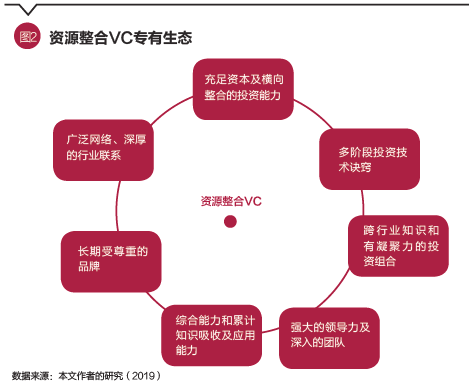
Third, resource-based VCs actively bring value to their portfolio companies, especially through their ability to make long-term investments covering multiple stages of a company's development. Take the English education startup VIPKID: HSG made four consecutive investments in it (from Series A to Series D). Precise post-investment services and effective risk control systems help resource-based VCs reduce enterprise risk. For example, they can provide portfolio companies with extensive networks of CEOs, CFOs, CTOs, as well as deep industry connections, industry knowledge, operational know-how, and extensive post-investment support.
Finally, these VCs excel at synthesizing, combining, and applying existing knowledge, possess "combinative capabilities," and transform market inefficiencies into the foundation of their market dominance. Every member of HSG can access and systematically learn from global investment achievements and knowledge dating back to 1972. Over time, accumulated knowledge helps the China team cultivate the ability to absorb thinking, information, management, and methodologies from all aspects of the global venture cycle. For resource-based VCs themselves and their investors, this enables them to conceive and implement strategies aimed at improving performance, using economies of scope to streamline the venture cycle. Overall, resource-based VCs reduce resource redundancy, amplify venture value, and maximize potential financial returns.
Composition-based VC
Composition-based VCs use resource linking and post-investment services as their vehicle, continuously expanding their capabilities through novel ways of creating, combining, and introducing strategic partners. As independent venture capital firms, their ecosystems are built through external strategic partnerships — such as commercial collaborations with internet giants, new economy leaders, or other financial institutions (third parties).
Generally, composition-based VCs can combine industrial and capital forces, integrating industrial resources, industry insights, and capital within the ecosystem to form "collective brainpower." This helps VCs amplify their competitive advantages across fundraising, investing, managing, and exiting, and further enhance internal comprehensive capabilities through external perspectives. Meanwhile, it can establish and leverage market synergies among the VC, strategic partners, and portfolio companies, creating multi-party value. Take Source Code Capital: it has built a unique "industry super connector," a "Ma Hui" mutual assistance system composed of over 30 new economy leaders and Source Code portfolio companies, with key members including Meituan, ByteDance, and KE Holdings. The resulting composition-based capabilities integrate domain expertise and networks (technology, brand, product, capital, services, intelligence), with continuous quality co-sharing, helping startups connect with internet giants and fully leveraging market resource allocation. Compared to traditional VCs, this combination of industry and capital can enhance such VCs' information advantages, brand recognition, and competitiveness in deal sourcing.
For portfolio companies, these ecosystem VCs can help improve commercial technology and management efficiency, provide recruitment services, strategic and operational advice, and comprehensive financing assistance. The network effects brought by composition-based VCs provide entrepreneurs with efficient and customized connections to promote diverse, in-depth cooperation among parties. This further assists portfolio companies and strategic partners in technology and sales collaboration, follow-on financing, closed-door exchanges, and mentorship, thereby integrating into extensive industry-leading networks and accelerating the development and potential investment returns of venture-backed enterprises. Meanwhile, through effective arrangement and integration of partner resources, products, and services, composition-based VCs can achieve compound effects for multiple parties, stimulate multi-dimensional collaboration, and cultivate strategic information distribution and exchange. For strategic partners, the ecosystem can provide information about new technologies or business concepts, enable supply chain synergies and business collaboration possibilities, and even potential future M&A targets.
In summary, the fundamental difference between ecosystem VCs and traditional VCs lies in how they build, manage, and leverage ecological networks to better promote the growth of portfolio companies. Based on empirical research and industry interview surveys covering over 81 leading Chinese VC institutions and global top-tier LP institutions (equivalent to over 178 professionals), the author found through qualitative and quantitative comparative analysis that ecosystem VCs have greater advantages than traditional VCs (see Table 1).
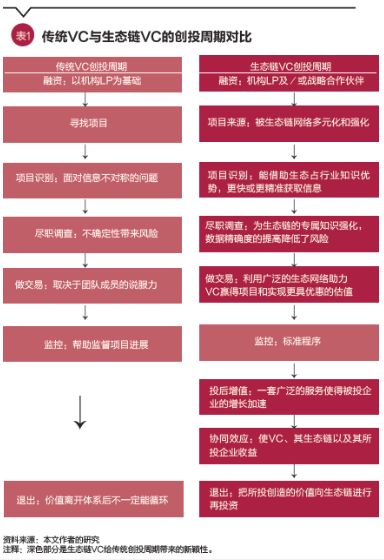
In the pre-investment phase, ecosystem VCs can leverage their "ecological capabilities" — such as ecological knowledge to acquire information about markets, technologies, and products faster and more accurately — greatly increasing deal flow, reducing uncertainty in due diligence, and lowering investment risk. In the post-investment phase, by leveraging operational, industry, and business synergies between the ecosystem and portfolio companies, ecosystem VCs can provide broader and more diversified value-added services, fully utilizing ecosystem network resources to accelerate enterprise growth and value appreciation, thereby having the opportunity to achieve excess returns. Of course, it cannot be denied that various types of ecosystem VCs also have potential drawbacks and limitations.
Challenges and Evolutionary Trends Facing China Ecosystem VCs
The main challenge for ecosystem VCs lies in their dependence on interpersonal relationships and aligned interests. Platform-based VCs may limit other strategic partnerships for portfolio companies. Resource-based VCs need to replenish potentially depleted "resources" over time, and face the question of whether new and old team members can continuously share, absorb, and apply accumulated knowledge, with economies of scope potentially encountering diminishing returns. Thus, operating substantial capital and large teams places higher demands on leadership and management skills. The challenge for composition-based VCs also lies in the sustainability of strategic partnerships. Long-term coordination with external partners may face costly possibilities, and changes in partners' ambitions or preferences may increase the difficulty of relationship maintenance. As Clayton Christensen's theory of "disruptive innovation" suggests, if a composition-based VC's portfolio companies begin to challenge the business of their original strategic partners, the ability to manage or transform the network becomes an even greater test.
Based on these challenges, the author speculates that existing ecosystem VCs may evolve into a new type — a fourth category of "Dynamic-model" VC. Among various variants, the most foreseeable is the combination of composition-based and resource-based VCs. The former has the highest degree of "ecologization" and possesses important external ecological resources, but in the long run needs to strengthen internal proprietary capabilities. While the latter's ecosystem is closed-loop, given the close ties between Chinese internet enterprises and the venture capital industry, it may consider enhancing external competitive networks. Other changes are also possible, such as "degenerating" from composition-based VC to platform-based VC by reducing the number of strategic alliances. Platform-based VCs may also gradually distance themselves from their parent companies, developing more composition-based characteristics.
In any case, ecosystem VCs provide new perspectives for China's venture capital industry and create more VC operation and post-investment management models.
Outlook and Significance of Ecosystem VCs
Since 2000, the core competitiveness of Chinese VCs has shifted from learning Western practices to focusing on localized decision-making and competing in domain expertise. In the past five years, the prevalence of global VC "spin-offs," the establishment of multiple new funds in China, the shift of senior VCs from single-stage to multi-stage investing, and the increasing influence of internet giants in the venture capital industry have collectively facilitated the emergence of the ecosystem VC model.
First, the development of ecosystem VCs has opened new topics for China's venture capital industry and demonstrated the originality of Chinese venture capitalists in recent years. Ecosystem VCs have become a new competitive force, with more and more Chinese VCs moving in this direction in pursuit of differentiation. However, becoming an ecosystem VC requires a unique set of conditions, keen organizational effort, and a specific management mindset, and may not become mainstream.
Second, post-investment services are an increasingly important core skill for Chinese VCs. VCs that can professionalize post-investment services will enjoy first-mover advantages before services become commoditized. In due diligence, LPs are advised to evaluate the breadth and depth of post-investment services, and how they tangibly reduce fund risk and accelerate enterprise growth.
Third, the influence of LP preferences is becoming increasingly apparent. As the balance of power swings between traditional and innovative venture capital approaches, these trends may bring restructuring to China's VC industry in the next 3–5 years. This suggests that Chinese venture capitalists must not only excel at investing but also accelerate their consideration of management and organizational capabilities.
Fourth, the author suggests applying ecosystem VC elements to asset classes such as private equity or healthcare funds. Further consideration should be given to the causes of ecosystem VCs, the cost-effectiveness and impact on performance of post-investment services, and related behavioral finance and organizational behavior topics.
The development of China's ecosystem VCs marks a significant transformation and surpassing of Western traditional VC by China's venture capital industry, presenting a dynamic landscape unique to the Chinese VC industry in time and history. Ecosystem VCs are a manifestation of China as a global power, paving the way for new paradigms and breakthroughs in the art of venture investing. Just as foreign VCs brought adaptations to Western management practices in the early 21st century, ecosystem VCs can serve as a vehicle for transmitting "Chinese insights" back to the West, becoming a globalized model for Chinese VC management methodology.
This article was published in Tsinghua Financial Review, January 2020 issue, published January 5, 2020. Editor: Xie Songyan