Everything You Need to Find a Job

Where Are the Jobs in 2020?
Spring Returns in March
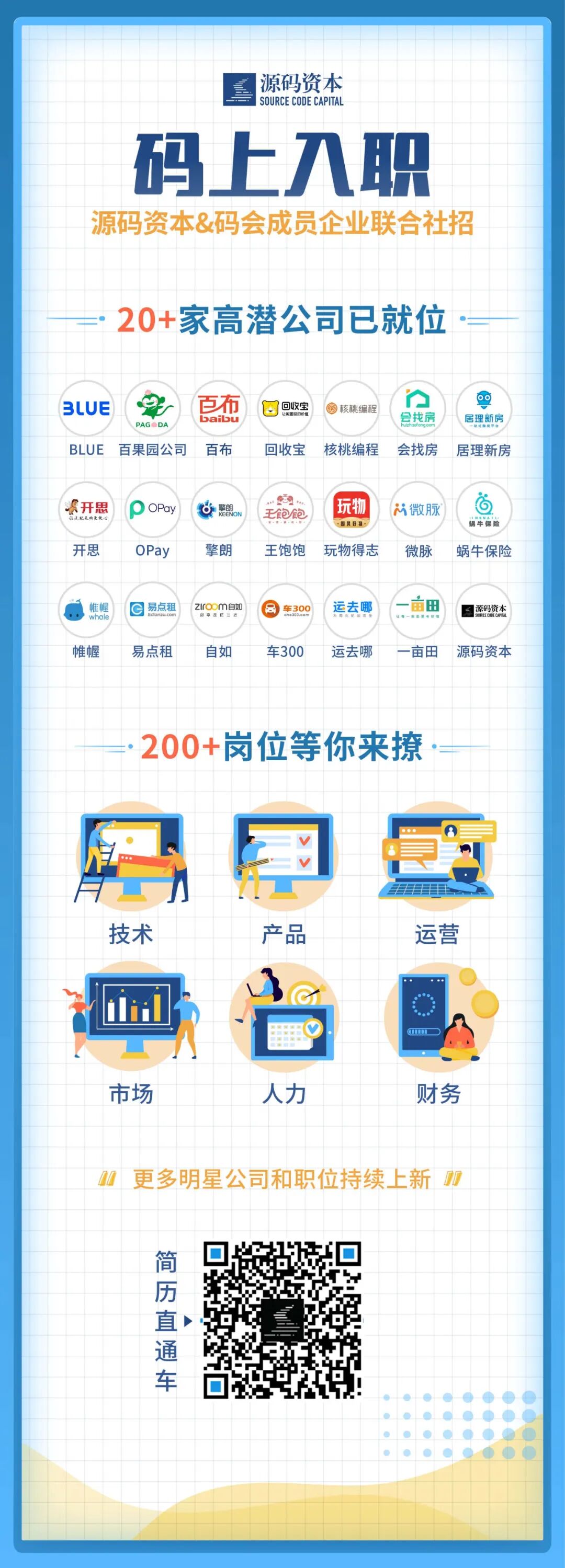
To help Ma Hui member companies tackle their spring hiring challenges, Source Code Capital has joined forces with 17 Ma Hui member companies to launch an online joint recruitment event — "Ma Shang Ru Zhi" (Quick Hire). This joint recruitment drive features over 200 high-salary positions spanning technology, product, operations, marketing, human resources, and finance, covering premium sectors including e-commerce and retail, medical insurance, online education, and industrial internet.
"Resume Express"
Additionally, "Ma Shang Ru Zhi" has specially invited Kebin Dai, founder and CEO of Liepin, to share insights from The Current State and Trends of China's Internet Industry Job Market in 2020, offering job seekers an in-depth analysis of the spring 2020 recruitment landscape and interpreting key industry development data.



I'm very glad to have this opportunity to connect with everyone through livestream today. I'd like to talk about the current state and trends of the internet industry job market.
I. Where Are the Job Opportunities?
Looking at February data, this period is typically a peak hiring season. Under the overall impact of the pandemic, internet job postings on the Liepin platform saw varying degrees of decline, with overall demand dropping by nearly 24%. However, compared to other industries, the internet sector remains a major source of demand.
In the comparison of top five industries by new talent demand, mobile internet and e-commerce ranked first, falling under the broad internet category. This is closely tied to the overall economic environment, as technological innovation remains the core driver of industry development. Within the internet sector, many online products actually benefited from the pandemic — such as online education, online entertainment, and online gaming. Professional services also saw significant demand, as specialized consulting became crucial during the pandemic: legal consulting on labor relations, marriage counseling, financial and accounting consulting, and professional expertise shared during livestreams all fell into this category. Biopharmaceuticals unquestionably saw surging enterprise demand in this environment. Industries involving offline gatherings or upstream and downstream supply chain operations were hit harder by the pandemic, but the impact on internet professionals was relatively limited.
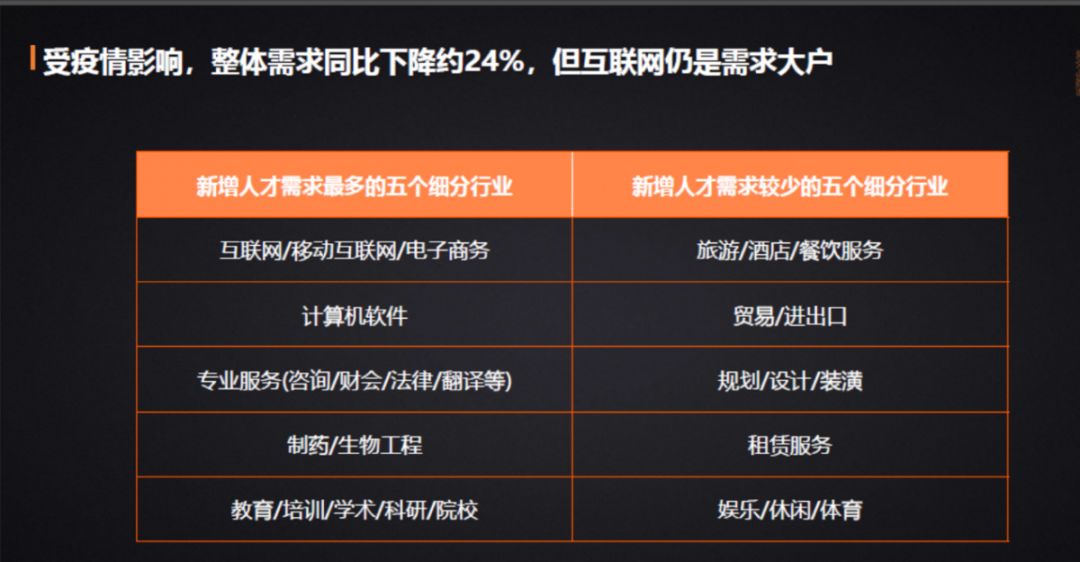
Image source: Liepin
Looking at the three internet sectors with notably growing demand: blockchain, online education, and artificial intelligence. The government has recently placed strong emphasis on new infrastructure — industrial internet, 5G, IoT, and related fields — driving substantial demand for blockchain, AI, and high-tech talent.
In terms of functional demand distribution for new internet positions, demand for Java engineers has remained consistently high. Product managers, web frontend developers, operations specialists, architects, data analysts, and algorithm engineers also saw strong demand. These roles are familiar territory within internet companies, but what's increasingly noticeable is that more and more traditional enterprises — or companies that aren't inherently internet companies — such as major banks in the financial sector, and traditional industries like real estate (community operations) and retail, are also recruiting technical talent.
These industries, inspired by the pandemic, are considering how to move their offline commercial activities online and digitize their products: products online, customers online, employees online, management online — a comprehensive shift to digital operations. As more traditional industries recognize this imperative, they're increasing investment in technology. So demand for these positions isn't just coming from pure internet companies, but also from traditional industries undergoing technological upgrades and transformation.
II. Where Did Those Who "Escaped the Internet" Go?
Frankly speaking, the warming trend in job-seeking demand after the Spring Festival work resumption has been the slowest in many years — and there are objective reasons for this. In early March, local governments gradually encouraged rapid work resumption, and by that point we basically saw demand reach last year's peak levels. The first week of March showed very rapid year-over-year growth.
Looking at the overall distribution of talent applications by position, one conclusion stands out: internet talent is gradually tilting toward traditional industries, with the internet sector's attractiveness to talent declining. However, these positions remain concentrated in internet-related technical roles, product roles, or operations roles — likely heading to traditional companies that are seeking digital transformation. From 2015 to now, nearly five years, China's internet sector received capital injections and rapid development, but many underlying business foundations were never solidified, lacking genuine industrial backing. They largely played the role of innovative tools or conceptual products — once cash flow dried up, they relied on investment and financing for survival.
Job seekers have become more pragmatic, preferring to join industries with clearer industrial positioning and more transparent business models, even if relatively traditional, to participate in these enterprises' informatization, digitization, or online transformation — this is a clear trend. I believe this trend will become even more pronounced against the backdrop of China's new infrastructure push. The likelihood of technically and product-capable professionals pivoting toward new infrastructure and traditional sectors will only grow.
III. Scale Represents Resilience
Next, let's examine the distribution of internet job seekers' applications by company size. After 2015, during the innovation and entrepreneurship wave, smaller companies and teams were actually more attractive because they were more agile and free from big-company bureaucracy. Data from that period shows people prioritized a company's future, vision, flexibility, and personal-company fit. But looking at today's data, most job seekers now clearly prioritize large enterprises first — company scale represents resilience.
Today, companies of considerable scale that continue growing demonstrate stronger resilience, and this is what people now prioritize. Recent research into SME development also reveals that within China's internet ecosystem, smaller companies — especially those beyond Series A and B seeking Series C funding — face considerable difficulty. When data growth stalls without a cash revenue model, securing the next round becomes nearly impossible. Such companies can only cut costs, and many won't survive past March or April — this is a clear trend. Meanwhile, salary expectations among internet professionals and job seekers have also become more rational compared to last year or previous periods. When changing jobs, people typically expect a salary increase — data shows little change in those expecting less than 30% bumps, but those expecting 30%+ increases dropped noticeably, by nearly 5 percentage points; meanwhile, the proportion willing to accept pay cuts or flat compensation when switching jobs is rising. Everyone recognizes the challenging environment and prefers stability and security over being sold grand visions — people are now more sober about compensation.
I think after experiencing five years of China's high-speed internet development, this calmer mindset has become relatively pronounced today, especially under the pandemic environment. Internet professionals are somewhat more anxious than usual, particularly if their company isn't relatively mature and stable — without cash flow, such companies face serious difficulties.
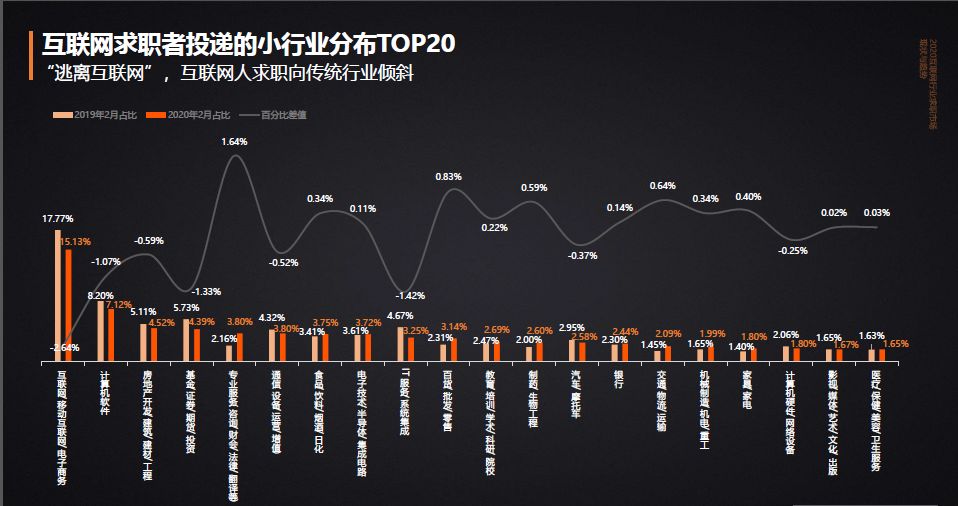
Image source: Liepin
IV. Generally Slightly Pessimistic, Locally Opportunistic
A widely circulated article online recently, "Sincere Advice for Big Tech Employees: Don't Mess Around in 2020!" was quite pointed. Overall sentiment remains slightly pessimistic, but there are local opportunities — for instance, the new infrastructure wave bringing industrial internet, blockchain, 5G, and IoT represents a major positive opportunity for internet professionals, as traditional industries urgently need such high-tech talent. High-tech professionals, whether in pure technical skills, product skills, data skills, analytical skills, or operations skills, are extremely valuable to these companies. The professional capabilities you've developed in the internet industry will, I believe, present very real opportunities under China's new infrastructure initiative.
V. Rationalize Expectations, Leverage Strengths and Avoid Weaknesses
In today's job market, we can no longer afford the somewhat irrational expectations of the past. Additionally, don't limit yourself to only big companies — while they offer relatively better security, the definition of "big company" should be broader than just BAT, TMD, and the like.
Many companies with ample cash and robust business models are also worth considering. For internet companies with unclear business models and insufficient cash reserves, I'd advise relative caution. Regarding leveraging strengths and avoiding weaknesses, I recommend developing more diverse professional capabilities during challenging times.

Upcoming Session Preview
On March 19, 19:30-20:30, "Ma Shang Ru Zhi" will host Hua Zhuang, founder and CEO of premium executive search firm CGL, and Xiaofeng Xiao, CGL's Chief Operating Officer, for a livestream session on "How to Make Yourself More Valuable at Innovative, Entrepreneurial, and Growth-Stage Companies." Scan the QR code below to watch the livestream.