MaHui Member Booster Robotics Completes Series A+ Funding, Powers Chinese Team to Historic First RoboCup Championship in Humanoid Category


- This article is republished from Z Potentials
Recently, MaHui member Booster Robotics announced the completion of its Series A+ round, with investment from the Beijing Robotics Industry Development Fund, the Beijing Artificial Intelligence Industry Investment Fund, and Broad Vision Funds. YiBai Capital served as the exclusive financial advisor. Earlier this year, the company completed its Series A round in June, led by Shenzhen Capital Group. Completing multiple rounds in quick succession — with investors spanning top-tier financial institutions, industrial capital, and government funds — fully demonstrates the market's strong recognition of Booster Robotics' core technical capabilities and industry-leading position.
At the recently concluded 2025 RoboCup, the Tsinghua Hephaestus team supported by Booster Robotics won the AdultSize championship. This marks the first time in the competition's 28-year history that a Chinese team has claimed gold in the most technically demanding humanoid category, signaling a major breakthrough for Chinese companies in cutting-edge humanoid robot competition.
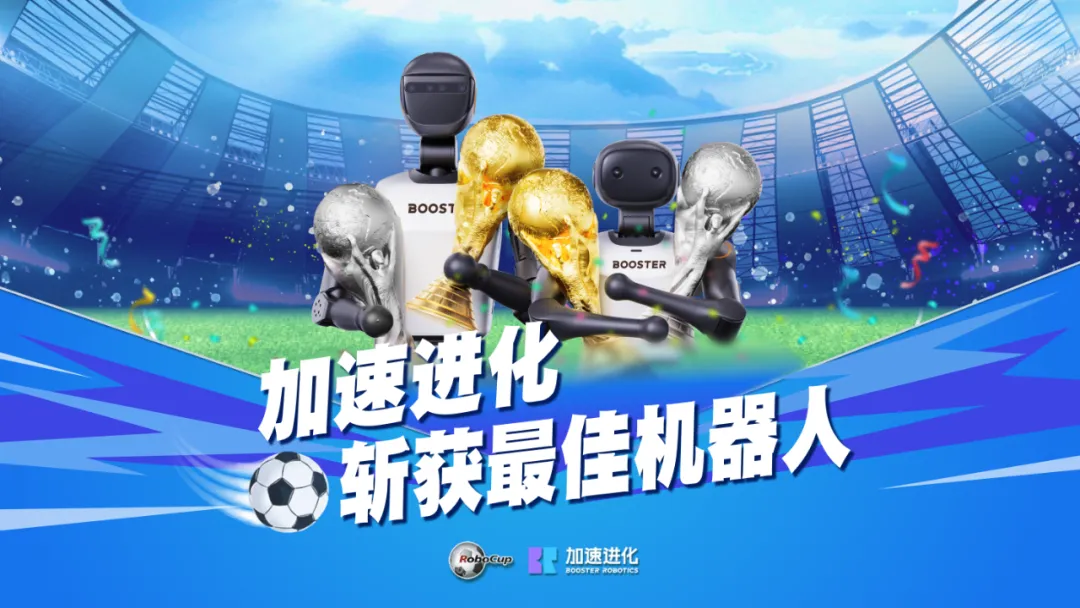
2025 RoboCup World Championship official results link
Since its founding, Booster Robotics has been committed to building humanoid robot products that are truly "simple, reliable, and practical." Through its differentiated product strategy of "hardware + system + developer tools," the company has built deep full-stack technical moats in humanoid hardware R&D, end-to-end whole-body motion control large models, and system-level development tools — creating a general-purpose, developer-friendly hardware and software platform for Embodied Artificial Intelligence and fostering a thriving, open development ecosystem.
Present Focus: Leading Industry in Mass Production and Delivery, Building Multi-Dimensional Closed Loops Through Competition Scenarios
In less than two years since its founding, Booster Robotics has taken the industry lead in commercialization and mass production, securing bulk orders from top-tier customers including research universities, global leading technology companies, and renowned competition teams.
Booster Robotics has carved out a unique commercialization path, making robot competitions an early priority breakthrough scenario. Compared to research scenarios that focus on academic R&D with limited scale effects, and B/C-end scenarios that remain nascent with low-frequency usage, robot competitions represent an extremely scarce high-frequency, high-technical-threshold, globally-oriented landing scenario in the humanoid robot field. This scenario effectively tests robots' comprehensive performance across hardware, motion control, autonomous perception, multi-agent collaboration, and intelligent decision-making, while accumulating massive volumes of high-quality real-world operational data to provide solid support for continuous technological innovation and product iteration.
Currently, Booster Robotics has built the "RoboSuper" competition IP, successfully establishing a multi-dimensional closed loop of "business — technology — ecosystem" in the competition scenario. On one hand, the company provides hardware and software services to global competition teams for bulk shipment, while generating diversified revenue from tickets, sponsorships, and derivatives. Through high-intensity real-world combat, it continuously refines product performance and accelerates technology iteration, and has built a full-chain ecosystem covering competition operations, participating teams, schools, audiences, and media channels. The company's robot soccer education courses have entered universities and high schools, further opening new commercial pathways through the synergistic effects of the competition IP.
During the World Cup, Booster Robotics' T1 and K1 robots served as the official equipment not only for top Chinese teams including Tsinghua Hephaestus, China Agricultural University Shanhai, and Tsinghua TH-MOS, but also won favor from strong international teams such as the United States' UT Austin Villa and Germany's Boosted HTWK. German team HTWK also used the Booster Robotics K1 to win the KidSize championship. Moreover, all robots used by the champion and runner-up teams in both the AdultSize and KidSize categories came from Booster Robotics. This represents the first time that a Chinese hardware platform, with its excellent performance and user-friendly development tools, has become the "general equipment" of an international top-tier competition — emerging as a core force on the global competitive stage.
Future Planning: Expanding B&C-End Scenarios from Competition Foundation, Building Humanoid Robot Companions
While successfully establishing commercial closed loops in early scenarios such as research and competitions, Booster Robotics has also achieved dual coverage of "B-end R&D output" and "potential C-end consumers."
Competition participants essentially encompass the current top robot developers, who naturally develop deep trust and stickiness with Booster Robotics' hardware platform and open tools during the competition process. These developers are precisely the main force in enterprise R&D departments that will drive future humanoid robot deployment across B-end scenarios. The competition's broad audience base covers potential massive consumer-level users, and naturally allows for competition training programs that address core educational needs of C-end users, particularly families — creating future opportunities to enter the home consumption scenario.
The company's upcoming official launch of the K1 robot, the World Cup champion model, targets developers and the broader application market. The developer ecosystem established and gradually enriched through competitions will provide a continuously evolving "capability foundation" for the company's products, enabling them to break through the boundaries of standardized products and precisely respond to the personalized and specific needs of thousands of families and industries — ultimately growing into "digital members" that combine functionality, emotional connection, and adaptability.
On the technical level, the visual perception, environmental understanding, and behavioral decision-making capabilities validated in competition scenarios share identical underlying algorithmic requirements with home and commercial scenarios, and can be optimized and generalized for various application scenarios.
On the commercialization level, cooperation projects in education scenarios including in-school courses and after-school training are already actively advancing, laying the foundation for large-scale entry into the consumer market.
Looking ahead, Booster Robotics will leverage its multiple advantages in technology, market, and capital to further accelerate technological innovation and market expansion, continuously deepening its advantages in competition scenarios, accelerating its layout in home consumption and commercial markets, and working with global developers to make humanoid robots as simple, reliable, and practical as personal computers.