MaHui Entrepreneurs | Webb Telescope's First Images Released: Seeing the Unknown

Infinitely outward, and at the same time infinitely inward.
#MaHui Entrepreneurs — Resilient and Bold, Exploring Without End
The James Webb Space Telescope released its first image, pushing humanity's view of the stars farther than ever before — 13.1 billion light-years. Because of how light travels through time, seeing farther means seeing older, bringing us closer to the origins of the universe. To look infinitely outward is, simultaneously, to look infinitely inward.
We are always on the path of creation. Looking farther is the infinite outward: breaking boundaries, exploring and creating across ever-larger scales. We are also moving infinitely inward: drawing closer to sources and essences, finding optimal paths from first principles. Some say Source Code Capital's logo resembles the vast river of stars in the cosmos, its shimmering waves concealing three universal constants in Morse code: e (elementary charge), g (gravitational constant), and c (speed of light). We hope to explore the infinite, together with you.
Source: Starry Sky Astronomy
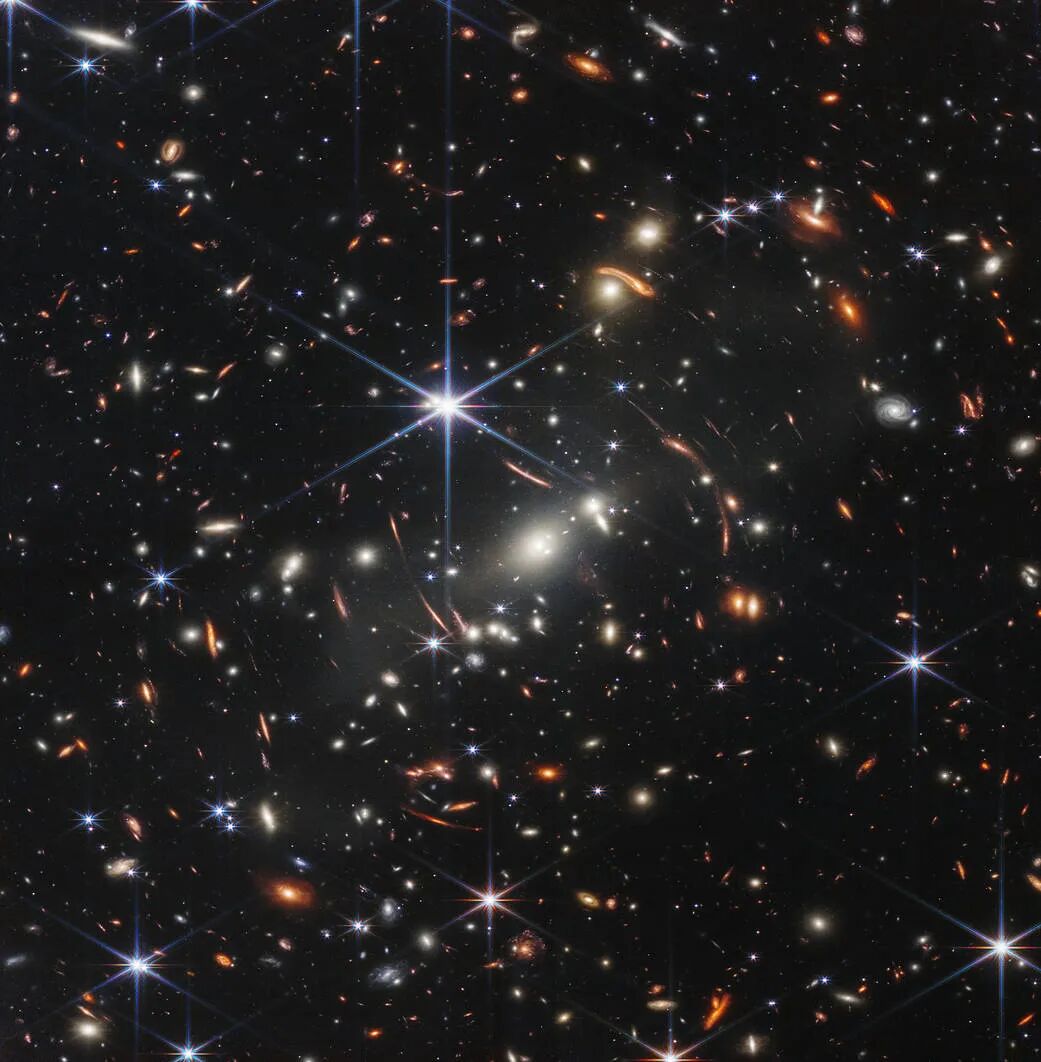
The Webb telescope's first full-color infrared image, showing the "deepest" and sharpest deep-space image to date. NASA / ESA / CSA / STScI
The James Webb Space Telescope's first "Extremely Deep Field" full-color infrared photo was leaked early this morning. The image is extraordinarily sharp, containing a massive amount of detail that humanity has never before seen.
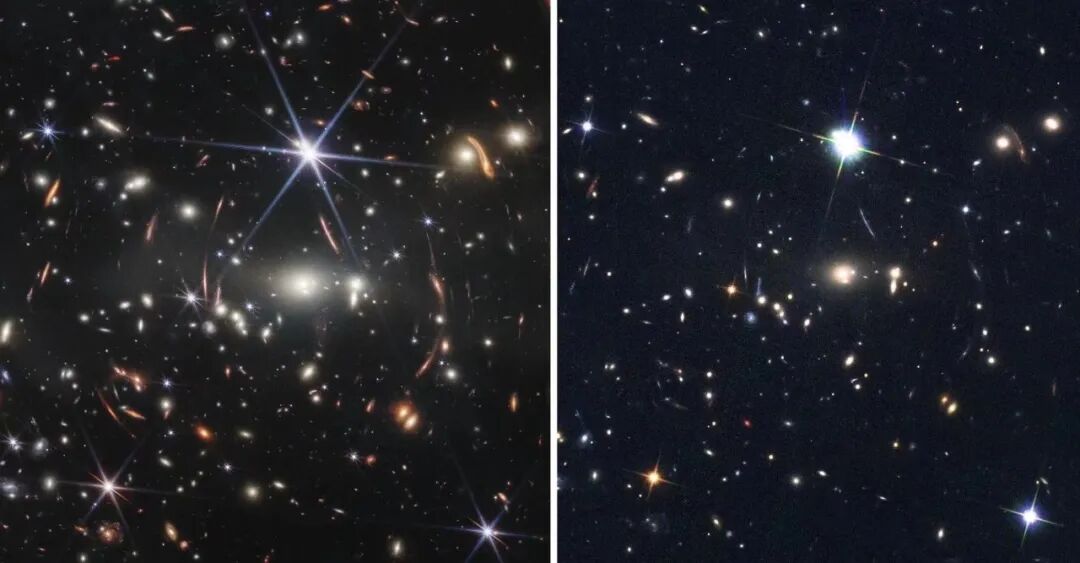
Comparison of Webb (left) and "non-Webb" photos of the same sky region
The photo contains at least thousands of galaxies — many never seen before. Each one is an "island universe" on the same scale as our Milky Way — yet these thousands of island universes are all concentrated in a patch of sky as small as a grain of sand held at arm's length.
The image was captured by Webb's Near-Infrared Camera, synthesized from multiple wavelength bands with a total exposure time of about 12.5 hours. For a comparable image, the Hubble Telescope would need several weeks, and still couldn't achieve this "depth."
The main subject is the SMACS 0723 galaxy cluster. Light from this cluster takes 4.6 billion years to reach Earth, so what we see is actually an image from 4.6 billion years ago.
This galaxy cluster serves as a foreground "lens," magnifying and distorting the images of even more distant galaxies behind it — this is what's known as "gravitational lensing." The Webb telescope captured with unprecedented clarity the abundant details of these background galaxies, amplified and brightened — details also never before seen by humans, including numerous star clusters and nebulous structures.
Scientists will soon be able to understand the mass, age, history, and composition of these galaxies, and Webb will also help them search for the first galaxies formed after the birth of the universe.

- MaHui Entrepreneurs | Exploration Never "Extinguished": Saluting the Spirit of Spaceflight
- MaHui Entrepreneurs | James Webb Space Telescope Launches, Exploring the Infinite
- MaHui Entrepreneurs | Post-90s Entrepreneur Zhang Junbin: Building Transformative Products, Pursuing Value from Zero to One
- MaHui Entrepreneurs | Two 29-Year-Old Genius Scientists' "Moon and Sixpence"
- MaHui Entrepreneurs | Mech-Mind's Shao Tianlan: Some of My "Grassroots" Experience
- MaHui Entrepreneurs | GravityXR's Fan Shunhao: What Kind of Operating System Does the XR Era Need?
- MaHui Entrepreneurs | When the Founder of a "Software-Defined Storage" Company Is Also a Race Car Driver
- MaHui Entrepreneurs | Academician Weinan E Proposes a "New Dawn" for Applied Mathematics: AI for Science Deeply Integrates Artificial Intelligence with Fundamental Science
Click "Read Original" to view more MaHui members