MaKe | MaHui Member DeepMaterial Completes Series A Funding to Continue New Materials R&D Iteration



- This article is republished from Yingke, written by Huaxiu Wu.
AI-powered metal new materials R&D company DeepMaterial recently completed a Series A funding round of tens of millions of RMB, with investments from Heshijia Capital and Aurora Capital. The proceeds will go toward iterative new materials R&D, upgrades to its high-throughput automated laboratory, AI model development, and scaled deployment across vertical industry scenarios.
Notably, the company's self-developed integrated software-hardware materials intelligence agent, DM Agent, will officially launch on September 10, further accelerating its technology commercialization.
"Materials R&D isn't something you can crack just by building a model. The real difficulty lies in closing the data loop and achieving industrial deployment," said founder Xuanze Wang. This, in his view, explains why AI has already spawned multiple listed companies in pharmaceuticals and other fields, yet few have succeeded in the metal materials space. What attracted investors, he noted, is that DeepMaterial has already demonstrated a viable industrialization path in "AI + materials" with conditions for rapid scaling.
Founded in 2021, DeepMaterial has creatively embedded artificial intelligence into the full-cycle R&D process for metal new materials, building everything in-house from algorithmic models and high-throughput laboratories to materials data systems. This approach is closely tied to Wang's background: he holds bachelor's and master's degrees from Shanghai Jiao Tong University in AI, and grew up in a materials science family in Anshan, Liaoning — a steel industry stronghold. In 2015, he first recognized AI's potential to transform materials R&D, but the technology, computing power, and data conditions weren't yet mature. Five years later, he saw the opportunity approaching. "In the metal materials field, what customers care about most is performance metrics — and that's precisely what AI can optimize with precision."
In metal materials R&D, data is widely acknowledged as the bottleneck: hard to acquire, wrong dimensions, poor consistency. DeepMaterial chose to circumvent these obstacles by using self-developed high-throughput equipment to generate high-consistency experimental data at low cost and high efficiency, then employing large models to orchestrate specialized small models for formulation and process optimization — forming a multimodal "materials intelligence agent" plus high-throughput experimental system. Under this framework, R&D cycles compress from the traditional several years or even more than a decade to as fast as under two months, with costs dropping by one to two orders of magnitude.
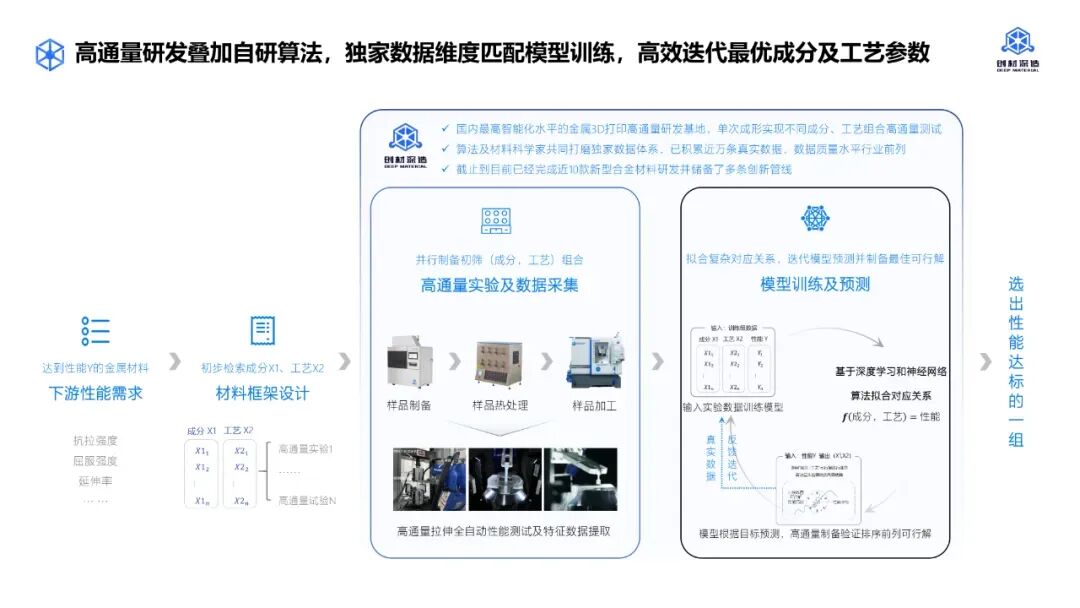
(Image source: Company)
This capability has also led DeepMaterial to make different choices on business model. Wang believes future materials companies must build "dual capabilities": improving R&D efficiency through algorithms while possessing industrial deployment capacity. "A business model purely providing R&D services has limitations," he emphasized. "If you can't control the scaled production环节, the value of R&D gets diluted." Therefore, starting in 2023, the company shifted from taking contract R&D orders to proactively selecting materials categories with large market demand and high process barriers for self-directed R&D projects.
The first product line is high-strength aluminum alloy for 3D printing — with strength exceeding 550 MPa, meeting aerospace-grade requirements, and costing only one-third of comparable overseas products due to the absence of precious metal components, giving it significant cost advantages. These materials have already entered validation and procurement processes at aerospace research institutes and leading 3C OEMs.
This strategic upgrade stems from DeepMaterial's forward-looking assessment of the metal additive manufacturing industry landscape. Global penetration of 3D printing metal materials remains in early stages. According to Precedence Research data, the global metal additive manufacturing market was approximately $5.87 billion in 2024, expected to grow to $6.68 billion in 2025, with potential to surpass $20 billion over the next decade at a CAGR of roughly 13.7%. However, in terms of specific material categories, there are fewer than thirty metal material grades available for stable printing, heavily concentrated in conventional grades and performance levels of aluminum alloys, high-temperature alloys, titanium alloys, and stainless steel — making it difficult to meet customized demands for special properties like high strength and light weight in aerospace, consumer electronics, and other fields.
"The biggest opportunity in this industry is using materials breakthroughs to remove constraints on downstream applications — for instance, letting aerospace and consumer electronics eliminate excess weight from structural components," Wang said. Over the past decade, domestic manufacturing's attitude toward new materials has shifted from cautious to proactive, especially among consumer electronics makers: "They actively ask whether we can make new materials that are light, strong, and cheap."
DeepMaterial's business isn't limited to materials themselves; its high-throughput laboratory equipment and materials intelligence agent solutions are also entering the R&D systems of top domestic universities, national laboratories, and manufacturing enterprises. This "self-generated data — self-developed models — production line deployment" model opens up additional application scenarios.
Over the next two years, they hope to have one or two materials achieve mass production profitability; in five to ten years, cover more industries and complete an IPO. For the longer-term goal, Wang summarized it in one sentence: "To ensure human progress is no longer limited by materials."