MaHui Founder Ethan Yuanming Hu's 48 Reflections

How should a founder work with their team? What are the things I haven't done well myself? And how can I do better?
On October 5, Meshy was named to a16z's "Top 50 Consumer AI Apps by Monthly Revenue" list, ranking 31st — the only AI 3D company on the list, alongside OpenAI, Anthropic, Canva, Superhuman, Higgsfield, and others.
Meshy has now surpassed $100 million in ARR. In July this year, the company also closed a nearly $400 million Series B round... Meshy is growing with steady, rapid momentum. Source Code Capital led Meshy's Series A in 2021, continued to double down in subsequent rounds, and oversubscribed in this year's Series B — witnessing and supporting Meshy's journey from early exploration to where it stands today.
This past May, Ethan Yuanming Hu shared his reflections on the AI era at the "2026 MaHui Founders Annual Conference": technical capabilities are evolving at breakneck speed, and founders must constantly revise their understanding of people, organizations, and their own roles through practice. Now, as the company stands at a new starting point of scaling from 10 to 100, he has conducted a deeper, more systematic review of his entrepreneurial journey, distilling his thinking into 48 principles.
We're sharing the full 10,000-word piece with all founders currently in the trenches — bookmark it before you read. The following is republished from Ethan Yuanming Hu's personal WeChat account:
First, congratulations to the Meshy team on reaching a new milestone: our strictly calculated Annual Recurring Revenue (ARR) has surpassed $100 million. We've always advocated pursuing "technological idealism" while remaining commercially pragmatic, so achieving this revenue scale on top of Meshy 7.1's market-leading foundation model is truly worth celebrating. Every department in the company has put in tremendous effort.
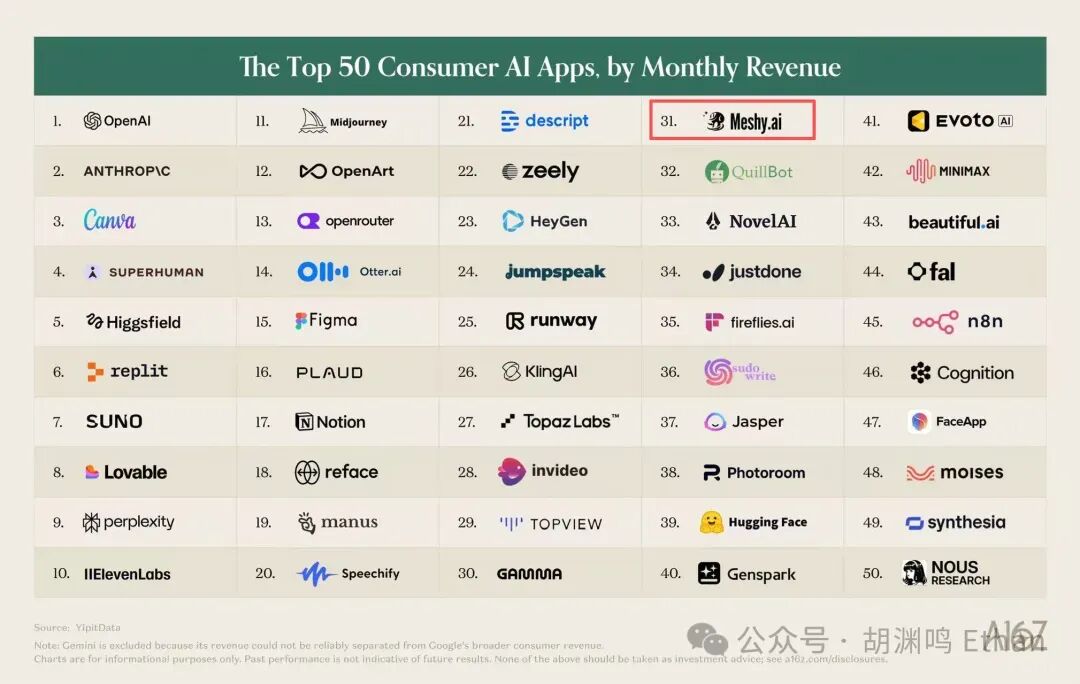
Thanks to Andresson Horrowitz for the congratulatory note
Last year I wrote a piece reflecting on and reviewing Meshy's experiences and lessons learned as we found product-market fit and entered a phase of rapid growth. Now, as the company enters a new stage of scaling from 10 to 100, I think it's time for some new reflections to lay groundwork for future challenges. My reflections center on three questions:
- What do I wish someone had told me before this stage began? These might be useful to others too.
- Why did I become someone with this personality? As a founder, how should I relate to my team?
- What am I still not doing well? How can I do better?
I started writing this article when Meshy was at $80M ARR, and finished at $100M ARR — about a month in between, jotting things down as they came to mind. During the National Day holiday, while traveling on business, I spent five more days cutting two-thirds of the content, refining it into 5 sections and 48 principles.
The five sections are: I. Warmth and Principles II. Time and Founder Mode III. AI and People IV. Team and Management V. Strategy and Execution

(Image completely unrelated to the article. Taken in Sunnyvale.)
1
Warmth and Principles
Put others before yourself; be a principled good person.
- The education I received growing up always demanded that I "be kind to others" and "be a nice guy" — fundamentally because at every stage I encountered remarkably kind mentors. In middle school, during my Olympiad in Informatics (OI) days, my competition coach was endlessly encouraging. Later at MSRA, my mentor Steve Lin was widely recognized as the nicest mentor in the entire organization, patiently teaching me to revise papers bit by bit and fully supporting me in pursuing what I loved. During my PhD at MIT, both my co-advisors Fredo and Bill deeply respected students' interests, giving me maximum time and freedom to work on my preferred topic: Taichi. Even at MIT, there were advisors who would force grant proposal writing — something no one wants to do — onto students, packaging it as "I'm preparing you for becoming a professor," but Fredo and Bill never did that; they handled it themselves. My parents often told me "to suffer loss is to gain." They all considered others before themselves. On the surface this seems like losing out, but it actually builds profound trust and allows those around you to fully flourish, leading to better outcomes for the entire team. This simple belief is also why we placed "empathy" in our cultural code from the very founding of the company.

The kind and gentle Princess Mipha and the taciturn Link. Screenshot from The Legend of Zelda: Breath of the Wild.
-
Schools exist to educate and nurture, but commercial companies operate in a fundamentally different external environment — they must win battles to survive. Therefore, kindness in a corporate setting cannot lack principles, or a person devolves into "people-pleasing," or worse, becomes a pushover. "Returning good for evil" is admirable when possible, but as teams grow, you inevitably face the question: "Then how do you return good for good?" A saint cannot manage teams or win battles, cannot collaborate with principled people, and will drive away talented individuals. So "being kind to others" cannot be evaluated in isolation; it must consider the entire team and take the long view, transforming "small favors" into "great kindness" for the collective.
-
"Fairness" is an excellent principle, but achieving it as a manager is an extraordinarily difficult systems engineering challenge. Managerial laziness often leads to the conscientious getting shortchanged. A common trap: one colleague is particularly hardworking and uncomplaining, so their leader piles on all the dirty work. Out of responsibility, they do it well. So the leader gives them more dirty work. In effect, their responsibility and diligence are rewarded with more dirty work — this is essentially "punishing conscientiousness." If the leader cannot compensate in other ways, this is unfair and unsustainable. Similarly, we often feel less gratitude toward parents than toward those who occasionally do us small favors; we give better treatment to employees who make noise than to those who quietly deliver; we reward colleagues for overtime rather than for achieving results more efficiently. These all focus on the local while missing the global picture — they are unfair.
-
One way to help yourself make fair decisions is to "examine your own heart." For example: "I'm about to give A a raise and more options. Even though compensation is confidential, if one day everyone's pay were accidentally made public, would people consider this arrangement fair?" Any unfair approach may solve a problem in the moment, but it is inevitably a hidden risk that will explode sooner or later.
-
"Objectivity and sincerity" is also a sound principle. Call good "good" and bad "bad" — don't soften "bad" into "good" just because the other person can't handle it. You may comfort them today, but it will certainly harm them in the long run. The delivery can be tactful, but it must be grounded in reality. Disrespect reality, and reality will punish you. Don't look at what people say; look at what they do, at whether they truly "solved the problem." Speak up about problems, even if the other person can't take it and leaves — leaving today is better than dragging it out. A reluctant, drawn-out situation drains both sides.
-
"Holistic thinking and trade-offs" is another good principle. Why can games be addictive while the real world cannot? Because games offer immediate, deterministic rewards and mostly follow simple black-and-white logic. The real world is not so clearly delineated; understanding the pros and cons of anything is extremely difficult. A typical "can't see the forest for the trees" fallacy: seeing a good person do one bad thing and deciding they were bad all along; seeing a bad person do one good thing and deciding they're actually good. Managers cannot be rigid; they must weigh trade-offs and consider multiple factors — short-term vs. long-term, individual vs. team, fairness vs. efficiency, and so on. A landmine you bury may not explode for months or even years. Even if you must bury it today, you should spend double the effort digging it out tomorrow or the day after, or the damage will be severe.
2
Time and Founder Mode
The cognitive ceiling of the #1 person is the cognitive ceiling of the entire team. Time is the most important non-renewable resource. Therefore, the most important expression of the #1 person's cognition is deciding who to spend time with, in what priority, doing what.
-
For founders, "being kind to others" also has a limit. If you ignore your own feelings too much to accommodate others, draining your energy on meaningless matters and leaving yourself without the mental bandwidth for major company decisions, you become irresponsible to the entire team. Yet another balance between "small kindness" and "great kindness."
-
Entrepreneurship is a system of ordinary differential equations with respect to time t. Internal and external factors interact. One of the #1 person's most important jobs is to see clearly how these factors interact, distinguishing leading indicators from lagging indicators. Ray Dalio's The Changing World Order is a useful reference. This system of differential equations essentially answers "how the world works" — finding this pattern guides strategy and execution.
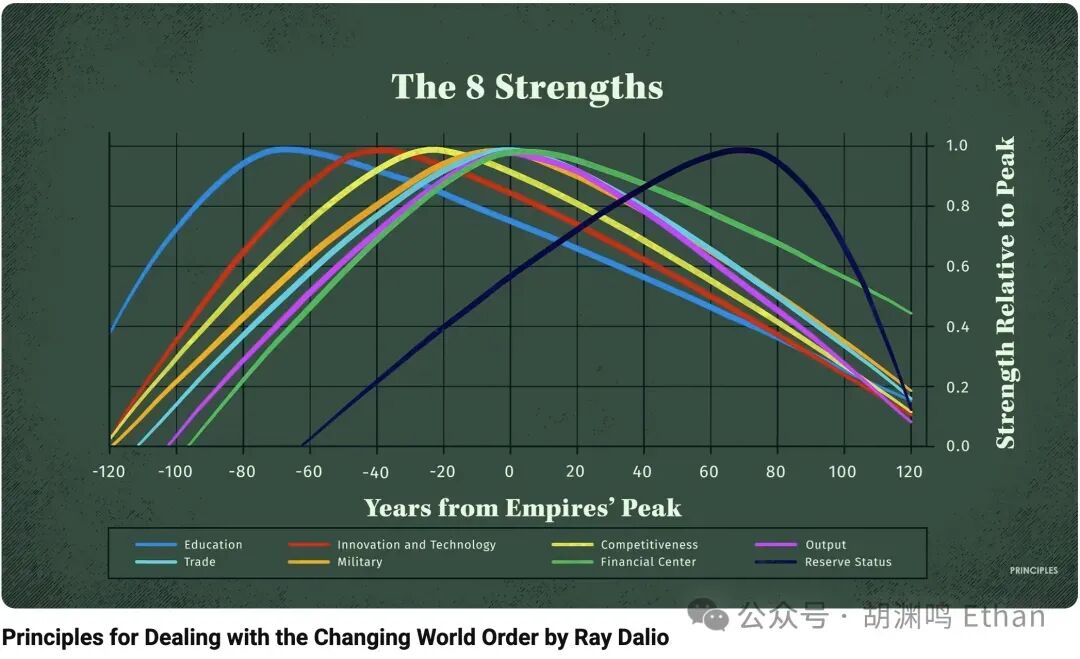
A great power rises first through education, then innovation and technology, then the competitiveness of its products (quality, cost), then military strength, then trade share...
- A company's "value" has many layers, and revenue floating at the surface is just the tip of the iceberg. Beneath it lie talent density, clarity of vision, technical strength, product capability, cultural values, morale, even whether shareholders are truly aligned, the founder's physical health, and many other complex factors — all of which interact and evolve over time. Judging a company's progress solely by revenue or valuation is extraordinarily superficial, or at the very least, deeply lagging. Two companies with similar external metrics could be in radically different conditions: one still accelerating energetically uphill, the other already rotting from the roots and about to decline.

The sunlight we bathe in every day has actually been randomly walking inside the sun for over a hundred thousand years. Even if the sun suddenly vanished, according to relativity, we wouldn't know for more than eight minutes. Image source: https://svs.gsfc.nasa.gov/11084
- A good friend in Silicon Valley taught me a way to calculate time cost: take the company's valuation one year from now, subtract today's valuation, divide by 365 days, then divide by working hours per day — that's roughly the company's hourly opportunity cost. If we assume 50% comes from the founding team's decisions and 50% from everyone else's execution, founders can easily calculate their own per-second opportunity cost. Once this is clear, many small matters become not worth agonizing over, because the time spent agonizing already costs the entire team — failing to allocate the founder's time appropriately is irresponsible to the team. For example, when considering who to meet each hour, weighed against that hour's opportunity cost, many people naturally fall away from a team-responsibility perspective. (Of course, this rule doesn't apply to time with family and friends, which cannot be measured in money.)

Taken in Fukuoka
-
Health is one of a founder's most important resources. In my observation, at the startup stage, the best founders (or really anyone at the top of their field) fundamentally have no work-life balance. Jensen Huang's formulation is: "I relax when I work." Perhaps a better term is "work-life unification" — work and life are one. Health and output are objectively tradeoffs. Yet even lying flat every day, the body deteriorates with age; no one lives forever. All we can do is avoid meaningless harm to our health. Don't overeat (for me, fewer spicy strips or McSpicy wings), minimize late nights, squeeze in some exercise — globally speaking, this is probably the better solution.
-
Founders must have ego, but the line between ego and arrogance is extraordinarily hard to draw. A founder can be right or wrong, but must proceed from team interests and vision, not from "proving I'm right." Putting "whether I'm right" ahead of "what's actually true" is extremely dangerous. On this foundation, "independent thinking" becomes crucial, because only you have 100% context; your subordinates maybe 50%, outsiders maybe 1%. By the same logic, someone with 1% context criticizing you can be safely ignored — they're not criticizing you, but the "you" they imagine. The CEO is the "try {...} catch {...}" in the main function; there's no layer above to raise exceptions to, so everything that happens in the company ultimately lands on you. Following bad external advice or criticism into the ditch ("exit(-1)") — you bear the cost yourself.
-
Founders appear glamorous on the surface, but are profoundly lonely inside. There are many truths you can't speak casually; others lack the complex context you face daily, making deep conversation at the same level difficult, unless it's with another founder. But founders are human, so an easy trap is hoping subordinates will provide the emotional value ordinary people access easily but founders lack. This is quicksand: if a founder subconsciously needs subordinates' validation, it inevitably leaks into daily behavior, or gives positive feedback to sycophantic employees, leading more to start managing upward, eventually wrapping the founder in a carefully woven information cocoon, even being PUA'd by subordinates, obstructing objective and fair judgment.

Shinji from Neon Genesis Evangelion, my favorite anime, desperate for recognition from his father and others
-
But founders are ultimately human, and humans have emotions. If emotional value can't come from subordinates' approval, where from? For me, three sources. The more worldly one: as a founder of a reasonably successful business, my economic foundation lets me buy things I've long wanted with my eyes closed — like a Hasselblad. I promised myself I'd get one when we closed Series B; the photos in this blog post are taken with that camera. Building this company has already brought me material and spiritual abundance, joy, and growth as a founder. This is extraordinarily fortunate, since most startups return zero. The second is cognitive growth — working and talking daily with more capable people, learning constantly, which brings me genuine happiness. The slightly nobler source of emotional value is seeing people who've joined me grow. I sincerely rejoice for colleagues who've fought alongside me, then achieved outstanding things and built good lives; their happiness and growth I count as my own success.
-
Since the company pioneered the 3D AI track and entered high-speed PMF development, I've been quite happy. If the opposite of "happy" is "painful," then for me the opposite of "fulfilled" is probably "bored." I feel "whether happy" and "whether fulfilled" are orthogonal. These past two years I've experienced "happy fulfillment" and "painful fulfillment" ("exhilarating struggle"?). But as long as there's growth, there's no boredom. I treat every challenge as a "growth opportunity."
3
Humans and AI
Sometimes AI is the army of thousands I command. Other times, I'm the "carbon-based pet" AI raises: AI "feeds" my curiosity with curated knowledge.
-
Without solid fundamentals, using AI only amplifies confusion, producing plausible-sounding conclusions that are laughable to professionals. My high school math teacher constantly emphasized: "Weak foundation, earth-shaking collapse" — this matters even more in the AI era. I sometimes tell colleagues: "Sorry, I can't understand this AI-written report, please rewrite it manually." Or a more diplomatic version expressing my protest at others using AI content to "fool" me: I genuinely can't follow the logic of "not X, but Y" in AI-written articles, nor the rhyming but incomprehensible metaphors. After a torrent of output, AI will even note "One honest caveat" ("frankly, my approach has a flaw"), as if thinking deeply. But does AI writing really hold up to scrutiny? Before AI, "form" and "content" had some correlation; AI has completely decoupled them, making "speaking nonsense with a straight face" the norm.
-
Back at Yao Class exams, TAs set the grading rule: correct proof, full marks; wrong proof, zero; writing "I don't know" earned half credit. From a mechanism design perspective, this neutralized the strategy of "I don't know, but I'll write a long proof hoping the grader won't find the flaw and give me points." The workplace equivalent: "if you can't explain it clearly, better not say it." At our company, communication clarity is the most basic requirement — wording must be precise, concise, easily understood; no "correct nonsense." Unclear expression is usually not a communication problem but a thinking problem.
-
On one hand, nearly everyone in the company has unlimited AI tokens; see I Have Ten Claude Codes Working for Me. On the other hand, in interviews we heavily emphasize old-school programming fundamentals. Across hundreds of interviews, I've found that candidates who write clean code by hand tend to have stronger problem-solving abilities. AI hasn't changed this correlation at all. And with weak fundamentals, what you build with AI is a castle in the air with an extremely unstable foundation. In this sense, AI hasn't leveled the playing field for software — it's made the strong stronger and the weak weaker.
-
In the domains mentioned above, humans are still needed—for now—to understand and steer AI. But in an growing number of specialized fields, I think we have to admit that AI has already surpassed our imagination. These fields share certain traits: they can form closed loops in the software world (like AI coding, which doesn't involve "moving atoms"), their results can be verified (like AI for math, where Lean can check proofs), and they don't require domain-specific knowledge from verticals like law.
-
I haven't lost sleep over this, but a persistent anxiety about humanity's future haunts me daily. This wave of AI revolution differs fundamentally from previous industrial revolutions—steam, electricity, computers, the internet. Those merely gave humanity better tools that obeyed our commands; humans remained the ones giving orders. What's terrifying about this AI revolution is that "intelligence," which humans consider our most unique and proudest attribute, has already been surpassed by AI in many domains.
-
Take mathematical research: AI will soon replace humans as the primary force in proving theorems, much like OpenAI's recent progress on the Navier-Stokes problem. Mathematical proof is a frightening breach—it can form a complete closed loop in the software world, and results can be mechanically verified for correctness using tools like Lean. The future will likely evolve like this: AI delivers proofs like a god, and human mathematicians can know such proofs pass Lean verification, so the results must be correct, yet they cannot comprehend the internal logic or learn anything from them. Scott Aaronson's The Age of Wonders and Terrors is an excellent essay; Logan Graves's Priest, Monk, and Mathematician is equally fascinating—and terrifying. "The mathematician of the future will not prove, but serve as a 'priest,' interpreting the 'oracles' delivered by AI; and soon even the priest's role will be lost, as AI can interpret its own proofs better." For me, this has long been reality: I have too many questions about the world I cannot grasp, yet by querying AI and having it build visualization tools, I can learn rapidly. In these domains, AI is like a deity, taking truths obvious to it and translating them into forms my limited intelligence can comprehend, thereby "feeding" my curiosity.
-
So do we need to understand AI at all? In the specific case of coding agents, if you completely don't understand what AI is doing, you hit a wall: "you can't write the next prompt that drives effective AI progress." Conversely, if humans can keep writing prompts to push problem-solving forward, then not understanding AI seems fine—the problem gets solved regardless. In truth, we still need some understanding of what AI actually does today, particularly when writing production code. I don't know how long this situation will last. The root question here is probably: "As carbon-based lifeforms with inferior intelligence, should humans step aside for smarter silicon-based beings?" I won't address that here. In a sense, AGI has already been achieved—it's just unevenly distributed across domains.
-
Seeking advice from disinterested parties when facing problems is crucial. When someone tells you "you're sick," you may not actually be sick—they might just want to sell you medicine. From this angle, AI still holds tremendous value: at minimum, it can be genuinely "disinterested."

Taken in Los Angeles.
4
Team and Management
A neutron's mass is approximately 940 MeV/c², while the three quarks composing it have a combined rest mass of only about 12 MeV/c². In other words, roughly 99% of a neutron's mass does not come from the simple sum of its three quarks' rest masses, but from the energy of motion and fields of quarks and gluons under the strong interaction.
-
Teams resemble quantum mechanics in this way: individual capability matters, yet the interactions between individuals profoundly shape the entire team's output. When hiring, beyond assessing someone's individual abilities, you must consider how their addition will change the team's "energy field." Thus, we examine both whether fundamentals are solid and culture fit: whether they embrace the team's core values, whether they can spark and elevate each other. Managing a team of a few people can rely on camaraderie; managing dozens requires the leader's deep understanding of business details; managing hundreds demands genuinely practiced principles and values, plus a high-density talent pipeline. As team scale expands, the leader must build trust, collaboration, and shared pursuit among people into an organizational force that continuously creates value.
-
We support paying employees at the top of the market. Beyond our belief in "being good to people" and wanting colleagues who grind alongside us to live better lives, another reason is our business generates sufficiently high gross margins to afford this. Put bluntly, a company's compensation and benefits cannot exceed its ability to generate profit—otherwise it's unsustainable long-term. Human resources are an investment, not a cost. I strongly agree with Yiming Zhang's view: don't use the term "human cost," use "human capital investment." In an emerging industry like generative AI, virtually all achievements come from outstanding employees' contributions. Thinking this way makes us more generous with compensation. Conversely, when employees face less life pressure, they naturally do better work—which is self-consistent given our business model.
-
Scarier than being understaffed is probably the irreversible cancer of talent density decline from overexpansion. Strong people attract strong people; weak leaders only recruit weaker ones. Hence some basic hiring principles: every hire must be stronger than existing team members; better to leave a seat empty than fill it with someone who gives you pause—they'll likely blow up later; only hire self-driven people, because no one here wants to micromanage.
-
Drive teams through vision. For a team building ships, you must ignite their longing for the sea—otherwise everyone will feel they're just swinging hammers at nails. Founders must themselves think through and precisely articulate a vision. You cannot borrow someone else's vision, because it lacks the deepest underlying thinking. If the process of arriving at a vision isn't rigorous, it crumbles under team challenge—or you can't even convince yourself.
-
Earlier I said founders must guard against being gaslit by subordinates; conversely, managers shouldn't gaslit subordinates, superiors, or peers—such as through negging, using unjustified negativity to undermine others' motivation and self-perception. Treat everyone fairly, don't violate principles, but figure out what each person wants, place them where they fit, and give them the rewards and growth they need. Healthy relationships should feel positive, beneficial, and comfortable for both sides; principles and people-centricity can absolutely coexist. Don't "mess with" the team. For what constitutes gaslighting and how to build resistance, see Robin Stern's The Gaslight Effect. Stay away from toxic relationships.
-
A company and team at the startup stage must be an extension of the founder; otherwise the founder will inevitably feel off, and a拧巴 (awkward/ill-at-ease) founder cannot build a good company. So the team reflects the founder. Quoting Jensen Huang: "You don't have to change your personality or behavior when you become a CEO. You can continue to be yourself. One thing I learned a long time ago—I have no idea where I first came across it—is this: as a CEO and founder, you're building a car that you are going to race. You want to build a Formula 1 car, but you have to build it in a way that you can drive it. Adapt the car to you." Original: "You don't have to change your personality or behavior when you become a CEO. You can continue to be yourself. One thing I learned a long time ago—I have no idea where I first came across it—is this: as a CEO and founder, you're building a car that you are going to race. You want to build a Formula 1 car, but you have to build it in a way that you can drive it. Adapt the car to you. — Jensen Huang"
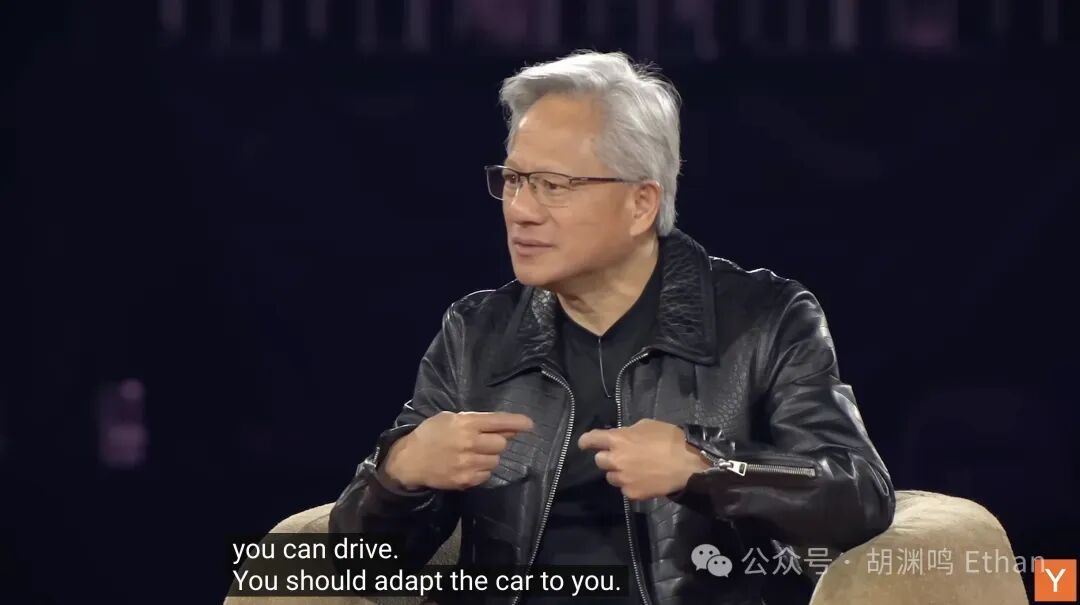
Jensen: You're the one driving the race car! Make the car adapt to you.
-
Give the team space, let them try more things—unless there's an obvious logical flaw, don't reject ideas out of the gate. Bottom-up innovation is critically important. "Restrained" management is sometimes the most effective. The difficulty lies in judging when to be "restrained" versus when to tighten grip slightly. Andy Grove's "Task-Relevant Maturity" is a good standard; see High Output Management.
-
A leader's thinking must lead the team, so the leader will likely be misunderstood—but that's fine. The leader can earn trust through track record, reasonable milestone-setting, or strong communication skills. Given that the AI era generally features only technical talent leading teams, and technical talent tends to be young and lacking management experience, helping these technical prodigies become good leaders should be a challenge all AI companies face. (I've spent considerable effort personally delivering an internal training series called Management Lessons for Good Students, because I've found that good students—those with stronger individual combat ability—sometimes face greater psychological barriers when transitioning to management. If there's interest, leave a comment and I'll organize the lecture notes.)
-
"Founder mode" shouldn't be the work style of the founder alone — it should be how the entire team operates. What kind of leaders do we like? Leaders absolutely need to understand a certain level of detail. When necessary, they should be able to look two or three layers down, even get their hands dirty. Main reasons:
- Talented people want to learn something from their leader. A leader who doesn't understand the details will struggle to retain the best people, let alone attract them;
- A leader who doesn't understand the details can't accurately assess each person's contribution. If you haven't done it yourself, how do you evaluate whether your subordinate did a good job or not?
- A technical leader who doesn't understand the details easily feels insecure, worries about being replaced by subordinates, and then many uncontrolled managerial interventions into subordinates' work start appearing;
- One of a leader's most important jobs is comprehensive trade-off decisions — considering talent, capital, brand, product, market, and other constraints holistically, then finding a globally optimal solution. Without understanding the details, you can't do deep global thinking.
- ...
- Many decisions are like office air conditioning temperature — some guys will definitely find it too hot, some women too cold. You can't satisfy everyone; accept this. I recommend every new manager play Frostpunk (remember to play I, not II).

Frostpunk was my favorite game during my PhD at MIT
-
Low performers drive out high performers. After low performers mess things up, they lick each other's wounds and "join hands" to lower quality standards. What's worse, since most people don't want to admit their own problems, some low performers will blame other departments, further poisoning team morale. If you don't want to lose your best employees, be decisive about saying goodbye to colleagues who aren't a fit. Of course, if you're also running a high-margin business, please handle the farewell with some warmth.
-
The first time I heard the term laodeng (literally "old geezer," a slang for out-of-touch older people), I resisted it: wasn't "respecting the old and caring for the young" a traditional virtue of the Chinese nation? Later I realized that in the context of the AI era, this term actually has something to it — it seems hard to replace with any other word. Writing this, I can't help thinking: I'm turning thirty this year. In the minds of you younger readers, am I also a laodeng, or perhaps a zhongdeng ("middle geezer")? And how does one prevent oneself from becoming a laodeng? Maybe analyzing a few examples of "old but not deng" would help. Three examples immediately come to mind: Nintendo (founded 137 years ago), Studio Ghibli (founded 41 years ago, with Hayao Miyazaki still creating at 80), and Ray Dalio of Bridgewater Associates (77 this year).
-
What do they have in common? When Nintendo and Ghibli create their works, they absolutely put players and viewers first priority — polishing every detail to the extreme, making players happy playing games, making audiences moved watching films. For example, the god of games Shigeru Miyamoto would pull a janitor colleague from the hallway to play a game he'd made, then quietly observe their reactions from behind. This was called "Mr. Miyamoto's over-the-shoulder perspective" by Satoru Iwata. Ray Dalio's books — perhaps more of you have seen the animated videos he made on YouTube — you can feel he genuinely hopes his content helps others. Of course, the most important thing is that Nintendo's players, Ghibli's audiences, and Ray Dalio's readers can indeed learn something from their content, gain some growth. Here we're back to what I said at the beginning about being kind to others: put others' wellbeing first, not whether others listen to you or whether you have a sense of participation. So in the new era, not "working," not creating new value — that's the original sin. Create new value, and you naturally won't have the deng stench.
-
Analyzing to this point, one can roughly judge that behind laodeng behavior often lies insecurity — worrying about being abandoned by the era, worrying that young people won't listen anymore, so one must prove oneself. Actually, each generation has its own mission; being left behind by the era is perfectly normal. If one day I myself can no longer achieve state of the art at something, I'll just let someone else do it. I'll do something else; no need to micromanage. Set the goals for them, like in Breath of the Wild and Tears of the Kingdom — you place the Skyview Towers, shrines, Koroks, and Lynels in appropriate places, and players will naturally find ways to solve them. No need to micromanage what exactly the player does. Of course, one problem with this is that no player will go rescue Princess Zelda, but as long as the player has fun, not saving the princess probably isn't a big deal.
-
That said, if you don't grow fast enough, can't become the best in your industry, then it's indeed hard to level up and set goals for the smartest young people of the new era. This is probably the source of anxiety that the AI era brings everyone. Only by growing at the fastest speed can you constantly shake off the deng stench. Once a person stops learning rapidly, they get corroded by the deng stench. Some people aren't old, but they're already deng; some people are old, but they're not deng.
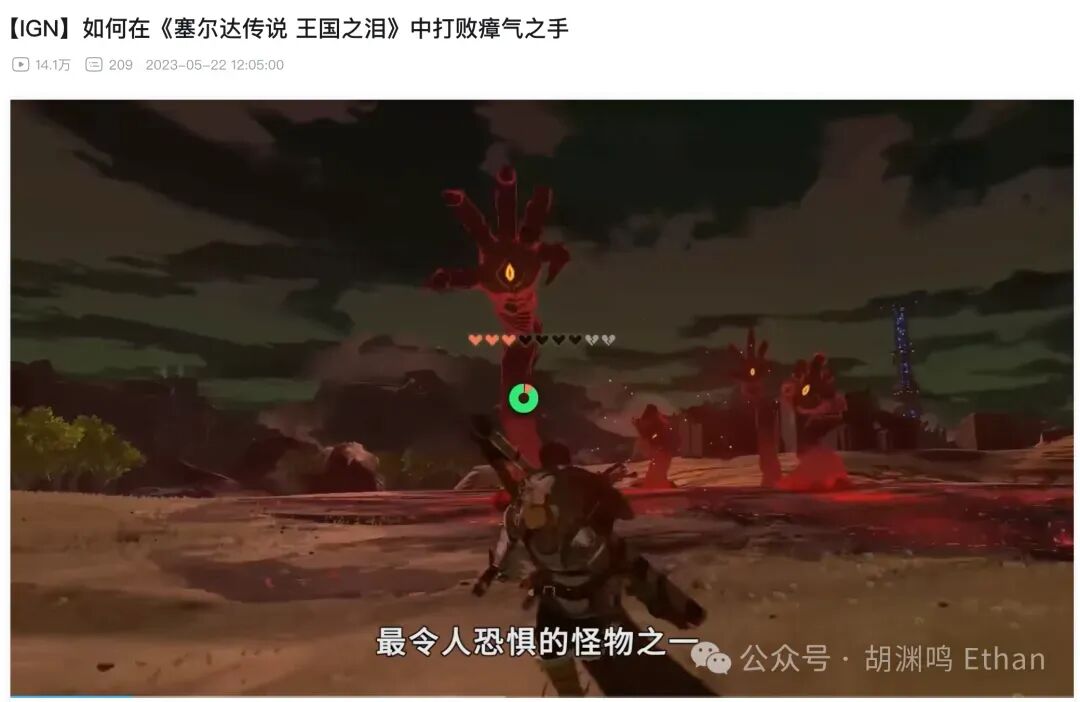
You could replace "miasma" with "deng stench" — gotta learn fast enough...
5
Strategy and Execution
Do hard and right things. The world should reward those who think deeply and execute solidly.
-
Most effort in the world is futile; entrepreneurship and new ventures are no different. Therefore, spending more time thinking about what matters is more effective than spending all your time heads-down executing. Also, if you're too afraid of losing, you can't gain. Risk always exists. "Big bets, big wins; willing to bet, willing to lose." "Resolute gambling spirit."
-
I like attributing success to luck, mainly not to appear humble, but because I'm too accustomed to failure. After all, if the goal is innovation, most efforts will necessarily fail. So from the start, you can adopt the attitude of "even if it'll probably fail, I'll throw myself into it fully; failure is fine, and if it succeeds, that's wonderful." Try more, and you'll eventually succeed. This habit of "low expectations" makes me more危机感 (sense of crisis), more easily feel happiness, and more able to do things better. The downside is it makes me relatively conservative.
-
Resources can substitute for each other: talent density, culture, morale, brand recognition, cash reserves, vision, founder's physical stamina, etc. Some aspects being weaker — as long as not weaker than unacceptable — can be compensated by strengths in other directions.
-
Begin with the end in mind. The most important thing I learned from Professor Ming Zeng: don't think about what you can do in the future based on what cards you hold now; instead, reverse it — first think about what you want to achieve in the future, then see what cards you still need to acquire. The latter mindset can enable you to do things 10x larger than the former, and it won't necessarily be harder. In other words, honestly asking "why can't I do this today" is basic, but the better question is "what should I do today so that I could possibly do this in the future?" How would you know you can't do it without trying?
-
The most important lesson from my time at Tsinghua University and MIT: "Often the smartest people around you are also working many times harder than you." And the market only rewards those with the best results, so smart but not hardworking people, in most cases, can't compete against smart and hardworking people — (market) competition is that brutal. Compared to people who haven't experienced this environment, perhaps my biggest advantage is two firm beliefs: "No one can succeed casually," and "Anything gained by luck will eventually be lost by skill in the long run." Once you think this way, many things become much simpler — just solidly do every thing well.

"Getting an education at MIT is like taking a drink from a fire hose." So a bunch of MIT students modified a fire hydrant into a drinking fountain. Photo Credit: Wally Gobetz
-
The second biggest gain from these two places was getting to closely observe how "geniuses" in outsiders' eyes actually work. Many from these two groups became industry leaders, and from my observation, the most important characteristic is genuine love for what they do. Because "hardworking + smart" people will definitely lose to "hardworking + smart + passionate" people. The former's "hard work" is a drain; the latter's "hard work" is "doing what I love": the former thinks "dear god, enough, I can't anymore," the latter thinks "I can still do better, because I haven't had enough fun." Additionally, they all solidly nail every detail: experiments must be extremely rigorous, papers must have every punctuation mark correct. That they can have such patience to do things ordinary people find tedious comes from passion.
-
"Strive for perfection," not "good enough." Polish endlessly — there's always room to make it a little better. I used to think, "Making a huge fuss over a single punctuation mark? That's just nitpicking and control freak behavior." Later I realized every top performer across every industry is like this: Hayao Miyazaki animating films, Michael Jackson rehearsing choreography, Shigeru Miyamoto designing Mario, Lei Jun making phones, Elon Musk building Tesla, Steve Jobs designing the iPhone, Steve Lin teaching me English writing, Professor Chenfanfu Jiang guiding me through SIGGRAPH papers, Zhang Yimou directing the 2008 Olympics. People who are "careless and sloppy" basically never achieve anything great. There's a prerequisite here: they know their priorities crystal clear, and they practice "important things first." If they're already following this priority discipline, then "nitpicking" becomes an astonishing capability and capital: they've already solved all the fundamental problems that others haven't even tackled, leaving only refinement — while others aren't even qualified to pursue these details, because they haven't reached that stage yet! On the other hand, they're crystal clear about what they want and what they can sacrifice. They know that demanding seemingly incomprehensible standards from their team, while creating enormous pressure today and even getting them called assholes, will ultimately produce good results.
-
Since the world is one giant slapdash operation, if you just solidly nail every basic thing, becoming top 1% is entirely achievable. The hard part is that "doing the basics well" isn't actually that easy. What counts as basic? Things like "knowing exactly what you want," "doing what you say," "sleeping on schedule," "thinking independently," "making sure what you write is comprehensible to readers," "only asking high-quality questions," "using your own product daily," "letting bigger contributors get more," "putting facts above your own face," "not spouting correct but empty platitudes." These all require tremendous self-confidence, self-restraint, execution, independent thinking, and helping others succeed. So there's a reason "top 1%" is only 1%.
-
Since doing the basics well is already hard enough, let's not try to do too many things at once. As a company grows larger, "focus" and choosing "what not to do" become even more important. "Not doing" doesn't mean "losing" — it actually means "gaining":
- Killing a few projects means gaining more time to think about strategic priorities;
- Skipping some events means gaining more time with family;
- Meeting fewer new friends means building deeper friendships with truly like-minded partners;
- Hiring fewer people who don't quite fit means achieving higher talent density and cultural concentration.
- Deep thinking is something others can steal without it mattering. Because such thinking is the final product of synthesizing market demand, founder capability, team capability, the era's context, company DNA, culture, and more. So only you can execute this deep thinking at 100%. Someone else could take it and do 80% at their own company, but they still can't compete with you, because the market only chooses the best. If something can't be done best-in-class, better not to do it at all.
When I was very young, my father once took me to dinner with a student of his who had gone out to start a business. The two of them discussed: "A scientist is someone who makes science their home; an entrepreneur is someone who makes their enterprise their home." More than twenty years later, I still remember this. Having a cause worth dedicating your life to, and enduring its daily ups and downs — some might see that as immense pressure. But for the goal of becoming a "scientific entrepreneur" who creates some value for society and leads an interesting life, I find it endlessly enjoyable.
So what's actually similar between doing science and doing business? My answer is: Find a problem important and interesting enough, then solidly nail the most fundamental things.