Mobile Going Global: Entrepreneurs Should Zero In on the Big Opportunity in Content Products | Source Code Capital Insights

"Mobile going global" has evolved over nearly a decade into a new phase of content going global. How can entrepreneurs catch the next big thing?
Source Code Capital Internal Briefing
Issue 4
Author Bio
Di Yuan Senior Investment Manager

Di Yuan joined Source Code Capital in 2016, focusing on digital entertainment and international expansion. His investments and portfolio management experience includes Xianlai Huyu, Mybo, and RozBuzz. Previously, he worked at Fohou Capital and Ping An Ventures, leading or participating in multiple investments across content, entertainment, and gaming. He holds a master's degree from Tsinghua University. Contact: yd@sourcecodecap.com
[Editor's Note]
After nearly a decade of development, "mobile going global" has entered a new phase of content-driven expansion. How should we understand the logic behind content globalization? What are the key factors? And how can entrepreneurs seize this major opportunity? Source Code Capital presents its exclusive analysis in this fourth issue of the Source Code Capital Internal Briefing.

Key Insights
Mobile Going Global: Entrepreneurs Should Focus on the Major Opportunity in Content-Based Products
Research by Source Code Capital
- Over the past nine years, Chinese mobile products going global have experienced explosive growth and consolidation. Previous global products lacked strong competitive moats. Driven by supply-demand matching and capital support, mobile globalization has entered a new phase dominated by content-based products.
- With American products like Facebook and YouTube having already established clear first-mover advantages in most countries, Chinese entrepreneurs can identify opportunities through a "macro-meso-micro" methodology.
- Drawing parallels from the evolution of Chinese content products, only after progressing through three developmental stages — "scale, virality, and platformization" — can new products hope to differentiate themselves from incumbents.
1. The New Phase of Content Dominance
Since Apple launched the App Store in July 2008, mobile globalization — pioneered by companies like iHandy, Tap4Fun, and Zenjoy — has entered its tenth year.
Over the past nine years, Chinese mobile products going global have evolved from the proliferation of utility apps to explosive growth and consolidation in security, launcher, and lightweight gaming apps, culminating in the rise of entertainment content products in 2015–2016.
Utility apps addressed smartphone users' needs for convenience, efficiency, ease of use, and aesthetics, but they lacked strong geo-cultural attributes and struggled to build durable competitive moats. Many subcategories became transitional opportunities as the Android system matured and super-apps consolidated functionality.
Following Musical.ly's breakout success in North America in mid-2015, a new wave emerged in China's mobile globalization push. This included fresh combinations of "domestic internet talent + veterans with deep overseas experience," as well as overseas-returned entrepreneurs who intimately understood local cultures. Product formats evolved to encompass news/photo content distribution, short-video communities, globalized mobile games, and live streaming. The matching of supply and demand, combined with capital support, has propelled mobile globalization into this new content-dominated phase.
1. Supply Side
China's massive internet population and rapidly developing infrastructure have provided sufficiently rich soil for diverse user segments and sample sizes for different mobile products. The rapid development of content products in recent years has not only demonstrated domestic companies' product and operational capabilities but has also created an overflow of content product expertise and production capacity.
2. Demand Side
In emerging markets like Southeast Asia, the Middle East, and India, predominantly young demographics have fueled demand for more diverse content and entertainment products beyond Facebook and YouTube. Non-English-speaking users' content consumption needs remain unmet due to low localization by foreign products and gaps in local offerings. Meanwhile, improvements in device performance and network speed, alongside declining data costs, have created opportunities to digitize traditional offline entertainment and content consumption, with content formats evolving toward richer media.
In mature markets like the United States and Europe, younger generations crave mobile worlds they can call their own, and are more willing to experiment with products driven by new interactions and technologies like cameras and AR. This has given rise to new social and content platforms represented by Snapchat and Monkey.
However, even with this supply-demand alignment, China has not yet become a cultural export powerhouse on par with the United States or Japan. Content going global remains, for now, an export of product content ecosystems and distribution methods. For Chinese companies going global, there remain enormous challenges in opportunity model identification, localization, and content ecosystem development.
2. Opportunity Identification Framework for Going Global
Regional differences across overseas markets are vast; no single country's internet development perfectly mirrors any historical stage of China's. "Copy from China" can easily create dependency on benchmarked products and validated paths, leading to poor product-market fit. American products like Facebook, YouTube, and Twitter have already established clear first-mover advantages in most countries, further squeezing room for new content products to grow.
For domestic entrepreneurs accustomed to content ecosystems like WeChat, Weibo, and Toutiao, understanding target markets and identifying opportunity models becomes particularly critical. We recommend using a "macro-meso-micro" methodology for opportunity discovery.
1. Macro
Key macro indicators include GDP growth, per capita GDP, disposable income, internet policy, demographic structure, as well as language, religion, and cultural characteristics. New economy expansion driven by internet models must still follow fundamental business principles. Therefore, macro-level understanding should be anchored in a target market's economic development level and disposable income.
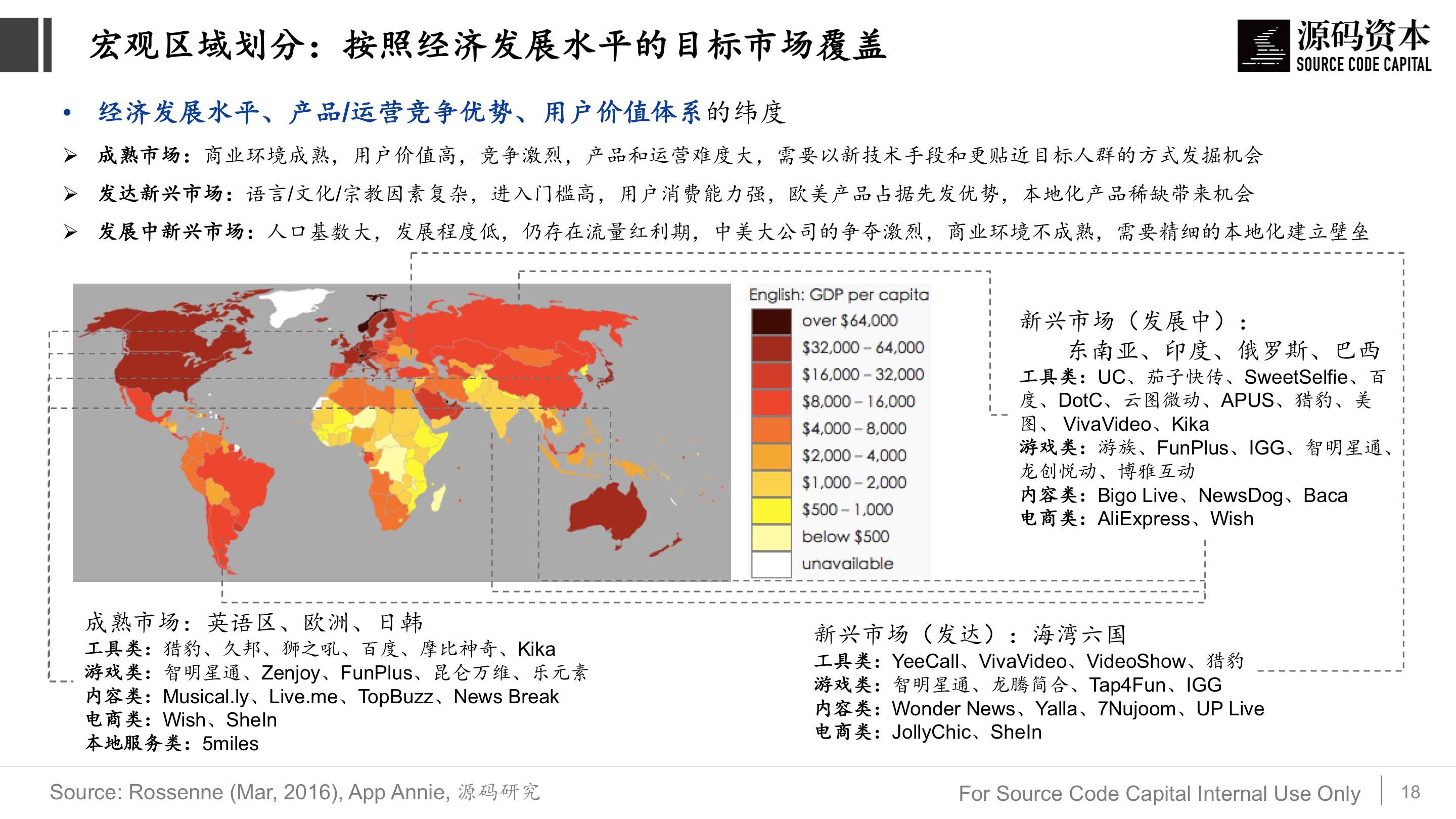
Correspondingly, basic ROI calculation — the ratio of Customer Acquisition Cost (CAC) to Lifetime Value (LTV) — comes into play. While content products don't all pursue high ROI as a core metric, the impact of macro environment on commercialization paths still indirectly manifests in product operations strategy, corporate development strategy, and fundraising rhythm.
To illustrate: if an emerging market's per capita disposable income is one-third of China's, and basic living expenses are roughly comparable, the gap in remaining discretionary income becomes even more pronounced. This means users in that market will be more price-sensitive when it comes to discretionary spending, and near-term commercial value must be discounted accordingly.
For content products entering such emerging markets, beyond commercialization considerations, particular caution is needed around user acquisition costs and promotion pace. For macro information gathering, economic indicator reports serve as primary data sources, while Cost Per Install (CPI) and effective Cost Per Mille (eCPM) obtained through advertising platforms also provide meaningful reference points.
Demographics, language, culture, and religion are equally critical macro indicators. Young populations in emerging markets satisfy users' time-killing needs through more entertaining, casual approaches. Countries with complex linguistic structures can build moats through refined multi-language operations. For religious countries, opportunities exist both in providing derivative content consumption rooted in religion itself and in capturing secularization trends to deliver novel product experiences and gain first-mover advantage.
Beyond the benefits of China's Belt and Road Initiative for new economy expansion, changes in target market internet policies may also harbor major opportunities: policy relaxation on VoIP in the Gulf Cooperation Council countries; Indonesian President Jokowi's revocation of the Ministry of Transportation's ban on app-based motorcycle taxis to encourage innovation; and Indian Prime Minister Modi's demonetization and tax reforms, which substantively boosted internet entrepreneurship — all represent angles for discovering new opportunities.
2. Meso
Mobile internet penetration, smartphone shipments, basic network infrastructure, and data pricing are important factors influencing user behavior. In mature markets with well-developed infrastructure, users demand stronger interactivity, new technologies, and innovative mechanics from content. In emerging markets, where users largely bypassed the PC internet era, products must compromise toward text-heavy formats, smooth performance, offline scenarios, or offline distribution — alongside cultivating user habits.
Yet emerging markets also nurture opportunities amid rapid meso-level change. Indian carrier Jio's six-month free 4G offer not only acquired 100 million users in 170 days but also raised India's 4G mobile internet penetration from 5% to 70%, creating significant tailwinds for content product innovation.
For meso-level information gathering, beyond media and research reports, building relationships with Huawei and ZTE — which are deeply involved in global network infrastructure construction — as well as global CDN service leaders like Akamai and Wangsu Technology, offers effective methods for trend forecasting.
3. Micro
Trends in target market mobile app rankings, shifts in mobile device usage behavior and scenarios (from PC to mobile, from text to GIFs and video), and the rise of online payment penetration all serve as barometers for content product opportunity discovery.
At the product level, key questions include: how to differentiate from already-dominant foreign products; whether viral effects can be achieved in the near term; whether deep localization can build offensive and defensive moats; and whether content formats present upgrade or migration opportunities.
Social media can often help content products establish tone and conduct early testing. Topics and focus areas users prefer on Facebook and Twitter, as well as trends driven by influencers and internet celebrities, provide extremely valuable reference points.
Returning to the product development process, beyond Minimum Viable Product (MVP) testing and rapid iterative development, social media can also serve as an effective channel for content type and user preference research, as well as advertising creative testing.
3. Team Composition at "1:1"
Compared with utility products, content products require far more complex "land-sea-air" integrated operations, involving product positioning, target user needs research, content ecosystem building, operations strategy, and monetization — with higher demands on user retention, time spent, content distribution, and circulation efficiency. Stronger localization support is therefore essential.
From Source Code Capital's nearly one year of engagement with startups, the combination of domestic internet talent + experienced local talent, as well as domestic teams built by overseas returnees with deep local market understanding, has gradually become standard for content globalization companies. The ratio of local to domestic team members has reached 1:1 or higher.
- Product Level
- Photo/text and short-video content products: Need to establish PGC/UGC/OGC production capacity, organizational structures, and ecosystems;
- Gaming products: Need to address integration of game design with local culture, sometimes requiring discovery of distinctive gameplay from folk traditions, while avoiding cultural or religious taboos;
- Live streaming products: In many markets require the comprehensive export of China's live streaming industry chain to sustain platform operations, inevitably involving organizational development such as streamer guilds and influencer alliances.
Localization operations should combine online and offline approaches. Online, user communication can happen through app store reviews, feedback, and email, supplemented by social media operations to deeply mine user needs. Offline, for photo/text and short-video products, beyond securing external content licensing, companies need to build proprietary content ecosystems while addressing content creators' incentives across both "fame" and "fortune" dimensions.
4. Scale, Virality, Platform
Drawing parallels from the evolution of Chinese content products, building a quality content platform requires progressing through three stages: scale, virality, and platformization.
1. Scale
Content produced through PGC/OGC/UGC methods, once it accumulates reads, likes, comments, and shares, must achieve scaled production as the first priority for user aggregation and commercial value discovery. Drawing parallels from the development of self-media in China across news, entertainment, and vertical categories, mid-to-long-tail content creators face enormous challenges in traffic acquisition and monetization. Many target markets have less developed media industries than China, making scale and sustainability even more critical.
2. Virality
The second stage involves empowering content with virality — through refined operations, distinguishing audience segments through content consumption behavior, generating media value or IP accumulation, facilitating connections between content producers and consumers, and achieving viral spread within target user groups. This drives emotional engagement and interaction with content, ultimately influencing user behavior.
3. Platformization
After establishing production and distribution systems comes the platformization of the content ecosystem. This requires building diverse content distribution systems through tagging and user classification, as well as employing feed streams, recommendation algorithms, and other distribution methods to satisfy differentiated user consumption needs.
From scale to platformization, content ecosystem establishment typically decomposes into production, tagging, curation, distribution, consumption, and evolution. Production mechanisms, distribution models, and circulation efficiency serve as indicators of platform ecosystem health.
In production, how to effectively motivate content creators to produce consistently and efficiently within platform standards is key to building content product moats.
In distribution and circulation, establishing user segmentation and content tagging systems forms the foundation for improving distribution efficiency. The combination of content presentation, human curation support, and recommendation algorithms can enhance distribution and circulation efficiency. Particularly in content grading, filtering, and evolution, sufficiently granular categorization and operational data feedback not only facilitate content survival of the fittest and platform evolution but are also critical to building content platform moats.
Looking at specific regional markets: in emerging countries, copying from China can help platforms go from zero to one — content formats, presentation methods, and recommendation mechanisms are core to guiding user consumption and generating platform stickiness, while refined localization operations serve as moat-building tools. In mature countries, beyond the elements of scale, virality, and platformization, maximizing mobile device performance and嫁接ing real-time interaction, camera, AR, and other technological innovations into product differentiation is the path to winning against giant incumbents and leading consumption trends among younger demographics.