MaHui | DeepMaterial Launches One-Person Lab, Marking AI for Science's Leap Into Physical Intelligence



At the inaugural China "AI + New Materials" Conference held recently, MaHui member DeepMaterial officially unveiled "One-Person Lab" (OPL) — a complete scientific discovery system that for the first time gives AI genuine autonomous experimental capabilities. With One-Person Lab, a single researcher, leveraging AI Agents and high-throughput automated laboratories, can achieve the R&D output of an entire team without the traditional 5–10 year trial-and-error cycle. It marks a milestone turning point for AI for Science, advancing from "digital intelligence" to "physical intelligence."
According to reports, DeepMaterial is the only Chinese company to have fully closed the loop of "AI design → automated experimentation → data feedback → model iteration" and achieved scaled mass production. The company has already successfully run through its industrialization闭环, with scarcity value and growth potential far exceeding market expectations. In the AI for Science 2.0 era, One-Person Lab is not merely a tool provider, but a builder of next-generation materials science infrastructure.
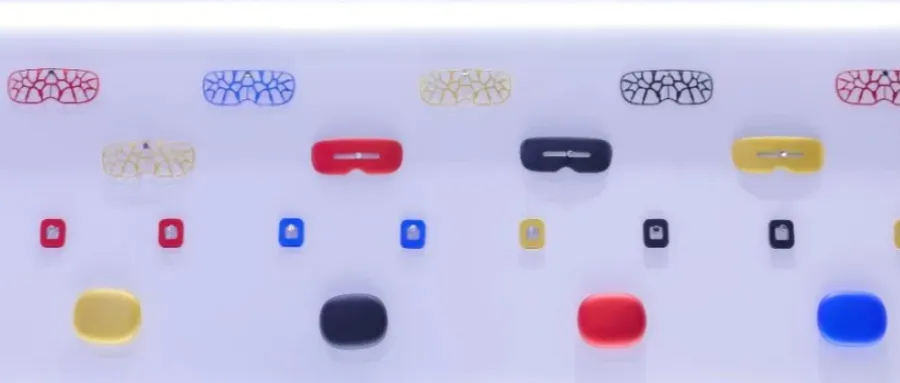
New materials developed by DeepMaterial are already widely deployed in end-use applications
1
The Predicament of Traditional AI for Science: AI That Only "Reads" but Doesn't "Do"
New materials are the "chassis" of strategic industries including aerospace, new energy, semiconductors, and robotics — a market worth trillions of RMB. Yet China has long faced "chokepoint" challenges in high-end alloys, specialty composites, and other domains: low domestic substitution rates, import dependence, and slow iteration cycles.
Under the traditional materials R&D model, bringing a new material from lab to market takes 5–10 years, dozens of team members, and thousands of trials. This approach can no longer keep pace with rapidly growing market demand. The core bottleneck lies in its "forward trial-and-error" nature — make a sample, test its properties, adjust the formulation, and repeat. Every step relies on manual operations and experiential judgment.
The evolution of materials science is, at its essence, a history of R&D paradigm shifts. From empirical trial-and-error (the first paradigm), to theoretical modeling (the second), computational simulation (the third), and data-driven methods (the fourth) — each leap has brought order-of-magnitude efficiency gains. Today, we stand at the threshold of the fifth paradigm: AI for Science.
The core of AI for Science is not using AI to "assist" humans in conducting experiments, but making AI the principal agent of scientific discovery. It no longer passively analyzes data; it actively proposes hypotheses, designs experiments, executes validations, and refines theories — forming a complete autonomous scientific discovery loop.
In recent years, AI for Science has made plenty of noise in materials, but its footprint on the ground remains light.
This is because the vast majority of "AI + materials" solutions on the market today are essentially literature readers plus data fitters. They learn known knowledge from massive volumes of papers, use machine learning models to predict material properties, and output a "recommended formulation." But ultimately, human experimental verification is still required, and the closed-loop speed is constrained by the physical experimentation bottleneck. This path has three insurmountable flaws:
Fatal flaws in data sources: Training data comes solely from published papers, which omit over 90% of failed experiments, negative results, and process details — the critical "dark knowledge." AI has never seen real-world failure, so it cannot understand physical boundaries.
No physical feedback mechanism: Model outputs are based on probabilistic statistics, with no way to verify or correct them through real physical experiments. When the model hallucinates — say, recommending an alloy composition that is thermodynamically impossible — the system has no awareness of the error.
No closed scientific methodology loop: Genuine scientific discovery requires a complete cycle of "propose falsifiable hypothesis → design rigorous experiment → refine theory based on results." Current AI only completes the first step (and not even well); the latter two are entirely missing.
Xuanze Wang, founder and CEO of DeepMaterial, put it bluntly: "The essence of scientific discovery is not reading literature, but doing experiments with your own hands and learning from the results. Today's large language models are students who have read ten thousand books but never lifted a finger."
This is precisely the core problem that "One-Person Lab" was designed to solve.
2
One-Person Lab: Letting AI Do Experiments with Its Own Hands
The core concept of "One-Person Lab": one researcher (top-level design) + AI Agent (intelligent hub) + high-throughput automated laboratory (execution terminal) = the R&D output of a traditional team.
It is a complete system with autonomous scientific discovery capabilities, built on a three-layer technical architecture:
Top layer: Materials design engine. Traditional R&D follows "forward trial-and-error" — make a sample, test its properties, adjust the formulation, a lengthy cycle. Inverse design flips this entirely: input target properties (e.g., "yield strength > 1000 MPa, elongation > 10%") and work backward directly to the material formulation, overturning the traditional "trial-and-test" paradigm and enabling exponential leaps in R&D efficiency.
Middle layer: DM Agent + Knowledge Graph. Fuses large language models with materials science knowledge graphs to build a reasoning engine with physical common sense. A physical law validation layer is superimposed on top of general-purpose foundation models. Model reasoning is forced to follow the causal chain of "composition → process → microstructure → properties," rather than pure statistical correlation. A built-in physical common sense filter actively intercepts outputs that violate thermodynamic or metallurgical principles — for example, if an Agent tries to print nickel-based superalloys using FDM工艺, it will throw an error immediately.
Bottom layer: M-LAB 7×24h "lights-out laboratory": Based on the self-developed HMPT-3000 high-throughput mechanical property testing platform, it achieves fully unmanned operation across the entire workflow from material preparation, heat treatment, mechanical testing to data upload. Room-temperature testing throughput reaches 600 samples/day, more than 10× faster than traditional manual methods; collaborative robots and AGV carts coordinate to automate the full process, eliminating human operational variance; and negative data is fully recorded, ensuring every failed experiment is captured, archived, and used for model correction — forming the core asset for AI's understanding of physical boundaries.
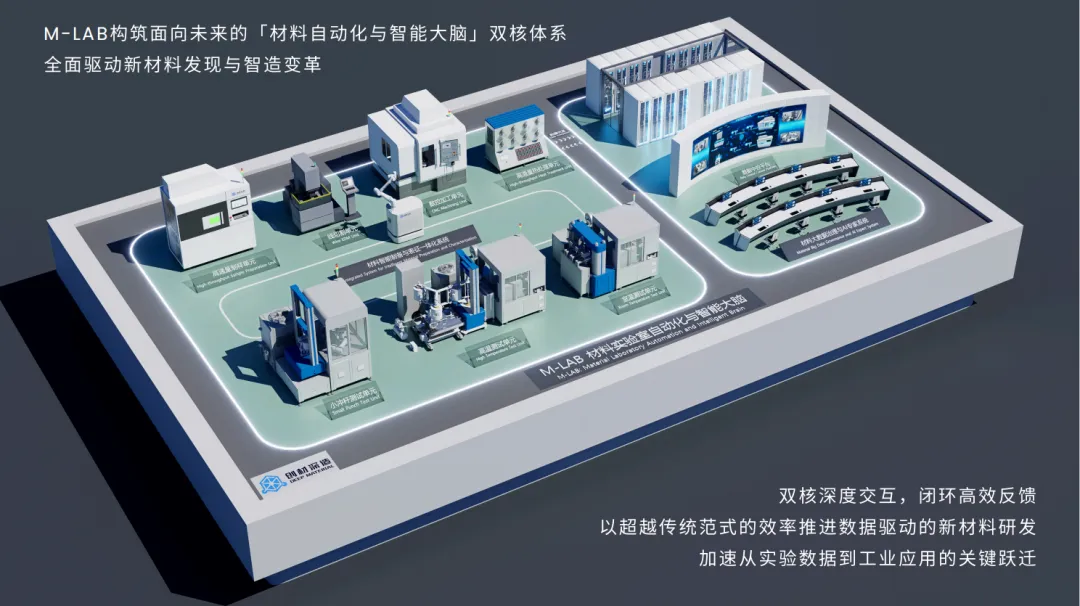
M-LAB materials laboratory automation and intelligent brain system The three layers form a closed loop: DM Agent proposes hypotheses → M-LAB executes automatically → physical data flows back → model corrects and iterates. With each completed cycle, the agent's understanding of physical laws deepens. This is not a one-time software delivery, but a self-accelerating R&D flywheel.
Currently, One-Person Lab is not a concept on a PowerPoint, but a technology-business closed loop that is already up and running.
Take the M-LAB high-throughput laboratory: it is equipped with a complete automated materials preparation and characterization hardware system, including 4-channel LPBF additive manufacturing units, fully automated wire-cutting and CNC machining units, and 8-channel independent temperature-controlled heat treatment units for efficiently preparing micro-specimens with controlled composition and process parameters; on the testing side, it integrates three-station fully automated room-temperature tensile testing units (600 samples/day), fully automated small-punch high-temperature creep testing units, and morphology inspection equipment, supplemented by robotic arms (10 seconds/sample pick-and-place), non-contact extensometers, flexible specimen stages, automatic speckle spraying, and vision-based alignment correction.
Furthermore, M-LAB can conduct batch mechanical characterization experiments including room-temperature tensile, high-temperature tensile, high-temperature creep, full-field strain distribution, and surface morphology inspection, processing up to 140 micro-specimens in a single batch and returning high-quality data including complete stress-strain curves, elastic modulus, yield strength, tensile strength, fracture elongation, hardening curves, and 2D full-field deformation evolution details — enabling rapid, economical, and precise construction of large materials property datasets for materials performance prediction and AI model development.
3
One Person Rivals an Entire Team
DeepMaterial's goal is to build an "AI materials scientist" capable of autonomously executing physical experiments. Its One-Person Lab has already achieved seamless connection between the "brain" (AI Agent) and the "hands and feet" (robots, AGVs, high-throughput equipment), with a complete data closed loop and iteration speed at the hourly level. It has fully打通 the "computation → experiment → validation → iteration" cycle, allowing AI to truly "touch" the physical world with its own hands.
On this foundation, the company has completed R&D and mass production of 13 alloy materials within six months, covering nickel-based superalloys, ultra-high-strength titanium alloys, rare-earth-free high-strength aluminum alloys, and high-entropy alloy die steels. Multiple products have already achieved substantive substitution of imported materials in aerospace, new energy vehicles, consumer electronics, and other fields, with order value exceeding ten million RMB.
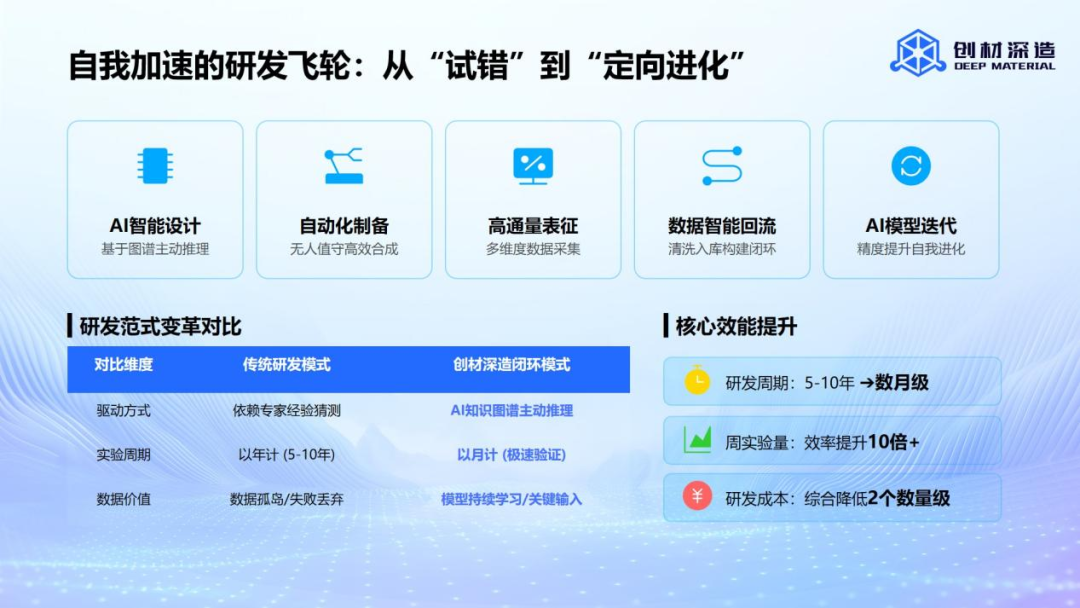
AI + high-throughput driven materials R&D flywheel On the One-Person Lab platform, a single researcher need only handle top-level design; the AI Agent autonomously generates experimental protocols, schedules equipment, and iteratively optimizes, executing 7×24 without interruption and completing the R&D of a new material within months.
According to reports, One-Person Lab adopts a subscription pricing model. Customers need not make a one-time investment of tens of millions of RMB to build their own laboratories, nor assemble teams of dozens. Annual subscriptions with flexible pricing: customizable by equipment usage hours, sample throughput, or data output volume. This dramatically lowers the barrier to entry for materials R&D while ensuring output efficiency.
In essence, One-Person Lab represents the scaled implementation of "R&D as a Service" in materials science. For DeepMaterial, the subscription model means recurring revenue streams, extremely high customer stickiness, and decreasing marginal costs. With each additional customer, M-LAB hardware utilization rises and AI models grow more accurate with more data — forming a classic "data network effect."
Xuanze Wang said: "We are not using AI to assist R&D; we are teaching AI how to think, act, and discover like a physicist. One-Person Lab is not a product, but an idea — giving every researcher their own 'AI team.'"
In the wave of AI for Science, whoever first builds closed-loop capabilities for "physical world AI" will occupy the commanding heights of next-generation scientific infrastructure. DeepMaterial's One-Person Lab has already taken the decisive step.