Code Brain | Open AI Shake-up Settles: Who Won, Who Lost?

The OpenAI Palace Drama: A Complete Account
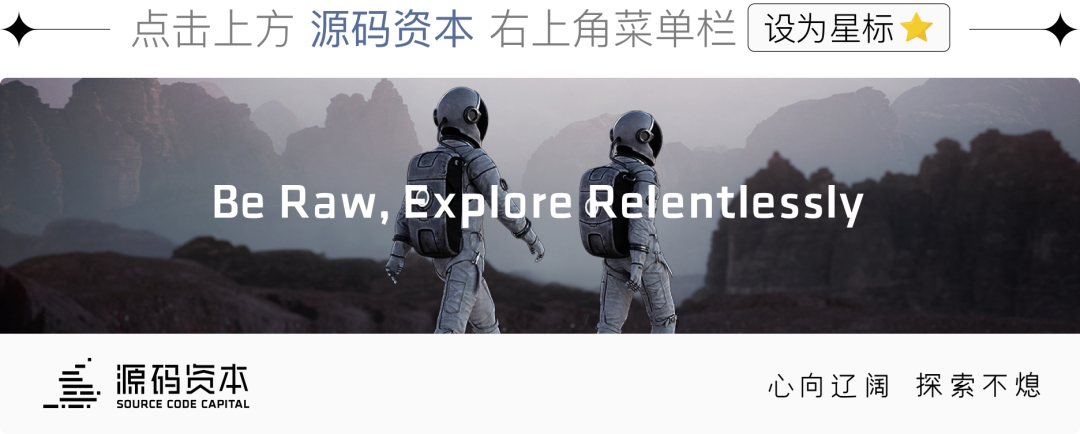

Sam Altman is indeed back.
Silicon Valley's palace-intrigue drama, which had shaken most of the AI world, finally reached a temporary conclusion after five days. On November 22, Beijing time, OpenAI announced that Altman would return as CEO of the AI startup he co-founded just days after being fired by the board, and that a new board would be formed consisting of Bret Taylor, Larry Summers, and Adam D'Angelo, with Taylor serving as board chair. In its post, OpenAI also stated that all parties were "working out the details." Three of the four board members who participated in Altman's removal on Friday would not be part of the initial board. This marked a temporary end to the stalemate over "who would lead OpenAI" — with the combined push of allies, employees, and investors, Altman successfully reversed the outcome of his removal by the company's board the previous week. "I love OpenAI, and everything I've done over the past few days has been in service of keeping this team and its mission together," Altman wrote on X.
But this sudden crisis has also triggered a series of reflections on the AI industry and humanity's future. According to people familiar with the matter, a previously unreported letter was one of the triggers for the board's ultimate decision to remove Altman. Four days before OpenAI made the decision to fire Altman, the board received a warning letter from researchers stating that a powerful AI discovery could threaten humanity — a project called "Q" (Q-star)**. Q could become an important breakthrough toward artificial general intelligence (AGI), but are people prepared with the corresponding safety measures?
Throughout this personnel shakeup, discussions about Q* never appeared on the front stage, but the problem won't suddenly disappear with Altman's return. In 2015, Altman publicly stated at a conference: "AI will very likely bring about utter catastrophe, but at the same time, great companies will emerge."
How should humanity face what may be coming?
What Actually Happened?
Last Friday (November 18), OpenAI's board announced that CEO Sam Altman was departing and leaving the board, with CTO Mira Murati appointed as interim CEO. OpenAI's reason was that Altman was "not consistently candid in his communications."
Just half an hour earlier, Altman had attended a meeting where he was fired by all board members except OpenAI co-founder and president Greg Brockman. Five hours later, Brockman also announced on social media that after stepping down as board chair, he had decided to leave the company entirely, resigning from all positions at OpenAI.
Elon Musk posted, demanding that OpenAI's board explain its reasoning for this move.
That same day, according to The Information, three senior researchers at OpenAI resigned on Friday evening: research director Jakub Pachocki, Aleksander Madry who led the team evaluating AI's potential risks, and researcher Szymon Sidor. People familiar with the matter revealed that this resignation decision was influenced by Altman's firing and Brockman's departure.
Against this backdrop, The Information also reported that OpenAI was in discussions with investors about a new funding round at a valuation of up to $86 billion (approximately 620.1 billion RMB), selling employee shares to investors.
Bloomberg, citing people familiar with the matter, reported that OpenAI's investors and employees were pressuring the board to reinstate Altman as CEO, with OpenAI investors including Microsoft and Thrive Capital all working to broker Altman's return.
On social media, Altman said he would decide whether to return to OpenAI as early as the evening of the 19th local time. Media reports stated that Altman was planning to found a new AI company or chip company.
On Sunday, Altman arrived at OpenAI's headquarters and posted a photo of his visitor badge on social media, writing: "This is my first and last time using an OpenAI visitor badge."
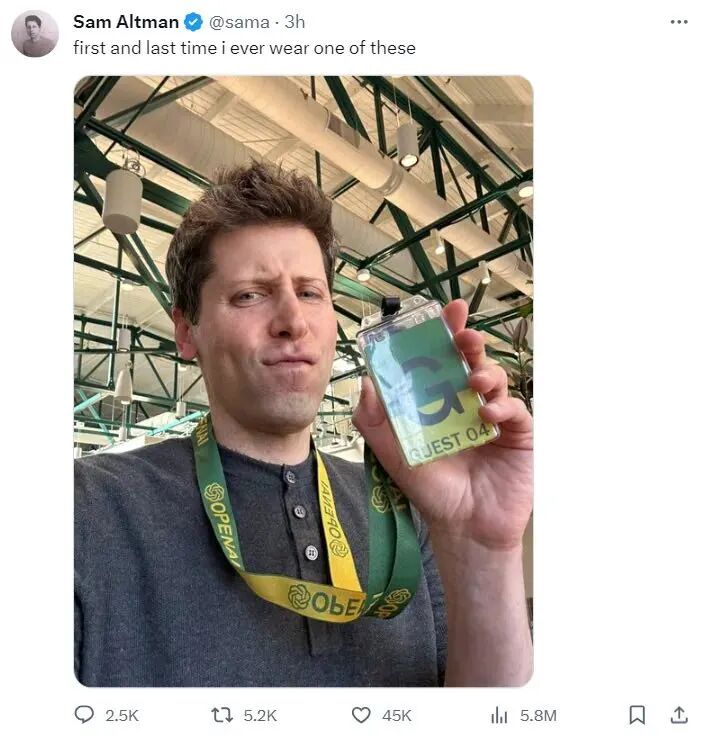
Microsoft stated that if Altman returned, it would consider joining the restructured board. Late that night, OpenAI announced in a memo to employees that Emmett Shear, former head of Twitch, had been appointed interim CEO, stating that removing Altman was "necessary to preserve the board's ability to execute its responsibilities and advance the company's mission."
Regarding the reasons for Altman's removal, Shear posted on X: "The board did not remove Sam over any specific disagreement on safety."
Soon after, Microsoft CEO Satya Nadella announced that Altman and Brockman would join Microsoft to lead a new AI research division.
In pre-market trading Monday, Microsoft's stock rose more than 2%. Microsoft's market cap exceeded $2.75 trillion, meaning Altman's joining added $55 billion to the company's value.
On November 21, hundreds of OpenAI employees signed a joint letter accusing the board's actions of demonstrating its inability to oversee OpenAI, demanding that the company bring Altman back or they would collectively resign and join Microsoft's new division.
OpenAI co-founder and chief scientist Ilya Sutskever also stated: "I deeply regret my participation in the board's actions. I never intended to harm OpenAI. I love everything we've built together, and I will do everything I can to reunite the company."
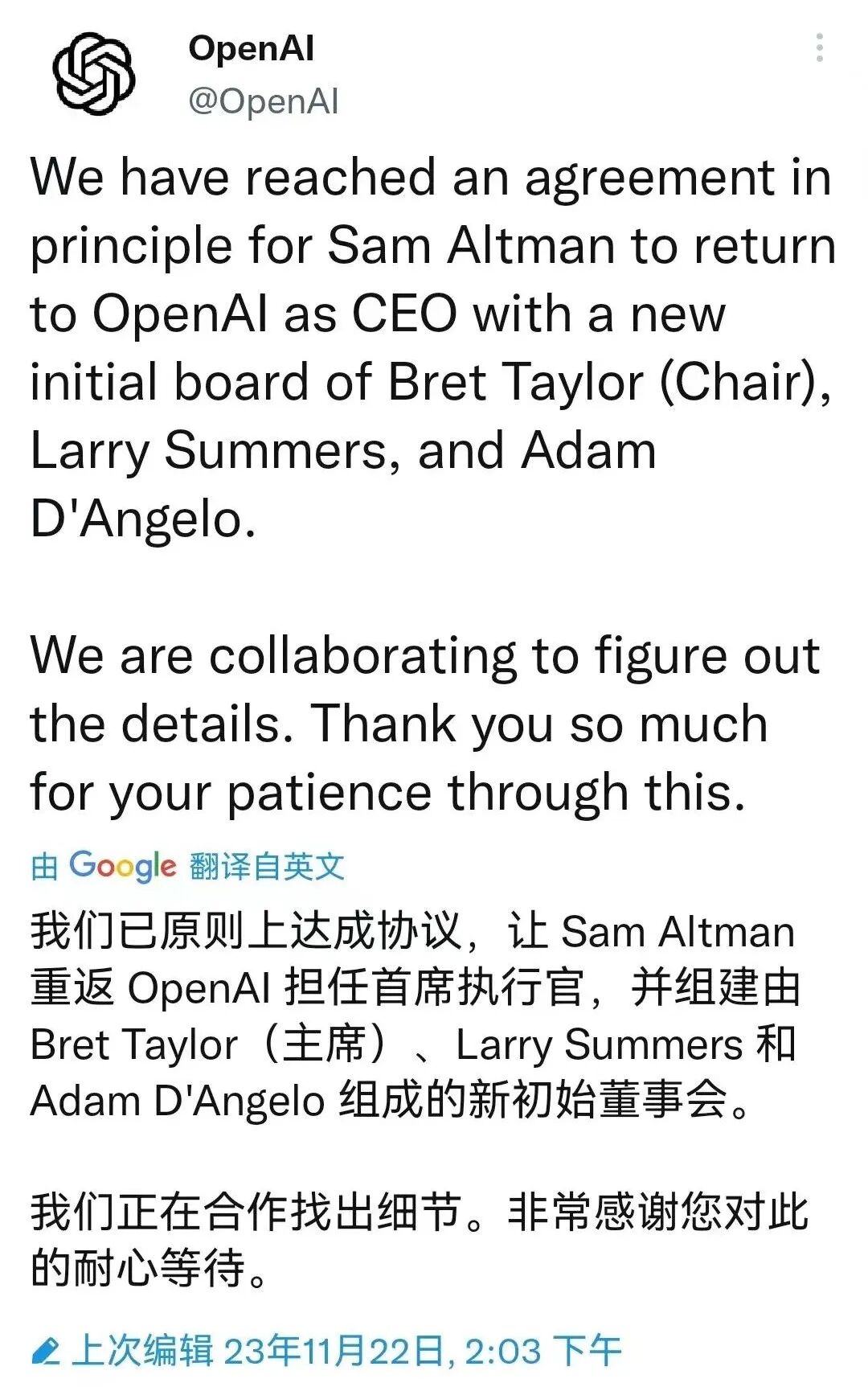
On November 22, OpenAI confirmed the news of Altman's return.
Microsoft May Be the Biggest Winner
When OpenAI was founded, it was a non-profit organization aimed at exploring how to achieve artificial general intelligence (AGI) in a safe manner, so that all of humanity could benefit equally rather than being driven by commercial incentives. In 2018, Elon Musk, one of the co-founders, left OpenAI, and Altman set about transforming the AI lab into a for-profit company controlled by a non-profit organization and its board.
In 2019, Microsoft invested $1 billion in OpenAI. That same year, now a for-profit company, OpenAI released a powerful language model — GPT-2, capable of generating human-level text.
The development of this language model consumed enormous funds, and investors flocked in.
About a year ago, with the release of ChatGPT, OpenAI had already taken the lead in the race to build generative AI — systems that can create text, images, code, and other multimedia in seconds.
The reason the board was able to make such a major move this time is related to the company's unusual governance structure. It is controlled by a non-profit board that can determine the company's leadership, while the company's investors have no formal way to influence decisions.
Microsoft CEO Satya Nadella said on Monday that he received brief notice only after OpenAI's board fired Altman and just before the firing was announced. He stated that whether Altman returned or took a new position in Microsoft's AI research division, OpenAI needed major reforms to its corporate governance.
Earlier this year, Microsoft invested $10 billion in OpenAI as part of a "multi-year" agreement that valued the San Francisco-based company at $29 billion.
Just earlier this month, Altman told the Financial Times that OpenAI's partnership with Nadella was "working really well," and that he expected "to raise more money over time from this tech giant and other investors" to keep pace with Microsoft's development.
But in this removal incident, Microsoft had almost no right to know. In actively promoting Altman's return, Microsoft was also considering pushing for adjustments to OpenAI's corporate governance, including demanding that OpenAI expand its board size and raise the experience level of board members. People familiar with the matter revealed that Microsoft was also considering whether it should try to get one of its own executives onto OpenAI's board.
Viewed this way, Microsoft and Altman seem to be the big winners of this fight — Altman will continue to lead the company he helped create, and the new board will theoretically be more supportive of his vision.
Dan Ives, an analyst at Wedbush Securities, stated that this incident actually strengthened Microsoft's position and made OpenAI look quite bad.
Microsoft will gain more control over this company, thereby enhancing the tech giant's ambitions in developing AI — which many in Silicon Valley believe will be the most important wave of technological progress in the coming decades.
With ChatGPT introducing the concept of a chatbot that can interact with humans to the global public for the first time, the 38-year-old Altman quickly became a star in the AI industry, seen as one of the few people who grasp the future direction of this enormously promising technology.
When discussing the risks and benefits brought by this powerful technology, he had stated that he too feared that AI might one day exceed human control. But at the time, he seemed not to have foreseen this sudden turn of events.
In a previous interview with the Financial Times, Altman said he divided his time between two areas: researching "how to build superintelligence" and methods to enhance computing power. "Our vision is to build AGI, figure out how to make it safe... and figure out the benefits," he said.
But in the short term, Altman still seems to need to brush up on corporate governance, and not let "palace intrigue" become a stumbling block on the path of development for "technology that may reshape human society."