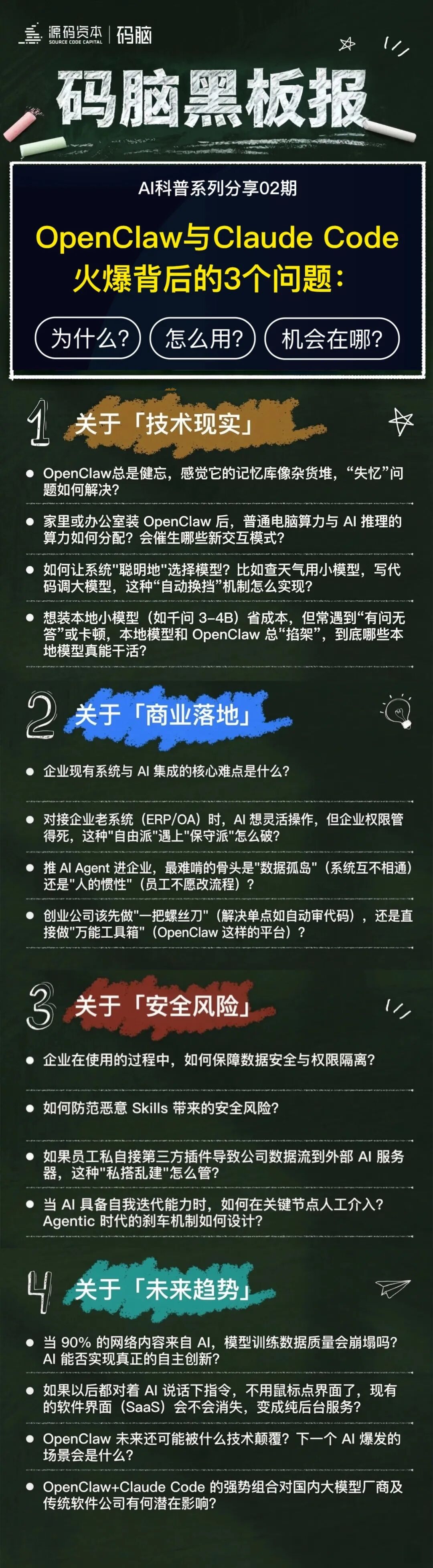
Code Brain | What Do Entrepreneurs Really Care About When It Comes to OpenClaw and Claude Code?

This list of questions reflects both their genuine confusion about AI right now and, to some extent, the gap between AI's viral hype online and its actual implementation in the real world.

No one could have predicted how violently 2026 would begin. It's not just founders — everyone is being shoved forward by AI's invisible hand. These past few months, AI anxiety has spread silently, migrating from code editors into everyday life...
That anxiety mostly stems from a superficial understanding of AI. In early March, we organized an online educational session on OpenClaw and Claude Code, featuring Wen Zhang, senior solutions architect at Amazon Web Services, who broke down three questions behind the hype: What are they? How do they work? Where's the opportunity? We hoped this session would help founders cut through the noise and grasp the essential facts.
This was also the second installment in Code Brain's "AI Education Series." Exactly one year prior, we'd held a similar online session on DeepSeek. In fact, since the rise of AIGC in the first half of 2023, Code Brain has been organizing AI-themed salons covering topics like AIGC, opportunities in large language models, and ecosystem applications. We've hosted speakers including Hongjiang Zhang, former dean of Microsoft Asia Engineering Institute; Dr. Wei Li, chief scientist at Trend; Dr. Bo Long, who led Meta/Facebook's monetization AI research team; and Dahai Li, CTO of Zhihu and CEO of ModelBest — more than ten sessions in total.
Yet this session's turnout still exceeded expectations. Nearly 70 portfolio companies participated, with over 350 attendees joining online. Many companies even treated it as corporate training, organizing group viewing for their staff.
Rather than summarizing the speaker's presentation, today's piece presents a selection of frequently asked questions from founders during the session. This list captures their genuine confusion about AI right now, and in some ways, represents the gap between AI's viral presence online and its real-world implementation.