Code Brain | How Did People Give Presentations Before PowerPoint?

The Birth of PowerPoint Killed an Industry

PowerPoint — PPT or slides for short — is now software that nearly every office worker uses. A great deck and a stellar presentation can earn you a promotion, secure investment, or win users over to your product. On the flip side, PPT is also the workplace demon that torments people endlessly, from founders down to entry-level employees, all of whom have found themselves staring at unfinished slides late into the night, pulling their hair out.
Before PowerPoint was invented, how did people give presentations? Who invented PowerPoint, and did they ever sense the complex love-hate relationship office workers would have with it? Most people know nothing about how this software, which has been with us practically since our school days, came to be, or what impact it had on the world back then and what changes it brought. Today, Code Brain brings you an article on the history of PowerPoint and the presentation. After reading it, the next time you click that red icon, you might feel something new.
1948 was not a good year for the American liquor industry. Prohibition had long ended, and the trade was once again a buyer's market — something you could tell from Seagram's annual sales exhibition, a touring event hitting 11 cities designed to boost nationwide alcohol sales. The exhibition spared no expense on spectacle: professional actors performed a two-hour stage play about a whiskey salesman; there were lavish lobby displays and free drinks; and the centerpiece of it all was a "slideshow." This "Seagram-Vitarama" presentation far exceeded ordinary slideshows, offering an extraordinary experience: hundreds of images of the distillation process, set to music, projected across five screens measuring 12 by 4.5 meters each. One attendee marveled: "It's made of pictures, but it's not static — the overall effect is stunning." Inspired by Eastman Kodak's exhibition at the 1939 World's Fair, the Seagram-Vitarama was the first audiovisual sales presentation in history. From that point on, the format caught on.
In the late 1940s, multimedia was still a novelty. By the early 1960s, almost every company with a substantial advertising budget was using all kinds of multimedia equipment — 16mm film projectors, slide projectors, filmstrip projectors — for sales training and promotion, PR events, and some internal meetings. Many companies even hired their own audiovisual directors, who served as both performers and technicians. Though everyone generally found such presentations boring, when done well, they could wield theatrical influence, and the business world knew it. From the era of the Seagram-Vitarama onward, major corporations began harnessing the power of images to sell their ideas to the world.
Please turn to the next slide
The champagne in guests' glasses and the music in the hall masked the deafening click of slide changes. The 2,500 dignitaries and VIPs in the audience were treated to a one-hour operatic performance about luxury travel. On stage, a massive choir and the full Stockholm Philharmonic Orchestra played, with some 50 dancers and performers gathered around two Saab 9000 CD sedans. Behind them, on an 8-meter-high screen, exquisite shots of chrome detailing, leather seats, and open roads cycled through. These images weren't digital — they were nearly 7,000 carefully arranged film slides, powered by 80 Kodak projectors. In 1987, the slideshow reached its historical peak.
Before PowerPoint or even digital projectors existed, the 35mm film slide projector was king. It offered larger, clearer images than 16mm film at lower production cost; higher resolution and better color than video. It was the only medium CEOs and executives had for delivering impactful presentations at annual shareholder meetings, all-hands gatherings, and sales conferences. Putting on such a show required a small team of producers, image specialists, and live crew — known in the industry as "multi-image" presentations.
Creating one of these began with a full script, storyboards, and a musical score. Photos were selected from stock libraries or commissioned, animations and special effects produced. Technicians in white gloves developed, mounted, and dusted the film before loading it into carousels. The show-control computer was programmed with thousands of cues, then tested repeatedly — all to prepare for potential computer crashes, projector bulbs burning out, or slide carousels jamming.
"When you think about how much equipment one presentation required, all the complex connections, all the countless little details — the fact that it ever ran smoothly was a miracle," said Douglas Mesney, a commercial photographer turned slide producer. His company, Incredible Slidemakers, was behind the Saab launch that used 80 projectors. Now 77, Mesney's retirement project is archiving the forgotten slideshow business.
As a commercial photographer, Mesney shot for Playboy and automotive magazines, occasionally bringing along a Kodak projector or two to pitch clients. At the 1972 New York Boat Show, he saw an impressive six-screen setup and decided to enter the multi-image business. "You look at these six projectors, think about what they can do, and suddenly you go: my God," he recalled. Six projectors was just the beginning. At the height of his career, Mesney used up to 100 projectors in a single presentation, mounted on towering rigs. Multiple projectors aimed at the same screen could create seamless panoramas and complex animations, all synchronized through film. Though the risk of disaster ran high, when it worked, his shows held audiences spellbound and made corporate executives loom like giants.
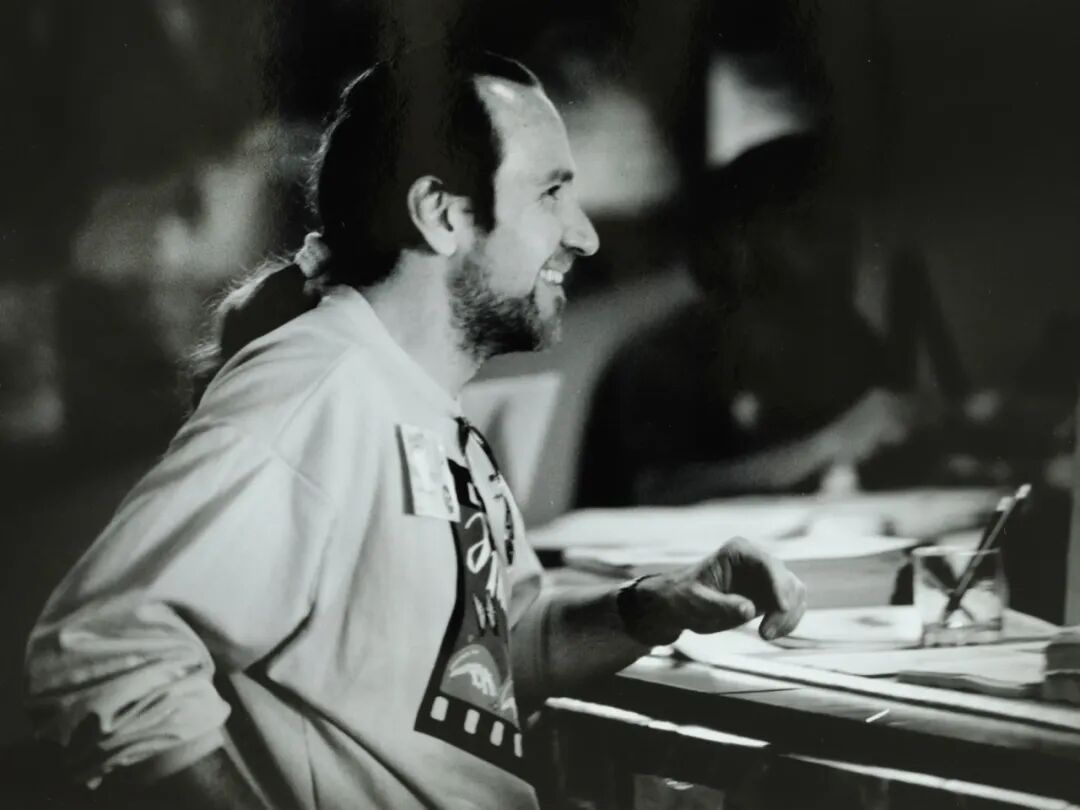
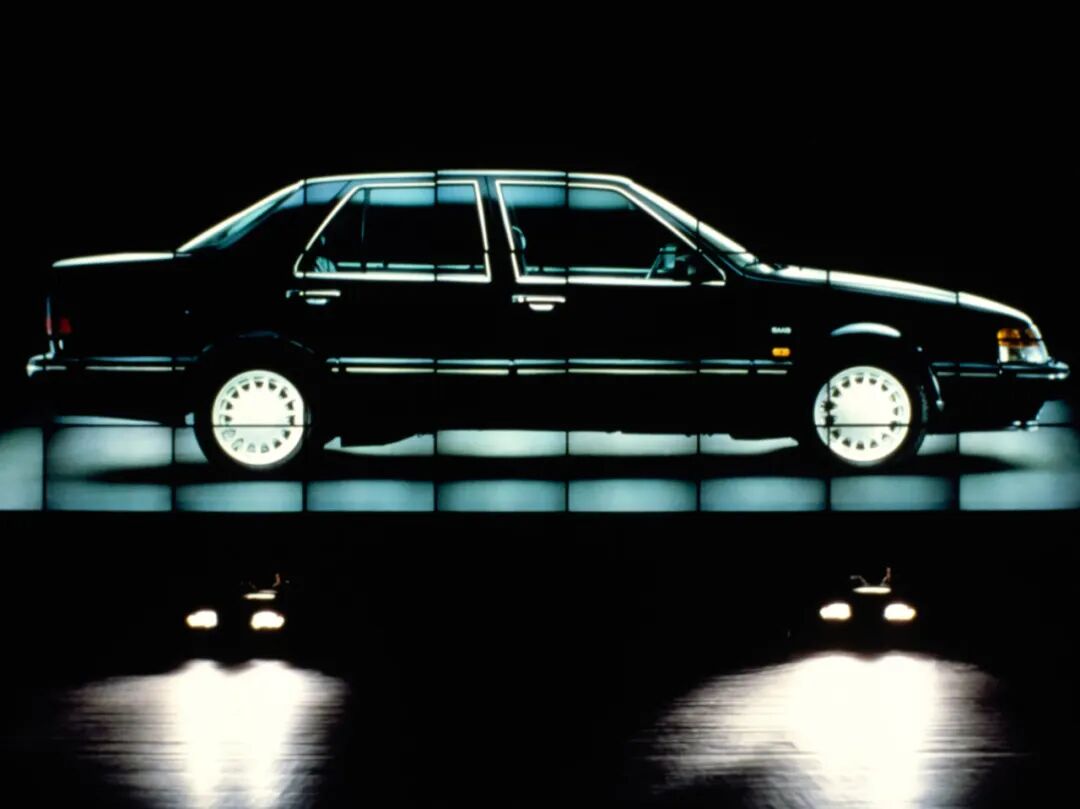
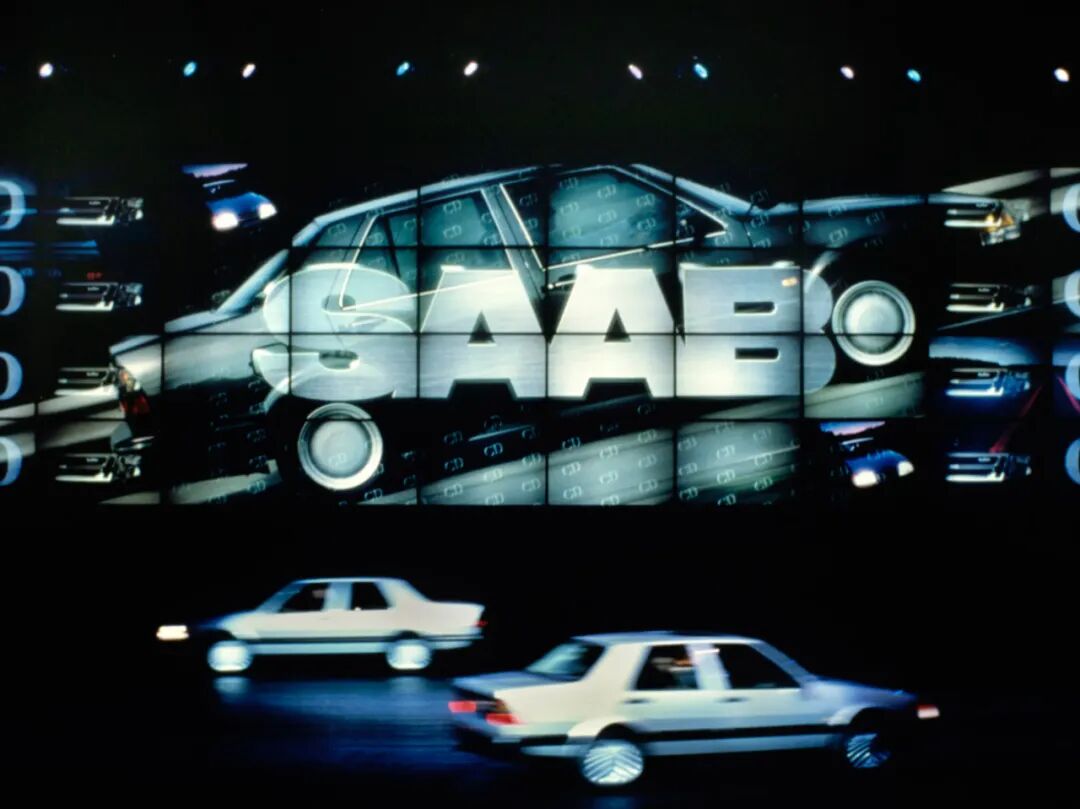
Douglas Mesney and his company with slides made for the Saab launch
Mesney's clients included IKEA, Saab, Kodak, and Shell. A single presentation could cost several hundred thousand dollars to produce — on the cheaper end for the multi-image business. Major production companies like Carabiner International charged up to $1 million to stage a corporate meeting, augmenting their generic multi-image shows with laser light displays, dance performances, and big-name bands and acts (Hall & Oates, the Allman Brothers, even the Muppets). "I compare it to being a roadie for rock and roll, except I never got on the tour bus," said Susan Buckland, a slide programmer who spent most of her career at Carabiner.
The Association for Multi-Image, founded in 1976, grew rapidly in the mid-1980s, expanding from zero to 5,000 members. At its peak, the slide industry employed roughly 20,000 people and supported several festivals and four trade magazines. In 1980, one of those magazines published an interview with Douglas Mesney. Asked about the future of slides, he replied: "We could make a lot of money, or we could go bankrupt within a year." He proved prophetic.
At the time, more than 30 manufacturers of electronic slide programming equipment were competing for market share in multi-image presentations. To meet demand for ever more impactful shows, technology advanced rapidly. Manual dissolve switches and basic control systems programmed with paper tape and cassette tapes quickly evolved into specialized computers for precise slide control. The AVL Eagle I, for instance, could drive 30 projectors at once. The Eagle came with word processing and accounting software — a true business computer. So when Eagle spun off from its parent company, Audio Visual Labs, in the early 1980s, it became one of Silicon Valley's most promising computer startups.
Eagle went public in the summer of 1983, making its president, Dennis R. Barnhart, an instant millionaire. Just hours after the IPO, Barnhart crashed his brand-new cherry-red Ferrari into a guardrail near company headquarters, flipping it into the air and down a ravine to his death.
The slide projection industry followed soon after.
Douglas Mesney often says that if you haven't seen a slide show, you never will. The projection equipment has long since been buried as garbage; the slide film barely archived. Occasionally a box of old multi-image modules turns up in a warehouse, miraculously undamaged. But aside from a handful of hobbyists and retired programmers, no one knows how to repair or show them.
"We don't have a single module that survived," said former slide professional Susan Buckland, frustrated. "We're all sad about it. We have no past, because we can't explain it to people now."
Born at the intersection of the pre-digital era and high-tech art, the industry quietly ended after two decades.
Demand from the presentation industry also drove technological progress. In the multi-image era, producers like Mesney pushed slides to play as fast as possible, using every tool to create bigger, bolder shows. Mesney claimed to have set the record for fastest slide playback — 2,400 slides in three minutes. But even the fastest slideshows were still static images. The computers controlling playback were automated, and it didn't take long for them to surpass manual and mechanical media. Steven Michelsen, a former slide programmer, now restores and projects these vintage slides in his garage. "Back then, computers were fast enough to issue commands to slides, but not to generate images. It took about 15 to 20 years for computer graphics to develop enough to rival film quality and handle the entire slideshow process independently."
In 2004, the last Kodak slide projector rolled off the production line. Workers and Kodak executives signed the machine, which was ultimately sent to the Smithsonian Institution, an organization of museums, education, and research centers.
People raised glasses and gave speeches for the final projector, but it all served as a eulogy for the slideshow. PowerPoint had already conquered the world.
Inventing PowerPoint
The Hôtel Régina, an Art Nouveau masterpiece overlooking the Tuileries Garden near the Louvre, was occupied by the latest technology on a day in 1992. Its antique meeting room had been taken over by a refrigerator-sized, $100,000 color projector that required an hour to warm up, which staff had been debugging for 48 hours to ensure peak performance.
Robert Gaskins walked in. He was the developer of the new software, PowerPoint 3.0. He carried a laptop to the podium, plugged in a video cable, and played a video presentation directly from his computer — in full color.
This was the first presentation of what has now been presented hundreds of millions of times. Every Microsoft employee from Europe present was deeply stunned. They "immediately realized this would completely transform the future of the presentation industry," Gaskins later wrote. "The applause was thunderous."
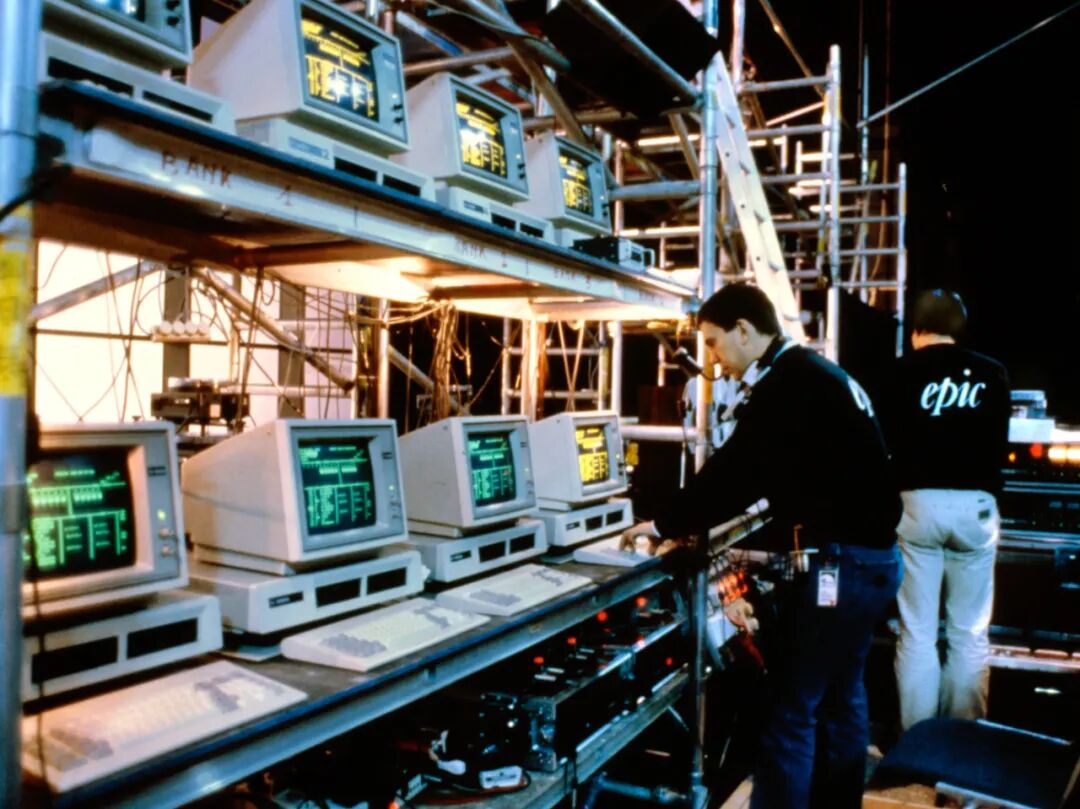
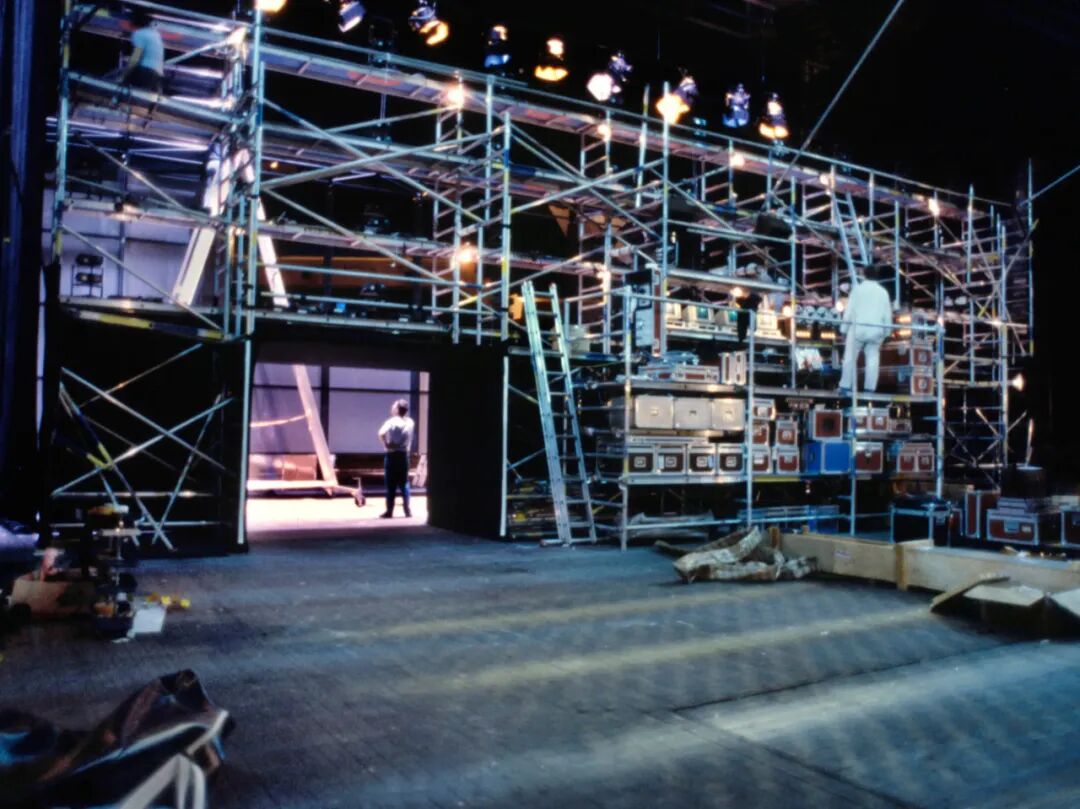
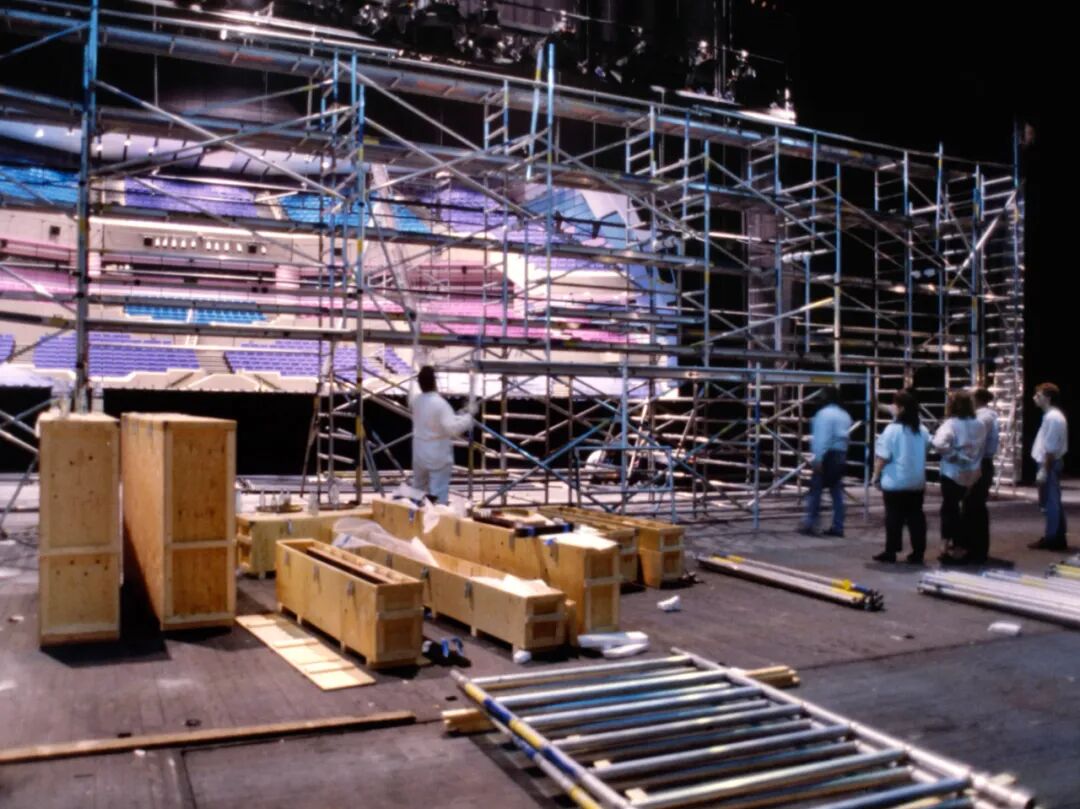
Douglas Mesney and his company setting up on site
Today it's hard to imagine a PowerPoint presentation drawing thunderous applause, just as it was hard back then to imagine Robert Gaskins at that podium launching the PowerPoint era.
Gaskins's father ran an audiovisual company; Eastman Kodak factories were regular stops on family trips. At UC Berkeley, Gaskins studied machine translation and programming computers to generate Japanese haiku. After earning three PhDs — in English, linguistics, and computer science — he went to Silicon Valley to chase his American dream.
Deeply influenced by the humanities, Gaskins surrounded himself with like-minded talent from around the world and maintained an unusually high proportion of women on his technical team. His was the only office in all of Microsoft's Silicon Valley operations to hold museum-quality art. The engineers developing PowerPoint worked surrounded by pieces from Frank Stella, Richard Diebenkorn, and Robert Motherwell.
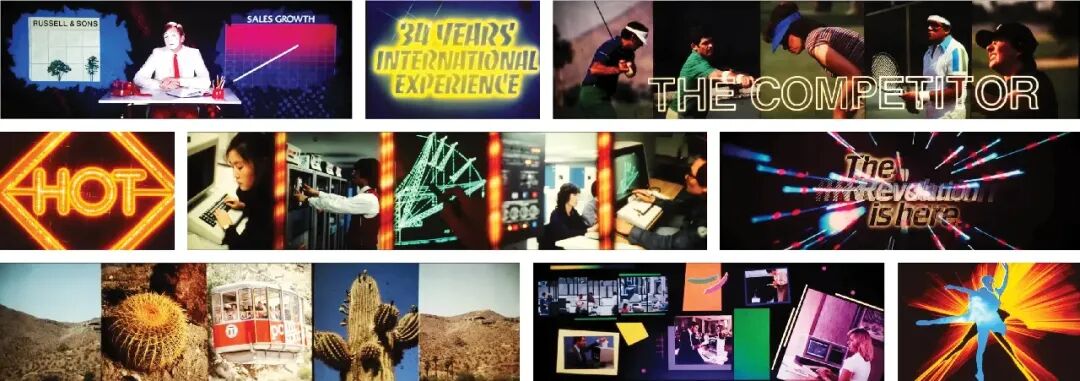
Computers accelerated the slide projection industry — and ultimately replaced it
In 1984, as VP of product development at the startup Forethought, Gaskins wrote a manifesto-style proposal for PowerPoint built around key points. It outlined a $3.5 billion potential market in business presentations and the field's need for clear, efficient slides; it listed emerging technology trends — laser printing, color graphics, what-you-see-is-what-you-get software — signaling a new presentation software market. The proposal was visionary, but Gaskins italicized only one point:
User pain point: letting content creators control the presentation.
This was Gaskins's crucial insight: presentation information gets diluted when production is outsourced. In the early 1980s, this dilution was very real. PowerPoint's first two versions were designed to help executives make their own slides or film decks, rather than handing the work off to secretaries or slide production companies.
"In the 1950s, '60s, and even early '70s, information didn't flow smoothly," explained Sandy Beetner, former CEO of Genigraphics, the longtime leader in professional presentation graphics. Their clients were mainly Fortune 500 companies and government agencies with the resources to produce full-color charts, 3D renderings, and other high-tech images. Everyone else mostly made do with text. "Before PowerPoint, communication was black and white, and a lot of information got lost," Beetner said.
Beetner oversaw Genigraphics's nationwide network of service bureaus across America. The bureaus operated around the clock, with graphic artists ready to produce, polish, and print slides. Genigraphics was so important to the slide production industry that Gaskins signed a partnership agreement: Genigraphics was the officially designated 35mm film production service for PowerPoint 2.0. The "Send to Genigraphics" menu command in PowerPoint remained until 2003 — the year Kodak stopped making the Carousel projector.

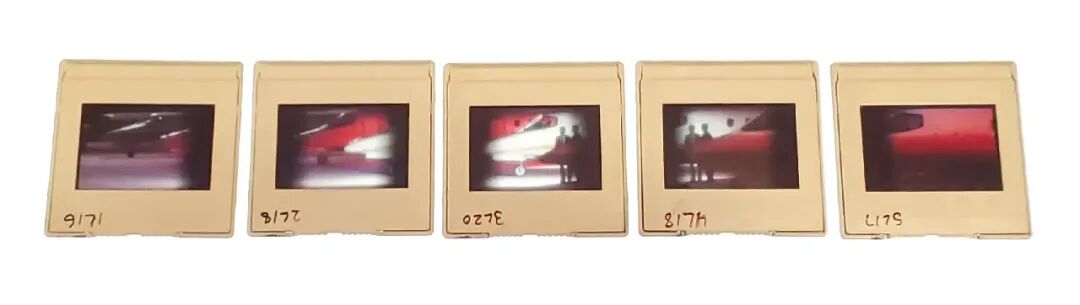
Multiple projectors could cast seamless panoramic images and complex animations
Gaskins retired from Microsoft in 1993, moved to London, and ten years later became an expert on antique accordions before returning to the United States.
By then, PowerPoint had become synonymous with the suffocating, demeaning aspects of office work. A 2001 New Yorker profile called it "software that imposes." Data visualization expert Edward Tufte blamed a PowerPoint slide for the 2003 Columbia space shuttle disaster. Tufte argued that Gaskins's software produced hierarchical, slogan-filled, over-managed presentations riddled with "chartjunk" and devoid of real meaning. No wonder software companies loved it.
Robert Gaskins agreed with these critiques — not least because Tufte's mother, Renaissance scholar Virginia Tufte, had been his mentor in the English department at the University of Southern California. In a retrospective on PowerPoint's 20th anniversary, Gaskins acknowledged that "more and more business and academic talks look like bad sales pitches," blaming both "declining public taste" and PowerPoint itself — a tool so powerful it dissolved all prior context.
Sales pitches weren't everything, and shouldn't be. But PowerPoint made it effortless to add multimedia effects to speeches, letting ordinary users achieve design styles once reserved for professionals. As an early PowerPoint print ad put it: now the people making the slides are giving the presentations. Whether those people were any good at presenting became irrelevant.
What mattered was that presentations were no longer major year-end events or product launches requiring expensive, labor-intensive color slide production.
"PowerPoint's scalability of information and audience is astonishing," Beetner said of the software. "PowerPoint opened the door to presentations so quickly. Now, students of any age have seen PowerPoint presentations."
Her company survived on PowerPoint templates and clip art, transforming from an industrial giant into a digital service.
In reality, PowerPoint has also been used for religious sermons, student book reports, funerals, and weddings. In 2010, Microsoft announced that PowerPoint had been installed on more than one billion computers worldwide.
PowerPoint's impact on how the world communicates is incalculable. But one thing can be quantified: during Robert Gaskins's tenure leading Microsoft's graphics business unit, Microsoft's size grew tenfold, and fifteenfold again after that.
Like PowerPoint itself, tech companies sprouted everywhere. Their major presentations also changed — no longer closed-door affairs. Now they are semi-public events, watched voluntarily and enthusiastically by consumers around the world.
No one needs to worry about slide carousels jamming anymore, but all kinds of other problems still occur — from botched tech demos to theatrical performances without sufficient thought behind them.
When everything goes according to plan, a great presentation can lead the market and build reputation. Of course, this evolution in presentation style wasn't entirely driven by Microsoft. Because one of the most memorable corporate presentations in history — Steve Jobs unveiling the iPhone at Macworld in 2007 — didn't use PowerPoint at all. It used Keynote.
Article adapted from MIT Technology Review. Original title: "Next slide, please: A brief history of the corporate presentation," by Claire L. Evans Link: https://www.technologyreview.com/2023/08/11/1077232/corporate-presentations-history/