MaKe | Zhonghai Energy Storage, a MaHui member, closes over RMB 100 million Pre-A++ round



- This article is republished from 36Kr Future Industries, by author Zhang Bingbing
36Kr has learned that Zhonghai Energy Storage Technology (Beijing) Co., Ltd. (hereinafter referred to as "Zhonghai Energy Storage") recently announced the completion of a Pre-A++ funding round exceeding RMB 100 million. The round was led by Ant Group, with follow-on investments from Junheng Investment and Beijing Changping SME Growth Investment Fund. The proceeds will be used primarily for technology R&D and capacity expansion. Zhonghai Energy Storage's previous investors include HSG, Source Code Capital, Qingliu Capital, and Matrix Partners China.
Founded in 2020, Zhonghai Energy Storage targets the large-scale long-duration energy storage sector, focusing on the R&D and application of iron-chromium flow battery technology. Its self-developed iron-chromium flow battery technology addresses the grid integration challenges of renewable energy at scale. Its products have been selected for the national catalog of first-of-a-kind major technical equipment in the energy sector, and the company has been recognized as a "National High-Tech Enterprise" and a "Beijing Specialized and Innovative SME."
Recently, Zhonghai Energy Storage announced its successful bid for the Huiyang 50MW/300MWh independent new-type energy storage power station project, with a total investment of nearly RMB 1 billion. The company has established a nationwide industrial layout centered on its Beijing headquarters, with annual production capacity reaching 1GWh and plans to build industrial bases in multiple locations.
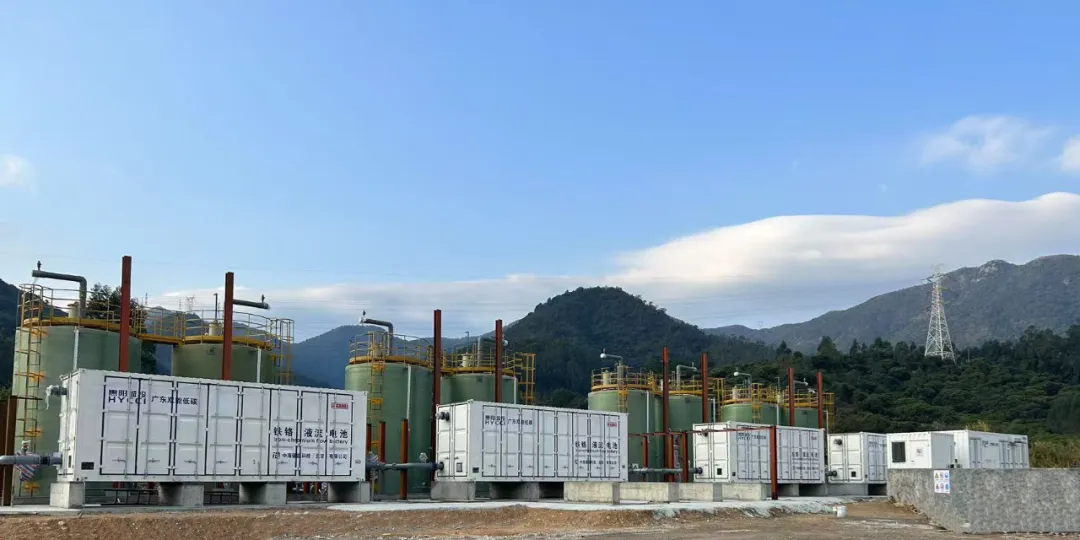
Zhonghai Energy Storage's Huiyang Energy Storage Power Station Project
1
Cross-Disciplinary R&D Team
Independently Breaking Through Flow Battery Technical Bottlenecks
Against the backdrop of accelerating new-type power system development, wind and photovoltaic power generation capacities continue to expand. Constrained by meteorological conditions, such new energy generation exhibits intermittent characteristics, and direct grid integration poses challenges to grid stability. Therefore, long-duration energy storage power stations must be built alongside generation facilities to enable temporal shifting of electricity through a "store-and-release" mechanism.
Due to their unique structure and operating principles, flow batteries are considered one of the most suitable battery technologies for long-duration energy storage. Among them, iron-chromium flow batteries show promise in safety, environmental friendliness, cycle life, and energy conversion efficiency. However, issues such as hydrogen evolution, low activity, and high costs once constrained their commercial development.
"Flow batteries simultaneously incorporate the 'three transfers and one reaction' from traditional chemical engineering and introduce electric fields, making them a highly complex coupled system. Relying solely on adjustments to a single material or technology makes it very difficult to truly solve problems like hydrogen evolution and reaction activity," said Wang Shen, CEO of Zhonghai Energy Storage. Through years of R&D, Zhonghai Energy Storage ultimately resolved these challenges by combining new materials, new processes, and structural coupling applications.
For example, electrodes and bipolar plates are two core materials in flow batteries. Traditional carbon-based electrodes have an internal 3D space similar to a sponge, simultaneously serving both electrochemical reaction and electrolyte flow channel functions. During flow, local turbulence and circulation occur, generating significant hydrogen evolution.
To fundamentally suppress these side reactions, Zhonghai Energy Storage independently developed carbon cloth electrodes, transforming the sponge-like electrodes several millimeters thick into cloth less than one millimeter thick. Simultaneously, it designed bipolar plates with flow channels, allowing the electrode carbon cloth to handle only electrochemical reactions while transferring the traditional electrolyte flow channel function to the bipolar plate flow channels. This enables control of electrolyte flow velocity, flow rate, direction, and flow trajectory, improving reaction efficiency while suppressing hydrogen evolution.
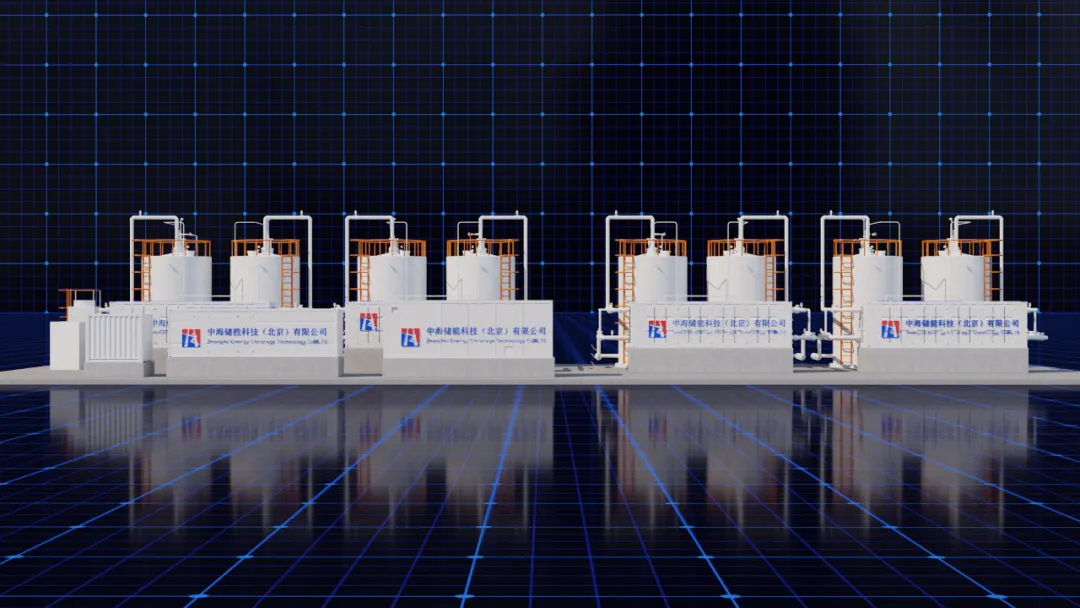
Zhonghai Energy Storage Product Simulation
Currently, Zhonghai Energy Storage's cross-disciplinary R&D team includes top talent in electrochemistry, control systems, and electrical engineering. In 2022, the company began developing vertical large models for the flow battery sector and has now launched a flow battery-specific large model with chain-of-thought reasoning capabilities.
"From the perspectives of process, materials, and structure, and from a market-oriented standpoint, Zhonghai Energy Storage has already broken through industry technical bottlenecks," Wang Shen said. The company's R&D focus and long-term goal for 2025 is to continuously reduce the levelized cost of energy (LCOE) across the product's full lifecycle.
2
Targeting Grid-Side Independent Energy Storage Power Stations
Driving Down Iron-Chromium Flow Battery Prices
Energy storage product cost accounting has roughly two dimensions. The first is the initial investment cost that customers care most about — the upfront expenditure on energy storage equipment when building a storage power station. The second is the annual operation and maintenance costs over the storage power station's full lifecycle. This is especially important for grid-side and generation-side storage power stations with service lives exceeding 20 years, where total investment must be calculated comprehensively across the full cycle.
Wang Shen explained that lithium iron phosphate batteries, which currently hold a higher market share, have advantages in initial installation cost. For 4-hour duration storage equipment, lithium batteries can achieve RMB 0.6-0.7/Wh. However, lithium iron phosphate batteries experience capacity degradation during use, and when degradation reaches a certain level, new battery cells must be replaced. Multiple cell replacements over the full lifecycle lead to substantial increases in operating costs and total lifecycle costs.
Flow batteries have slightly higher initial installation costs than lithium batteries, but all main equipment has a 20-30 year lifespan without requiring replacement of main components. Annual operation and maintenance costs are very low, making component costs and total investment more advantageous overall. Moreover, as storage duration increases, this cost advantage grows exponentially.
Different technical routes correspond to different application markets. Wang Shen believes that lithium iron phosphate batteries are more suitable for commercial and industrial energy storage, where the scale and payback period requirements make lower initial-cost lithium batteries a better choice. For generation-side and grid-side storage power stations, however, where service life starts at 20 years, the disadvantage of higher initial costs is flattened when calculating full lifecycle costs. The advantages of flow batteries — long-duration storage, safety, and scalability — become prominent. The two complement each other in the energy transition, jointly supporting new-type power system construction.
Therefore, Zhonghai Energy Storage targeted grid-side independent storage power stations and source-grid-load-storage integration scenarios from the outset. "We believe that in the coming years, the Chinese market will give rise to massive numbers of independent storage power stations and source-grid-load-storage integration projects and demand," Wang Shen said. Behind this demand, he sees three major trends driving it: continued growth in new energy installed capacity and generation, widening electricity price spreads in the power spot market, and increasing ancillary service needs such as frequency regulation and peak shaving on the grid side.
In market competition, the product must always pursue the lowest levelized cost of energy across the full lifecycle while maintaining essential safety.
To this end, Zhonghai Energy Storage has focused on the two core elements determining product pricing: raw materials and integrated design. On the raw materials side, it has achieved 100% domestic substitution throughout the system and continuously reduces raw material production costs through newly developed formulations and production processes. Taking electrolyte as an example, Zhonghai Energy Storage's cost per kWh has dropped to half of 2020 levels.
On the design side, the company has optimized the overall system module structure. Traditional flow batteries pack power modules and even electrolyte tanks into containers, making container design a significant cost component. For station-based applications, Zhonghai Energy Storage eliminated container structures and uses alternative insulation methods to save costs. At the same time, for such station-based systems, it has comprehensively introduced waste heat recovery systems, increasing owner returns by approximately 5% to 10%.
3
Welcoming the "First Year" of Healthy Energy Storage Development
Signed Project Value Expected to Exceed RMB 1 Billion This Year
In February this year, the National Development and Reform Commission and the National Energy Administration issued the Notice on Deepening Market-Oriented Reform of New Energy Grid Electricity Pricing to Promote High-Quality New Energy Development. For the energy storage industry, the most important point was the cancellation of the "mandatory energy storage allocation policy."
The "mandatory energy storage allocation policy" was once a key driver of energy storage market development, spurring rapid growth in China's energy storage market for a period and laying groundwork for new energy construction. However, it also led owners to view energy storage investment merely as a cost, with subsequent phenomena including building without using and low-price cutthroat competition. Some experts have analyzed that the core rationale for canceling the mandatory allocation policy is to address the pain point of insufficient power system flexibility through market mechanisms, pushing the energy storage industry to shift from "mandatory allocation" to "allocation based on actual needs."
"We believe that after this 2025 policy takes effect, owners will genuinely and proactively consider which energy storage technical route to choose, and after construction, think about how to operate it, what revenue streams to pursue, and ultimately generate actual transactions and income. Only then will energy storage truly enter a complete economic闭环," Wang Shen said. Based on this assessment, he believes that for companies deeply committed to R&D and technical routes, 2025 will truly mark the first year of energy storage development, bringing healthy growth opportunities.
Starting from 2025, Zhonghai Energy Storage has officially entered full industrialization, beginning to undertake large projects on both the grid side and user side. Wang Shen expects signed contract value to reach the tens of billions of RMB level in 2025, with a projected doubling in 2026.
As AI computing power surges, AI data centers consume enormous energy and require long-term stable power support. Long-duration energy storage technology, particularly flow batteries, has become key to solving this problem. Flow batteries' characteristics of long cycle life, high safety, and strong scalability allow flexible configuration according to AI data centers' specific needs. Additionally, flow batteries can achieve over 20,000 cycles with a calendar life of up to 20 years, matching data centers' long-term operational requirements.
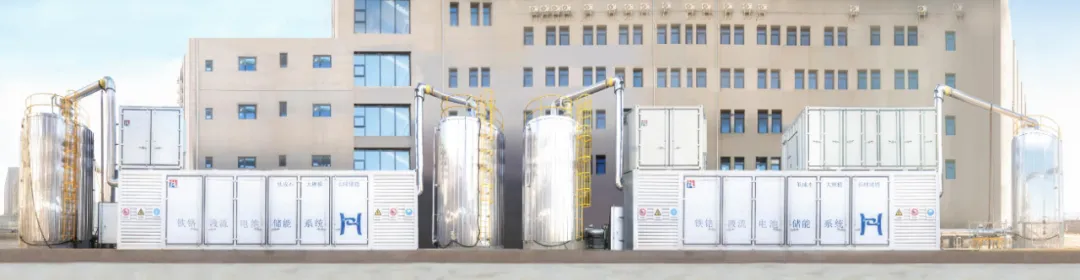
Zhonghai Energy Storage's Huailai Cloud Data Center Project
Facing rapidly increasing delivery demands, Wang Shen sees the challenges lying in precision control of product batch production and the supporting capabilities of upstream suppliers. On precision control, since 2022, the China Academy of Machinery Science & Technology has participated throughout Zhonghai Energy Storage's product design and new material development, customizing a fully digital intelligent factory that truly achieves measurable and controllable processes from single cells to battery stacks to overall system modules, ensuring high levels of assembly precision and consistency at factory exit.
Regarding upstream supplier supporting capabilities, Zhonghai Energy Storage requires at least 3-5 qualified suppliers for each individual material, with each qualified supplier undergoing rigorous factory audits, small-scale trials, pilot trials, and scale-up processes. For the large-scale signed project in Huiyang, all major suppliers are required to have construction engineers participate throughout and control every critical node in their production processes as well as product exit inspection procedures.
Meanwhile, Zhonghai Energy Storage will refine its "1+4+N" industrial layout, accelerating construction of industrial bases in Huiyang District, Huizhou City, Guangdong Province; Lankao County, Kaifeng City, Henan Province; and Jungar Banner, Ordos City, Inner Mongolia. It expects to complete first-phase construction of industrial bases within this year, achieving overall capacity exceeding 2GWh.