President of Meituan's Food Delivery Business Group: How an Internet Operations Iron Army Is Forged | Source Code Capital Masterclass

Operations really just comes down to doing the right things over and over again — and doing them better than 99% of other people.
"Source Code Academy" is an exclusive course series offered by Source Code Capital for the founding teams of its portfolio companies. Each session invites industry heavyweights in management, fundraising, product, technology, sales, marketing, human resources, and finance to help startup CEOs and functional leaders solve real-world business problems. Since its launch, Source Code Academy has drawn tremendous interest from entrepreneurs. Source Code Capital is committed to providing founders with the highest-quality value-added services and growing alongside them.
For this edition of Source Code Academy, we invited Jiawei Gan, then president of Meituan's dining business group, to share his insights on managing an offline sales force.
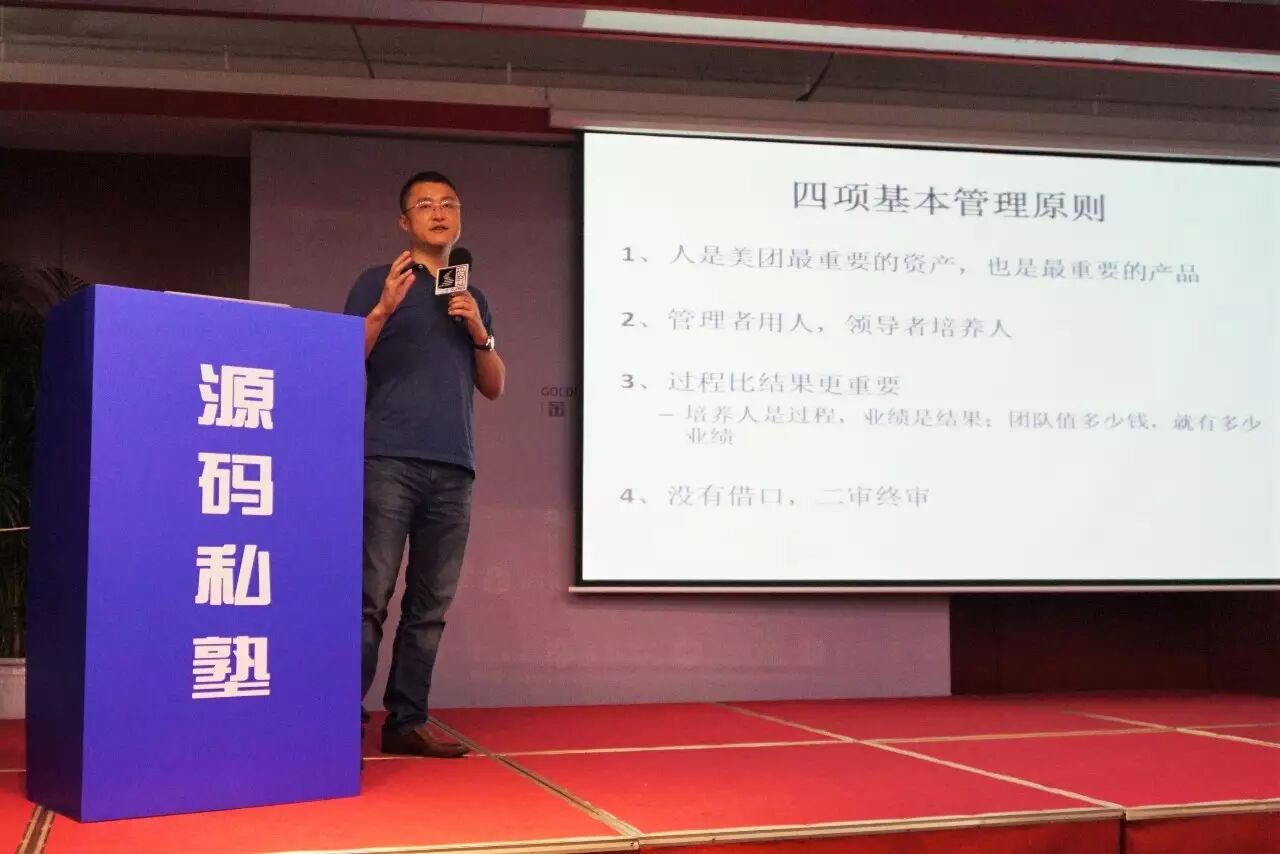
There's No Silver Bullet in Management: Meituan's Four Basic Principles
Operations is simply about doing the right things repeatedly, and doing them better than 99% of others.
I see a lot of people under pressure, hoping I'll just hand them the answer, solve their problem, give them a silver bullet. Frankly, sorry — I don't have one. I'd love one too if it existed, but it doesn't.
The world is fair. Whether in sales, operations, management, product, or technology, if you could just find an expert, get the answer, and solve your problem, life would be much easier. But that's rarely how it works.
I joined Meituan in November 2011, right when the group-buying bubble was bursting. So at Meituan's 2012 annual meeting, I first systematically laid out my management philosophy — what I call the four basic principles.
People are the most important asset, and also the most important product
Managers use people; leaders develop people
Process matters more than results. Developing people is the process; performance is the result. A team is worth what it can deliver
No excuses; two-strike finality
A Second-Rate Team Can't Deliver First-Rate Results: Talent Is the Core Asset
First, people. People are the most important asset and the most important product. The fact that you're here at Source Code Academy today means your problem isn't solved yet.
The internet differs from traditional industries. You can't expect to use old methods, stay in your corner, and just run your little patch well — the internet rarely gives you that opportunity. It's a vast world.
During the thousand-group wars, everyone was a light-asset company. Who won in the end? The team that was strongest. To become the strongest team, you know what that means?
It means if we want to be the ultimate winner, our overall team quality has to be the highest. Hiring people at market average is far from enough — you must treat talent as your core asset, even your product.
Once you have this talent pipeline, this system, this mechanism, you can confidently say that the people you develop are above the societal average. Once you achieve that, your business evolution and competitiveness have excellent conditions.
Meituan's Team Promotion Mechanism: Not Just Management Ability, But Leadership Potential
Management and leadership development. As a manager, your team is human resources the company has given you. First, you must make those resources perform fully. But we hold managers to a higher standard — we hope they're not just managers, but leaders.
Over the years, promotions first look at end results, but not only results. If your final results rank in the top 50%, you basically enter the candidate pool. Beyond final results, for promotion we have another crucial metric: who you've developed — how many sales champions, supervisors, and city managers you've trained. Who you promoted, who you developed — this matters enormously.
We often say management should focus on doing things right. Entry-level management training covers basic skills. But beyond these, what does a leader need? Leadership. They need to know what the right things are — to do the right things.
If you only require someone to be a manager, they might not care how employees achieve results. For example, they might tolerate "brushing" fake orders — as long as there's performance, the task is done.
But as a leader, they must not only deliver results, meet the company's targets — they must care whether they're doing the right things.
They have core values and judgment. When there are no regulations to consult, no superior to guide, in ambiguous situations, in gray areas — that's where a leader's value far exceeds a mere manager. A manager just needs to deliver results. A leader always focuses on the team's long-term development and the organization's sustained success.
Ordinary people fear consequences; bodhisattvas fear causes. First, you must do things right.
The third principle: process matters more than results. Everyone knows results are extremely important in business. Without results, there's nothing. So I don't need to emphasize results here.
"Ordinary people fear consequences; bodhisattvas fear causes." "Ordinary people fear consequences" is like burning incense and praying to Buddha: bless me with wealth. Wealth is the result. But actually the bodhisattva can't help them, because if you want wealth, you first must do things right.
At Meituan, my main work was interviewing and developing people. In 2014, I set a Meituan record: I held 94 "face-to-face" sessions that year. What was this? At the time, all new M0s at Meituan — we called them potential management trainees, M0 — upon promotion to M1 or M2 (city manager, regional manager) had to come to Beijing for standardized, full-time three-to-four-day training. For every session, unless I had special circumstances, I'd do face-to-face exchanges with everyone — called "A Gan Face-to-Face."
In 2014 I did 94 face-to-face sessions, each at least two and a half hours. Do the math: roughly 52 weeks a year, that's about two sessions per week, five to six hours weekly. So again — process matters more than results.
Of course I also spent lots of time tracking results. Basically every morning at 9 a.m., I'd have a stand-up with my direct reports — unwavering for years. But watching results alone is useless, because all the business data I see, by the time I see it, it's already a result.

The "Unwritten Rule" of Management: No Excuses, Someone Must Own the Consequence
Fourth: no excuses. In our company, we need this kind of management culture, or unwritten rule, or ground rule: no excuses.
In daily work, we face all kinds of management excuses every day. The most typical: why didn't we get this merchant? Because someone else paid them off, so I couldn't win them over. This is the most typical excuse.
So as an efficient organization, I believe in no excuses. I've always pushed what I call the "two-strike finality" system — I think it works quite well.
What is "two-strike finality"? Say we're making a decision on something. Anyone can raise differing opinions, objections — "I think this won't work" or "I don't think we can do this." I'll definitely discuss it with you. At the end of discussion, maybe I'll listen to you, maybe I won't.
If I don't listen, then what? You listen to me, you execute, because I bear greater responsibility — you go do it. Of course in execution, you might still find problems. Then what? You can come back to me: "A Gan, I tried, there really are problems, let's talk again." I can discuss with you again. In the end I might listen to you, or I might still not. Either way, once you walk out, don't come a third time to discuss this issue. This is two-strike finality — no third strike.
Because in a business organization, someone must make decisions, someone must bear consequences. As your superior, he bears the greatest consequences. He made this decision, and we've gone through this democratic two-strike process. But we can't do this again and again — if so, I'll never get anything done in this company. Don't appear before me a third time to discuss this.
We have a sixteen-character coaching mantra, which many may have heard: "I speak, you listen; I do, you watch; you speak, I listen; you do, I watch" — just sixteen characters.
How do you implement these sixteen characters? Through sales accompaniment visits. For example, a salesperson says: "Hey, this guy takes kickbacks from others so I can't win him." How do you solve this sales team problem? You can't rely on talk alone. Frontline managers — the reason the company promotes you, gives you higher base pay, lets you share sales commissions, is that when others can't close, you must be able to. So you take the salesperson with you: you speak, they listen; you do, they watch. After leaving the client, you debrief: they speak, you listen. Then run another client: they do, you watch. This is how you coach.
So even at Meituan, when people reached regional manager or sales director level, we still mandated accompaniment visit quotas — minimum visits per month. Only through this can you know what's really happening on the front lines, rather than sitting in an office making assumptions.
Another sixteen-character principle: move them with emotion, convince them with reason, entice them with benefit, restrain them with law. What do I think management is? Communication, coaching, delegation, motivation — including leadership, vision-driven, challenging the status quo, enabling others to act. I think these things need to be discussed continuously. But to get middle and frontline staff, especially those with weaker foundations, to grasp them quickly — I think plain, colloquial language like this is my management handle.
Management is doing simple things repeatedly, doing repeated things with passion, and doing passionate things with your brain.
Finally, focus on business fundamentals. Xing Wang, for example, cares deeply about customer service. Meituan was early to say: automatic refunds if not consumed. Meituan invested heavily in team building and basic product improvements. The great principles are broadly similar. I think the ultimate essence of running a business is the same: create value for users, deliver returns for shareholders.
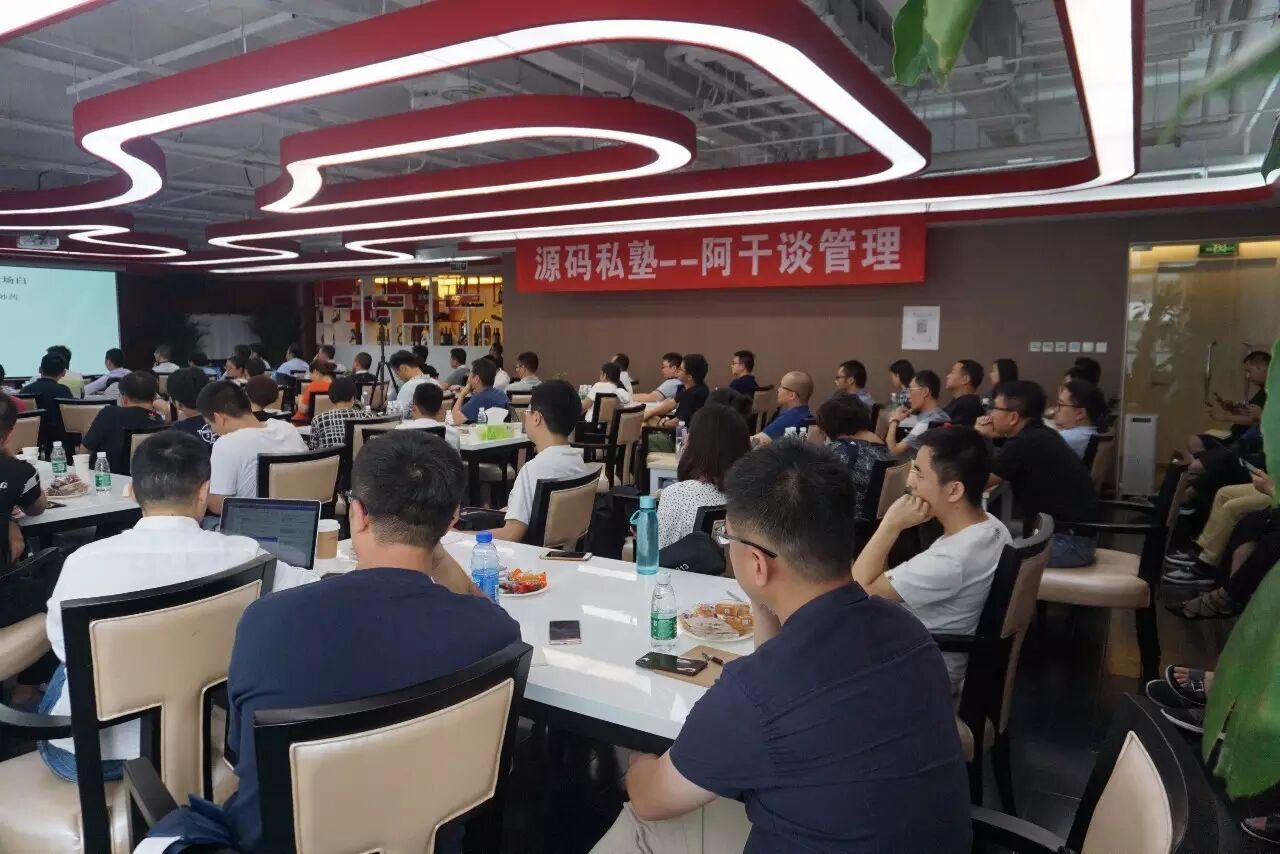
CEO Dialogue
CEO: How do you reasonably set KPIs for salespeople?
A Gan: The core of frontline management isn't KPIs, but basic commission and incentive design. The commission framework starts with benchmarking. What's the market-average compensation in your industry?
Say in a third-tier city it's 5,000 RMB per month, all-in. How do you split that? Into fixed and variable — the fixed-to-variable ratio. Different businesses require different ratios.
If your salesperson's role is mainly relationship-building, with a professional team handling subsequent service, then the fixed-to-variable ratio should be lower — less fixed, more variable — so the salesperson's main task is aggressively expanding the client base. If the salesperson not only builds relationships but also provides ongoing service, regular follow-ups, and the client's results are closely tied to service quality, then your fixed-to-variable ratio should be slightly higher. Give the salesperson more stability, so that if new orders don't come in, they're not desperate — otherwise they definitely won't serve clients well. So for frontline direct sales, it's mainly about compensation design. So-called KPIs are just basic business requirements.
CEO: What are the three most important elements of a sales team, and how would you rank them?
A Gan: First in sales management is still benchmarking. You must know: in your industry, who's the best? You must believe that you're not the first to encounter this problem. Before you, many smart people have struggled for years and already found solutions.
Which company is the best? Find that first. Once found, you'll know why they're good. Then look at your current person — your partner, your COO, your sales director — whether they can quickly reach that company's level in short order. If not, then find a way to bring in talent from that company. This is methodology. I don't think anything else is more important. I'm saying all this hoping you'll use scientific approaches.
CEO: How do you expand into new regions quickly and efficiently?
A Gan: From experience: first, you need veterans. Generally when Meituan opened new stations, we'd send veterans to launch them. Second, if opening in batches, I think headquarters needs a dedicated department for certain things — recruiting, leasing, buying office furniture, setting up systems, new-hire training. It's like hiring an experienced confinement nanny for a newborn — very apt.
CEO: How do you balance stability and aggressiveness in a team?
A Gan: I don't think stability and aggressiveness are in conflict. You can't say a team without aggressiveness is particularly stable, or an aggressive team is unstable.
Frankly, I don't think even for sales teams that more aggressiveness is always better. I think it depends on the business and development stage — it's always a balance. If you need them to do lots of after-sales service, then in system design, hiring, and training, you can't be overly aggressive. If you just need them to build client relationships, sign a contract, with others handling follow-up service, you can lean more aggressive. But whether weak aggressiveness or weak competitive drive — I think these are management problems. For frontline teams, commission design is the most important lever.
CEO: What types of sales require offline team service?
A Gan: As I mentioned, offline teams are expensive — high management costs, definitely higher labor costs than typical customer service or telesales. So offline teams are generally only warranted when several conditions are met. First, necessity: the business isn't very standardized, or something people understand immediately, or won't have problems during promotion. Take group buying — everyone knows it was a low-margin industry, but used the highest-cost direct sales team. Why? Because group buying was a non-standardized product. If given to agents, all kinds of problems would easily arise.
Second, early market stage — people need time to understand, or there's a relatively long decision-making process. So you generally see direct sales in B2B businesses. Because B2B has longer decision processes, plus higher unit prices — selling online or by phone is difficult.
CEO: The company incentivizes salespeople to rapidly expand the market. We increased sales incentives early on, then after stabilization found costs too high. After reducing costs, people left.
A Gan: This is a very typical problem, but what you're describing may not be the real problem. Because you said you increased sales incentives, then after stabilization found costs high — I want to say costs are the boss's problem. You're running an unprofitable business with a direct sales team — this is destined to fail. Employees don't care about costs, they only care about their cost-benefit ratio.
So I think you still need to use that method: what's the income level in your industry? Then look at your company brand, your business development stage, your work requirements — only after nailing these down can you correctly judge. Then you design how your sales team earns commissions.