RozBuzz Raises Tens of Millions in Series A Funding from Shunwei Capital, Xiaomi, and Source Code Capital

Capture the feed-content entry point for India's indigenous languages.
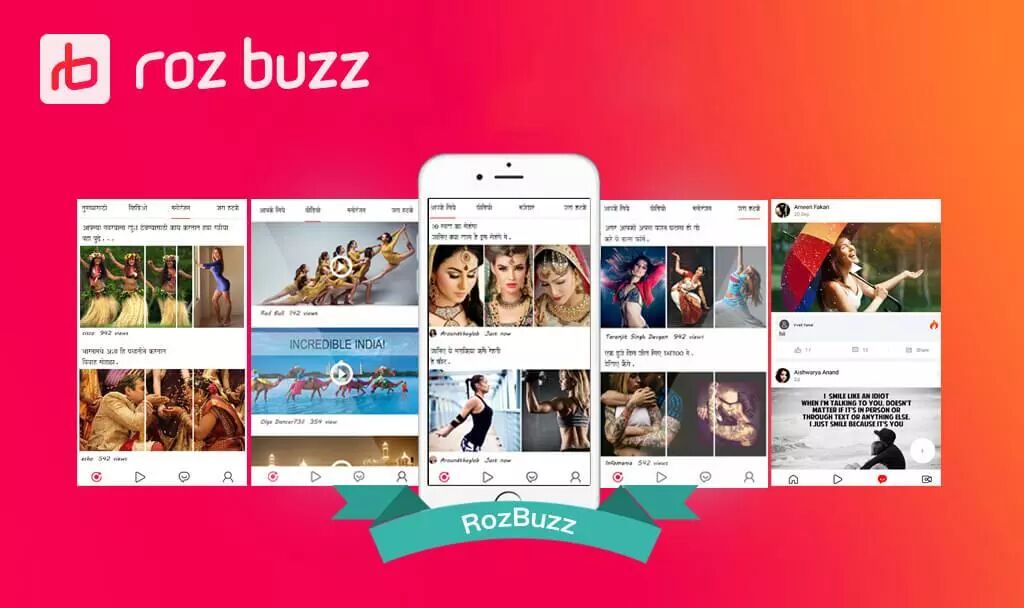
RozBuzz, a content feed app focused on delivering mobile internet news aggregation to India's massive urban and small-town population, has officially announced the completion of its Series A funding round. The round raised tens of millions of RMB, led by Shunwei Capital, with Xiaomi and Source Code Capital participating as co-investors.
All three investors are star players in the venture capital industry, with track records of backing and nurturing multiple unicorn companies. Prior to this round, RozBuzz had also received early-stage investments from Qingliu Capital and Plum Ventures.
Notably, RozBuzz marks the first content feed mobile app investment in India by Xiaomi's ecosystem fund. Xiaomi is accelerating its push into the country of over 1.3 billion people, where its smartphone market share has already rapidly surpassed Samsung to claim the top spot. The deepening partnership between RozBuzz and Xiaomi will further enrich Xiaomi's India ecosystem, providing more potential content entry points for Xiaomi's MIUI system, with both parties coordinating to further expand in the Indian market.
1
RozBuzz: Reading India Right
Founded in 2016, RozBuzz is effectively a China-India "hybrid" company — its domestic team focuses on technology and data, while its India team handles product design, content, and user operations.
The founding team brings years of internet industry experience and deep familiarity with the Indian market. CEO Ning Chen comes from the Sohu ecosystem; as general manager of Sohu Changyou's web application development department, he led the development of multiple websites and apps with tens of millions of users, and began developing mobile app products for the Indian market as early as 2013. COO Qi Jiang has over a decade of overseas work experience, having managed overseas regional operations for Changyou and Baidu, with deep expertise in localized operations in India. CTO Shansong Shi has partnered with Chen for years, bringing more than ten years of R&D management experience.
RozBuzz has also attracted top local talent from institutions like the Indian Institutes of Technology. Liu Yu, general manager of RozBuzz India, was among the first batch of Chinese students to study in India in the new century and has lived in the country for over a decade, excelling in cross-cultural communication and personnel management across borders.
Back during his Changyou days, Chen keenly observed that India's internet user growth was already far outpacing other overseas markets. Data shows that India is currently the world's second-largest mobile market after China, with mobile users expected to exceed 700 million in the future. Chen resolved to build a mass-market mobile internet product for India, zeroing in on the country's content feed sector with enormous untapped potential. Leveraging machine learning, artificial intelligence, and other technologies, the RozBuzz he built focuses on personalized recommendations of image-text and video content, delivering the most efficient content push service to mobile internet users.
India is a multicultural, multilingual region where roughly 10% of the population lives in tier-one cities and 90% in tier-two through tier-four towns and rural areas. With the rapid普及 of 4G users, India's mobile user base is quickly下沉 from tier-one and tier-two markets into tier-three through tier-five markets.
As a four-year veteran deeply embedded in India, Chen found that the vast majority of users started directly on mobile, with no migration process from PC to mobile. Precisely because they lacked the accumulation of the PC internet era, internet content suited to ordinary people's tastes was notably scarce in the Indian market.
For a long time, the massive user base in India's tier-three through tier-five towns was a demographic ignored by local traditional media giants. Various news apps operating under the "News" banner on mobile primarily promoted to the upscale population of tier-one and tier-two cities through channels and advertising, while the big-city news content market gradually approached saturation. Yet the Indian mobile internet market's user base as a whole remained completely untapped. Chen concluded that amid the rising tide of mobile internet, India would rapidly see hundreds of millions of first-generation mobile users hungry for content entertainment — and that this world's second-largest mobile market would inevitably give rise to a content entry platform with hundreds of millions in daily active users.
2
RozBuzz as a Model for "Up the Mountains and Down to the Countryside" in India
While the vast majority of Chinese startup teams were still clustered in Delhi and Bangalore, Chen was already leading his team "up the mountains and down to the countryside" across India. The RozBuzz team, blending Chinese and Indian employees, has embedded itself in India's tier-three through tier-five towns — the deep waters that WhatsApp has only just reached. These regions hold nearly one billion people in total, users who have just switched to new smartphones and installed JIO's 4G SIM cards offering 1GB of data per day for 15 RMB per month. In Chen's view, the serious news content from traditional media, dominated by English and Hindi, couldn't capture their attention; they weren't inclined to read long, dry blocks of text either. RozBuzz launched local-language news content, diverse in subject matter, paired with rich images and a lively, down-to-earth writing style, immediately winning their affection. Meanwhile, its deep learning-based recommendation engine served them more content matching their tastes. These superior experiences, so unlike traditional media apps, quickly earned RozBuzz a devoted following.
Where the readers are, the writers should be too. RozBuzz took a path that seemed笨 but proved highly effective: they broadly mobilized grassroots民间 forces,挖掘 and signing local grassroots self-media creators in every small town. RozBuzz provided an outlet for Indian grassroots authors who had no access to contributing to traditional media, and these writers, intimately familiar with their hometowns' customs and culture, were eager to share all kinds of fresh happenings — they knew better than anyone what the mobile users around them wanted to read. Less than six months after the self-media platform's launch, RozBuzz had already attracted thousands of grassroots self-media authors, with hundreds more requesting to join every week. Beyond image-text content, an increasing number of grassroots creators were also experimenting with video content, and even UGC videos uploaded by ordinary users were quite active.
Through just one year of operations, RozBuzz has rapidly grown to tens of millions of users, with over a million active on the platform daily. Chen predicts that as India's mobile user scale leaps upward, RozBuzz will eventually cover a mainstream Indian user base of roughly 300 million.
As smartphones and digital content platforms like RozBuzz rise in India, the country's traditional media, video, and other content ecosystems will inevitably undergo further transformation.
More Recent Funding News
Zhangshang Fucai Raises 20 Million RMB Angel Round from Source Code Capital and Buhuo Ventures
Source Code Capital Portfolio Company Qudian Successfully Lists on NYSE

Ergen Completes 100 Million RMB Series B+; Source Code Capital Backs Short Video Leader


Cijinrong Announces Completion of 65 Million RMB Series A Led by Source Code Capital


Create Enduring Real Value
Create Enduring Real Value
Long-press to scan QR code and follow Source Code Capital