MaHui Portfolio Company Sand.ai Closes $200M Series A+ Round, Plans to Release Full MAGI-2 Foundation Model Soon

Source Code Capital led J&T Global Express's seed round and continued to increase its stake in three subsequent funding rounds.

On November 5, MaHui portfolio company Sand.ai (Sanda Technology), a video generation foundation model company, announced the completion of a $200 million Series A+ round. This marks the company's third funding round in 2026, bringing its total raised to $300 million over ten months — officially earning it unicorn status post-round.
The round brought together a mix of strategic corporate investors, prominent RMB and USD funds, and Shanghai state-backed capital. Cornerstone Capital and Wangsu Technology (300017.SZ) co-led; Jeneration Capital, Panlin Capital, and Orient Securities Capital joined as participants. Tianjin Venture Capital partnered with Shandong Railway Industry Investment and Shandong Railway Fund for strategic participation. Shanghai Pudong Venture Capital Co., Ltd. and Shanghai Guofang and other Shanghai state-backed entities also came in. Existing shareholders Matrix Partners China, Hua Capital, and CASSTAR continued to increase their stakes. Source Code Capital led Sand.ai's seed round and has continued to double down across all three subsequent rounds.
Proceeds will go toward R&D on video foundation models, training and inference infrastructure, product iteration, and global market expansion. Sand.ai is set to release the official version of MAGI-2, its next-generation larger-parameter MoE-architecture video generation foundation model, in the near future.
Since its founding, Sand.ai has focused on video generation foundation models and application products. The company has steadily explored technical architectures for video generation models, progressing from autoregressive generation to audio-visual joint modeling, and onward to hundred-billion-parameter MoE models — achieving a series of breakthroughs in both model capability and inference efficiency.
In April 2025, Sand.ai released and open-sourced MAGI-1, an autoregressive video generation model that generates video clips in chronological order, supporting continuous generation and long-form extension. In March 2026, the company further open-sourced MagiHuman, which employs a unified single-stream Transformer architecture for joint modeling of text, visuals, and audio; alongside infrastructure technologies including MagiAttention and MagiCompiler to improve training and inference efficiency at scale.
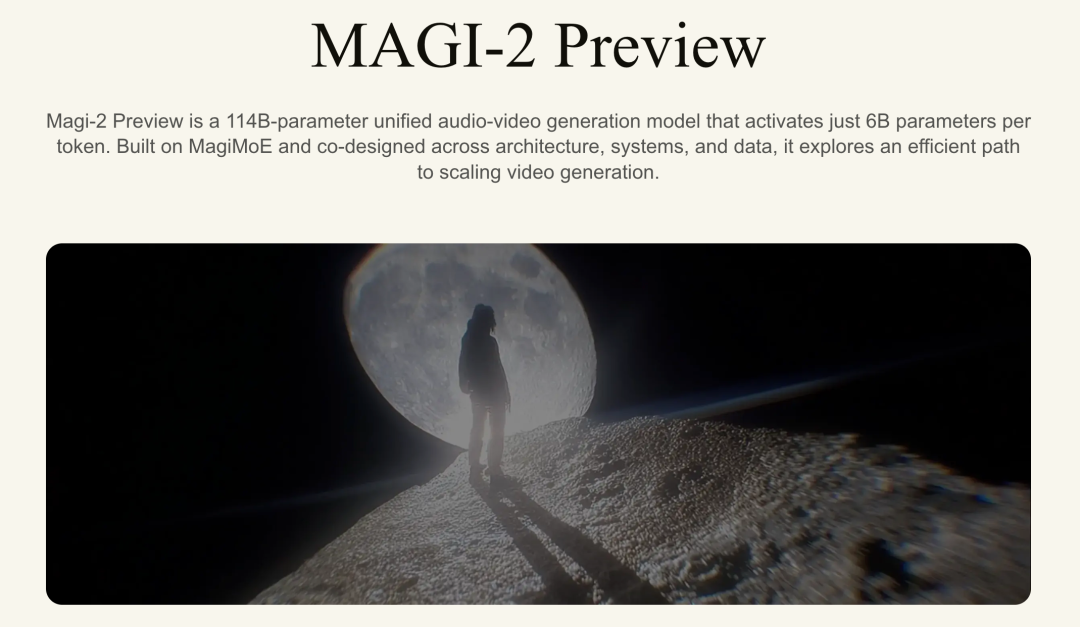
In August 2026, Sand.ai released and open-sourced MAGI-2 Preview, becoming the first team globally to scale a video generation model to hundred-billion-parameter scale while openly releasing model weights. The model uses an ultra-fine-grained MoE architecture with approximately 114B total parameters and about 6B activated per forward pass — expanding model capacity while controlling computational overhead. Inference cost for a 10-second 1080P video runs just 0.5 RMB (distilled model). At launch, MAGI-2 Preview ranked sixth globally on the image-to-video leaderboard of third-party evaluation platform Artificial Analysis.
Beyond foundation models, Sand.ai has launched VidMuse, a video generation product exploring generative AI applications in video creation and content consumption. The product surpassed $10 million ARR within two months of launch.
With this round completed, Sand.ai will continue advancing next-generation large-scale video models, exploring synergies between open-source foundation models and application products, and further expanding its global developer ecosystem and commercial applications.