Source Code Capital | Be the "Number One" Customer Service Rep, Focus on Real Needs

#Source Code Capital: A Single Grain
Tianlan Shao, Founder & CEO of Mech-Mind Robotics. He graduated from the School of Software at Tsinghua University in 2012, then went on to study at Technische Universität München in Germany, where he earned a master's degree in robotics with the highest honors in 2015. He worked at a well-known German robotics company and contributed to the development of cutting-edge industrial robots. In October 2016, Shao returned to China and founded Mech-Mind Robotics, applying advanced technologies such as AI to develop intelligent industrial robots centered on 3D vision and deep learning. The company is committed to providing cost-effective, stable, and reliable intelligent industrial robot solutions for logistics, manufacturing, and other industries. Over six years, Shao has led his team to become one of the largest, fastest-growing, and most widely deployed companies in the global AI + industrial robotics sector.
From concept to prototype, from relatively rough early products to initial scaled deployment, and now to large-scale implementation across multiple industries, Mech-Mind Robotics has achieved considerable success along the way. Yet Shao remains humble, saying, "After six years of entrepreneurship, I'm still the company's number one customer service rep."
Excerpts from the Livestream
Xingchen Zhang: Tianlan just got back from a business trip to Germany. I'd like to ask you — when you were studying and working there, did you ever imagine returning one day as the CEO of a unicorn startup to do global business?
Tianlan Shao: My last trip to Germany was three years ago. We had just established our German subsidiary, at that zero-to-one stage. Back then, people said Mech-Mind was a startup that might do something interesting. This time, with our business grown, we clearly felt different expectations. Both large and small clients see us as people who understand leading technology in the industry — "they should solve the problem."
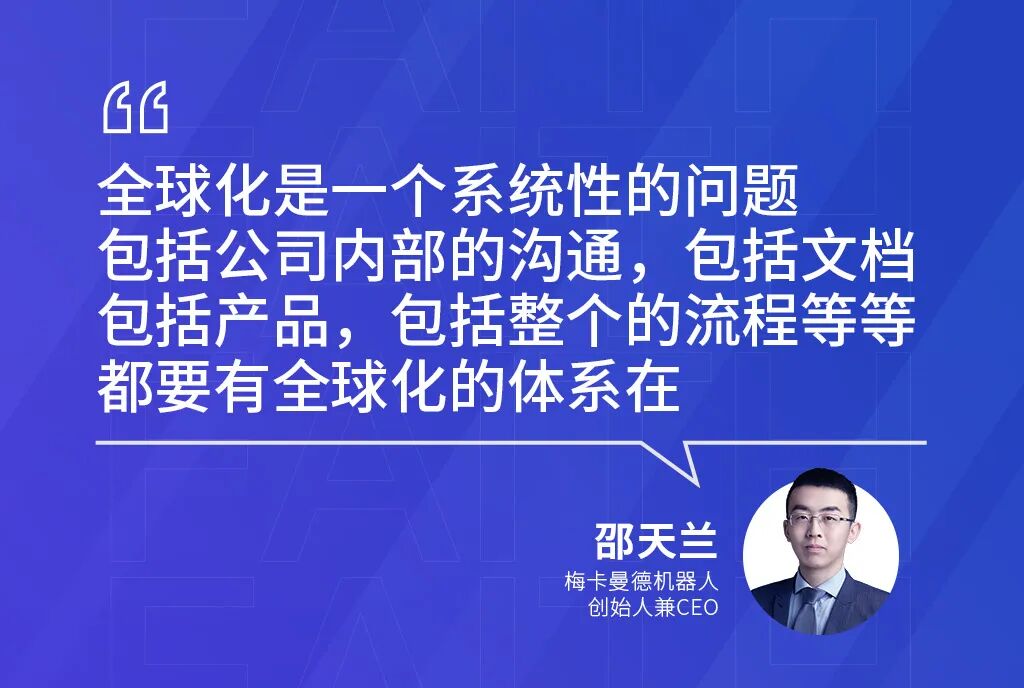
The second impression was that as Mech-Mind's planning has expanded, the sense of being a global organization has grown stronger. Globalization is a systemic issue — internal communication, documentation, products, entire processes — everything needs a globalized system. These two points struck me deeply on this trip.
Xingchen Zhang: Robot "eyes" with depth information are pretty cool. Why did you choose this direction for entrepreneurship?
Tianlan Shao: When I first went to Germany for study and work around 2012, the robotics industry was still in its early stages. A few data points illustrate this: over the past decade, the entire robotic arm industry grew roughly tenfold, while the sub-sector combining 3D vision and AI with robotics grew more than tenfold in just the past five years. People are used to reading about internet companies, autonomous driving, electric vehicles — industries with several-fold annual growth. But industrial robots are fundamentally industrial products; achieving 10% or even 20% annual growth is quite remarkable. By comparison, the robotics industry's growth has been extraordinary and hard to foresee.
When I returned from Germany at the end of 2016, I felt that working on robotics was genuinely interesting and probably wouldn't be a mistake. There was some personal interest, some coincidence and luck. In retrospect, it was indeed a path that balanced interest with career development, including catching a wave. It was genuinely hard to predict beforehand.
We've been fortunate. Mech-Mind's broad direction, business model, and overall path haven't changed since founding. Looking back at our earliest pitch decks, we're basically saying the same things now — which suggests the direction was roughly correct, and that involves considerable luck.
"Roughly correct direction" means that the 3D vision and AI capabilities we discuss — enabling robots to recognize and locate objects, including basic operation planning — are clearly essential for human workers in manufacturing and logistics. Close your eyes, and most manufacturing and logistics work becomes impossible. This general direction ensures real demand, and that technology can genuinely address these needs.
Another point: these technologies were indeed undergoing rapid development. Of course, we took many risks. Much of the technology we use today didn't exist when we started. If we'd waited for all technologies to mature before beginning, we'd have been too late. We relied heavily on technologies we developed ourselves after founding, and on new academic research to experiment with. So we can only say the direction was roughly correct.
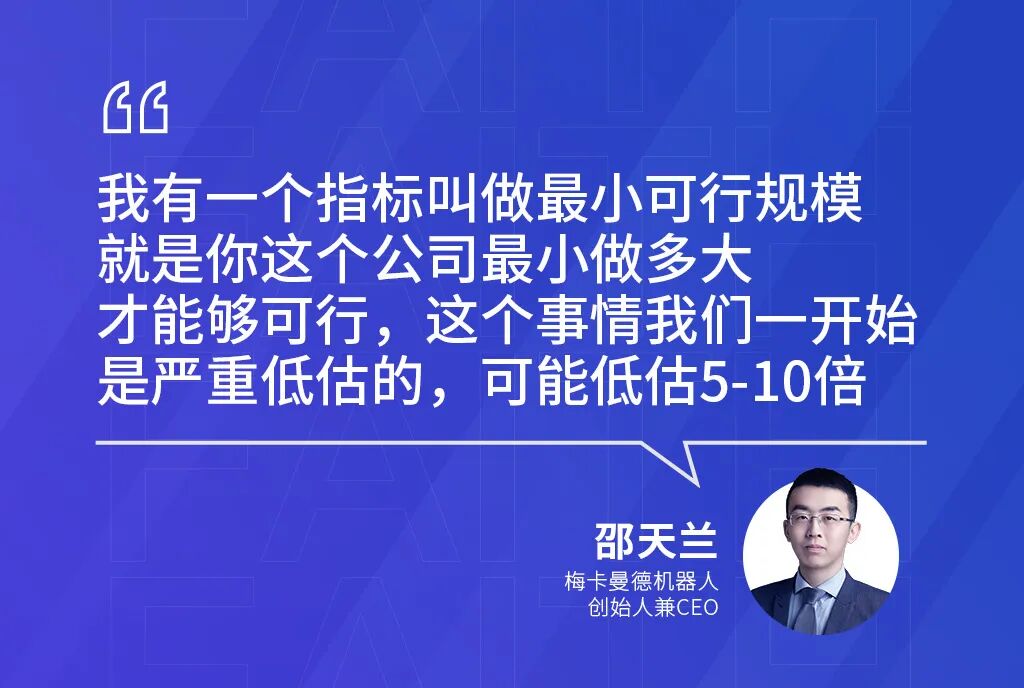
On specific technical issues, we seriously underestimated the length and complexity of the technology-to-business-model chain. I have a metric called minimum viable scale — how big a company needs to be at minimum to be viable. We seriously underestimated this, probably by 5-10x. Along the way, we engaged with numerous clients, visited countless factories and logistics facilities, saw many needs. Some we couldn't address; some were false needs. But with so much demand coming in, we gradually found our path.
Xingchen Zhang: Your minimum viable scale reminds me of Amazon founder Jeff Bezos's "regret minimization framework" — when making life choices, minimize what you might regret later. If you hadn't started a company, would you regret it?
Tianlan Shao: I've never regretted starting a company. Today's entrepreneurial environment is better than many years ago. Entrepreneurs can get lots of help and guidance, with less "drama."
In Germany, I studied and worked on intelligent technology, 3D vision, AI combined with industrial robots. But when I first returned, there were virtually no startups like Mech-Mind. The hottest topics then were autonomous driving and facial recognition. Industrial automation and robotics as an industry leaned toward mechanics and control; traditional companies were slower and more lagging in their willingness, capability, and control over new technologies. I couldn't find a company where I could do this work.
Of course, several years later, the robotics industry went through two or maybe two-and-a-half waves of hype. That hadn't happened yet, so I chose to start my own company.
Xingchen Zhang: You wanted to apply what you'd learned, but found no one using it. Didn't you doubt yourself? Or were you just courageous enough — to use our Source Code Capital phrase, a "leap of faith"?
Tianlan Shao: I was about 27 or 28 when I returned, young with no baggage and few worries. I wasn't a big company executive, a prominent professor, or anyone famous — grassroots entrepreneurship. Wanted to do this, found a place, just do it, whatever happens happens. Many entrepreneurial choices are more about going with the flow. I felt the timing was right, felt I could do it. If internally you feel the timing isn't right, that you can't do it, there's no point forcing it.
Of course, Mech-Mind has had good fortune. Our direction hasn't changed significantly, and we've received support from investors including Source Code Capital. We've also met many excellent partners and clients who grew with us. Today, our annual shipment volume equals four to five times the entire industry's shipment in our founding year.
Xingchen Zhang: You mentioned the journey hasn't been easy, with many partners, especially clients. Our theme is that you're still the company's number one customer service rep, showing you've remained sensitive and attentive to listening to customers. How did you develop this habit? What customer issues reach you, and what needs are most concentrated?
Tianlan Shao: This is indeed determined by our business model.
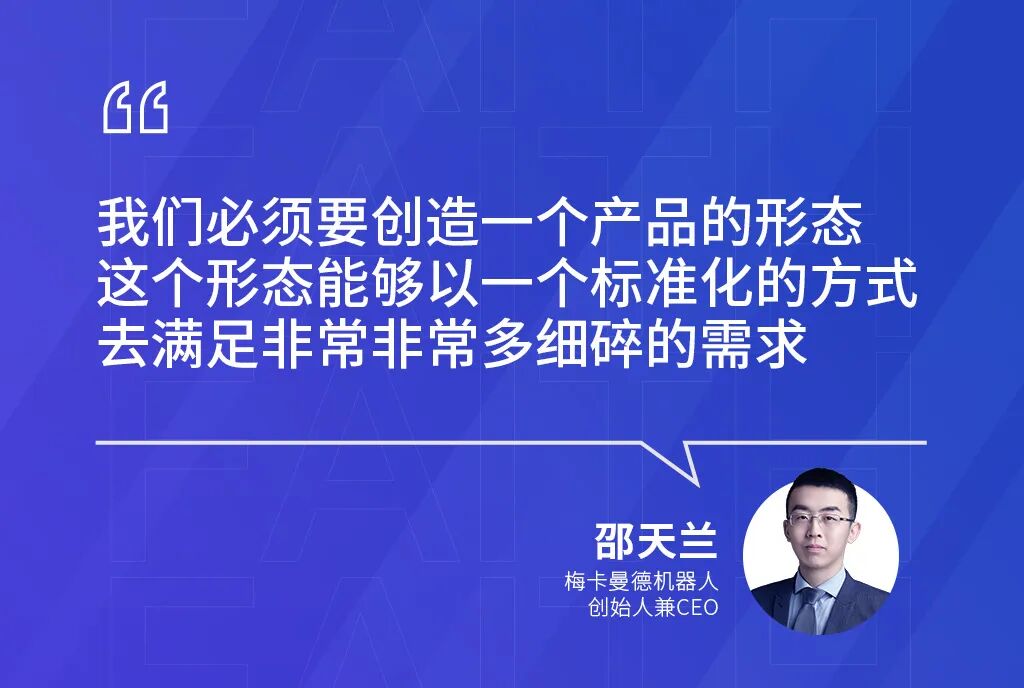
Our business model has two particularly major challenges. First, the technology chain is long — we cover optics, electronics, imaging, AI, various robot planning, etc. It's a very long technology chain where every link must be done well, meaning enormous investment. Second, customer needs are extremely fragmented. We mainly address automation needs in manufacturing and logistics. "Manufacturing" alone breaks down into over 40 major categories, each with many subcategories — an extremely fragmented industry. This creates a phenomenon: the total demand looks large, but drilling down, needs are extremely fragmented. Having already made such huge investments across this long chain, we can't be like many companies that can generate returns by satisfying just some customers' few needs. We must create a product form that can address very, very many fragmented needs in a standardized way.
This also presents an information challenge: no one can truly understand all needs across all these industries. We can only explore ourselves, must go to sites, talk to customers. Without seeing so many needs, designing product forms purely from imagination would inevitably be way off.
For us, "customer needs" actually has two parts. One is specific customers' specific needs. The other is an abstraction layer — how to select from so many customers and needs what we can do, finding commonalities. If I see a thousand needs, how do I find two hundred that can be addressed one way? This is a product definition process.
Xingchen Zhang: Abstracting needs into standardized products. Why are you so committed to the product route rather than integration?
Tianlan Shao: We've studied many large companies. I've never seen an integration company, especially small-to-medium robot integration projects, grow large. Though many startups choose non-standard automation, integration projects, customized projects — I've never seen such a company grow. Since no one's succeeded at this, I don't believe we could.
But product companies have grown large and succeeded — Siemens, Festo, Keyence, Hexagon, Pepperl+Fuchs, Inovance, etc. What departments should such companies have? How should teams be structured? What financial gross margins are appropriate? What's the right global layout? What are reasonable internal processes? These are worth learning.
Of course, product companies have two problems. First, long cycles — a product needs high market share and a good ecosystem to truly scale volume. Second, small individual orders, slow revenue growth. These issues were quite apparent in our first four years, requiring more first-principles thinking to solve.
Xingchen Zhang: Finding PMF — the process of a product truly hitting customer needs — how long did that take? Were there many internal and external voices saying your product wasn't working?
Tianlan Shao: There were many such voices.
We started at the end of 2016. Throughout 2017 and 2018, we barely sold anything. Only in 2019 did we begin having meaningful order volume. By today's standards, our products then were "industrial trash." But timing was good; market product maturity was low, with no better alternatives available. We were very lucky to have no particularly strong competitors. Looking back, timing really is the number one factor, surpassing all others.
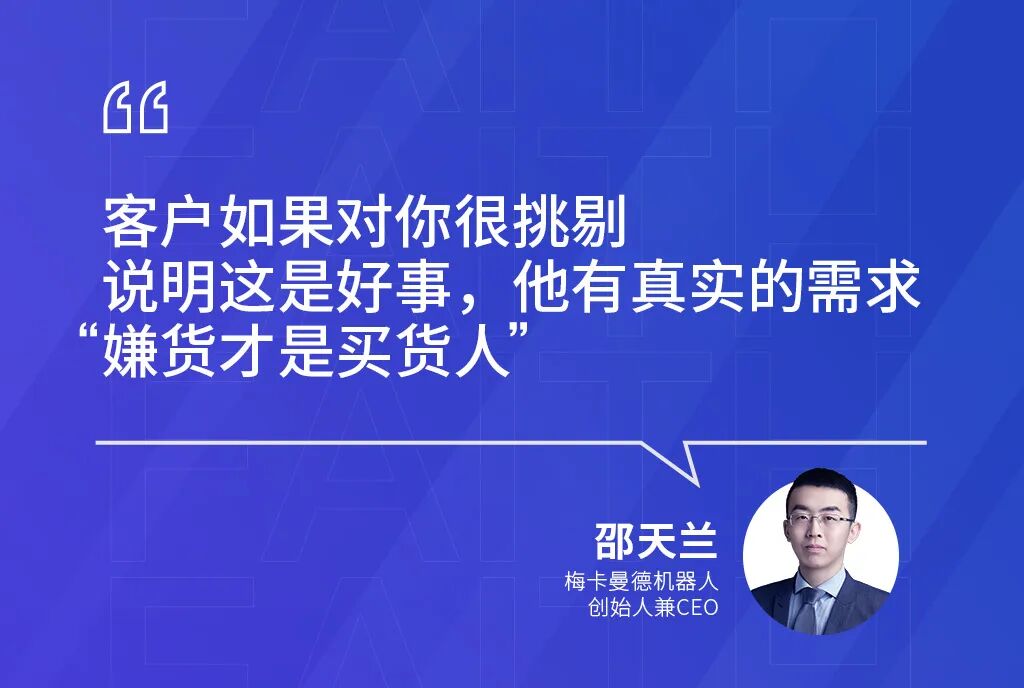
Our seed customers were excellent and patient, giving us lots of time to grow together — this mattered greatly. If a customer is picky with you, that's good — they have real needs. "Those who criticize your goods are the ones who buy." If you're at a stall and someone comes picking, saying "this is expensive and lousy," that's a good customer. If they praise everything, they probably won't buy. We found many customers cared deeply about our products, feeling they could solve their problems — this gave us great confidence.
One customer found problems with our product, so we took it all back and sent a new generation; found problems again, replaced again. In the end, we spent several months with triple the effort to resolve it. There were also unexpected environmental issues — a customer said the 3D camera wasn't working; troubleshooting revealed a large spider on the lens. While we can't solve spiders, product hardware and software design can better prepare for harsh environments.
The market is more mature now. Maturity shows in two ways. First, sales networks — customer needs are more easily captured by sales networks in short time. Second, product testing cycles. Whether a product tests out in a day, a week, or a month makes a huge difference to customers.
Also in recent years, many large companies have started following our product designs, giving us great confidence. Objectively, our scale can't compare with giants, so our internal deliberations and processes may not be as rigorous as multinational corporations with tens of thousands of employees. When they start following our path, I see it as free validation for us — very reassuring. If they suddenly took a completely different route, that would be worrying.
Xingchen Zhang: Do you think Mech-Mind has achieved zero-to-one?
Tianlan Shao: Our three-step path is very clear.
Step one: The R&D team no longer needs to participate in solving fragmented business issues. For quite a long time after founding, our R&D team had to get involved in business — otherwise customers would encounter many problems: software bugs, design gaps, wrong features. As Mech-Mind developed and customer needs were comprehensively collected, the R&D team now largely doesn't need direct business involvement. Masters and PhDs from MIT, CMU, Tsinghua, and elsewhere can focus on R&D, with much improved efficiency.
Step two: The business delivery team doesn't need to personally execute most project deliveries, but mainly provides training and technical guidance to customers and partners. Our partners can independently resolve the vast majority of customer technical issues. This is our next goal; we're rapidly approaching but haven't fully achieved it.
Step three: Form a good ecosystem. Many people have used Siemens products without ever actually dealing with Siemens itself — they connect through Siemens partners, attend training courses, or read books to solve problems. There's still much work to do for this step.
Xingchen Zhang: What do you think of "doing hard but right things"? Startups always have boundary constraints; how do you balance them?
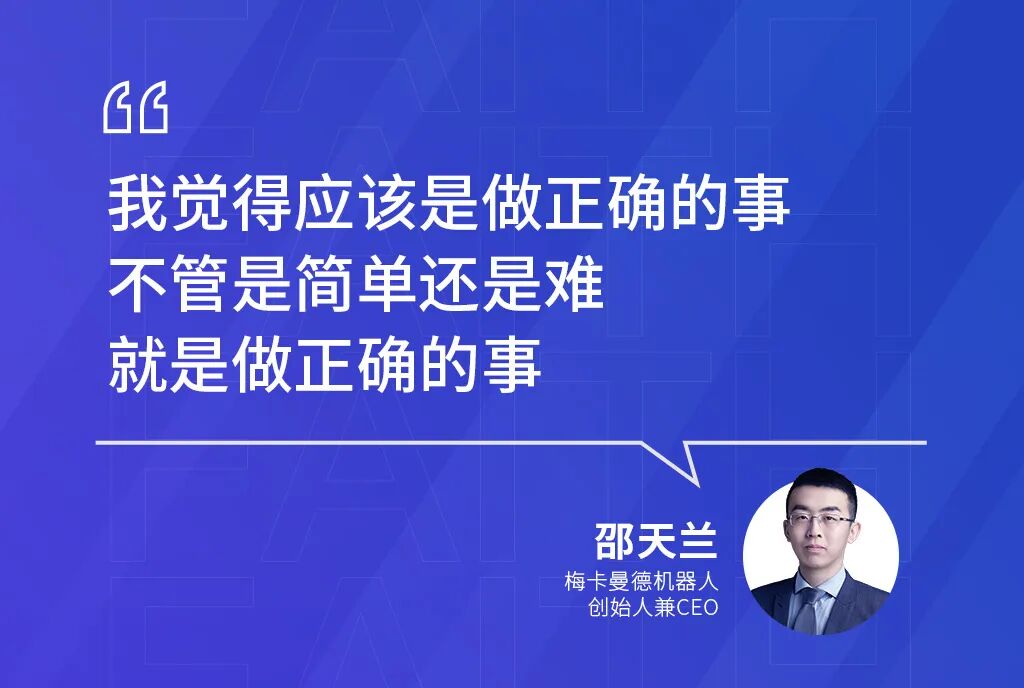
Tianlan Shao: I think it should be doing the right thing, whether simple or hard — just do the right thing.
This "right" is actually hard to demonstrate. There aren't so many instances of overruling objections or sudden flashes of insight — much requires research. In industrial automation, excellent companies are similar: software, hardware, ecosystem, even sales models. Whether from financial reports or actual business, the whole cycle from product to service to ecosystem — how to make it work — can all be learned.
Startups certainly have many constraints; this always exists, and I still strongly feel them today. Mech-Mind has been fortunate, in a positive cycle: good products lead to good customers, good customer endorsements lead to better financing. But if facing harsh external environments, existential threats — the right thing is still to survive. The urgent priority is to stay alive, then consider how to re-enter a positive cycle. "When the time comes, heaven and earth work together."
Xingchen Zhang: Facing entrepreneurial challenges, how do you find good problem-solving approaches?
Tianlan Shao: I don't think there's any particularly good trick. Today's entrepreneurs are quite fortunate — there are experienced investors like Source Code Capital, and many entrepreneurial peers. There are many opportunities for exchange.
Since our founding, almost no problem has been unique to us; nearly everything has been solved by countless people before. Whether business models, management, finance, capital, or lessons learned — talking with experienced entrepreneurs turns many problems from essay questions into multiple choice, where you can guess by probability. Don't keep problems bottled up; go out and ask more questions.
Xingchen Zhang: Final question from the comments: What's the most important strategic decision you've made, and how was it made?
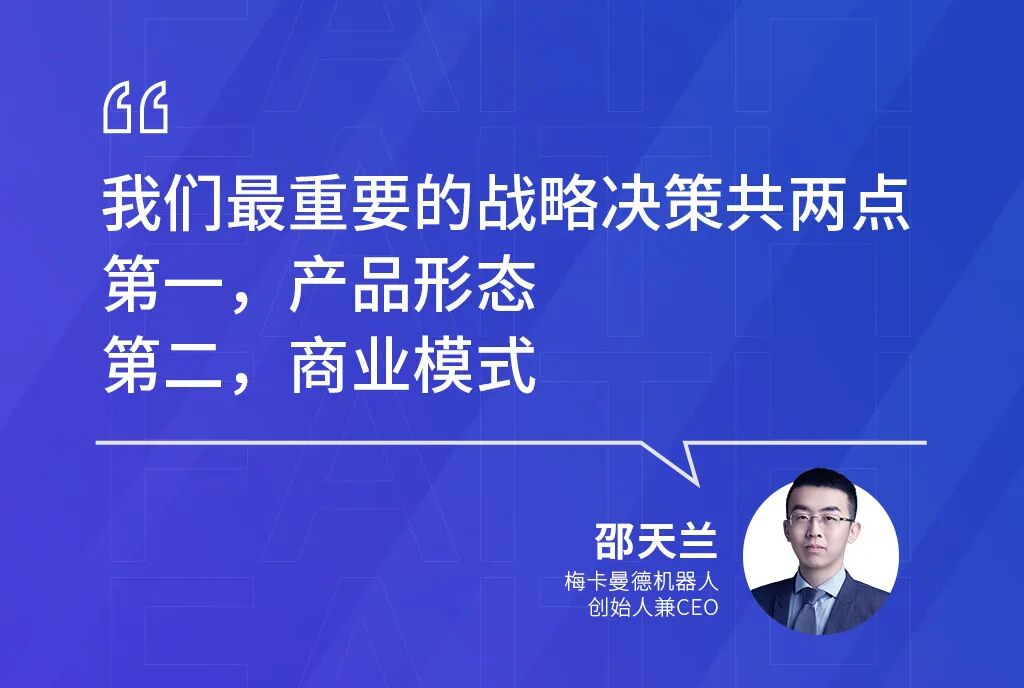
Tianlan Shao: Our most important strategic decisions are two: first, product form; second, business model.
Our product form is visible on our website — hardware, software, plus some support services. The business model is productization, achieving cross-industry, cross-country replication through integrator partners.
The value our technology creates is obvious, so in terms of business model, we didn't choose anything particularly unusual or unprecedented. Industrial automation has developed for over 100 years; business models that have been validated still have their merits.
Actually making decisions is relatively easy; persisting with a decision is harder. A better approach is to anticipate negative impacts when deciding, so when problems arise, you're less likely to waver. If you make a decision thinking it's wonderful, that you'll reach life's peak and smooth sailing forever — when you encounter problems, you may not persist as strongly. How to maintain commitment after deciding is more important.

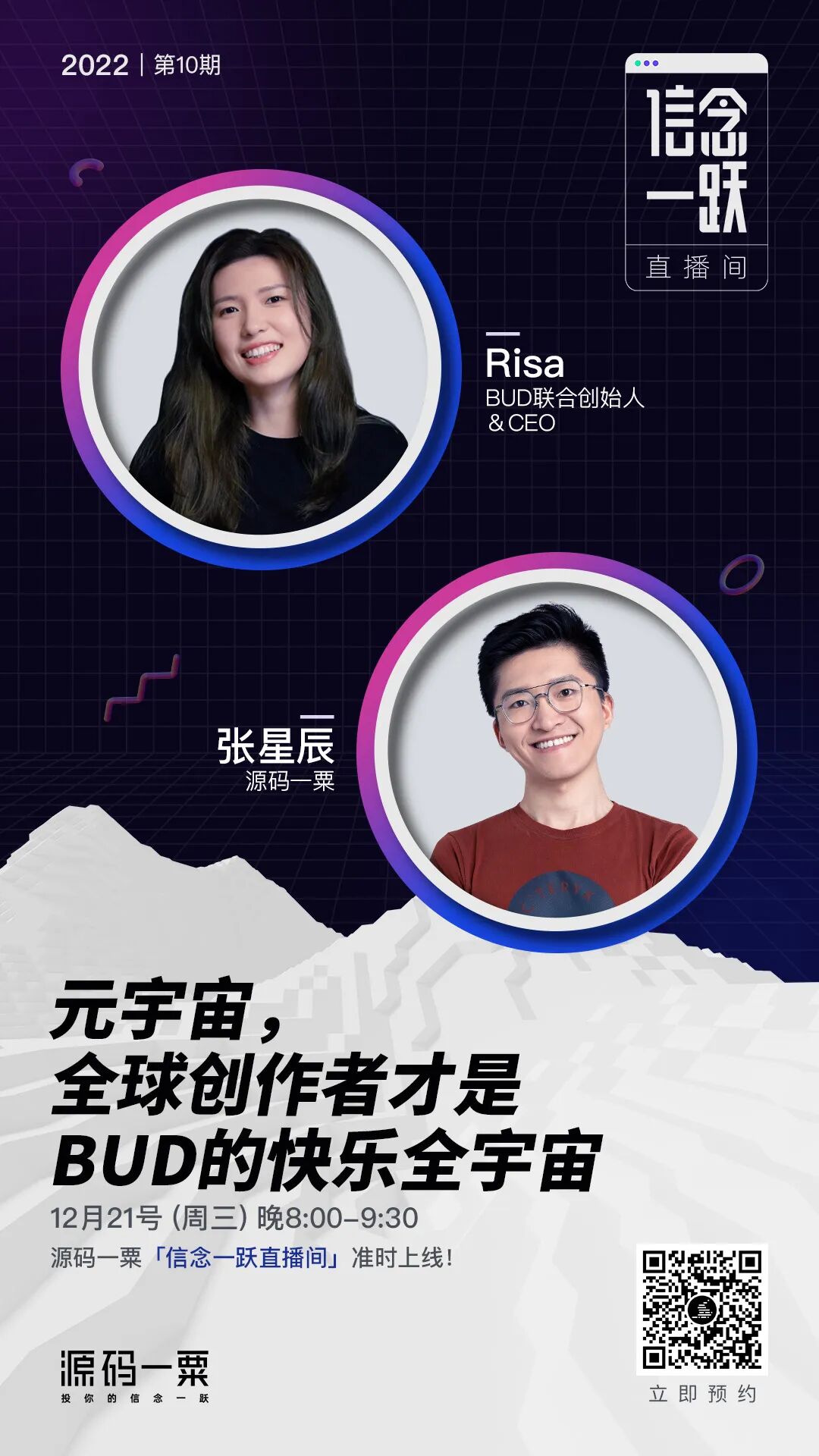
Wednesday, December 21, 8:00 PM,
Source Code Capital "Leap of Faith Livestream" Episode 10,
featuring Risa, Co-founder & CEO of BUD
exploring BUD's Happy Metaverse with you

- Source Code Capital | The "Star Ocean" of Scientist Entrepreneurs
- Source Code Capital | Teams with Conviction Will Filter Out Noise
- Source Code Capital | "Interest" Was Ethan Yuanming Hu's Mentor at Taichi Graphics
- Source Code Capital | At 28, I've Been Working on Power Supplies for Ten Years and One Month
- Source Code Capital | Guangmi Li of Shixiang: Choosing Entrepreneurship Was My Leap of Faith
- MaGuan | Power Laws — Understanding Complexity in a Non-Random World
- MaGuan | Source Code Capital's Dual-Carbon Investment, Exploring New Species Through Whole-Chain Layout
- MaGuan | China Electric Power News Interview with Source Code Capital: Industry Inflection Point Arrived, Vast Market Space
- MaGuan | Yungang Huang of Source Code Capital: How Does AI4S Land in Different Stages, Industries, and Markets?
- MaGuan | Yungang Huang of Source Code Capital: "Cross-Disciplinary Intersection" Drives Innovation in Healthcare Industry
Click "Read Original" for more MaHui members