Source Code Capital | Belief-Driven Founding Teams Cut Through the Noise

#Source Code Capital's "Grain of Rice"
Longbo Chen, founder of ILLA Cloud, joined ByteDance straight out of college through campus recruiting and was part of the early team that built Douyin, witnessing its entire journey from zero to 300 million users. He later joined Kuaishou, where he led front-end development for internal startup incubation projects including Bifeng (predecessor to Kuai Kandian). For four years after graduation, Longbo moved at breakneck speed, building innovative businesses inside major tech companies. At the end of 2021, he finally took the leap of faith into the "real" world of entrepreneurship. Nearly a year later, what has he learned and how has he grown?
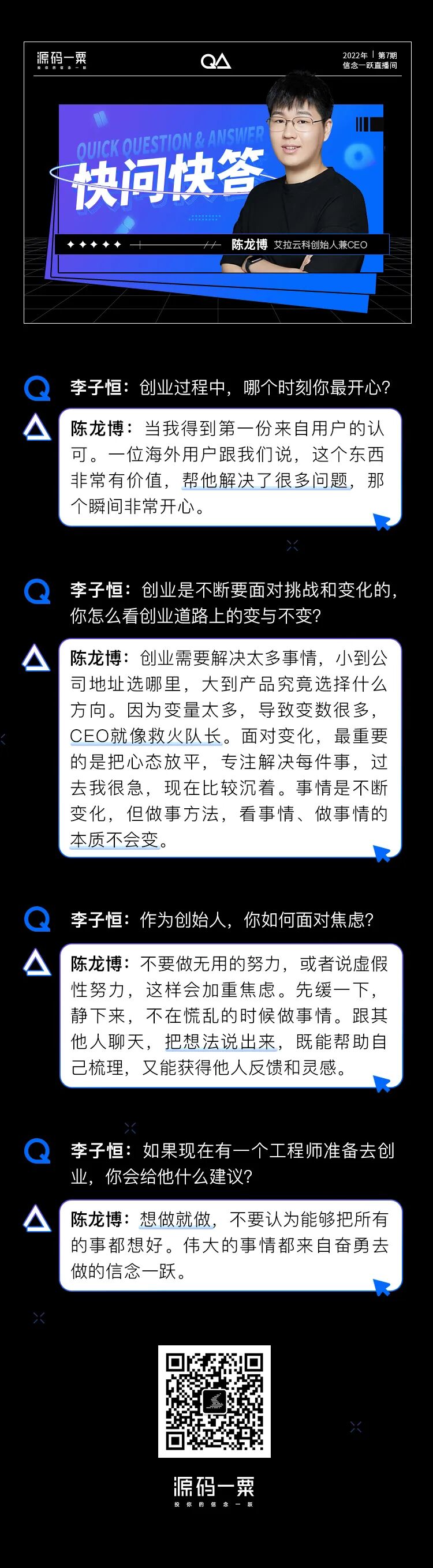
Livestream Excerpts
Source Code Capital's "Grain of Rice" — Ziheng Li: From student to Big Tech employee to startup CEO—how have these constant identity shifts felt?
Longbo Chen: The core of growing anything from small to large is having a team that's truly aligned, where everyone genuinely wants to make it work. When we were exploring Douyin at ByteDance, that's exactly the state we were in—a humble little team, everyone obsessing over it day after day, hearts pointing in the same direction, and we made it happen.
After that, I went to other major companies and saw teams of two or three hundred people working on innovative products that still didn't succeed. The main reason is that once a team gets big, it generates a lot of "noise," and that noise becomes incredibly hard to filter out. So I chose to start my own company partly because I wanted that direct line to users, and partly because I wanted a small team where we could all pull in the same direction and actually ship something.
Source Code Capital's "Grain of Rice" — Ziheng Li: What insight or observation led you to found ILLA Cloud, and how do you position it?
Longbo Chen: ILLA Cloud is an open-source project aimed at helping engineers rapidly build internal company systems. Every company has tons of internal systems—review dashboards, campaign backends, some permanent, some temporary. The time and human resources spent on these systems are enormous. If we could use tools to build internal systems quickly, it would help these companies dramatically improve efficiency and cut costs.
I've experienced many types of companies—very small ones, high-growth ones, massive ones—and this internal systems problem is a universal pain point across all of them. Based on these varied experiences, I understood how to solve these problems, so I chose this direction for my startup.
At the same time, open source is something all engineers love, and I had this dream too—to build a company born from passion. Solving problems through entrepreneurship is important, but what kind of company it becomes matters even more. I want to gather people who share my values and do this thing right.
Source Code Capital's "Grain of Rice" — Ziheng Li: What stage would you say your product is at now? How do you define it?
Longbo Chen: I want to always define it as a beta. For people like us building general-purpose tools, we're trying to solve a massive range of needs, and those needs are incredibly diverse, so we have to keep iterating and continuously polishing. The current stage is about listening to the community, getting more people to give feedback, letting users tell us what they want.
Our team feels tremendous satisfaction from helping others solve problems. We're willing to grow alongside open-source products and build a better ecosystem, and we welcome more open-source products to collaborate with us. In the future, we define ourselves as a platform where we can do interesting things with many others. Our onboarding cost is very low—anyone interested, please give it a try.
Source Code Capital's "Grain of Rice" — Ziheng Li: What's your view on open source?
Longbo Chen: I can speak to this from an emotional angle. My earliest awareness of open source came from writing blogs—you'd get traffic, users would interact with you and give feedback, people would validate your content. Later I participated in some events, sharing things I found useful. I discovered that "sharing" is fundamental to who I am. If my sharing creates value for others, the sense of accomplishment is incredibly powerful. Doing open source is about getting feedback; without it, you only receive cold, impersonal tickets. An open-source community has warmth, has interaction—it's not a cold SaaS product.
Source Code Capital's "Grain of Rice" — Ziheng Li: What's the user ecosystem like in open-source communities?
Longbo Chen: Compared to closed-source products, if there's a bug, it's harder to get feedback—people might just stop using it or work around it. But with open-source products, when people encounter bugs, they're enthusiastic about finding the problem and the solution, and they'll tell you. Since everything is visible in the code, and programmers have such strong intellectual curiosity, they don't just want to know why—it extends to methodology and details. The depth and granularity of open-source feedback is completely different. Some people go even further—say I find a bug in some well-known open-source project today, I might just fix it directly. I've contributed to the community, the community gets its bug fixed, and the process and details get documented and shared with everyone. That feeling is fantastic.
Source Code Capital's "Grain of Rice" — Ziheng Li: What has the development journey of open source looked like?
Longbo Chen: The evolution of open source demonstrates the value of sharing and the truth that "many hands make light work" and "strength in numbers." We've found that open-source software today shares one common characteristic: no open-source project was built by a single company. Take Android—there's no way Google could have done it with just their own engineers. The oldest open-source software started with operating systems, Linux, then countless distributions, then Red Hat. Then came databases—people building databases spawned many open-source products, which later evolved into consulting or selling databases, and then cloud services.
Source Code Capital's "Grain of Rice" — Ziheng Li: What do you think are the essential elements of a good open-source product?
Longbo Chen: First, an excellent open-source project must have a great community. For a SaaS product, achieving PMF is enough. But for an open-source product, before achieving PMF, you need to achieve PCF—Product Community Fit. The community doesn't need to be huge, but it must have good atmosphere, people giving feedback, people contributing. Every successful open-source project community I've seen has this characteristic. There are also many non-profit, public-interest open-source projects in the world that have created enormous value—not commercial value, but something more idealistic.
Second, feedback must be very timely. Excellent open-source products respond to user feedback extremely quickly, sometimes down to the minute. Not like a cold ticket that sits unresolved for ages.
Third, a culture of candid, open discussion. When a closed-source product breaks, it's hard to truly tell users what happened. But open source is different—you must be candid, the code is right there, so you openly communicate and collectively discuss and solve problems together. These three elements together build the strong reputation of open-source products and communities.
Source Code Capital's "Grain of Rice" — Ziheng Li: What differences between China and abroad do you perceive in this industry?
Longbo Chen: Our community is still small but very diverse. Different countries and regions have quite different consumption behaviors for B2B software. Some small details—for example, at Chinese companies, if a colleague finds useful software, they need to go through a procurement process. But overseas companies often have virtual corporate cards with fixed limits per person, so they can directly swipe to purchase for the company. These different consumption behaviors affect operational and sales strategies, requiring some customized adaptations.
But today, we believe open-source products are inherently global—you shouldn't only consider or limit yourself to one country or region. If we focus on the global market, doing global business, serving people from different internet ecosystems, and we take this to the extreme, the ceiling is high enough and the returns substantial enough. That is, adopting a global perspective and setting high standards for yourself ultimately yields greater rewards.
Source Code Capital's "Grain of Rice" — Ziheng Li: Returning to the product itself—from your identity as an engineer and developer, you sensed user needs and pain points. How did you transform yourself into a product manager to solve these problems at a higher level?
Longbo Chen: Transforming your identity first requires transforming your thinking. Work backwards from the result—first clearly think through what you want to do, what problems and pain points it solves, then go do it. Engineers tend to think about building something impressive, iterating past solutions to an extreme, enjoying making the work excessively polished. The whole process consumes enormous energy, but what problem it actually solves is uncertain. What I need to do today requires thinking about what commercial value it can generate, what social value it can create.
Here's a real example: a developer built a spreadsheet that could store a million rows of product data, while other spreadsheets start lagging at a thousand or so. His didn't lag. But I asked him one question: who puts a million rows of data in a spreadsheet? He never answered that question—he's still thinking about it. Later I developed a habit: when I think of something particularly interesting today, I don't immediately share it with the team. I sleep on it, reflect again the next morning, and only if it's truly useful do I share it. This prevents everyone from getting too "hyped up" and wasting team energy.
Source Code Capital's "Grain of Rice" — Ziheng Li: Looking back, from generating the idea to continuously refining and scrutinizing it, what did you experience? What were the important changes and iterations?
Longbo Chen: The idea came about because I'm somewhat obsessive-compulsive—I can't stand seeing a problem sitting there unsolved. It creates enormous psychological pressure. When I discover something that needs solving, I'll throw myself into it wholeheartedly. This is why I took the leap into entrepreneurship without hesitation, and what I hope this company can do: solve the problems and pain points of internal company systems.
The entrepreneurial process is like running a marathon—the goal is to reach the finish line, but the path isn't necessarily straight. We can't veer off course, can't be distracted by scenery along the way or chase after trends. We must stay firm in our value-based choices. In this process, we believe "change" is appropriate, because the road beneath our feet isn't straight—we have to follow where it leads. Adapt to the road's changes, continuously adjust direction, eyes on the goal, not straying. But the goal and original intention cannot change, because ultimately we're running to reach that finish line.
Source Code Capital's "Grain of Rice" — Ziheng Li: What detours have you taken? What were the warning signs at the time?
Longbo Chen: From a rational perspective, many management tools give precise feedback signals—you can see some problems in the data. From an emotional perspective, when things don't develop according to expected hopes, when you thought you'd get somewhere but didn't, that's a test of the CEO's judgment.
The detours our company took are similar to most early-stage startups, mainly around people and business. On the people side, from several co-founders to gradually expanding the team, questions of how to attract talent and organizational issues arise. On the business side, as the team scales, finding customers and building community both encounter various problems. This is my fifth year working, and October 26th marked exactly ten months since I started my company. The growth in these ten months exceeds the previous four years combined. I believe that whatever difficulties and setbacks I encounter are incredibly valuable wealth.
Source Code Capital's "Grain of Rice" — Ziheng Li: What's your team size, and what hiring challenges do you face?
Longbo Chen: We're currently a small team of about a dozen people. The hiring challenge is mainly in strategy. If you hire reactively as business develops and expand too quickly, suddenly growing the team creates hidden risks. If you insist on candidates whose values align with yours, finding people who "resonate on the same frequency," hiring speed becomes a problem. We're still continuously adjusting our hiring strategy, hoping to find better approaches that match our company's development.
Source Code Capital's "Grain of Rice" — Ziheng Li: What insights and lessons have you gained in team management?
Longbo Chen: A person's reasonable management span is 8-10 people. I'm currently right at that limit. Any more people and I'd struggle to track what they're doing each day, let alone any psychological changes they might be experiencing. A founder once told me about using values to unite a team.
If everyone shares the same values, on ambiguous matters they'll know what they should do—it means people in the company have standards for their actions. For example, our value is long-termism, so when making choices, between long-term value and short-term gain, they can easily choose the long-term direction. Values aren't something only big companies have—they exist from day one of a company's founding, and must be continuously iterated.
Source Code Capital's "Grain of Rice" — Ziheng Li: As a founder, you often face situations where plans can't keep up with changes—has this been your experience too?
Longbo Chen: Before starting my company, I believed that as an engineer you absolutely had to give timelines and communicate them to relevant collaborators—this was responsibility and attitude. After starting up, I told another entrepreneur roughly when I could get something done, and he said, you'll definitely delay. At the time I thought that with my professionalism, I could handle this and deliver. The result: I really did delay. Because all sorts of things come up, and the delays are measured in months. I was extremely anxious at the time, talking to people about it, and someone said delaying a quarter is normal. From this I learned that delay itself isn't scary—what's scary is not knowing why you're delayed. So encountering changes or problems isn't scary; what matters most is knowing the root cause, so you can get back on track afterward, and become increasingly punctual and better over time.
Source Code Capital's "Grain of Rice" — Ziheng Li: So do you frequently exchange ideas with more experienced entrepreneurs?
Longbo Chen: These conversations are an excellent growth process—every time I gain something. CEOs of different ages have rich entrepreneurial experience, some from stumbling into pitfalls, some accumulated over time. Different experiences shared over—absorb what's valuable, apply what suits you. It not only stimulates your own thinking and reflection, but is also a fantastic learning process.
Source Code Capital's "Grain of Rice" — Ziheng Li: What "positive feedback" during your entrepreneurial journey has stuck with you?
Longbo Chen: The earliest positive feedback came from small compliments about the product. Later, as product capability gradually improved and we could genuinely solve problems for users, they'd give us feedback. After that, this positive feedback became much more diverse. For example, a colleague spent a week on requirements, tested five directions, and found problems with all of them—but I still thought he was great, because at least we eliminated five unreliable directions and could explore new ones. Or when exceptionally talented people decide to join our team, it shows their confidence in us is high enough to commit their careers here—this is wonderful positive feedback. I've always emphasized values, and on the level of practicing values, I continue to receive positive feedback.
Source Code Capital's "Grain of Rice" — Ziheng Li: What can you gain from Big Tech? If you were to give advice to people working at large companies, what would it be?
Longbo Chen: Don't always do easy things. Going to a large company, you should absorb that company's methodologies or strengths—not just show up for work. Once you've learned them, you also need to think, for example: what if things weren't done this way? Things are multidimensional, people are multidimensional, and working with teams means learning to leverage each other's strengths. Continuous learning is what I consider most important.
Source Code Capital's "Grain of Rice" — Ziheng Li: Any advice for 35-year-old developers?
Longbo Chen: It still depends on what you want to achieve—age is irrelevant. People of any age can do well what they want to do; this is your right and your own subjective desire. We should do work we want to do, not work that might be more advantageous to us. Because without passion, you probably won't persist.
The father of Java was still innovating at 60 or 70, creating a computer language used by people worldwide. He consistently pursued what he wanted to do and took it to the extreme. When a person works hard at something for long enough, quantitative change leads to qualitative change, and you won't feel anxious or regretful about other things.

Engage with Source Code Capital's "Grain of Rice"
How did you first learn about Source Code Capital's "Grain of Rice"? And how did you discover this episode of "Leap of Faith" livestream?
Did Ziheng Li's conversation with Longbo Chen about his entrepreneurial journey inspire you?
We welcome your comments! We'll select 10 readers with the most likes and gift them curated books.
Wednesday, November 9th at 8:00 PM,
Source Code Capital's "Grain of Rice" — "Leap of Faith Livestream" Episode 08,
featuring Haixia Zhang, iCANX founder and Peking University professor
exploring the "sea of stars" of scientist entrepreneurship

- Source Code Capital's "Grain of Rice" | "Interest" was Ethan Yuanming Hu of Taichi Graphics's "mentor"
- Source Code Capital's "Grain of Rice" | This year I'm 28, and I've been working in power supplies for ten years and one month
- Source Code Capital's "Grain of Rice" | Guangmi Li of Shixiang: Choosing entrepreneurship was my leap of faith
- MaHui Perspective | Power Laws—Understanding Complexity in a Non-Random World
- MaHui Perspective | Source Code Capital's dual-carbon investment, exploring new species through full-industry-chain deployment
- MaHui Perspective | China Electric Power News exclusive interview with Source Code Capital's Di Wang: Industry inflection point has arrived, market space is vast
- MaHui Perspective | Yungang Huang of Source Code Capital: How does AI4S land in different stages, industries, and markets?
- MaHui Perspective | Yungang Huang of Source Code Capital: "Cross-boundary intersection" drives innovation in healthcare industry
- MaHui Perspective | Di Wang of Source Code Capital: The most needed capability for investing in carbon neutrality is multi-level cognition
- MaHui Perspective | Wu Fan of Source Code Capital: Opportunities and advantages, China's new energy in a new cycle
For more MaHui members, click "Read Original" to view