Space Transportation Announces Tens of Millions of RMB Angel Round Led by Source Code Capital
Delivering highly reliable, low-cost, and convenient space transportation services to customers.
In March 2019, Space Transportation announced the completion of a tens-of-millions-of-RMB angel round, led by Source Code Capital.
Founded in August 2018, Space Transportation is dedicated to solving the high-cost problem of commercial space launches, providing customers with high-reliability, low-cost, and convenient space transportation services.
The founder of Space Transportation stated: "The completion of this round reflects Source Code Capital's trust and support for Space Transportation, as well as investors' recognition of our team and our technological leadership. The funding will be primarily used for the development and flight testing of our reusable launch vehicle, the 'Skywalker I'."
The founding team all have over ten years of experience within China's state space system, with expertise spanning market development, overall system design, assembly and production, quality management, and all other critical aspects of space program development. They have also achieved a series of breakthroughs from scratch in the commercial space sector. The core R&D team has worked together within the state space system for many years, with comprehensive specialties and seamless collaboration.
As a board member of the company, Yiwen Hao of Source Code Capital commented: "The curtain has just risen on China's commercial space industry, and launch vehicles, as critical infrastructure within it, hold enormous growth potential. Space Transportation has an industry-leading rocket system design team, was the first to propose a horizontal recovery solution, and has chosen a more reliable and pragmatic product iteration path that creates more launch opportunities to refine a highly reliable, low-cost rocket transportation service. Source Code Capital is eager to support entrepreneurs and companies with original ideas and distinctive technical strength like this."
Drawing on its technical advantages in rocket launch and reentry recovery, and aligning with the realistic pace of China's commercial space market, Space Transportation quickly rolled out its "Skywalker" series of reusable rockets after its founding. Through vertical takeoff and horizontal landing recovery, the company aims to achieve full-vehicle reuse. Each product variant targets different stages of commercial demand, including scientific experiments in aerospace, commercial small satellite constellation launches, and crewed space tourism.
In 2019, the company's "Skywalker I" rocket will provide multiple scientific experiment launch services for universities and research institutions, and will attempt China's first full rocket recovery (including onboard experimental equipment).
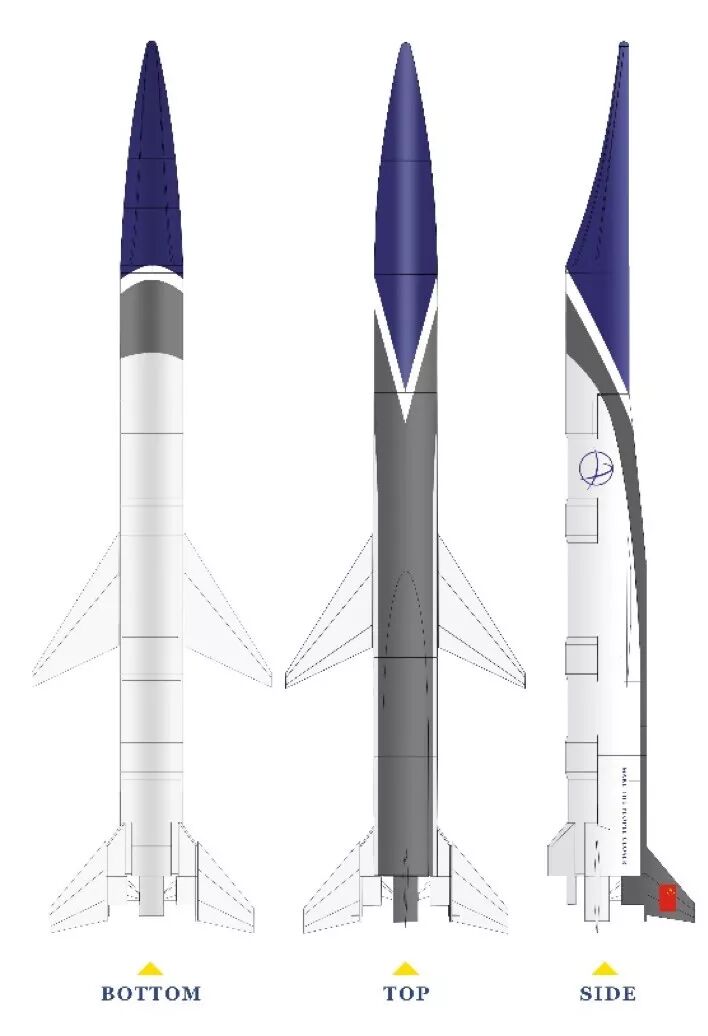
Image source: Space Transportation — "Skywalker I" rocket exterior design
Unlike SpaceX's powered retropropulsion vertical landing recovery approach, the "Skywalker I" combines winged horizontal glide technology with parachute recovery, using winged glide deceleration and parachute landing to achieve rocket recovery. The entire solution places high demands on the rocket's exterior design, precise motion control, and thermal protection and environmental control — all core system design capabilities. This technology can not only significantly reduce launch service prices, but more importantly, ensure that experimental payloads and various expensive equipment within the rocket remain intact.
For years, most aerospace scientists and engineers in China have had to rely on ground wind tunnel facilities to simulate high-altitude environments for aerodynamic testing of various aircraft and obtain corresponding data. However, due to inherent limitations, ground wind tunnels cannot fully replicate real high-altitude conditions, leading to some degree of data inaccuracy. The inability to actually fly means difficulty in finalizing research into commercial products; the occasional fortunate team that manages to hitch a ride on a state system rocket faces prohibitive launch costs plus the one-time use of expensive equipment, leaving many researchers watching from the sidelines.
The "Skywalker I" will enable high-speed flight environments with 100kg–1000kg payloads, maximum Mach 8, and altitudes above 200km, for applications including new high-speed engine testing, materials testing, guidance and control testing, and new equipment validation. The product has already secured a series of commercial orders during its R&D phase. Space Transportation's technological innovation and complete recovery capabilities are expected to bring more affordable costs and more accessible testing opportunities to the aerospace field.

More Source Code Capital Portfolio News

Source Code Capital portfolio company YQN Logistics
Completes tens of millions of USD in Series B2 funding
Existing investor Source Code Capital continues to increase stake

Source Code Capital portfolio company
Walnut Coding completes Series A+ round
Existing investor Source Code Capital continues to increase stake

Source Code Capital portfolio companyYimi Dida
Secures 1.8 billion RMB in Series D funding
Existing investor Source Code Capital continues to increase stake
Source Code Capital portfolio company
Community group-buying platform Linlinyi
Secures $30 million in Series A funding
Source Code Capital portfolio company
ABC Technology announces completion of
$30 million in Series B funding
and more...