Source Code Capital | The "Galaxy" of Scientist Entrepreneurship

#Source Code Capital
Professor Haixia Zhang, founder of iCAN & iCANX and professor at Peking University's School of Integrated Circuits, has spent years focusing on micro-nano technology and micro-energy research, achieving a series of fruitful results. A longtime advocate for innovation, entrepreneurship, and talent development, she launched the International Contest of innovAtioN (iCAN) in 2007. The competition now draws tens of thousands of students from hundreds of universities across more than 20 countries each year, giving it considerable international influence. In April 2020, Professor Zhang launched iCANX Talks, a livestream series on cutting-edge global technology that has since featured over 200 top scientists from around the world delivering outstanding academic presentations. As a scientist who has consistently paid attention to innovation and entrepreneurship, Professor Haixia Zhang has witnessed and helped numerous scientist friends and young researchers embark on their entrepreneurial journeys.
Source Code Capital has always paid attention to the scientist-entrepreneur community and continues to support scientists on their entrepreneurial paths. This episode of the "Leap of Faith" livestream, themed "The Vast Ocean of Stars for Scientist-Entrepreneurs," featured Xingchen Zhang from Source Code Capital and Professor Haixia Zhang engaging in a close discussion on practical questions such as how to translate scientific and technological value into commercial value, and the bumps scientists experience when transforming into entrepreneurs. The entrepreneurial road is often arduous, but with the vast ocean of stars in one's heart, the starlight never fails those who hurry through the night.

Excerpts from the Livestream
Source Code Capital Xingchen Zhang: As a Peking University professor, what motivated you to start an entrepreneurship competition?
Haixia Zhang: I came to Peking University for graduate studies in 2001, spent a few years abroad, and returned to China in 2006 determined to help China close the gap with foreign countries in high-tech fields like integrated circuits and microelectronics. To achieve this goal, I believed we needed massive talent investment. But at that time, my students told me they couldn't find jobs in this field.
To resolve this puzzle, I traveled across the country for research and called high-tech parks in the Yangtze River Delta and Pearl River Delta, only to discover that many so-called high-tech parks were actually high-tech real estate developments — there wasn't that much industry actually present.
Another thing: a close friend had founded a chip company about to go public. When I approached him full of hope about placing my students, he said he didn't want them. They could read books and pass exams, but they couldn't jump in and solve problems.
These two things moved me. How could we help university students become not only theoretically solid but also quickly practice-ready? I thought of using entrepreneurship competitions to fully unleash the imagination of university students and researchers — to see if we could foster innovation while exposing more scientific talent to entrepreneurship. The name we came up with for the competition was "Yes I Can," and that's how the iCAN name came about. This year marks the 16th year of the iCAN competition, and iCANX Talks has reached its 123rd episode.
Source Code Capital Xingchen Zhang: In this process, have you felt that many scientists around you have entrepreneurial ideas? Of those who truly take the entrepreneurial leap, from zero to one, with products and revenue, what proportion would that be?
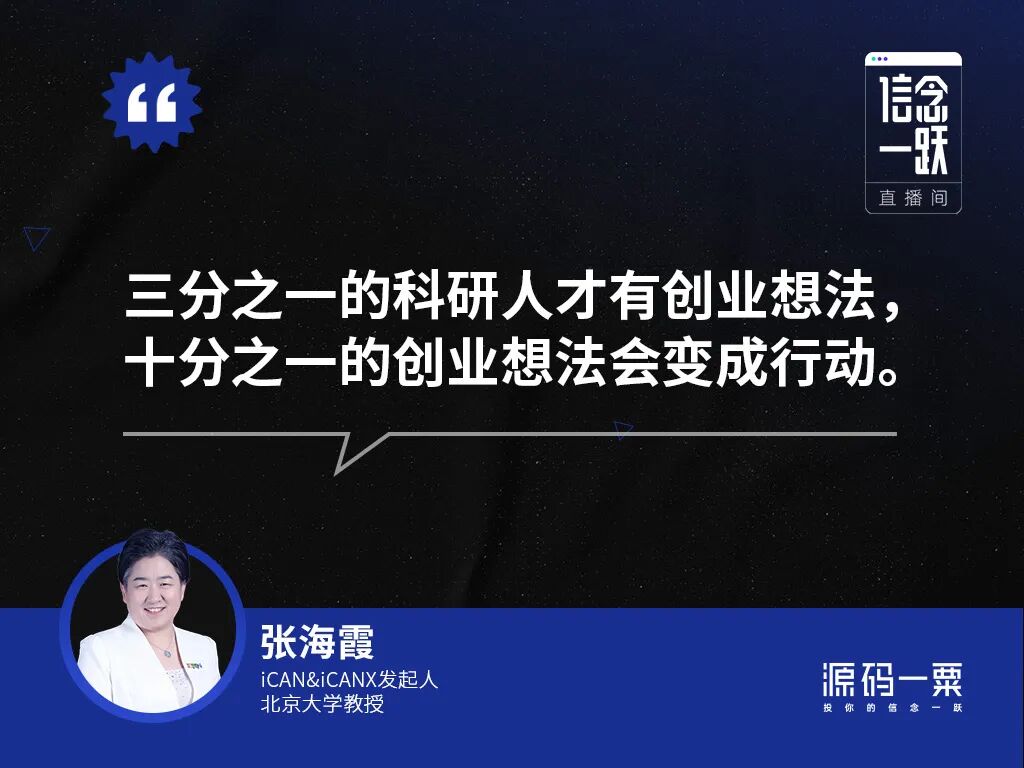
Haixia Zhang: The proportion of research talent with entrepreneurial ideas isn't low — roughly one-third. Especially at science and engineering universities, where people's technology tends toward practical applications, quite a few want to try entrepreneurship. But from having ideas to actually taking the entrepreneurial step, it's about one in ten. And surviving the valley of death to reach normal company operations and commercialization — that proportion is quite low, possibly even lower than typical commercial projects.
Source Code Capital Xingchen Zhang: What do you think the scientist-entrepreneurs who have succeeded commercially have done right?
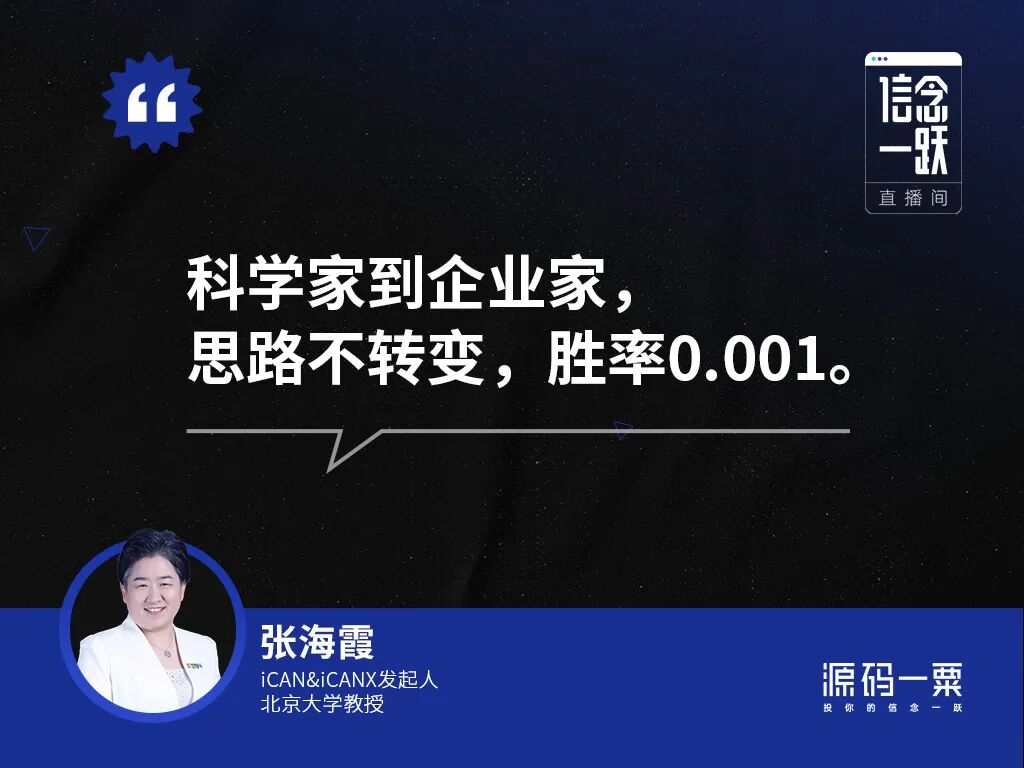
Haixia Zhang: Actually, none of the people who have truly built companies are scientists. Even if they were scientists originally, by the time they've actually built the company, they are definitely no longer scientists. The transformation of identity and role is extremely important — you must shift your mindset. It's essentially a shift from scientist thinking to entrepreneur thinking: accepting marketization, accepting team diversity, rather than remaining just a professor or scholar.
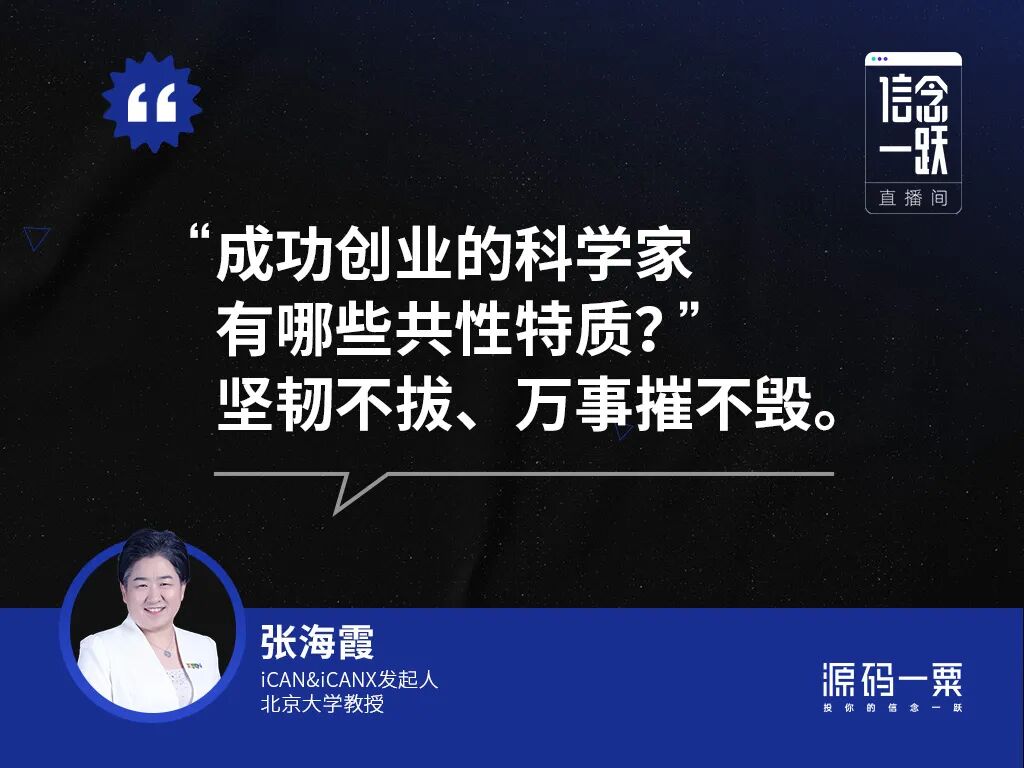
Second, they must be exceptionally determined people — tenacious, unbreakable by anything.
Source Code Capital Xingchen Zhang: When does the transition from scientist to entrepreneur typically happen in the startup journey? Can it be predicted?
Haixia Zhang: It can't be predicted, but there are signs that reveal whether someone has the potential for this transformation. It's a process of breaking through the cocoon to become a butterfly — and it's possible that even after reaching Series B or C, a scientist-entrepreneur still hasn't broken through.
From my observation, the moment that prompts breakthrough for the vast majority is when the product is nearly formed and preparing to enter the market. At this point, a massive conflict erupts between team management thinking and scientist thinking — it's a hurdle. If you can clear this hurdle, you're basically set. This is the most critical juncture.
Source Code Capital Xingchen Zhang: You mentioned "tenacious, unbreakable by anything" — are there any particular examples of this trait? Why is it important?
Haixia Zhang: One of my entrepreneur friends, at the most difficult moment in his startup journey, mortgaged his house. The process was incredibly hard, but he was exceptionally determined, believing this could succeed. He has now developed very well indeed. But if at that time he hadn't had such powerful conviction, everything would be gone now. Conviction and determination are extremely important.
Source Code Capital Xingchen Zhang: Determination is sometimes understood as stubbornness, even obsession. When is this a strength, and when does it become an obstacle?
Haixia Zhang: The "fatal point" for scientists is when someone challenges their technical approach — this of course reflects scientists' confidence in their own technology. But when scientists aren't open enough in other areas, such as marketing and sales, even becoming completely impervious to outside input, it becomes very difficult to collaborate with other teams. They'll dig in their heels when the business team designs business models, insisting that others must recognize their technology and buy the product on their terms. This becomes quite problematic. At that point, such stubbornness is meaningless.
Source Code Capital Xingchen Zhang: Have you encountered particularly regrettable teams — those that came so close to making it during their entrepreneurial journey?
Haixia Zhang: Quite a few. Through teaching innovation courses and business models, I've gradually come to appreciate the importance of business models. For example, one friend was doing a startup with internationally leading technology, but simply couldn't sell the product. The main reason was that the market he targeted had excessively high barriers, yet he stubbornly refused to shift his thinking to do dimensional reduction strikes on some lower-end markets, ultimately making things extremely difficult.
The higher the technology, the greater the reputation, the higher the ambition. His mindset wouldn't allow him to do easy things — he had to challenge the hardest ones. But if he had broken through his thinking, things would have been much better. Another entrepreneur was working on high-tech materials that should have been applied in the automotive sector. Affected by the pandemic, he spent time at home wondering why they couldn't be applied to protective equipment for medical workers. That single thought opened up his thinking — it was precisely such a "leap of faith," and his company is now a star enterprise.
Source Code Capital Xingchen Zhang: In the scientist-entrepreneur's journey from zero to one, they often encounter insurmountable thresholds in product development and R&D. What advice would you give them?
Haixia Zhang: I've seen too many people misposition themselves: truly zero-to-one things are actually very rare. For most scientist-entrepreneurs, especially in high-tech, don't talk about zero to one first — think replacement, optimization, upgrade. When you shift your thinking in this direction, you'll find opportunities everywhere.
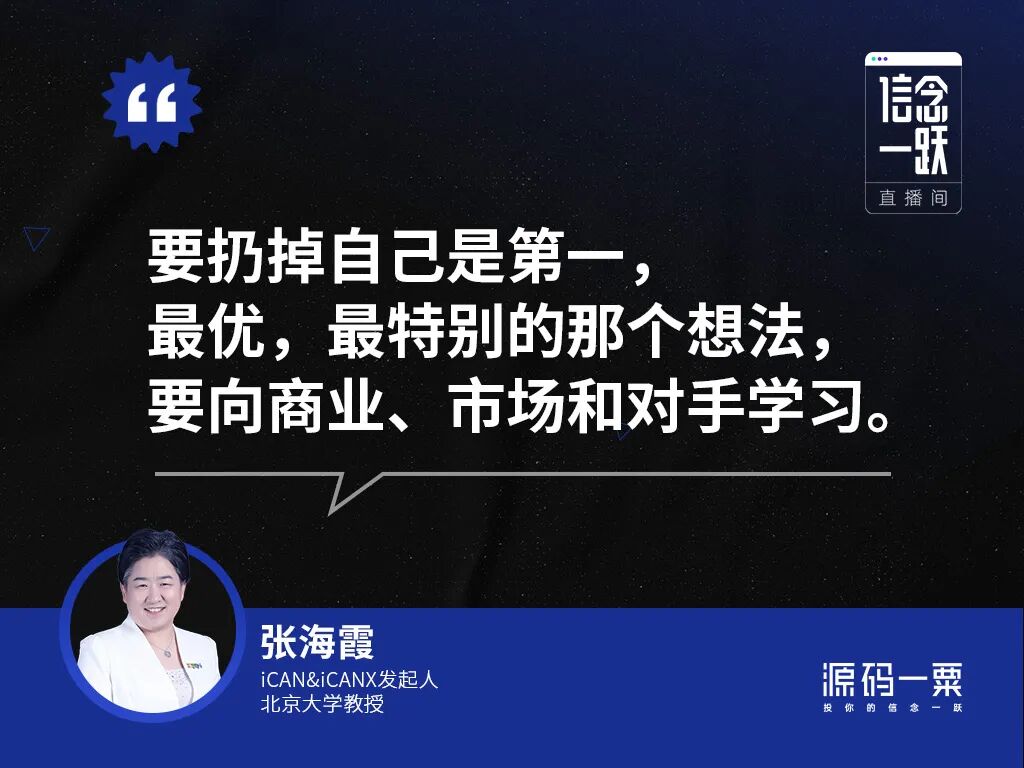
Scientist-entrepreneurs shouldn't shut out the market, but find suitable competitors to learn from. Discard the idea that you're number one, the best, the most special in the industry — things actually become easier after that. Don't talk too much about "changing the world" at first; survive first, prove yourself. Even if you're thinking about changing the world in your heart, always maintain this survive-first mentality.
Source Code Capital Xingchen Zhang: Have you witnessed any entrepreneurs' darkest moments?
Haixia Zhang: Although I'm not what people would consider an entrepreneur, let me share one of my own examples. When running the iCAN competition, I was already quite accomplished academically, but for the competition I went everywhere across the country to promote it. Once I returned to my alma mater to give a passionate speech. After it ended, a former teacher of mine asked me: "What exactly are you trying to do? You must have some ulterior motive." That moment of being questioned, of being provoked — I think that was my darkest moment: my efforts to pave the way for students' growth were seen as having hidden motives. But this experience helped me understand the loneliness of entrepreneurs, and repeatedly forced me to examine my own persistence. Ultimately I reaffirmed my original intention, and now I'm even more resolute.
I've also seen a scientist-entrepreneur with excellent technology who secured funding and deployed products to over 50 cities nationwide. When I saw him again in the third year, he had become a "discredited person" who could only ride slow trains. The various problems of entrepreneurship had devastated him, but he later made a comeback. Not being knocked down is also characteristic of entrepreneurs. Often it's the dream inside that sustains them — I simply must make this happen. After experiencing some darkest moments, you'll find yourself more determined, better able to see the value of what you're doing.
Source Code Capital Xingchen Zhang: If a scientist friend told you they were going to start a company, what three questions would you ask first to judge whether they're truly ready?
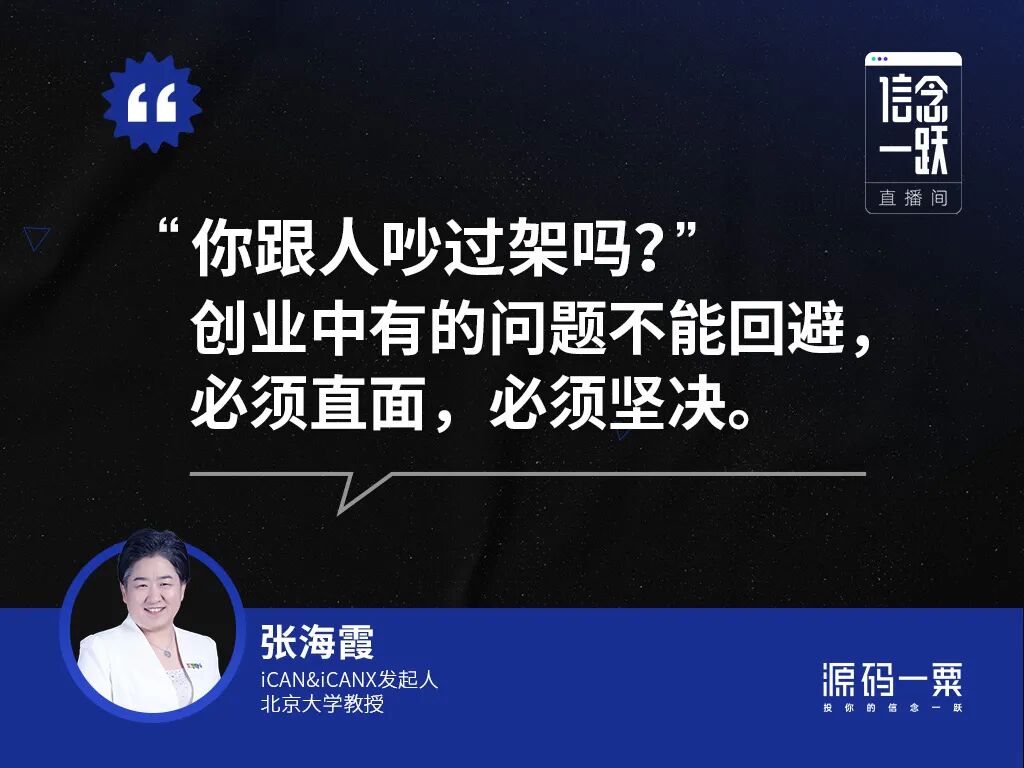
Haixia Zhang: First: Are you sure you can commit 100%? Can you handle going all-in on this state? Second: Have you ever had a real argument with someone? A real argument, slamming the table kind of argument. Third: Are you married?
The first question is to know whether they can fully dedicate themselves. The second is about the problem of intellectuals being thin-skinned — in entrepreneurship, some problems cannot be avoided, must be confronted head-on, must be addressed resolutely. The third is to see whether they have a solid rear base, which makes them emotionally more stable and more responsible.
Source Code Capital Xingchen Zhang: What mindset shifts do scientist-entrepreneurs need to make from technology orientation to market orientation?
Haixia Zhang: A very important point is understanding market rules, market models, and business principles. If targeted training and courses can be undertaken early in the entrepreneurial journey, you can avoid pitfalls later on.
Source Code Capital Xingchen Zhang: What should this targeted training include?
Haixia Zhang: Business logic, business models, finance, company management, organizational building, and so on.
Source Code Capital Xingchen Zhang: Do you think scientist-entrepreneurs must be their own CEO? If not, what kind of CEO works best with a scientist?
Haixia Zhang: We can look at this from Eastern and Western perspectives. In the West, the business environment is more mature — if you have core technology, there are corresponding policies and measures to ensure market mechanisms, investment, and other supporting elements. Scientists just need to output their technology; they don't need to be CEO. That's why there are many Western scientist-entrepreneurs, and more successful entrepreneurs and benchmark companies. But this situation is relatively rare in the East, or the proportion is lower.
From my personal perspective, I don't recommend scientists being CEO at the very beginning. Scientists are better suited to be CTO, translating technology, and when the technology and product are nearly finalized, they can directly become advisors — but they must ensure corresponding equity and returns. If a scientist personally has the capability and is willing to accept major challenges, they can be CEO, but if not, it's better to find a good partner.
However, finding partners mainly depends on strong trust relationships. What people more readily accept are bunkmates from school, fellow townsmen, or in some cases teacher-student relationships — these are the more common partnerships. In this process, the most critical thing is to know yourself, recognize your strengths and weaknesses, view yourself with a developmental perspective, understand what abilities you need to supplement, expand your mind, strengthen your capabilities, or let others compensate for you — and be able to accept others compensating for you. This is extremely crucial.
Source Code Capital Xingchen Zhang: Entrepreneurship can't be done alone. Beyond the scientist finding their partner as you mentioned, what other relatively successful ways are there to build teams together?
Haixia Zhang: I have a friend at MIT who said that MIT used to have a course where professors brought in entrepreneurial projects, and the business school found a batch of people who wanted to work with entrepreneurial teams. After a period of taking classes and training together, they quickly formed very good partnerships. This is also an effective way to find suitable people and assemble teams. In China, actually building intimate relationships is challenging — it requires gradual磨合 [磨合:磨合 is Chinese for "running in" or "breaking in" together, but per instructions I should translate naturally]. It requires slowly磨合, gradually finding like-minded people, like everyone together cultivating a small sapling in wasteland, watering and fertilizing together, nurturing its growth, forming relationships of mutual trust through the process.
Source Code Capital Xingchen Zhang: Does going all-in increase the success rate for scientist-entrepreneurs?
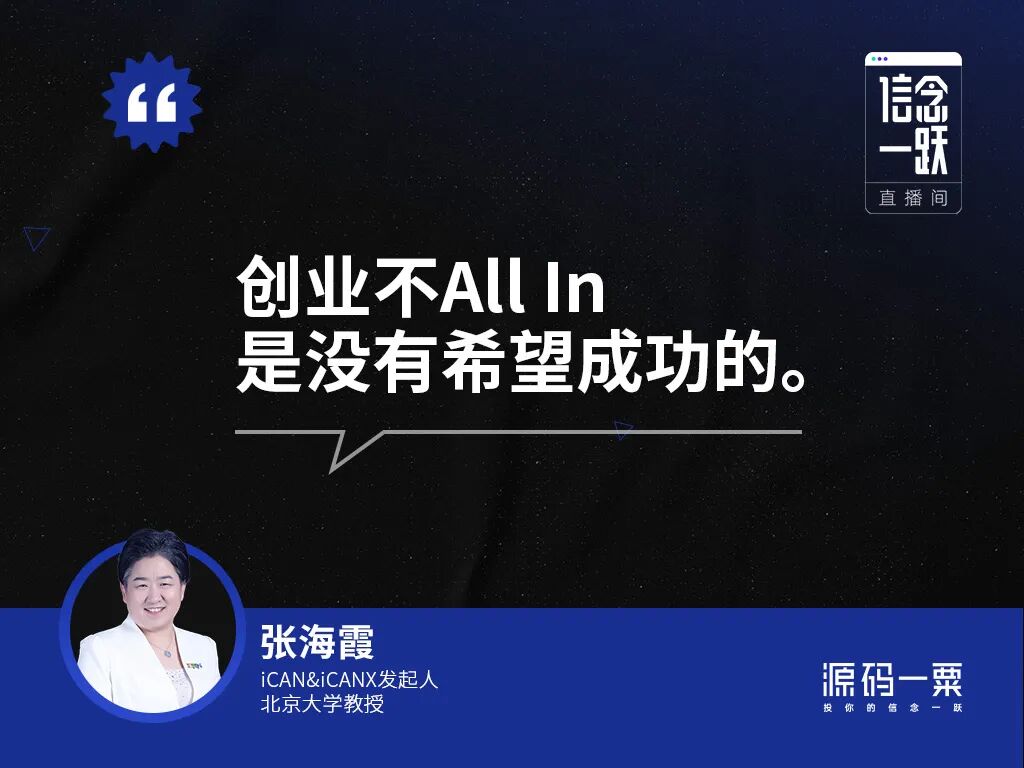
Haixia Zhang: You need to properly position yourself, because not going all-in really offers no hope. But going all-in has many forms: technology all-in, management all-in, mindset all-in, talent all-in, all-in for the first few years — these all work. It's essentially a state of full emotional investment. Because when you decide to start a company, you've already diverged from the normal path you were on before. You have to accept this; if you don't, you're trying to grasp both and ending up with neither.
Source Code Capital Xingchen Zhang: How do you view original technologies originating from China in the future, and using such original technologies to start companies?
Haixia Zhang: Over the past decades, our country's efforts have been focused on solidifying the foundation of science and technology, making the soil of technology more fertile. Once the baseline altitude of our country's scientific level rises further, large quantities of original technologies will emerge. But at the present stage, we haven't reached that position yet, so we need to continue cultivating. After cultivation, disruptive achievements and products that disrupt the world will come — this is the "fruit." All current efforts are about making the "cause" better.
Source Code Capital Xingchen Zhang: Do entrepreneurship and academia bring scientists different kinds of fulfillment?
Haixia Zhang: Scientists are excellent in their respective fields. As a scientist, fulfillment comes from peer recognition, publishing papers, having reputation within the industry. Entrepreneurial fulfillment comes from having your achievements recognized by the market. There's a popular saying in academia: if your research is good, your achievements will appear in books, recorded in textbooks; if you're even more successful, your achievements will appear on shelves, becoming products used by millions of households. Especially for engineering scientists, if their achievements can truly benefit society, they become extremely excited and moved.
Source Code Capital Xingchen Zhang: iCANX was the first to propose the term "scientist agent." What problems do you hope scientist agents can help scientists solve?
Haixia Zhang: I am personally the first scientist in the world to have an agent. My agent, Yalin, is the world's first scientist agent. Many people who want to find me first go through Yalin. I'm a football fan; my favorite player is Cristiano Ronaldo, and seeing his growth journey, his agent played a huge role.
Based on their characteristics, scientists as a group actually very much need agents. They are experts in their own fields or in ivory towers, but when facing real business society, they need people with other professional divisions to help them solve many problems — for example, negotiating terms, fighting for rights, talking about money, handling legal-related issues, reviewing contracts, building image, arranging external activities and speeches. With an agent's protection, scientists can focus on their own fields without being disturbed by unexpected matters.
Our direction of effort is to make scientists into stars, and help scientists bring value to society.
Source Code Capital Xingchen Zhang: From your perspective as a scientist, what help do you expect Source Code Capital and Source Code Capital to provide scientist-entrepreneurs?
Haixia Zhang: I hope scientist-entrepreneurs can join forces with investment institutions — scientists are the heart's original driving force, but they need to be given wings to let them take flight. Therefore, I very much hope to work together with Source Code Capital and Source Code Capital to help scientists take flight. We are still a group of people with very strong patriotic feelings. If it were just for making money, we could simply not do this. But the reason everyone works so hard is still hoping to discover good projects, be able to screen excellent technologies, unearth promising entrepreneurs, and make their success rates higher. Scientist-entrepreneurs represent the future of China's technology entrepreneurship — let us together help them succeed.


- Source Code Capital | Entrepreneurial Teams with Conviction Will Tune Out the Noise
- Source Code Capital | "Interest" Was Ethan Yuanming Hu of Taichi Graphics's "Mentor"
- Source Code Capital | I'm 28 This Year, and I've Been Working on Power Supplies for Ten Years and One Month
- Source Code Capital | Guangmi Li of Shixiang: Choosing Entrepreneurship Was My Leap of Faith
- MaHui | Power Laws — Understanding Complexity in a Non-Random World
- MaHui | Source Code Capital's Dual-Carbon Investment: Exploring New Species Through Full-Industry-Chain Layout
- MaHui | China Electric Power News Interview with Source Code Capital: Industry Inflection Point Has Arrived, Market Space Is Vast
- MaHui | Yungang Huang: How Does AI4S Land in Different Stages, Industries, and Markets?
- MaHui | Yungang Huang: "Cross-Disciplinary Intersection" Drives Innovation in Healthcare
- MaHui | Source Code Capital: The Most Needed Capability for Investing in Carbon Neutrality Is Multi-Level Cognition
For more MaHui members, click "Read Original" to view