MaHui | Source Code Rhythm's Yungang Huang: Where Are the Next ByteDance and Unitree in the AI and Robotics Era?

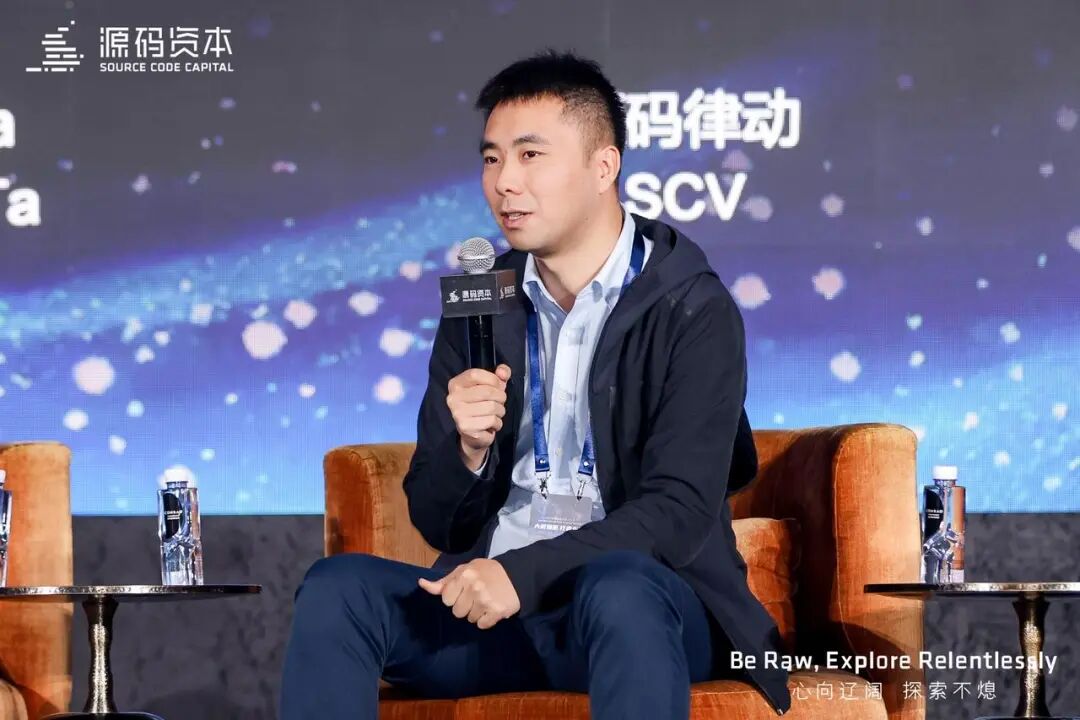
At the "2025 MaHui Investor Annual Conference" in November, Yungang Huang, Managing Partner of Source Code Rhythm, shared his understanding of China's robotics and AI industries, along with the fund's investment strategy and core methodology.
Below are the highlights from Huang's presentation:
1
Four Evolving Capabilities in Robotics and the Opportunities They Unlock
Right now, the robotics industry is caught between two seemingly opposing views: one holds that the bubble is too big and it's time to stop investing; the other argues that compared to large language models, robotics hasn't even had its "large model moment" yet — we're still in the pre-dawn hours with massive opportunity ahead. By this logic, now is the best time to enter, and everyone is more or less at the same starting line.
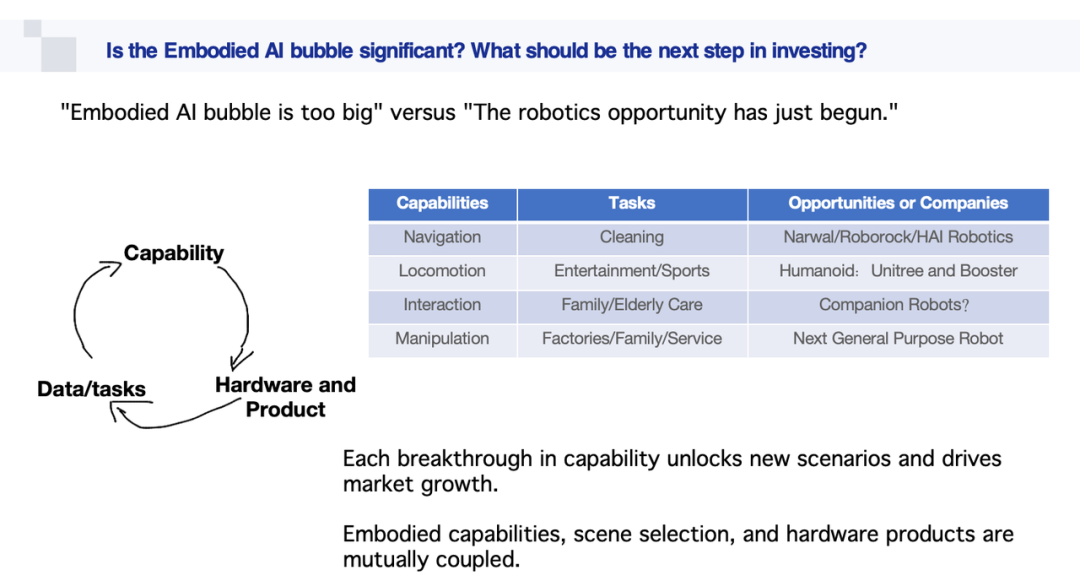
Our view sits somewhere in between. We acknowledge that general-purpose large models and general-purpose robots remain distant goals. But the technical capabilities to solve specific problems are gradually coming into place. We believe there's opportunity in identifying and backing teams that can close the critical loop: "technical capability unlocks a scenario → productization → shipment → acquisition of real-world data → feedback that improves the model."
Autonomous driving is the classic example. Cars are inherently useful, so they can be sold, which generates massive amounts of data, which in turn feeds model training and makes the system increasingly capable and mature. The same applies to robotics: without shipment volume, there's no real-world data, and without data, you can't enter many scenarios. But once you crack open even one scenario, the robot can be productized, shipped, and start generating real data — that's the closed loop.
Specifically, we track how robotics evolves across four capabilities, and what new opportunities each unlocks:
-
Navigation: iRobot existed ten years ago, but limited navigation meant poor performance — it couldn't clean thoroughly. When navigation technology broke through and floors could actually be cleaned well, penetration of robot vacuums rose, costs came down, and this enabled smart vacuum makers like Narwal and Roborock, as well as logistics warehouse robots like HAI ROBOTICS.
-
Whole-body motion control: Unlocking this capability enables large-scale applications in entertainment, sports, and education — exemplified by products from Unitree and Booster Robotics.
-
Interaction: If a robot possesses strong multimodal environmental understanding, it can already be useful in companionship and education scenarios even with limited manipulation capabilities.
-
Manipulation: This is widely acknowledged as the hardest challenge. But once key breakthroughs occur, the market opportunity will dwarf that of electric vehicles. As Elon Musk envisions, everyone may eventually need a robot.
So we continuously track where these capabilities, especially manipulation, currently stand and what specific scenarios they can unlock — then we go find the teams attacking these frontiers.
2
What Domains Might Get "Eaten" by Large Models?
In AI investing, two common opposing views also persist: one holds that large models will swallow all applications and solve everything; the other argues that you only need to track which large model is growing fastest, without worrying about moats or competition.
About two years ago, an article made a point I still agree with: a substantial portion of applications and scenarios will get "eaten" by large models, but some will remain outside that boundary.
AI Search, for instance, may get eaten because its interaction form is essentially a chat window — highly overlapping with the core form of large models. Deep Research falls into the same category. Looking further ahead, programming presents a more nuanced picture. Code completion and similar assistive features may not be fully replaced; but end-to-end code generation and delivery, with its clear task objective, is highly susceptible to being eaten by large models.
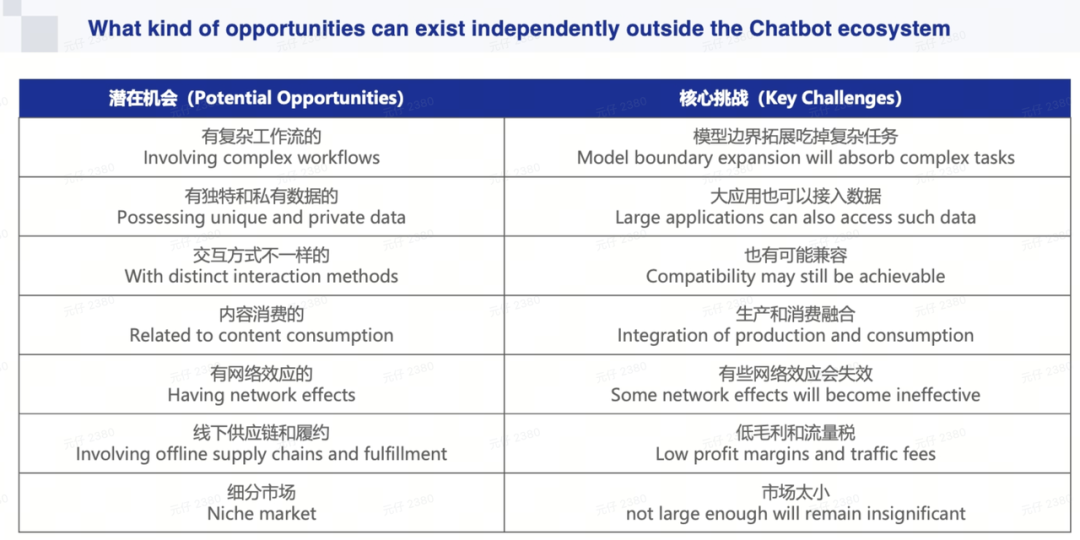
Above is a diagram I had Doubao generate, assessing what kinds of application scenarios can "escape" the吞噬 boundary of large models. For example:
- Applications with complex, multi-step workflows, especially those requiring multi-person collaboration, confirmation, and approval processes — these are harder to replace with a single large-model command than solo, linear tasks.
- Applications with unique data moats, particularly personal-data-rich assistant apps, are difficult for large models to replicate.
- Applications with distinctive interaction patterns — if the experience far exceeds a simple chat box, it's safer.
- Content consumption: Traditionally, content production and consumption were separate, and producing quality content was time-intensive. Going forward, as large models can generate content in real-time, accurately, and clearly, content platforms themselves may not need to exist.
- Domains involving physical goods movement, logistics, offline fulfillment, and real-world supply chains — certain new e-commerce models, for instance, with their heavy operations and offline characteristics, may sit outside the direct impact zone of large models.
Of course, some entrepreneurs believe that doing "corner businesses" too small for large models to bother with might be safe. But because the market may be too small, or because large models could easily expand horizontally to cover it, this isn't reliable protection. In my view, the core of large-model entrepreneurship must still be creating unique, high-value business models.
3
Early-Stage Investing Requires More Than "Backing People" — You Must "Evaluate the Opportunity"
Source Code Rhythm currently operates as a smaller, more agile team. We remain focused on AI and robotics, actively embracing global opportunities, and concentrate on two investment stages:
First, seed and angel rounds. At this stage, the team may be just one or two people, sometimes with only a preliminary business idea and no formal company yet. We're willing to step in at this earliest phase, sometimes even helping founders recruit co-founders and refine the business concept together.
Second, significant Series A rounds. By then the startup is established, with a product demo, perhaps no revenue yet or just beginning to generate modest sales. If we judge the project's potential to be substantial, we'll place our bet.
At both stages, our strategy is to lead rounds whenever possible, securing 10%-15% ownership and a board seat. We firmly believe that deep involvement — genuinely helping the company and exerting positive influence — is the optimal path both for the startup's long-term development and for building our own brand and reputation. Peers watch who Source Code Rhythm backs, which serves as a strong endorsement for the project and helps us earn deep recognition from entrepreneurs.
For specific project investments, our core methodology boils down to three principles:
-
Invest in technology-driven great businesses: Back at the earliest stage companies with the potential to become the next ByteDance, Li Auto, or Unitree. Dare to make bold bets — this carries forward Source Code Capital's investment DNA.
-
Invest in "dream-big, act-fast" entrepreneurs: We favor founders who can敏锐ly capture technological shifts the moment they occur and decisively act to combine them with user needs.
-
Weight "the opportunity" equally with "the people": Looking only at the team is insufficient. You must examine the team, the product, and the market together — only this triangulation yields a complete understanding of a business and its people.
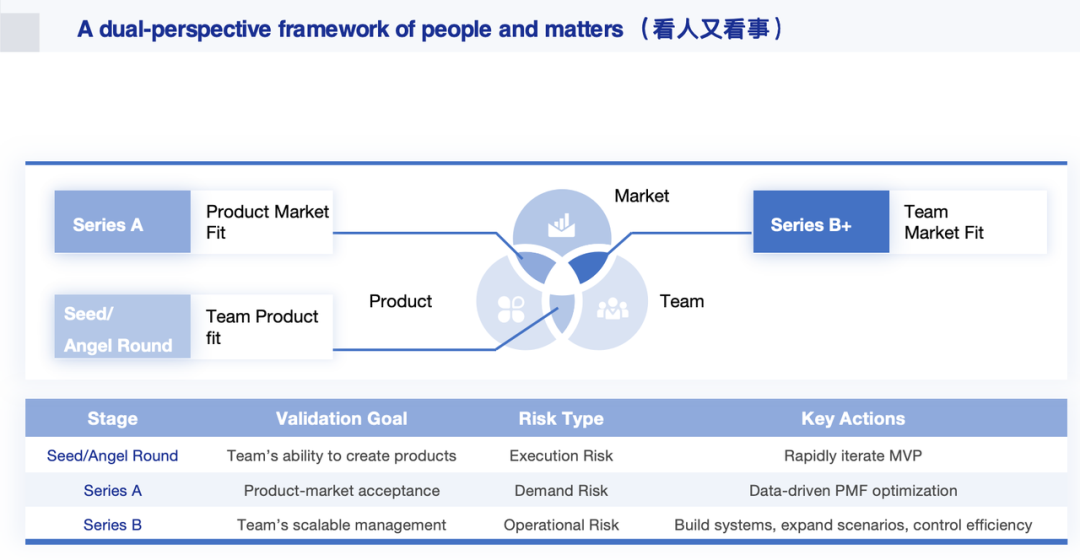
Specifically: at seed stage, you can indeed weight more heavily toward the team, with more subjective judgment — if you believe in the people, you might invest. But by Series A, there should ideally be signs of product-market fit. And for Series B and beyond, we of course want all three elements — market, product, and team — to be strong, as they form a tightly integrated whole.
This makes deep research the foundation of everything, and also the prerequisite for accurately "reading people." Investing purely on gut feeling without research — I don't think that works, at least I don't have that ability. Through deep study of a domain and business model, we can better discern a founder's depth of insight and execution capability.
Of course, for early-stage investing, desk research alone isn't enough either. Much frontier knowledge across industries must come from conversations with frontline researchers and entrepreneurs, especially top product managers at leading tech companies — not just when we're evaluating an investment, but maintaining dialogue even when we're not. So whether you can access and identify the best entrepreneur communities, and walk alongside them, matters enormously.
If you can engage with someone deeply and over an extended period, spending enough time together, that itself is an extraordinarily effective form of research and observation — you can judge whether they truly love what they're doing. We want to invest in what entrepreneurs themselves are genuinely passionate about, not entrepreneurship for the sake of success, not entrepreneurship for entrepreneurship's sake. Because we always believe that only genuine passion drives the kind of true, world-changing long-term commitment that endures.
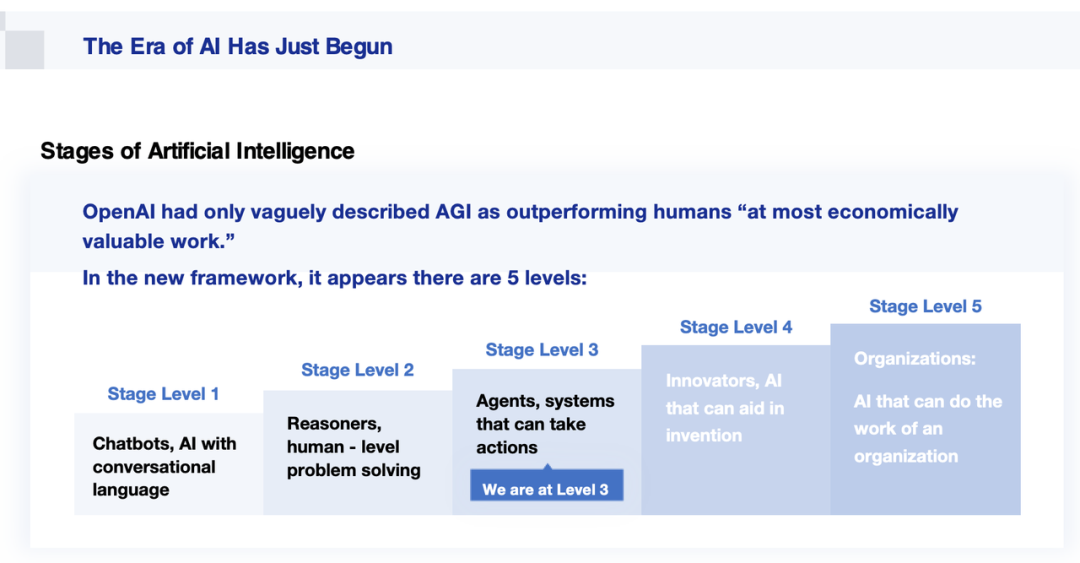
Finally, I'd like to close with OpenAI's "five stages" framework: we remain in the middle phase of AGI development, with enormous room for innovation still ahead. In this era of rapidly iterating AI technology, as long as technological progress continues, it will inevitably unlock new demands, spawn new products, and ultimately give rise to great business models. And Source Code Rhythm is committed to discovering and accompanying these future great companies from their earliest stages.