Code Class | Why Elon Musk and SpaceX Keep Bouncing Back from Failure

The Falcon 1, despite its repeated failures, laid the foundation for SpaceX's achievements today.
Of Elon Musk's well-known identities as an entrepreneur, his most famous role besides Tesla founder is founder of SpaceX. The private aerospace company, established in 2002 with $100 million of Musk's own money, set out to develop space technology, send humans to Mars, and ultimately enable interplanetary colonization — scenes and rhetoric that once seemed lifted straight from science fiction films. When people around the world first heard of SpaceX, they didn't take it seriously. But through repeated launch failures, and failures again, they gradually understood: Musk was serious.
Yet this was an extraordinarily ambitious goal. In SpaceX's first few years, it seemed as fantastical as a fairy tale. It wasn't until 2023 that SpaceX's super-heavy launch vehicle, Starship, conducted its first orbital test flight. Though it ended in failure, everyone at SpaceX was cheering during the livestream — because they knew that crewed Mars landing had been broken down into concrete objectives, and they were tackling them one by one.
From a business perspective, the questions are: How has SpaceX maintained such rapid iteration and progress through failure? How has a private aerospace company surpassed many spacefaring nations in rocket launches? And how does SpaceX tightly integrate science and commerce? From the ordinary person's view, the concerns are: Is it safe? Can it really help humanity achieve interplanetary colonization? And how much longer will it take?
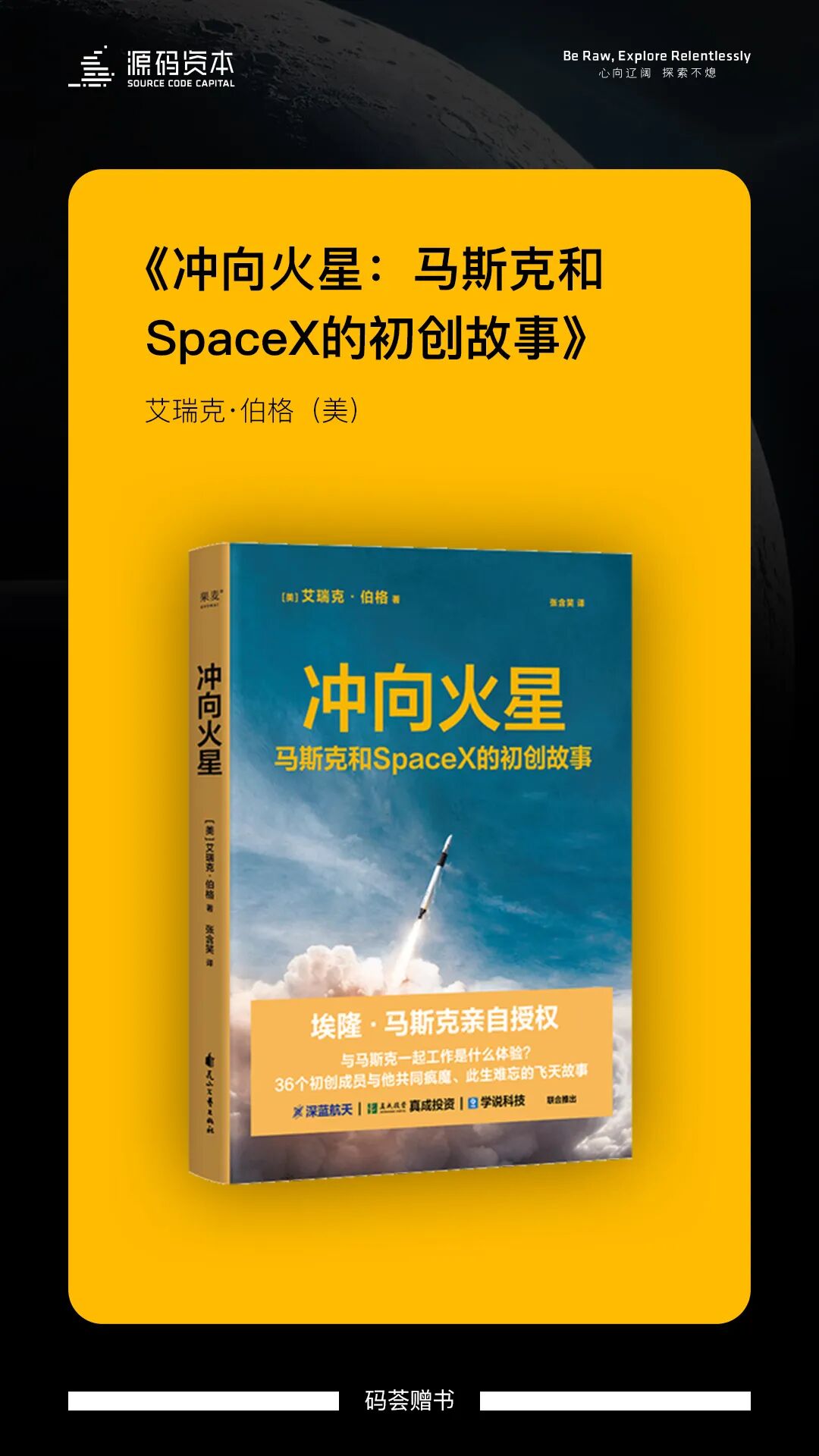
For this edition of Code Class, Source Code Capital, in partnership with Xueshuo — a professional knowledge platform incubated by Tsinghua University — specially recommends Liftoff: Elon Musk and the Desperate Early Days of SpaceX, published in June 2023.
The author, Eric Berger, is a veteran aerospace journalist who received the National Space Society's Space Pioneer Award. He began covering SpaceX in 2015 and earned Musk's trust, which is why the book carries Musk's personal authorization and endorsement.
Through extensive interviews with key early SpaceX employees and Musk himself, the book chronicles SpaceX's origins, the difficult yet remarkable early startup years, and the development of its first rocket, the Falcon 1. It captures the genuine feelings and perseverance of all team members throughout this process, and goes a long way toward explaining how this team achieved its pivotal 0-to-1 breakthrough.
There is passion and romance, but also cool-headed realism — all of it an authentic portrait of a startup team. SpaceX's success represents not just the pursuit of a spacefaring dream, but also the opening of the aerospace market to private companies. Building upon the talent, companies, and government contracts accumulated during the Space Race era, SpaceX single-handedly injected new possibilities into an industry that had grown somewhat stale. As a startup, SpaceX's unwavering commitment to its goals has earned the applause and respect of peers and observers alike.
Whatever industry you're in, you may see reflections of your own early entrepreneurial days in Musk and SpaceX, and find resonance there. We hope this book brings spiritual encouragement to entrepreneurs facing difficulties — to hold firm to your convictions and press forward through adversity.
Book Giveaway
Leave a comment below telling us why you want to read this book. Within one week of this post's publication, the three commenters with the most likes will receive a copy of Liftoff: Elon Musk and the Desperate Early Days of SpaceX from Source Code Capital.