Climber Summits Mount Everest with Peking University Mountaineering Club

Mountaineering and entrepreneurship are both acts of faith — gazing up at the stars, surviving against nine-to-one odds.
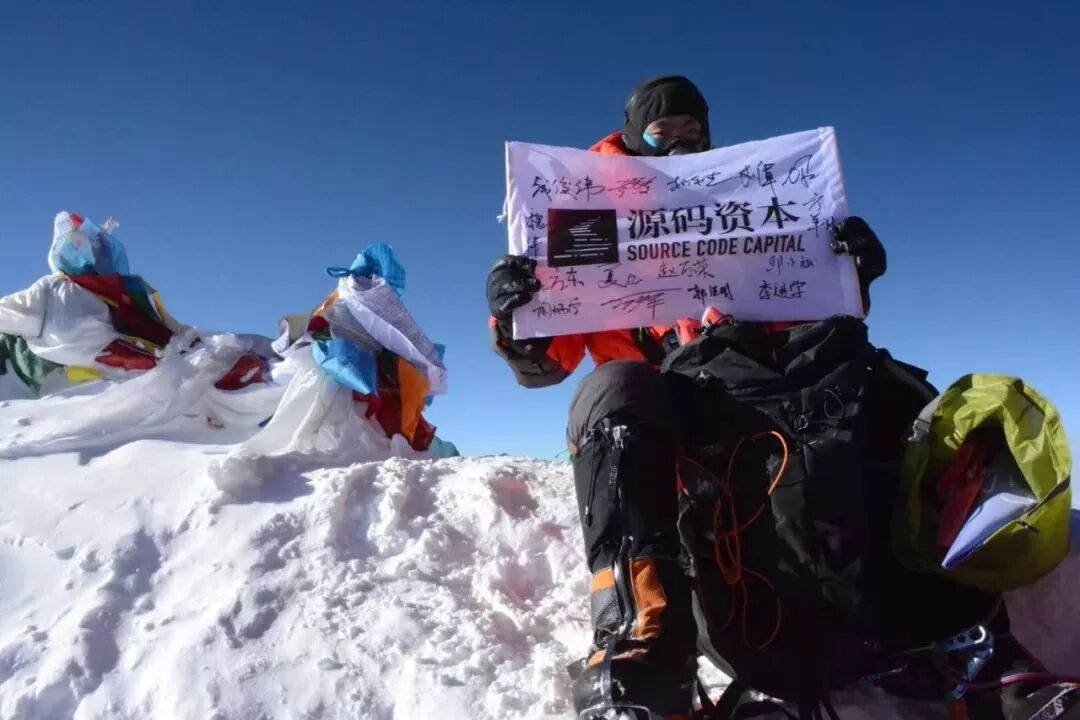
Wanrong Zhao is currently an analyst at Source Code Capital. He joined the firm in 2018, focusing on industrial internet and consumer sectors. Wanrong Zhao holds a Master of Finance from Peking University's Guanghua School of Management (Class of 2016). He served as the 29th president of Peking University Mountaineering Association (Shanying Society) and was captain of the student team for the 2018 Peking University Everest Expedition.
On May 15, 2018, Wanrong Zhao successfully summited Mount Everest together with his Shanying teammates. He has led expeditions to nine high-altitude peaks, including Geladandong in Qinghai, Xuebaoding in Sichuan (west face direct route), Cho Oyu in Tibet, and Mount Everest.
Contact: zwr@sourcecodecap.com
Wanrong Zhao's Climbing History with Peking University Shanying Society:
- May 2018: Mount Everest (8,844.43m) — summited
- January 2018: Siguniang Shan Third Peak (5,355m) — summited
- October 2017: Cho Oyu (8,201m) — summited
- May 2017: Everest North Col — summited at 7,028m North Col camp
- July 2016: Chomolhari Kang (7,054m) — reached 6,700m
- January 2016: Xuebaoding (5,588m) — reached 5,880m via west face route
- July 2014: Geladandong Peak (6,621m) — summited
- January 2014: Xuanwu Peak (5,390m) — summited
- July 2013: Kizilsu Peak, Xinjiang (6,525m) — reached 6,200m
Dedicated to the successful summit of the world's highest peak, Mount Everest, at 8:22 AM on May 15, 2018, and to the Third Goddess.
1
Origins
Before I knew it, I had spent six years on Peking University's campus — more than a quarter of my life so far. I couldn't help but feel a deepening reverence for this century-old institution. And if I were to say that the most profoundly influential "extracurricular activity" during these six years of higher education was mountaineering, it would surely have far exceeded anything I imagined when I first arrived at the Red Building.
But fortunately, I ended up climbing nine high-altitude peaks (above 5,000m) across four provinces while at Peking University, and finally summited the world's highest peak, Mount Everest, at 8:22 AM on May 15, 2018, and even managed to trick a wife into coming home with me — so in one sense, I ultimately lived up to the reputation of China's premier university, and in another, I suppose I inherited the freedom and romance of those who came before.
Rare footage of Wanrong Zhao proposing to his girlfriend on the summit of Everest
They were also the first couple to get engaged on the summit of Everest
Over six years, I can hardly claim any extraordinary insights about mountaineering, but I have spent these years thinking about what climbing means and why we climb; constantly reflecting on why I kept going back to the mountains. Additionally, through this Everest expedition and its preparation, I worked closely with outstanding Peking University alumni including Huang Nubo, Li Wei, Cao Jun, Yang Dongjie, Qiu Xiaobin, and Wang Hui, and learned a great deal from each of them. Combined with fragments and gratitude from my own years, these thoughts became this piece.
This article totals 5,287 characters, estimated reading time: 30 minutes.
2
Shanying
Joining the Shanying Society was a pure coincidence. In high school, after finally securing my admission recommendation, I researched what fun clubs Peking University had to offer, and during my freshman year, I found and signed up for all of them at the annual club fair. As a first-year student, I was quite mischievous — I skipped almost all the beginner activities and instead hung out daily with a few old friends from high school at the university next door, or attended various freshman dances between the two schools. I had completely forgotten about the clubs I had so carefully planned to join. It wasn't until just before the October holiday that I finally came to my senses and remembered. As it happened, that day at noon I received a text message inviting me to a field activity. From that point on, there was no turning back — once you enter Shanying, it's as deep as the sea. I had effectively added a "Shanying dual degree" with the heaviest coursework load to my college life. The climbing team holds many beautiful memories, but beyond those, there are always a few moments that touch the soul.
Keep the eagle's heart in the heights, Take the eagle's ambition to soar above the clouds, Learn the eagle's nature to brave dangers, Merge the eagle's spirit at the mountain's summit.
— Shanying Society Spirit
During the 2014 expedition to Geladandong, the highest peak at the source of the Yangtze River, I was the climbing captain of Shanying Society — the person responsible for all route-fixing and climbing-related matters. On the day we fixed ropes for the summit push, my partner and I fixed nearly 2,000 meters of rope. Finally, we reached the base of the most difficult section: a steep snow slope.
A 70-degree snow slope loomed above us, and it happened to be my turn to fix this section. The pride of being climbing captain welled up, and everything was going smoothly. All the rope-fixing team members were watching me climb in silence behind me. The entire valley was quiet, with only the rhythmic "crunch crunch" of ice axes and crampons echoing through the mountains. Suddenly, halfway up this 30-meter slope, wearing goggles with poor coverage, I found myself experiencing snow blindness — everything went completely dark.
I was genuinely frightened by this symptom and quickly began looking for ways to build an anchor mid-route. But unfortunately, on this steep snow slope, it was impossible to exert force properly. Vertical snow stakes were basically impossible to place, and the hard snow layer was too thick to dig through for ice screws. The idea of stopping to handle the emergency was shattered. So it was either up or down. But when I looked down, two people were hanging from a short ice screw belay station protecting me, and four rope-carrying team members were at the next short ice screw station below them. Going down was clearly impossible — too dangerous — and I absolutely could not fall, because neither of the two lower protection points was particularly reliable (since we hadn't bivouacked there, none were truly trustworthy). A fall at this moment could bring uncontrollable risk to the entire rope-fixing team. So I had to push upward, through the final 10 meters of steep snow slope. Fortunately, I discovered my snow blindness was still mild: if I focused on one spot for 5-10 seconds, I could roughly make out the situation.
Using this meager vision, I ultimately made it through the final section without incident, completing the rope-fixing task. When I finally secured the route rope at the top of the snow slope and was safe, I realized I had broken out in a cold sweat. I collapsed onto the snow slope, sitting there for a long time before finally recovering.
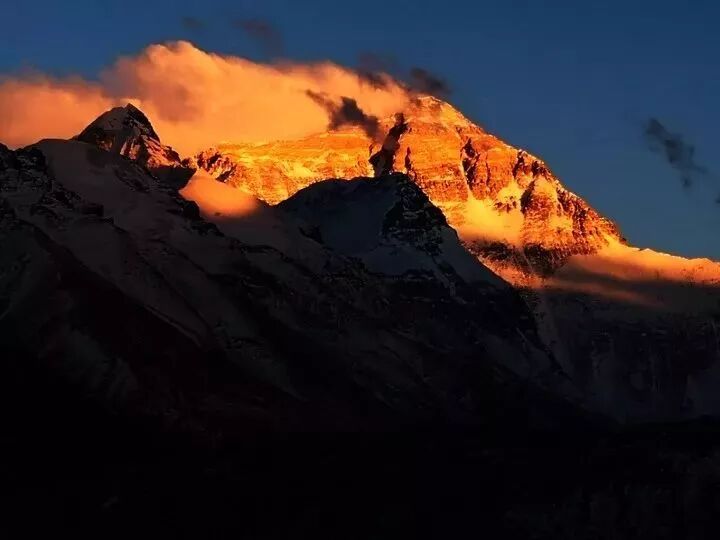
Photo: Everest at 5,200 meters
3
Life
The word "life" carries deeper significance for Peking University and for Shanying Society. In 1999, Shanying Society organized its first women's climbing team, and one senior sister forever remained on Xuebaoding Peak in Sichuan.
In 2002, five Shanying Society members were buried at the foot of Shishapangma West Peak. And as early as 1960, when China's national mountaineering team first challenged Everest and conducted mountaineering scientific expeditions, people from Peking University contributed greatly.
The renowned Peking University professor and "Father of Glaciology," Professor Cui Zhijiu, lost his fingers during a climb. And the young meteorology teaching assistant Ding Xingyou forever remained on Gongga Peak.
In Shanying Society's early days, and in the early days of Chinese mountaineering, the lack of objective and material conditions led to numerous safety incidents. But Shanying Society did not abandon its forward march because of these difficulties and setbacks.
On the contrary, starting in 2003, Shanying Society introduced a summer climbing model centered on mountaineering training, gradually bringing risks under control. To this day, Shanying Society has continuously refined its climbing training model. It now has a very complete operational paradigm for snow mountain entry and experience. And this Everest expedition, I feel, was also a declaration — a declaration that this society will never be easily defeated by difficulties.
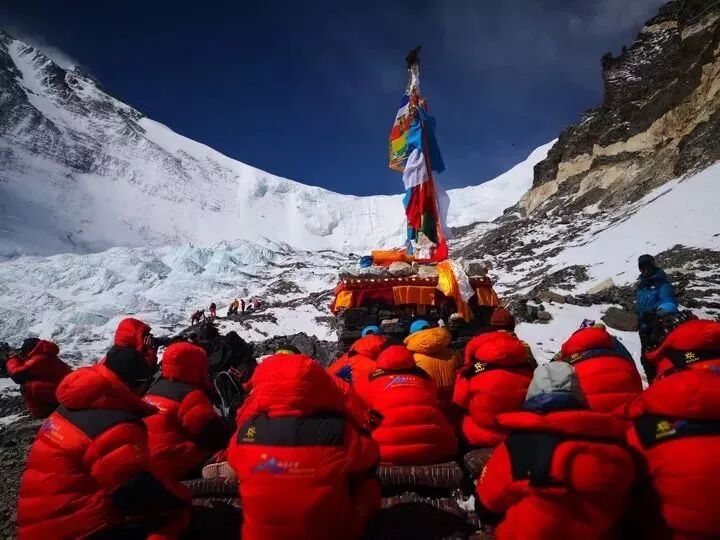
Photo: Everest at 6,000 meters
4
The Summit
Everest was actually the ninth snow mountain I had climbed. Before the climb, I didn't really expect this mountain to be any different from the previous eight. But when I reached 8,300 meters and continued upward, I truly understood what it means that "the boundless scenery lies at the perilous peak." Yes, Everest above 8,300 meters is a completely different mountain. Below 8,300 meters, no matter how many hardships or unexpected situations I encountered.
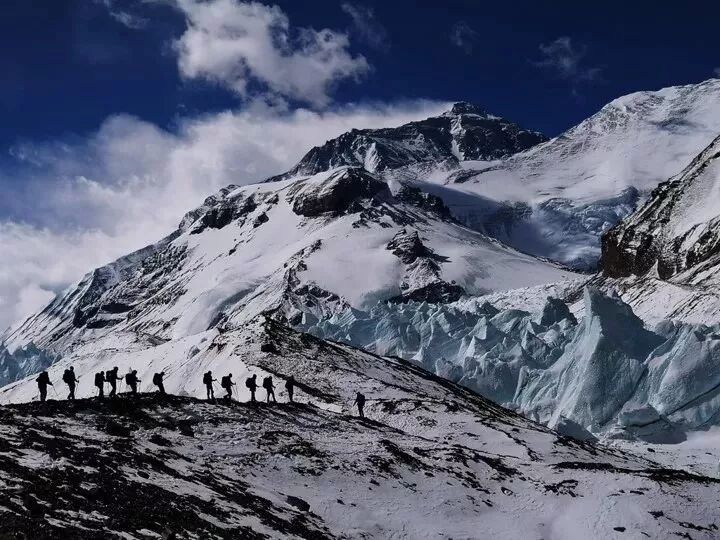
Photo: Everest at 6,000 meters
From a terrain perspective, it was nothing more than walking up a steep rock slope or snow slope — fundamentally no different from a 6,000-meter peak. But above 8,300 meters, the terrain was more like advancing along the slope of a steep right-angle triangular pyramid. The essence of this monopoly was actually treading out a traversing path on this steep slope. Walking on this narrow path barely wide enough for one person, with the summit to my right was a roughly 70-80 degree steep snow or rock slope. If I wasn't careful and stepped on loose snow along the route, I would slide down this steep slope until the rope suddenly tightened to catch me. And to my left was generally a rock/snow wall 1-2 meters above my head, but sometimes when walking beside the rock, I would discover that the left side was actually an unfathomable abyss — a sheer vertical drop.
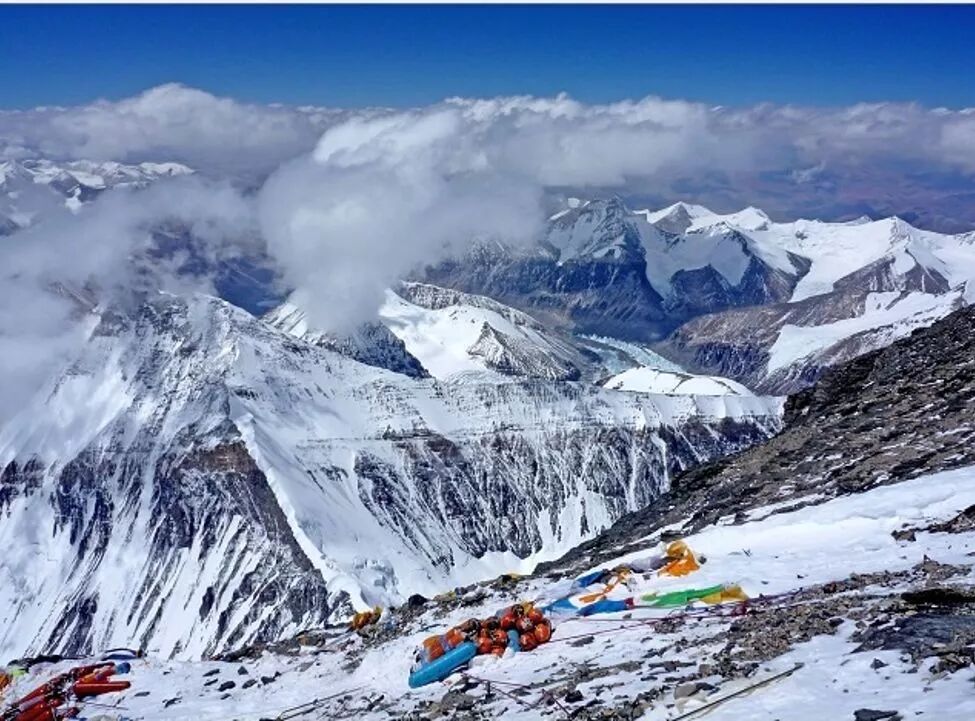
Photo: Camp at 8,300 meters
As you can see, traversing upward along Everest's Southeast Ridge, the average slope is relatively gentle, but encountering steep sections, the difficulty of rock passages is particularly severe. Especially at the famous First, Second, and Third Steps, almost all sections required climbing with both hands and feet. And below the famous Second Step, because the smooth rock slab was simply too difficult to climb directly, three ladders totaling several sections were installed on the route. Due to extreme fatigue on the mountain, if my body leaned even slightly away from the ladders with my center of gravity outward, it became exhausting. Especially during descent, I pressed my entire body tightly against the ladders, using only peripheral vision to glance at where to place my next step. Every step outward was uncertain; probing for each step's position was a challenge. And when I finally reached the top or bottom of the ladders, I would often wake from a dream-like state to discover that I had been breathing so faintly from tension that I would immediately start gasping for breath — for a moment, it really felt like I had snatched my life back from the gates of hell.
Before coming to Everest, I had always seen reports saying that commercial mountaineering mainly relies on guides and anyone can summit, and I had even heard rumors that Wang Shi was carried up Everest. But only after truly experiencing the sections above 8,300 meters did I realize that here, you can only rely on yourself — it's virtually impossible for others to provide any substantive help.
The route can only accommodate one person at a time. And when recalling the rescue scenes from 2013 and earlier at 8,300 meters, no matter how many guides were around at the time, they could help carry things and manage equipment, but what they did most was encouragement. Because they deeply understood: when a person gives up on moving themselves, no matter how many people are around, there's no way to get them down. They must not give up on themselves before those around them give up on them — they must stand up and continue forward.
Beyond the route, the weather on summit day starting from 8,300 meters was another major challenge. I remember checking the conditions before departure: the lowest temperature on the 15th was minus 26 degrees Celsius, and with wind chill, it felt like minus 40. Clearly, the wind was fierce that day. Indeed, some small issues appeared right from the start. Some teammates from the alumni team, because the wind was so strong, mistakenly thought departure would be delayed, and ultimately left their tents half an hour late. And when we students departed one hour after the alumni team, we immediately felt the wind's pressure.
I myself encountered wind trouble right from the start. At first, it blew so hard my eyes hurt — I basically couldn't keep them open after two steps. When it became unbearable, I put on my snow goggles, and the protective layer outside my eyes felt much better. But I quickly discovered my vision was becoming increasingly blurry. Indeed, when using oxygen masks above 8,000 meters especially, breathing is rapid and produces large amounts of hot air, which quickly condenses when it meets the cold goggles. But this is also a common problem in climbing and skiing. In this mountain environment, I didn't think much of it and immediately started using the usual method from flat terrain: breathing on them to melt the small water droplets on the surface, then wiping with thin gloves to clear them. But I quickly discovered that after breathing a large amount of water vapor onto them, it immediately frosted over on the goggles. Now it was worse — instead of half the goggles being obscured, I couldn't see anything at all. Putting away the snow goggles, I switched to sunglasses, which at least provided some coverage. But I immediately found that sunglasses worked even less in this environment. Wind blew through the gaps around the sunglasses, bringing in large amounts of snow particles, and the sunglasses quickly became white "snow goggles." Helpless, everything returned to the starting point — continuing with naked eyes, constantly squinting to reduce snow particles blowing into my eyelashes, immediately lowering my head whenever there was a moment's rest, minimizing contact with the fierce wind as much as possible.
5
Awe
After walking with my head down in the fierce wind for four or five hours, I weathered the storm and was finally about to see the sunshine after the rain. From around 6 AM, passing the Third Step, I could see the distant horizon faintly glowing blue. Gradually, the distant sky transitioned from blue to pinkish-gold — the splendor of colors was truly like something from Photoshop, as if God were constantly experimenting with bizarre and fantastical colors.
Filmed on the summit of Everest
But what was truly incomparably awe-inspiring was the Everest reflection on the other side of the sunlight. Visible only for about ten minutes after sunrise, a massive triangular reflection suddenly emerged among the distant mountains. For a brief period, the top of this triangular reflection happened to intersect with the skyline/horizon. For a moment, I felt something like looking down upon the world from above. As they say, the boundless scenery lies at the perilous peak — and I often heard that some climbers feel a great awakening after reaching the summit, probably moved by scenes like this.
In that instant, it felt as if time had stopped. There was no need to understand any connection with society or other people — I only needed to focus on my connection with nature, and my heart became much calmer. I had previously heard Senior Brother Huang Nubo describe feeling a great awakening at the summit, even somewhat wanting to stay there with those who forever remain on the mountain, quietly accompanying the Third Goddess.
Though my realm had not yet reached the point of understanding this feeling, looking back, the moment I saw the Everest reflection was probably when my state of mind was closest to this successful senior brother's.
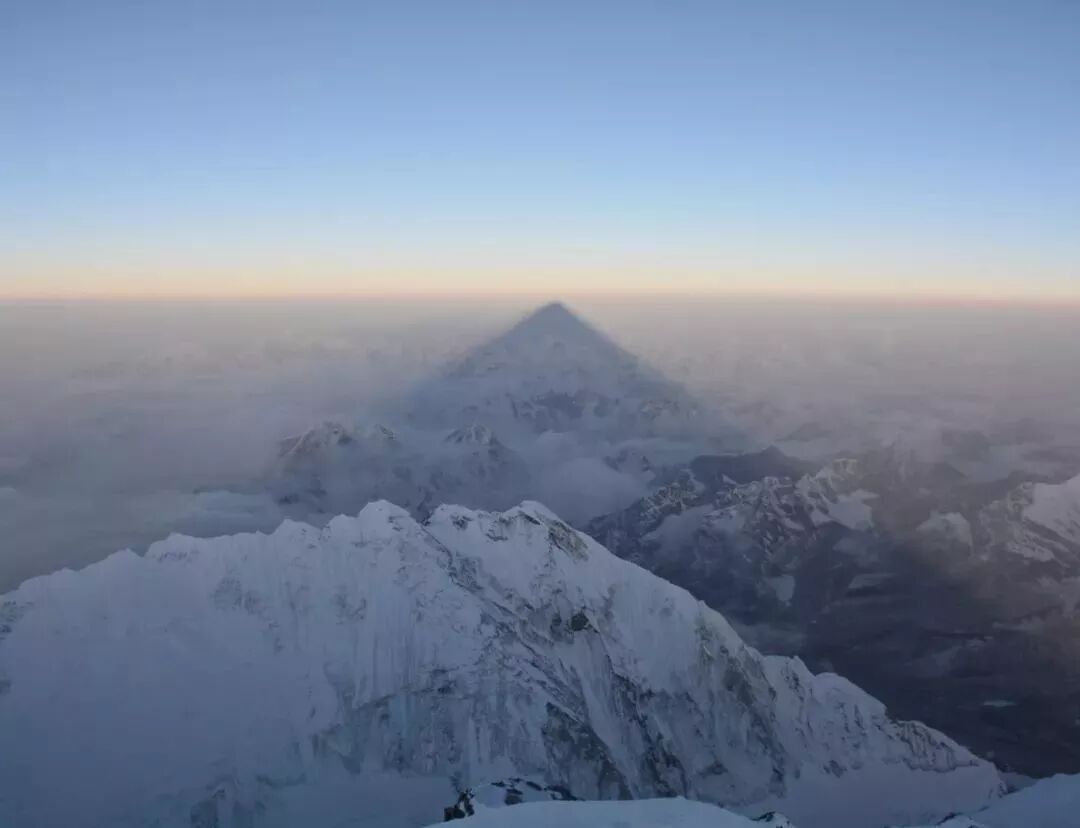
Photo: At 8,800 meters — the Everest reflection on the horizon seen after summiting
Reverence
When climbing, you can empty yourself and simply feel your relationship with the mountain and nature. You quickly discover and realize your own insignificance before nature, and once you recognize this, you only become more reverent toward nature, while simultaneously becoming fearless in facing anything.
And this devotion and reverence, I believe, was also one of the keys to this successful climb. Tibetans have a unique mountain deity worship ceremony — weisang (burning juniper).
Before each climb, monks are invited to chant scriptures and pray — for the mountain deity, for the climbers, for all living beings in the mountains. During our expedition, we even invented a Peking University-style prayer — picking up trash. After each weisang ceremony, we would do a major cleaning of garbage around the camp. And during each ascent and descent, we would clean garbage along the route, conveniently bagging trash by the roadside. We also established two temporary garbage stations along the Everest route to facilitate transporting garbage collected on the mountain. Perhaps this devotion and unique way of honoring the mountain deity moved the mountain deity. From Cho Oyu to the present, across four weisang ceremonies, each time we witnessed massive solar halos enveloping the peaks. Each time I marveled at this natural wonder, I would privately smile with satisfaction: yes, the mountain deity must be welcoming our arrival.
People often ask me what the most important factor was for this successful Everest climb. If I had to choose the words that best capture my true feelings, they would come from a senior who left deep marks on both Peking University and Shanying Society: Peking University taught me to look up at the stars; Shanying taught me to keep my feet on the ground. These two clichéd phrases were actually my most profound feelings this time.
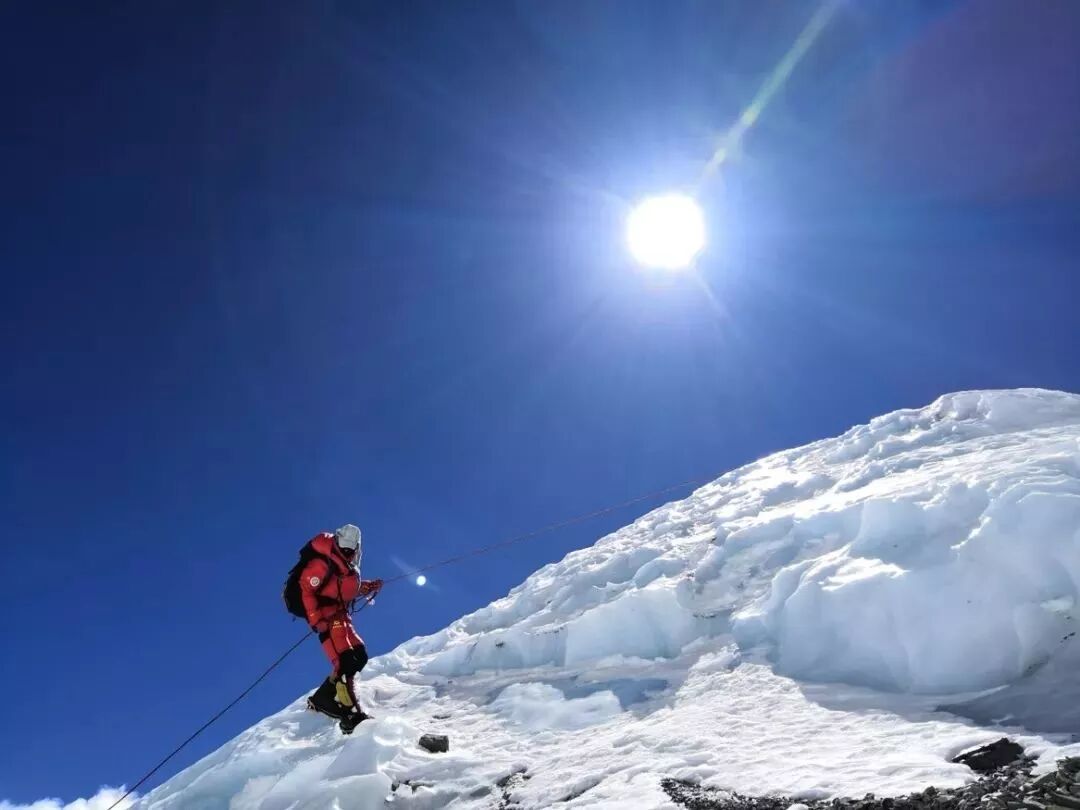
Everyone Should Summit Once in Their Life
As it happened, nearly all the alumni who participated in this climb were either in investment or running their own businesses, including founders of US-listed companies, second-largest shareholders of A-share companies, and many other successful alumni.
And most of these alumni encouraged us to consider starting our own businesses. Looking at those who frequent climbing circles, entrepreneurs are also the majority. Thinking back carefully, I believe this has much to do with mountaineering itself.
Mountaineering and entrepreneurship are both a kind of faith, a kind of fearless courage — this is what they call looking up at the stars. They both even more require practical action, whether before or after, a kind of attention to every detail, a narrow escape from death — this is what they call keeping your feet on the ground.
People often feel they've become completely clear-headed after descending from a mountain — this is precisely because mountaineering resonates with previous experiences, bringing sudden enlightenment. And those who have experienced mountaineering, having had this transcendent experience, can actually see many things more thoroughly, more clearly, and are better able to let go. I believe they will certainly be a more resilient group of people.
No matter the field, setting a goal and working toward it is a precious treasure. When you're young, you must climb a real mountain.

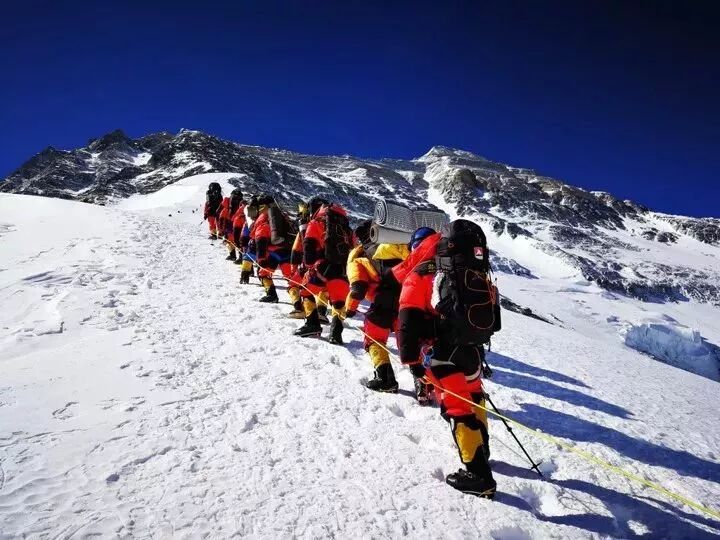

Source Code Capital
Creating Lasting, Real Value

WeChat ID: sourcecodecapital
More professional content
Follow our official WeChat