Talk to Future Founders: You Can Practice Deliberately Like This

Curious enough to ask, diligent enough to find the answer.
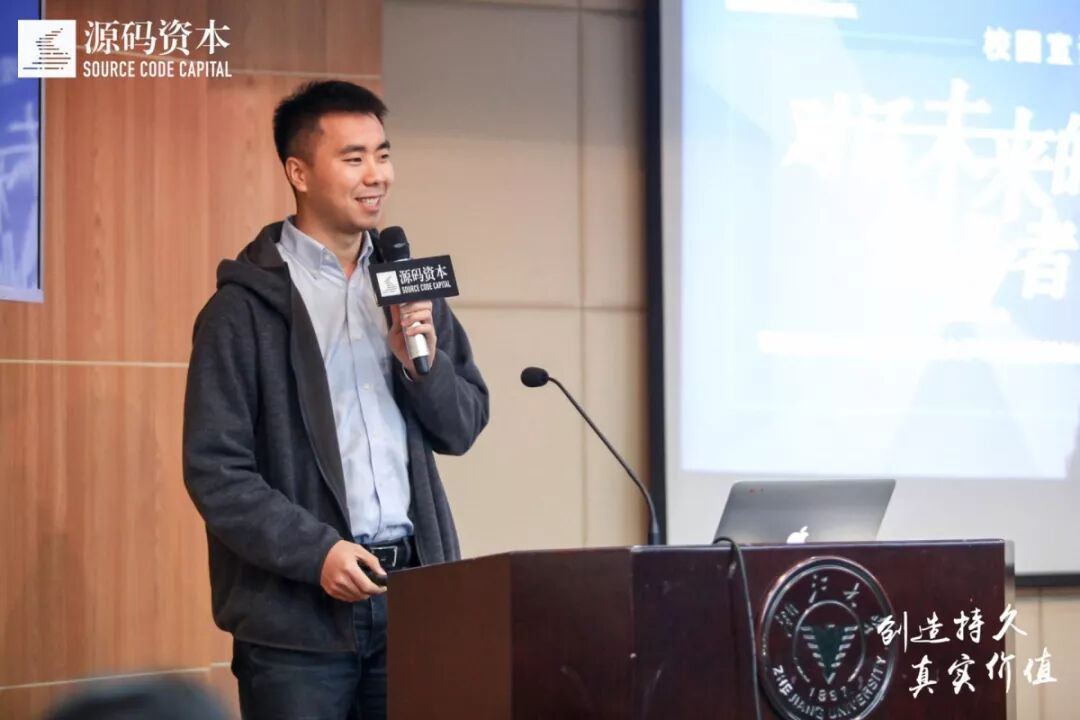
Yungang Huang, a partner at Source Code Capital, returned to his alma mater Zhejiang University to share nearly a decade of investment insights with students — his first time doing so.
His talk was titled "A Conversation with Future Founders." Zhejiang University has a strong entrepreneurial spirit, and Huang has been called both "the investor who backs the most Zhejiang University founders" and "the investor who understands founders best."
Huang said that whether you choose employment or entrepreneurship, the choice itself matters. You can build a small business, or you can start a startup that grows into something massive.
Success requires deliberate practice: staying aware, thinking deeply, and controlling your emotions. Be curious enough to want to know, but diligent enough to find the answers.
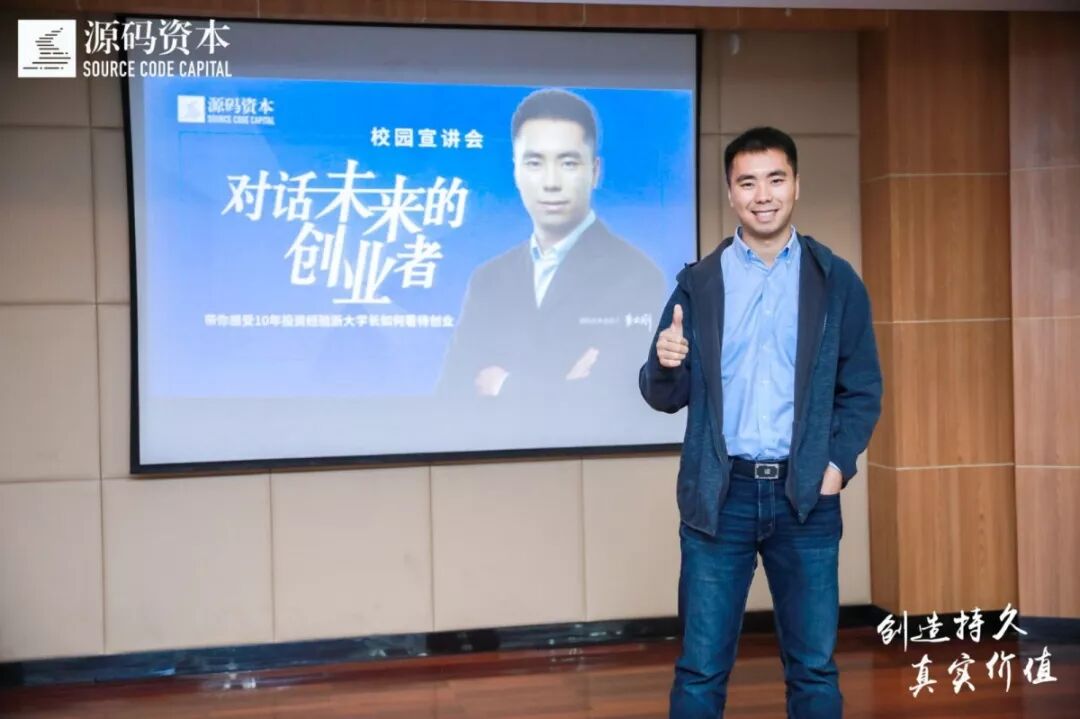
Mr. Huang joined Source Code Capital in 2017. He is a seasoned expert in corporate strategy, organizational structure, talent acquisition, market planning, and corporate financing. He has a deep understanding of how the internet and new technologies are penetrating and transforming industries, with particular expertise in marketplace businesses. In 2018, he was named to 36Kr's "Top 100 Most Founder-Friendly Investors in China" and "Top 10 Investors in China's Online Education Sector." He brings ten years of investment experience, having previously served as Managing Director at Matrix Partners China. Mr. Huang graduated from Zhejiang University with one of the nation's first master's degrees in entrepreneurship management and a bachelor's degree in management.
Speaker: Yungang Huang Editor: Source Code Capital
Quotes:
- When a founder hits difficulties, a low point, I hope that when they pick up the phone, the first person they call isn't their spouse, isn't their co-founder — it's me.
- "The investor who understands founders best" is a label others have given me, and one I've always pursued.
- No matter what time of night, getting a call and fighting alongside a founder — that's the state I enjoy most.
- How do you develop deep thinking ability? I believe it's "being curious enough to want to know, and diligent enough to find the answers."
- Excellent CEOs share several traits: long-term thinking, truth-seeking openness, and execution focus.
The full text of Yungang Huang's talk:
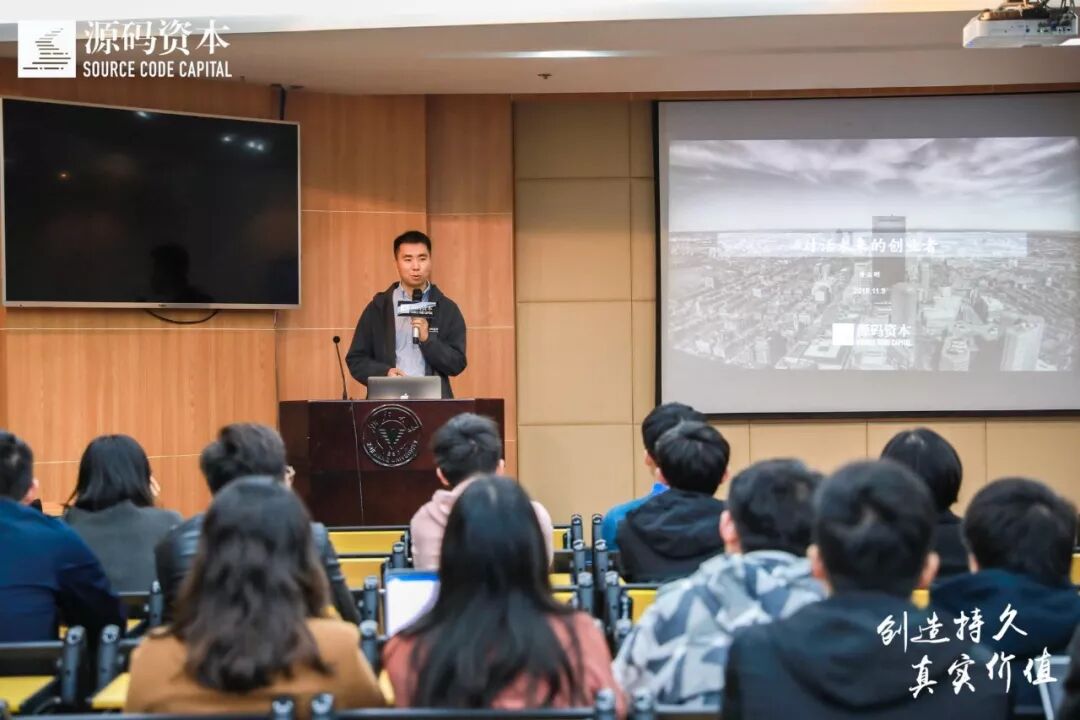
One: Beginning with "Seeking Truth"
Good evening, everyone. Walking into Yongqian Building just now, I was reminded of over a decade ago, when I came here with my resume to attend a recruiting presentation, watching seniors speak on stage. I felt quite happy then. In 2009, I began engaging with the internet and investment industries — roughly ten years ago now. Back then, the phones people mostly used were models like the Nokia E63 and N95.
I started working in investment right after graduation. When founders asked what year I graduated, I was embarrassed to say, afraid they'd think me too young. Today, when many founders ask me the same question, I'm still embarrassed to say — afraid they'll think me too old. Internet founders now are mostly post-90s and post-95s, getting younger and younger.
Why share "A Conversation with Future Founders" today? Imagine that in five or ten years, you might embark on the entrepreneurial path, or join a startup. If we could "time travel" back from that future to today, how would you make decisions, plan, and understand entrepreneurship? I hope to offer some valuable perspective.
When I attended campus recruiting presentations back then, no VC ever came to present — because VC was an extremely niche industry.
The past decade's massive growth in the internet industry also brought massive growth to VC. From the first VC entering China over 20 years ago, through the wave of VC firm founding and prosperity from 2005 to 2008, the past ten years have been a period of even greater expansion. Now VC is a pillar supporting China's startup market.
Do you know what SINA Corporation, Sohu, and NetEase were worth around 2004–2005? Look at today's BAT, Meituan, and ByteDance. The internet has not only transformed market capitalizations but has profoundly changed everyone's lives, generating deep impact and value.
Source Code Capital was also an early investor in ByteDance and Meituan. The valuation growth and development speed of these two companies would be unimaginable even in Silicon Valley. China's new economy, information technology industry, and investment industry are exceptionally prosperous. Many of you probably didn't experience the "hundred-group war" era — that history was spectacular and sweeping. I encourage you to learn about it; it will help you more deeply understand the evolution of China's internet landscape.
Two: How to Invest in the Next Kuaidi Dache
Zhejiang University's motto is "Seeking Truth." When I was studying, I didn't feel particularly deeply about those two words.
I graduated from the School of Management in 2008 and began working in investment. Gradually, especially when doing value investing and discovering excellent founders, I've increasingly appreciated how important the spirit and "way of thinking" of "seeking truth" truly is.
You'll find that excellent founders all possess "truth-seeking pragmatism" — the ability to penetrate to the essence and see the underlying logic of business.
I invested in ride-hailing (Kuaidi Dache) starting in 2013, then examined many other industries or companies being transformed by the internet.
Have you considered that portals, mobile games, e-commerce, ride-hailing apps, food delivery platforms, financial payments, and knowledge-based payments actually follow a timeline?
It began with portal information, then games, then e-commerce flourished. Ride-hailing apps emerged in 2013 and became widespread in 2014. Food delivery platforms saw large-scale subsidies and real growth in 2014–2015. Internet finance was 2014–2016.
The overall evolution moves from simple to complex. From very simple industries, from high-frequency to low-frequency, from simple decisions to complex decisions. Reading news is easy — it doesn't require much transformation. But doing food delivery means penetrating restaurant merchants and affecting an entire industry chain.
Every industry requires deep study of its development patterns.
In secondary markets, there are many star analysts covering energy, automotive, and other sectors. But it's hard to find truly strong analysts for the internet industry because it develops too fast, changes too much — every three months, six months, a year brings major shifts.
Therefore, we need to experience products as users, feel the service flow, understand the underlying logic, and figure out the business model. Without predecessors to learn from, deep thinking and research capabilities become extremely important.
After graduation I went to Beijing, didn't stay long, and soon moved to Shanghai. I often took the high-speed rail from Shanghai to Hangzhou to see projects and meet founders. Sometimes I'd walk through campus; sometimes I'd even schedule meetings at Zijingang or Yuquan.
I invested in many companies then, and Kuaidi Dache's founding team included quite a few Zhejiang University alumni. You could say I was the investor who rode high-speed rail the most at that time, and also "the investor who backs the most Zhejiang University founders."
"Empathizing" with founders means knowing from the heart that entrepreneurship is genuinely hard. Those who haven't experienced it don't know the ups and downs — there are peaks and valleys, and it's easy to get inflated at the peaks. When I began to excel, I felt good about myself; when inflated, I'd make mistakes. As an investor, you need to remind founders when they're inflated: don't get too self-congratulatory, you're still far from the goal.
When a founder encounters difficulties, a low point, I hope that when they pick up the phone, the first person they call isn't their spouse, isn't their co-founder — it's me.
This afternoon, before coming here, I met with a founder. He's been at it for over a year, working very hard, and gradually realized this industry is very difficult to do, with strong competitors. He feels it's very hard, maybe impossible to continue.
He can't tell his co-founders, because as CEO, saying the project might fail would cause the team to lose heart. On one hand he needs to show co-founders and employees that there are no major problems; on the other hand he's still trying to solve problems. He chose to talk to me. I'll listen to his struggles in the low point and help him through it. "The investor who understands founders best" is a label others have given me, and one I've always pursued.
No matter what time of night, getting a call and fighting alongside a founder — that's the state I enjoy most.
Three: Small Business or Startup
Whether you seek employment after graduation or start a company, choice is extremely important. What market you choose represents how much opportunity you have.
This is a diagram we often show people — the "Three Horizontals, Nine Verticals" investment map summarized by Source Code Capital founding partner Yi Cao.
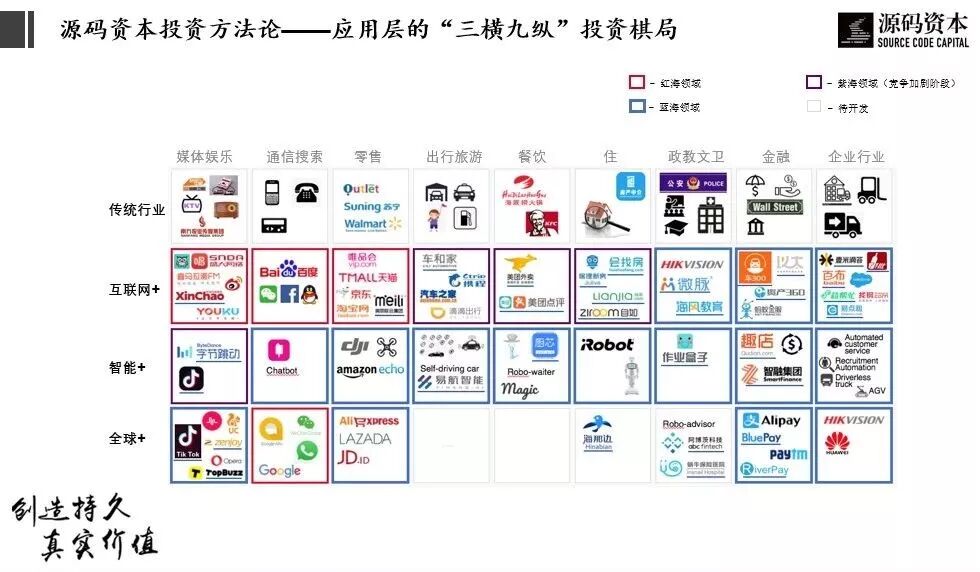
You can see the verticals: media, entertainment, communications, retail, transportation, dining — various industries have already transformed. For example, today in education many new companies are emerging, with new supply appearing. "Internet+," "AI+," and "Global+" are all profoundly changing these industries and creating new product and service formats. Every cell is a market.
The red areas — portals, search, social, e-commerce — these are truly red oceans where giants already exist and keep growing. Whether new companies have opportunity there may be quite difficult.
Overall, our investment framework believes that information technology will transform every industry. The timing of transformation varies, the speed varies, and the individual companies created in different cells will vary in size.
The bun shop downstairs is also a business, but is it the market you want to choose? Think about it.
In February 2015, Kuaidi Dache and DiDi merged. On one hand I felt somewhat dejected, even sad, but after the merger there was less mutual consumption and more focus on providing better service to users, which brought some comfort.
Later I was chatting with the COO, who said something that left a deep impression. He said, "Actually we put in 200% of others' effort and got 2000% of their returns. Why? Not because we're excellent, but because the path we chose was a fast lane."
How should you make choices?
Source Code Capital's slogan is "Create Lasting Real Value" — this is how Source Code people work and invest. We invest in and do things that create genuine value, and real value.
The best industry choices and investment choices have three elements:
First, create real value. Many CEOs, when starting companies, choose industries with no real demand — often purely imagined demand.
Determining whether there is real demand is actually quite difficult. Often something seems to have demand, but it's actually very niche, completely atypical, not mass demand. If you asked users before Douyin existed whether they'd be interested in a product called Douyin, they'd certainly say no. Before ride-hailing apps emerged, I remember doing research when they first appeared: would you use software to call a car? They said no, why use software to call a car? This demand might be huge but undeveloped, or it might be nonexistent. Real demand is crucial — who creates real value.
Second, lasting value. Beyond being real, it must be lasting. Is this demand truly existent, truly existent long-term, and can the enterprise sustainably provide it? Does its "cost structure" work?
For example, users attracted by subsidies may not represent real demand. For ride-hailing, some people normally don't take taxis, but because of a subsidy making it 13 RMB, they do. Can you keep subsidizing forever? Clearly subsidy-driven demand isn't real. The whole thing isn't sustainable — how can you keep spending to create and satisfy illusory demand? Heavy subsidies are wrong. Can the company's business model support long-term, sustained provision of quality service? This lasting quality is important — is it sustainable?
Third, create lasting, real, and grand value.
Many enterprises solve small problems. VCs should focus on solving big problems, on very large changes. Fundamental transformation of large markets — together this means creating lasting, real, grand value. For investing and entrepreneurship, it's best to choose what fits all three criteria and has the ability to sustainably provide quality, real service.
Market size is also often misjudged. Some founders sometimes underestimate their market, sometimes overestimate it.
When I first started investing, I believed founders' judgments. They'd describe a market, and I'd trust that having been in the industry so long and done so much homework, they must know. Later I found this wasn't so. For example, with ride-hailing, people thought it was a $1 billion business (taxis), but it turned out to be tens or hundreds of billions. Constant underestimation and overestimation can transform — the taxi-hailing market extending to private-car hailing made it bigger.
Some founders also make small things sound big. During the O2O boom, someone doing online car washing talked about the trillion-RMB car aftermarket. I asked: do you do repairs? No. Then how can you say trillion-RMB market? The car wash market might be tens of billions, so why claim trillion? It is indeed the car aftermarket, but you're only doing the car washing segment.
For founders, not every company needs to aim big. Some industries can't produce large companies; some models can't either. Jack Ma also said: sometimes being small and beautiful is enough.
The key is seeing both market and industry space, and looking inward at yourself. Desperately raising funding for a business that can't scale, growing increasingly anxious and miserable — it's better to properly run a small, beautiful business. There's no right or wrong in size; both are choices made through calm, rational thinking.
We still need to distinguish market size.
What kind of enterprise can grow large?
Several effects: network effects, scale effects, and brand effects.
If the more people use something, the stronger its network becomes — social networks, e-commerce networks, logistics networks — these are very typical networks where the strong get stronger, helping individual companies achieve greater concentration.
Some things can be done big, some small; you don't need to become huge. Opening a bun shop — this is still needed. It's something distinctive that will have its place.
In the next five or ten years, whether you start a company or even just choose which to join, look at whether it meets these criteria. What kind of enterprise can grow large, what industries are sunrise industries — take a look.
Four: Success Requires Deliberate Practice
Failed founders fail in their own ways; successful founders share commonalities.
I believe excellent CEOs share several traits: long-term thinking, truth-seeking openness, and execution focus.
Truth-seeking openness: some people can't hear criticism. You say they're not good, why not good? They immediately resist, argue, defend — rather than seriously considering whether the question raised has value, has meaning.
Many people inflate at certain stages, getting excited after climbing a small hill. In fact there are industry reasons, team reasons, luck. Do they truly recognize what proportion their own contribution represents? Many begin to inflate. After inflation comes vanity; after vanity, team members and others dare not raise negative feedback, begin flattering you, and you increasingly can't see problems — then problems easily arise.
Long-term thinking is similar. Why do we talk about delayed gratification, setting more distant goals? Because many people, at certain stages, become short-sighted and do things harmful in the long term for medium and short-term goals.
How to set long-term goals, think more long-term. If you just graduated and your goal is to buy a house within Beijing's Fifth Ring Road, or in Hangzhou's Xihu District, your life path might be completely different.
Long-term thinking, more open and flexible adjustment of yourself, boundless elevation of cognition, plus better execution — this is what we believe the best founders should possess.
With correct thinking patterns, we have the opportunity to improve our judgment.
First, always maintain curiosity. But curiosity alone isn't enough. I summarize it this way: be curious enough to want to know, but diligent enough to find the answers.
How to gradually develop this feeling? It's simple — small questions. For example, driving from Hangzhou to Shanghai today, I wondered: why are highways and high-speed rail built so close together, why not far apart? Why are there so many billboards along the highway, are they actually worth it? For a period there were many billboard ads, then fewer. What ads were they — alcohol, health products, textiles? I'd be curious: which industries need advertising, which don't, or don't advertise here? I'd ponder these things — some take 2 hours, some simple ones 5 minutes to figure out. Some take three to five days, three to five months. And bigger questions — three to five years still unclear. I have a habit of keeping things in my mind, thinking continuously. Can't figure it out? Put it back, keep doing things.
Every information intake, every mental processing is a gain for myself, a growth — but you must create these growth scenarios yourself. Daily life and work have many scenarios requiring self-training; you don't need others to create them.
Second, don't jump to simple conclusions — think more.
For example, when we looked at ride-hailing, many investors and founders wouldn't invest — too many problems. Like: using software to call a car is worse than waiting roadside. The car might come from 5 kilometers away, half an hour; roadside you might get one in 15 minutes. But if there are more cars, greater density, wouldn't you not need to wait 30 minutes? This is a very solvable problem; many don't think this way. Many think drivers won't use ride-hailing apps. Why not? Because it uses data. What data? If using this software can earn you 2,000 RMB more per month, 200 RMB of data is nothing.
Interviewing drivers: do you use ride-hailing apps? They say no, uses data. Ask: if subsidized, would you use? They say yes. Ask: if charged, would you use? Still charged? Not even with subsidies! Drivers really answer this way. I ask further: if I give you an airport order to Xiaoshan, charging 10 RMB, they think — yes, 10 RMB is fine. How to ask questions is quite interesting. An airport order from here is over 100 RMB; of course they'd pay 10 RMB. How to understand this? Using second-level thinking is very important — repeatedly thinking through things, resolving questions.
Third, pointing out problems is easy; solving them is hard. Investment is especially so.
It's easy to reject a project — too many problems: team, business model, market choice, competition, financing, all kinds of issues.
But what gives you the conviction that this will definitely succeed? That certainty is extremely difficult. It's the same loneliness and resolve founders feel moving forward.
In investing, emotions can also affect decisions — primary market investing is the same; emotions greatly influence your decisions.
Focus long-term, execute short-term. The Art of War has a chapter on how to fight: "Thus the victories of skilled warriors are not marked by fame for wisdom or merit for courage, so their victories bring no error." Those skilled at war usually aren't recorded in history because they were too skilled at war — sending 100,000 troops in overwhelming force, not exciting at all. Investing is the same: solid work, steady progress, and success comes naturally. Cao Cao's annotation in The Art of War: "Skilled warriors have no glorious achievements." It's the same when we do things. Concentrating superior forces to annihilate the enemy — this is good tactics; you shouldn't fight particularly risky battles.
Investing is about returns, but also about being relatively pure — you shouldn't focus on money in what you do. We shouldn't ask founders on day one: how does this business model make money? Many traditional investors ask this. The internet usually follows a free-plus-premium model — not profitable at first, but after creating value for users, profits follow. Many companies have proven this. Tencent, for example, or ride-hailing — not profitable at first, later highly profitable. The core is creating value; business model construction follows naturally.
Skill lies beyond poetry; material yet also spiritual.
Five: Q&A with Zhejiang University Alumni
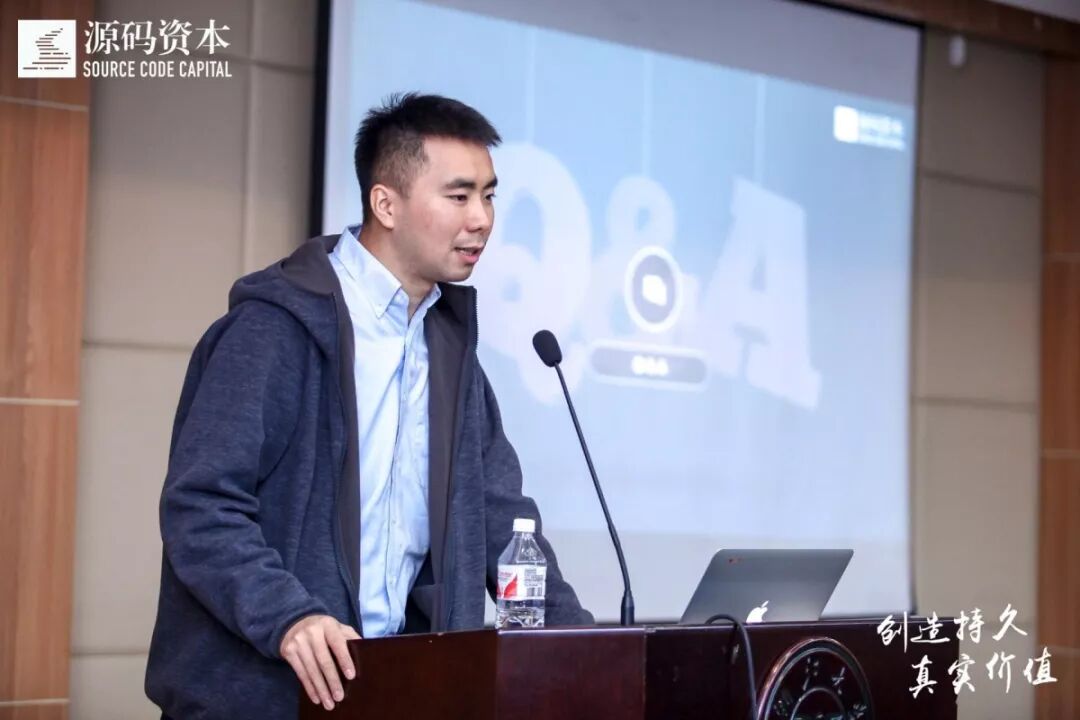
Question 1: I'm a senior. You said you joined the VC industry right after graduation. What's your view on whether founding an investment firm requires first accumulating experience at a consulting firm before joining an investment company — is this better for future development?
Yungang Huang: In entrepreneurship, many say it's best to invest in repeat founders, that executive-founded companies are the investment direction. But Mark Zuckerberg had never founded a company before — his first venture was Facebook, student-founded to its current state, and he understands management very well. Yiming Zhang hadn't managed tens of thousands of people before, yet ByteDance is now managed very well. Is experience important? Yes. But ultimately, people matter most.
The internet industry changes rapidly — every month brings major shifts. Using experience alone completely doesn't work. Consulting knowledge is somewhat helpful, but does doing consulting guarantee good investing? Not necessarily. Many in the industry started investing right after graduation; I've met people who've done it 15, 20 years and do it very well. Overall, you must continuously refine yourself through deliberate practice. The more you deliberately train yourself, the more your thinking patterns transform.
Beyond created scenarios, you must think hard. I also frequently see projects and chat with colleagues. Afterward, we regularly review CEOs we've met in recent months — what was their state then, what was their business state, have they pivoted, were there problems in pivoting? I remember these; some don't. Why don't they remember? I feel many people now easily have memory gaps — Monday through Friday they're in great shape, very engaged, working actively, good results. Saturday they seem to let loose, like in middle school or elementary school, coming back from summer vacation having forgotten their ABCs.
Good memory comes from repeatedly reviewing, repeatedly thinking. If impressions are profound, if deliberately trained, they leave marks in your mind. Correct thinking patterns, continuously creating these scenarios, self-creating, then iterating — this has nothing to do with experience.
Question 2: If I could intern at Source Code Capital, what growth resources could Source Code provide?
Yungang Huang: First, Source Code is an excellent organization. Though only four years old, we're absolutely in the industry's first tier. Our team has invested in a large number of successful, excellent companies. At Source Code, this environment lets you contact excellent founders and colleagues, learning alongside them.
Second, the organization has training, project discussion participation, continuous deep research. The work itself lets you learn much because it changes daily. Interns can also look at projects with us and discuss together. Meanwhile, our internship compensation is very good.
In summary: good work environment, good colleagues, good tasks, good training content, and quite good compensation. We're very confident in Source Code Capital's brand, organization, and future direction; very confident this position can provide students excellent growth.
Question 3: Thank you very much for your wonderful sharing. Two questions: first, regarding Source Code Capital's investment model — at what stages do we invest, from seed, angel, and when do we exit? Second, regarding emotional management — how do emotions, thinking, or logic affect you, and what methods do you use to reduce or eliminate emotional influence?
Yungang Huang: Two phases: one more early-stage, one when companies have reached certain scale. By round: angel, Series A, B, and C — we invest in all. For good companies, we hope to hold long-term and continue adding to our investment. We don't trade short-term but earn from growth, from value, not from stages.
Emotional control: look inward, control your emotions, maintain stability. From small comparison psychology to large-scale understanding of market sentiment — this is also an interesting topic. Self-awareness and awareness of others. First understand yourself — mental stability, sense of purpose, and emotions are all highly correlated.
Additionally, learn to observe market sentiment. Markets are often irrational, accompanied by various emotions — fear, greed — and knowing when to act. This is a cultivation process. Cultivation through entrepreneurship and investing: reading books, studying psychology, even meditation helps, because meditation is painful — legs numb, shoulders and neck sore — starting deliberate practice from simple things.
After reading Yungang Huang's talk,
if you're interested in Source Code Capital,
please send your resume to:
Source Code Capital welcomes you!
Source Code Capital
Create Lasting Real Value

WeChat ID: sourcecodecapital
More professional content Follow our official WeChat