Targeting Unicorns in the Consumer Upgrade Wave | Source Code Capital Insights

"Consumption upgrade" has become a sustained investment theme commanding capital markets' attention. How do we understand the underlying patterns behind this phenomenon, and how do we identify great consumer companies? Source Code Capital presents the third installment of its exclusive *Source Code Capital Internal Reference* series, based on its analysis and research.
Source Code Capital Internal Brief
Issue 3
About the Author
Xingshi Wang
Vice President, Investment

Mr. Xingshi Wang joined Source Code Capital in 2014. Prior to that, he worked at Hanergy Investment Group and TusVenture Capital, providing investment, financing, and M&A services for multiple internet companies. His investment portfolio includes Qudian, CHJ Automotive, eBaoyang, Chetree, Juli Xinfang, and Jiaoer Waimai. He holds a master's degree from Tsinghua University.
Contact: xs@sourcecodecap.com
[Editor's Note]
"Consumption upgrade" has become a sustained investment theme in capital markets. How do we understand the patterns behind this phenomenon? How do we identify great consumer companies? After thorough analysis, Source Code Capital presents the third issue of our exclusive Source Code Capital Internal Brief.

Perspectives
Targeting Unicorns in the Consumption Upgrade Wave
Research by/Source Code Capital
- Demand differentiation and trade-offs are the primary behavioral patterns of consumption upgrade
- Opportunities for unicorns exist in both the "trade-off" and "upgrade" directions
1 What Lies Behind Consumption Upgrade?
The consumption upgrade phenomenon of recent years has been driven by growth in per capita disposable income. Unlike the Industrial Revolution or the information technology revolution, consumption upgrade rarely produces era-defining products. Instead, it typically features incremental technologies, optimized products, and better alignment with consumer demand. Our in-depth research yielded two interesting findings:
1. Demand Differentiation
Many people now actively manage their health through fitness — some prefer weightlifting, others jogging, others yoga. The broad direction of consumer demand is upgrading to better products, yet specific consumer demands are diverging. Consumers are constantly choosing products that suit them better, and "suitability" is rarely a purely rational judgment.
The core of typical segmented demands tends to be labelable specific consumer groups. Post-'90s content consumption demand and bullet comments, blue-collar content consumption demand and short video platforms, white-collar food consumption demand and food delivery platforms, women's fashion consumption demand and cross-border e-commerce — these are all examples. Specific consumer groups with user bases in the hundreds of millions have segmented demands substantial enough to support hundred-billion-yuan market tracks.
Quality companies in these tracks possess deep understanding and grasp of specific consumer groups. The boundaries between channels and products begin to blur in such companies — take 7-Eleven's private-label goods and fresh food products. Even category boundaries blur, as with MUJI, which represents a specific consumer group's lifestyle. Precisely because positioning and category boundaries become blurred, the boundaries of enterprise value also become blurred.
2. Trade-offs
I remember saving pocket money for months as a child to buy an encyclopedia set. Now we have more income, yet we still spend more, save more, even take out loans to buy cars, luxury goods, or travel abroad. Consciously or unconsciously, we spend less on things that matter less to us, even when we can fully afford them.
This "trade-off" consumption behavior is more reflected in the proportion of spending across categories, rather than absolute spending amounts. Boston Consulting Group conducted consumer surveys across seven countries a decade ago and found this trade-off behavior to be global. Even in economically declining countries, while most consumers spend less and save more (hereinafter "downgrading"), some consumers still spend more for better products in certain categories (hereinafter "upgrading").
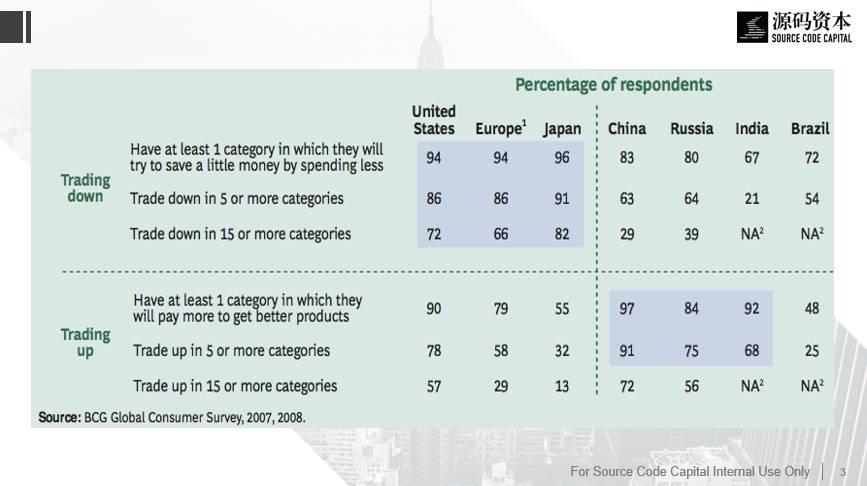
BCG's research also found that when downgrading, consumers feel "pragmatic, savvy, and informed"; when upgrading, they perceive the product as having "better efficacy" and "noticeable technological content."
When discussing cosmetics, male colleagues generally believe that active ingredients across brands are similar, functions lack rigorous scientific basis, and raw material costs represent a low proportion. Female colleagues, meanwhile, will enumerate different brands' efficacy and their personal experience.
Our demand for better, more suitable consumption is boundless. The checkout counters at Galeries Lafayette in Paris are packed with Chinese tourists; Ginza in Tokyo draws consumers from around the world. For categories where we upgrade, we search globally for better, more suitable products — so competition in this direction is global. Often, imported brands from culturally dominant countries carry an inherent upgrade halo — they are both objects of study and competitors.
For downgraded categories, "value for money" still applies, but with a different interpretation. We're not looking for the best product efficacy and features at the same price; rather, we're choosing the optimal price for the same or similar product efficacy and features. For categories we've clearly decided to downgrade, such high-value brands become the priority choice — MINISO, NetEase Yanxuan, and Xiaomi ecosystem hardware products, for example.
When improved product efficacy and features reach a relatively stable equilibrium with spending less, consumer demand rapidly converges on a particular product brand or channel brand.

2 Unicorns Emerge from Three Quadrants
If we divide differentiated demand into mass demand and niche demand, and trade-off outcomes into upgrading and downgrading, we get four quadrants. Unicorns are most likely to emerge from three of them.
1. Mass Upgrade Demand
Returning to our discussion of labelable specific consumer groups, "young parents" may be the group closest to me. Young parents represent a large population base, willing to endure hardship themselves to spend more on their babies. So they buy diapers from Japan, formula from Germany, and enroll in early education classes. As long as they can afford it, they give their children the best — this is typical mass upgrade demand.
2. Mass Downgrade Demand
Mass downgrade has more examples in Japan, such as the K-Car national vehicle model, which represents the most cost-effective solution for family transportation needs. Sometimes mass upgrade demand can transform into mass downgrade demand — this is how UNIQLO and MUJI rose rapidly. For the "young parents" group mentioned above, if domestic brands achieve comparable food safety and product quality to imported brands, many "pragmatic, savvy, and informed" parents might redirect more spending toward their child's education.
3. Niche Upgrade Demand
If a consumer group's population base is only in the hundreds of thousands or even smaller, upgrading becomes more extreme. In this case, a brand easily becomes synonymous with the niche consumer demand, and the niche market becomes the first ceiling the company encounters. Niche consumer groups are often opinion leaders in their domains, and their choices may influence mass consumer groups. If a company works in this direction — expanding categories, adding product lines — it can break through the ceiling and reach a new level, as with Canada Goose and Under Armour. There is no strict boundary between niche and mass demand, so great companies that will emerge from mass upgrade demand may well be hidden in niche upgrade demand markets today.