The Great To B Adventure

The true B2B adventurers have mostly become big winners.

Source: Blue Hole Business
ID: value_creation
Author: Zhai Wenting
Summary: In 2018, venture capital circles were defined by massive capital pouring into the B2B track and hidden champions rising to the surface. But if you trace the brief history of industrial internet, the true B2B adventurers have, for the most part, already emerged as big winners.
A stranger slid into Yi Cao's Weibo DMs. He introduced himself as a fabric wholesaler in Guangzhou looking for investment.
It was 2014. Cao had just left HSG and founded Source Code Capital. Might as well make the trip. He and a colleague flew to Guangzhou and stood at the entrance to the wholesale complex near Sun Yat-sen University. The scene before them was mesmerizing.
More than a dozen buildings shot up from the ground, each owned by a single landlord. Every floor was divided into dozens or hundreds of stalls rented out to merchants. A stall of roughly ten square meters commanded annual rent of two to three million yuan, generating yearly income of one to two billion yuan for the owner. This was the offline trading market — money never sleeps.
But Cao knew this model would eventually shrink or vanish. "Who would take over, and do it more valuably?" The answer had to be online. To use today's buzzword, this was industrial internet.
Since they were already in the heart of it, they might as well survey every company they could reach. In the end, another B2B fabric platform caught the eye of Source Code Capital VP Xingchen Zhang. The core team came from Alibaba, Meituan, and VIP.com. A few million yuan for 25% equity. This was Baibu, Source Code Capital's first industrial internet investment. That August, Baibu had just closed a $30 million Series C1 round, its valuation having long since doubled.
From there, Source Code Capital began systematically mapping industrial internet investments. Cao had proposed an investment framework of "three horizontals, nine verticals" — media, entertainment, communications, retail, transportation, and other industries had already been digitized. "Internet Plus" and "AI Plus" would inevitably repeat themselves in the enterprise services domain.
They were among the earliest hunters to venture deep into the industrial internet jungle. At the time, many B2B projects had never dealt with capital before, and competition among investors was rare — it was a frontier state.
Today, Source Code Capital's portfolio companies — Yijiupi, Edianzu, Yimi Dida, Xiaoyaoyao, Baibu, Rigour, Zhangshangkuaixiao, Zhangshang Fucai, YQN Logistics, Chuxin, and others — have become leaders in their respective fields.
Massive capital pouring into the B2B track, hidden champions surfacing — this was the portrait of venture capital in 2018. Tencent's pivot to industrial internet added more fuel. More people were looking at deals, term sheets came more decisively, and hot company valuations kept climbing.
But if you trace the brief history of industrial internet, the true B2B adventurers have, for the most part, already emerged as big winners. They have accumulated three to five years, even decades, in different fields — they just weren't widely known before.
Like the internet giants we know well, they too were once rule-breakers, value creators, and order reconstructors. This is the other, unexposed side of the internet revolution.
If we understand B2B through the lens of consumer internet user needs, enterprise demands typically fall into several dimensions:
Infrastructure digitization — servers, endpoints moving to the cloud, internal management going online. IaaS is considered the best business, but it's reserved for giants like Alibaba and Tencent; startups need not apply. But SaaS represents massive opportunities for innovation and entrepreneurship. Beyond that, enterprise needs for office space, software, and hardware have given rise to a new breed of companies. The rise of co-working spaces and Edianzu's computer leasing in recent years are prime examples.
The circulation link — essentially the online transformation of distribution across different industries. Previously, from factory to corner store, goods passed through layers of distributors — first-tier, second-tier, third-tier — with opaque pricing and no data trail. Internet intervention directly cuts out middlemen, going from first-tier distributor to small store, or even straight from manufacturer to store. The room for transformation here is enormous, with abundant entrepreneurial opportunities.
But where are the giants most likely to emerge, running parallel to consumer internet? Xingshi Wang, executive director at Source Code Capital, believes the answer lies in the transaction link.

Offline circulation will eventually be digitized
The leading companies in consumer internet are almost all transaction platforms — Alibaba, JD.com, DiDi, Meituan, without exception. Source Code Capital's self-drawn roadmap follows the same principle: in industrial internet, they too look for transaction platforms with built-in network effects.
Alibaba and JD.com, China's two e-commerce giants, plus other vertical players, have only captured 20% of the retail market. Eighty percent of transactions still happen offline.
Take baijiu consumption as an example. In a market approaching one trillion yuan in scale, online retail combined accounts for only a few hundred billion — negligible. The vast majority of consumption happens through millions of mom-and-pop stores, tobacco and liquor shops.
These small shops haven't been killed by e-commerce for good reason. Their service radius is generally small, their customer base stable, their relationships sticky — not easily replaced.
Before investing in Xiaoyaoyao, Xingshi Wang was doing due diligence in Hubei. The moment he saw that shop, he knew: the terminal nodes at China's extremities won't be easily displaced. It was a classic mom-and-pop store. The storefront was owner-occupied. No real estate agency nearby meant low property turnover. The street was under construction, but their business was completely unaffected.
Distribution channels won't be easily replaced by the internet, but they can be served by internet methods. They need the internet to bridge information asymmetry — lower procurement prices, better product sourcing, more services, additional revenue.
Upstream branders welcome this too. Precise sales data and user profiles are what they've always pursued.
This is the natural soil where B2B and internet converge, and the circulation link's imaginative space won't disappoint adventurers. B2B platforms can extend upstream to reverse-customize products, even develop private labels; in the middle, there's the possibility of supply chain finance; downstream, they can reach end consumers and connect with traffic platforms — considerable premium potential.
Pony Ma once asked on Zhihu what would happen when industrial internet and consumer internet connect. As a bridge between C-end and B-end, Yimi Dida can answer this through actual operations.
"Logistics companies can achieve data interoperability and application based on both ends, building more complete user and industry profiles, providing more precise and timely data support to upstream and downstream players, thus entering a larger cycle and closed loop," Yimi Dida founder Lucky Yang told Blue Hole Business.
Cao once did the math: from factory to consumer terminal, over ten industries have a circulation link alone worth 500 billion yuan.
Note, this figure is just the value generated by individual vertical industries like consumer goods and pharmaceuticals. The players are fragmented — roughly tens of thousands or even hundreds of thousands of companies nationwide participating in the carve-up. If consolidation happens, the top two players capturing over 100 billion in scale is entirely achievable.
If scale alone isn't persuasive, consider the margins. Low end: two to three percentage points. High end: four to five percentage points. A 100-billion-yuan market yields two to three billion in profit — and that's net profit.
Circulation link distributors are like holding the body's aorta. All data, all systems can potentially reach from the heart to the capillaries of commercial cash flow.
After investing in Baibu, Source Code Capital began systematically mapping B2B transaction models across industries. The logic mirrors their consumer internet approach: find offline prototypes, benchmark online. They hunted for potential winners in pharmaceuticals, fabrics, industrial goods, auto parts, agricultural products, and more. They deployed in fast-moving consumer goods, pharmaceuticals, fabrics, and industrial goods through Yijiupi, Xiaoyaoyao, Baibu, and Rigour; in logistics infrastructure through Yimi Dida and YQN Logistics.
But don't assume holding this map is a panacea. Investing in B2B is, to some degree, walking through no-man's-land — the probability of hitting visual blind spots is high.
Cao analyzed the reasons for Blue Hole Business: First, most models are unproven, requiring trial and error, inevitably leading down wrong paths. Different industries have different models. Source Code Capital's portfolio companies may switch between self-operated and platform models, or experiment with extensions into production and B2C. Industry experts and internet talent — two different DNA types working together — inevitably collide and need time to gel. He said you have to acknowledge industry differentiation, find commonalities, and understand individuality.
However, once you capture an industry leader, unlike consumer internet where replacement risk is ever-present, B2B models are hard to disrupt in short order.
Edianzu: Only Veterans Can Pull This Off
No one denies the B2B market is a gold mine. Only a few possess the map and ability to find the wealth. Unlike consumer internet companies that can catch up through capital and speed, B2B winners tend to be first movers.
Pengcheng Ji founded Edianzu in 2015 — a B2B company providing flexible office computer leasing and software services. Toutiao, Yonyou, CHJ Automotive, and others use their products. Want a few units? Rent a few. Want them for a month? Rent for a month. Done with them? Return them.
Three years, six funding rounds. In October 2018, the company closed a $60 million Series D led by returning investor Source Code Capital and a sovereign wealth fund.
Strictly speaking, Ji has 15 years of industry experience. In 2003, while pursuing graduate studies at Tsinghua University, he was already buying and selling used computers. By graduation, he was the country's largest used electronics retailer.

Edianzu founder Pengcheng Ji
The B2B market is relatively niche. They are the industry leader. "Life is very comfortable," Ji blurted out. Two to three hours at the office daily, stable clients, no competition, profits growing 20-30% annually. The only problem: too low a ceiling, hard to scale.
The upside: used goods trading and leasing are separated by only a glass wall, a natural seamless transition. Edianzu's pivot to office computer operational leasing was logical, and previous accumulation gave the company core capabilities: from trade-in to delivery, maintenance, software services, through final product disposition — full industry chain coverage, all self-operated.
They are also the only company in China able to offer general credit lines to enterprises. Data accumulated on the platform gives them built-in risk control capability.
Such companies don't need to buy growth through cash burn. Their needs from capital vary. Edianzu is currently marginally profitable; raised funds basically go toward bank loan guarantees.
Xingshi Wang explained that Source Code Capital invested mainly for the imaginative space of eventually becoming a full enterprise IT services platform.
Some investors view Edianzu as a financial company. Ji responded with a laugh: "Many people think we're peers — computer sellers, repair shops, software service providers, even financial companies. But essentially, our business model is the same as Mobike's. But no one thinks riding a bike is a financial activity, right?"
They've faced virtually no high-intensity competition. Their biggest competitor is companies' habit of purchasing office computers. Mindset is always the biggest enemy.
Edianzu is one sample of B2B services. Most of this wave of industrial internet companies were founded after 2014, yet their founders had already spent years immersed in their respective fields. They know industry rules, speak the language, instantly grasp complex enterprise needs. What can be solved, what can't — clear as day.
They are bridges, mastering core hard knowledge while translating arcane skills into internet products. These entrepreneurs share other traits: tolerance for solitude, refusal to duck problems, ability to solve real problems.
You don't sense acute anxiety from Ji. Everything seems within his grasp. "Every core capability you can see in the current B2B market — we have them all."
Car300: Small Entry Point, Big Business
Some things in B2B look small on the surface but lever open massive opportunities behind them. Most people wouldn't think of such models; even if they did, they'd lack the technical execution.
Used car e-commerce is so hot — where do transaction reference prices come from?
Few have heard of Car300, rarely covered by media. But this Nanjing-based company plays a key role in determining used car transaction prices. Whether online platforms, offline small-B dealers, or individual users — anyone buying or selling used cars relies on Car300's data services.
Wei Xu told Blue Hole Business about his founding motivation: "I love cars, I understand cars, and I come from a data analysis background. This business seemed tailor-made for me."

Car300 founder Wei Xu
He previously led data analysis and mining at an American software company. While living in the United States, he gained deep understanding of the used car market. At the end of 2013, when Xu locked onto car-related entrepreneurship, he discovered the opportunity in missing used car price standardization. An American peer called KBB mainly served C-end users. But in China, he believed this was more of a B2B business.
He thought it through clearly: to provide value in used car transactions, price standardization was paramount. Team members disagreed, arguing to the point of discouragement: "Different buyers, different sellers — used car prices can never be accurate."
Xu rejected this conclusion. If a car's actual value is 50,000 yuan, an appraisal of 40,000 or 60,000 is meaningless. But if you give 52,000 or 48,000, with error narrowed to a certain range, that number's value is obvious.
In reality, whether Guazi, Renrenche, or offline dealers, they all have their own pricing systems and sales preferences — strictly following third-party prices isn't realistic. But as long as they reference Car300's price when buying or selling, then make more specific price settings, that's the best proof of Car300's influence.
Xu spent three years obsessing over data accuracy. With no foundation or resources, they collected all kinds of new and used car data from public channels, filtered and cleaned false information, then predicted actual transaction prices from listed prices, exhausting every means. "Accuracy was maybe 80 points."
When evaluating similar companies, Source Code Capital found that used car e-commerce platforms were all using Car300's data. Through an entrepreneur introduction, Cao met founder Xu. A scheduled two-hour meeting stretched into the afternoon. Investment was quickly finalized.
When Source Code Capital invested, Car300 was valued at 100 million yuan. Today that number is 1.3 billion.
Xingshi Wang said data service providers share a characteristic: the more people use them, the more accurate they become — "a business that makes friends with time." But the process and sources of data generation are hard for others to discern — "that's the core competitiveness."
But early promotion was exceptionally difficult. Dealers, confident in their experience, were unwilling to try: "If it's wrong, I'll lose money." Xu personally ran to trading markets handing out flyers, achieving nothing. Slow growth plunged him into anxiety.
The turning point came with the rise of used car platforms like Guazi and Renrenche. Their recruited appraisers and inspectors were mostly young, lacking experience but adept at using internet tools. Plus their high turnover rate invisibly spread Car300's product and reputation. In 2015, DAU, retention, and other metrics began explosive growth.
Car300 now commands 70-80% market share in used car transactions, with 50,000-60,000 dealers nationwide using their product. Since then, they've moved into used car finance, building standardized risk control products. Over 500 leasing and guarantee companies are their users.
Yet this company still has only 200-plus employees, and has long been profitable.
Yijiupi: Settling the Scene
Truck Alliance founder Dai Wenjian once told media in an early interview, "Know what VCs value in me? Combat power."
Truck drivers could accept orders online via app — considered the freight version of DiDi. Because it touched local cargo network interests, it faced fierce resistance. People blocked store entrances with stools, smashed things. Every city Truck Alliance entered meant a fight. Smashed vehicles, cut internet were routine; they even had to navigate local criminal forces.
When the company entered the Northwest market, a 300-person team cracked seven provinces' networks in one month. The cost: several vehicles smashed. Dai personally directed from his Hummer. "Can't do this without combat power."
This is just one vignette of the industrial internet process. Traditional forces defend their fortresses to the death; the internet exists to break them.
Yijiupi had similar experiences. True to its name, it's a company in liquor wholesale, using internet methods to compress circulation links, connecting first-tier agents with corner stores.
While first-tier agents' interests weren't directly touched, liquor circulation's profit distribution was reshuffled, the established sales system challenged. Pushback and confrontation followed.
Founder Wang Chaocheng had done consulting in the liquor industry, built offline channels, run B2C e-commerce — a rich resume without failure. He knew branders' psychology well.
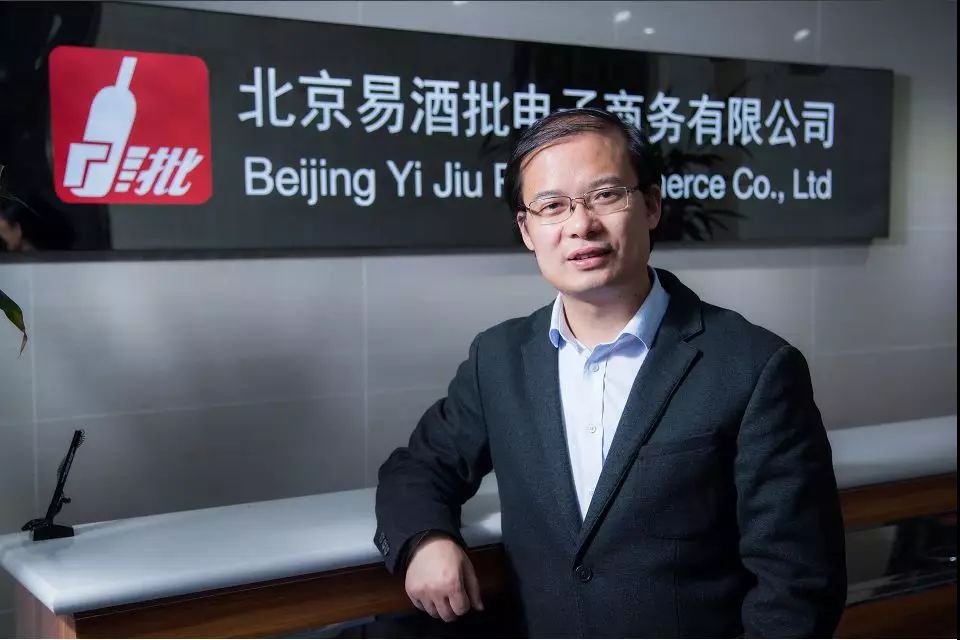
Yijiupi founder Wang Chaocheng
In the short term, the distribution system was entrenched, brothers were doing fine. Suddenly someone jumps out wanting to do things differently — as big brother, you need to protect your wounded little brothers.
But in the long term, dealers were scattered, individually small, collectively disorderly — they had no bargaining power. If one player grew large, gained weight in discourse, that was strategically unfavorable.
One liquor group maliciously reported Yijiupi for dumping at low prices, mobilizing quality inspection and industry and commerce officials to raid warehouses, even organizing forces to intercept delivery trucks. In Hefei's urban district, 17 first-tier agents were warned: anyone supplying Yijiupi would face heavy penalties.
Such treatment Alibaba and JD.com had long grown accustomed to. As late as 2012, Kweichow Moutai issued a statement that it had never supplied Tmall or JD.com. In recent years, Jack Ma and Richard Liu personally visited Maotai Town to rebuild relations.
E-commerce and industrial internet are both seen as rule-breakers — only the latter's influence is greater, the interests touched more extensive. But Wang Chaocheng doesn't fully agree: "Whether you're a true destroyer or simply misunderstood — the key difference lies in whether you're creating value."
Now he's gone from opposed to welcomed; some liquor branders supply him directly.
Yijiupi rewrote profit distribution. Internet-ification made small store procurement prices relatively transparent. Even newcomers wouldn't be bullied by information asymmetry, and earned more. This is the information-level value the internet brings.
Deeper impact: Yijiupi is building industrial infrastructure. Consolidating like items, shortening circulation chains, reducing goods handling, improving industrial efficiency. Beyond liquor, they've extended tentacles into the entire FMCG industry.
The third value industrial internet brings is capital. This is the natural advantage of transaction platforms — easy connection to supply chain finance.
After Source Code Capital's investment, through Cao's introduction, Yijiupi received strategic investment from Meituan, even being seen as part of Meituan's strategic ecosystem.
Yijiupi helps small stores upgrade ERP systems, open Meituan online stores, even develop mini-programs. Invisibly, this connects consumer internet with industrial internet. Only startups with deep industry understanding can accomplish this.
Like other industrial internet plays, liquor and the broader FMCG circulation link emphasizes deep upstream-downstream connection. This creates deep moats, stickier customer relationships than others — hard to change if someone wanted to.
Wang Chaocheng smiled mysteriously, "More heroes will emerge in industrial internet."

Source Code Capital
Creating Lasting, Real Value

WeChat:
sourcecodecapital
More professional content
Follow our official WeChat