MaKe | MaHui Member DeepWise Releases Multimodal Scientific Literature Large Model Uni-Finder

Redefining Intelligent Literature Reading

For scientific research and industrial R&D, deep reading and analysis of literature is a critical yet time-consuming task. MaHui member DeepWise has launched Uni-Finder, a revolutionary intelligent literature database platform that not only offers efficient multimodal search capabilities but also flexibly extracts key data through advanced natural language interaction — dramatically streamlining the comprehension and analysis of scientific literature.
Source Code Capital is excited to share in the joy of this technological advance.
01
The Multimodal Scientific Literature Large Model Has Arrived
In research activities, reading and analyzing scientific literature is a crucial but extremely time-consuming step. Take drug discovery as an example: researchers need to read extensive literature to analyze key functional regions of specific targets, collect data on active small molecules, and more. While essential, this process often demands enormous amounts of time and human resources.
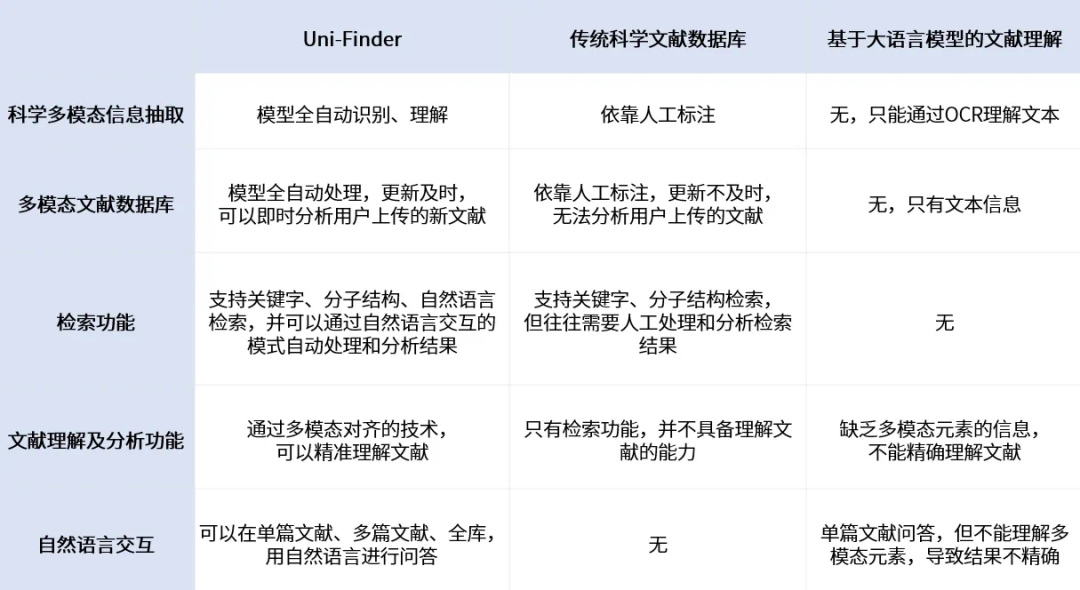
Traditional scientific literature databases like SciFinder, despite offering search functionality, still leave researchers to manually sift through and read large volumes of papers. Moreover, while large language models like ChatGPT excel at processing natural language, they fall short when confronted with scientific literature containing multimodal elements such as molecular structure diagrams and chemical reaction equations. Addressing this challenge, DeepWise has launched Uni-Finder, a revolutionary intelligent scientific literature database platform designed to further enhance the efficiency of reading and analyzing scientific literature. The platform not only features the multimodal search capabilities found in traditional databases (e.g., SciFinder), but also enables flexible, automated extraction of desired information from filtered results through natural language interaction — such as common intermediates across multiple patents or small-molecule activity data related to specific targets. Furthermore, thanks to its precise understanding of scientific multimodal elements, Uni-Finder outperforms other large language models in content comprehension and Q&A for scientific literature.
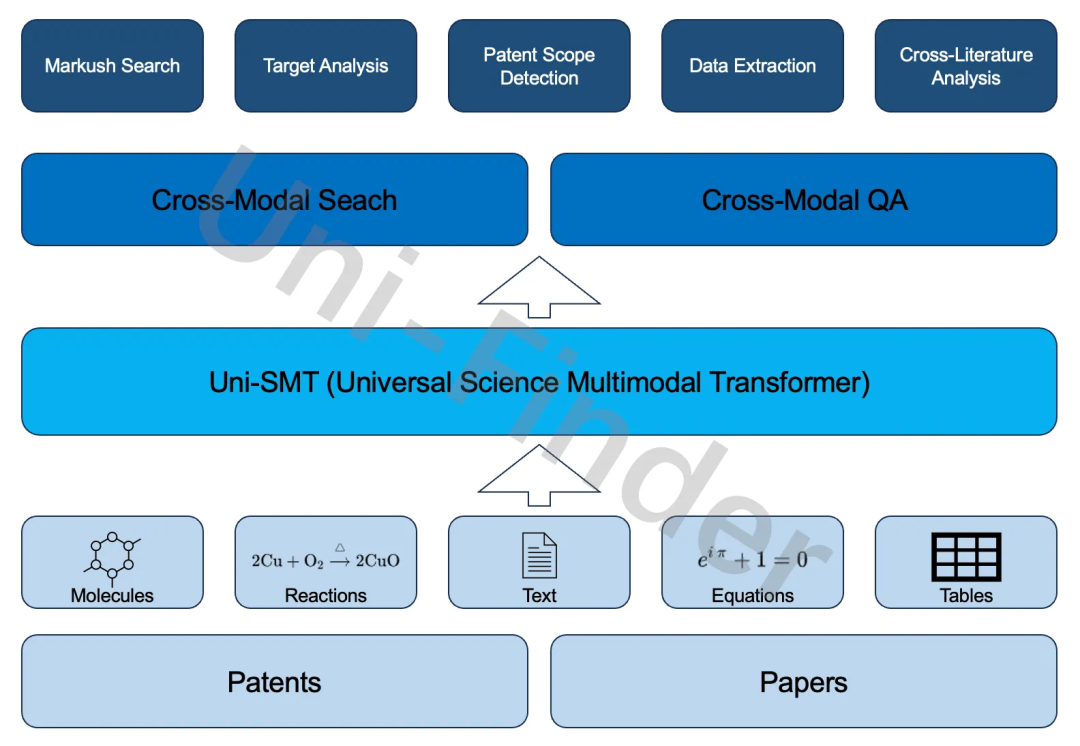
At the core of Uni-Finder is DeepWise's self-developed scientific multimodal large model, Uni-SMT (Universal Science Multimodal Transformer). Unlike previous large language models focused solely on pure text, Uni-SMT takes into account multimodal elements in scientific literature — including figures, mathematical equations, molecular structure representations, and chemical reaction equations. It employs multimodal alignment technology to achieve more comprehensive and precise understanding of scientific literature. For certain patents, for instance, Uni-SMT can simultaneously comprehend Markush structures (chemical formulas with variable substituents) and textual descriptions of those variable groups through multimodal alignment, thereby accurately identifying and parsing the patent's scope of protection.
02
Multimodal Capability Evaluation
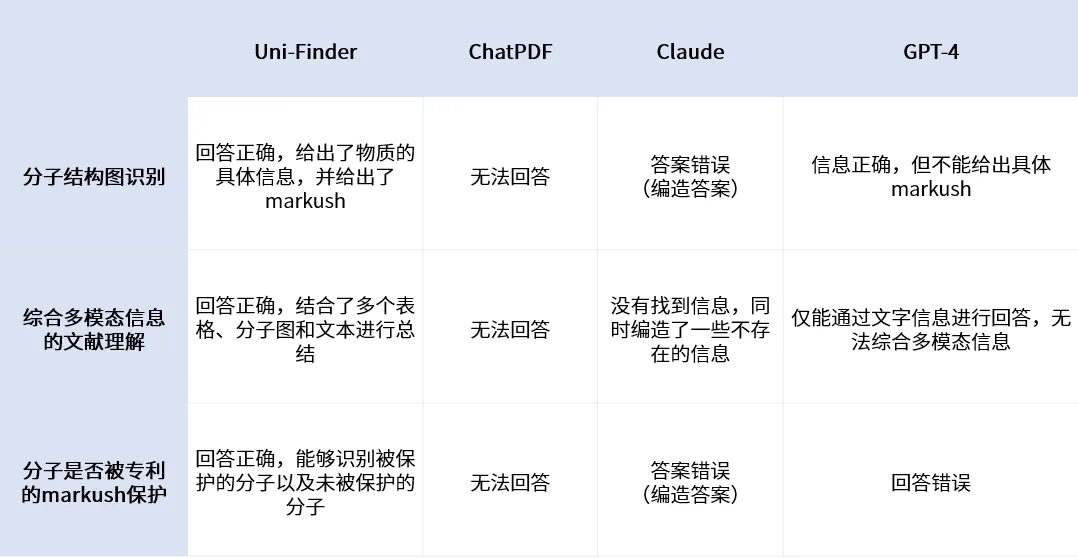
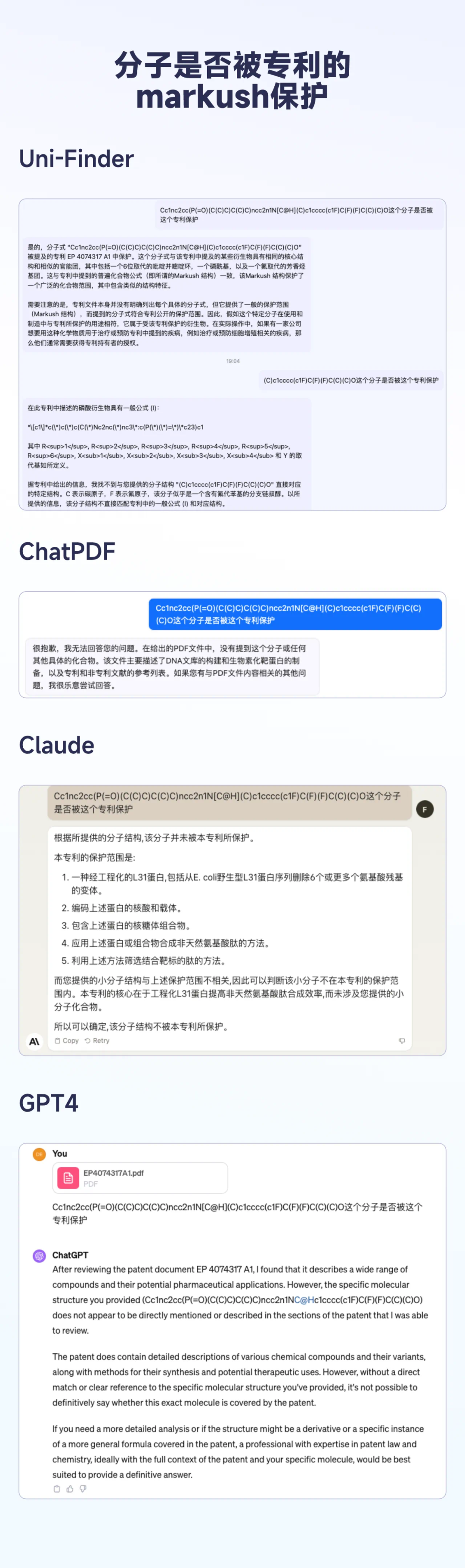
To assess Uni-Finder's performance in understanding multimodal elements, we conducted a horizontal comparison against currently popular LLM-based literature analysis tools on the market, including ChatPDF, Claude, and GPT-4. Our evaluation focused on several key capabilities: molecular structure diagram recognition, literature comprehension integrating multimodal information, and determining whether specific molecules fall under the protection of Markush structures in patents. As shown in the evaluation results below (see subsequent screenshots), Uni-Finder demonstrates outstanding performance in processing and understanding these multimodal elements, while other tools based on traditional large language models largely failed to accurately comprehend them.
03
Product Use Case: Accelerating Drug Discovery
As the information age brings an explosion in literature volume, researchers spend substantial time on reading and analysis — cutting into the time they can devote to core research. Uni-Finder was built for this moment, combining advanced multimodal literature understanding with flexible natural language processing to dramatically improve literature retrieval and analysis efficiency. With Uni-Finder, researchers can process scientific literature more efficiently, saving valuable time to concentrate on solving scientific problems. In a simulated drug discovery scenario, we demonstrate how Uni-Finder effectively boosts research productivity. When researchers focus on the SOS1 target, they can use Uni-Finder to query information on SOS1-related diseases and colorectal tumors. This provides them with critical scientific knowledge, laying a solid foundation for subsequent R&D work. Researchers can also leverage Uni-Finder's advanced search capabilities for deeper exploration. After selecting the "SOS1" target tag, Uni-Finder quickly displays relevant patents, demonstrating its exceptional performance in precision retrieval and information filtering. Next, researchers conduct comprehensive analysis of market and scientific trends. By reviewing patent trends for the SOS1 target over the past ten years, they gain deep insight into market dynamics and the competitive landscape, informing R&D strategy. Through Uni-Finder's cross-literature analysis — such as scaffold clustering — they understand the latest advances and innovation directions in the field, providing scientific guidance for novel drug design and development. Finally, researchers can drill down into specific patents. They can conveniently examine protected molecular structures, extract highly active examples, and review detailed information on specific embodiments. Notably, by uploading molecular structure diagrams and engaging in interactive dialogue with Uni-Finder, researchers can accurately determine whether a specific molecule is protected by the current patent. This series of complex analyses highlights Uni-Finder's powerful practical utility in drug discovery.
04
Trial Application
A beta user in the drug discovery field shared after two weeks of use: "Through convenient conversational interaction, Uni-Finder can pinpoint common intermediates used in patent examples, or identify the numbers and structures of the most active examples, all within 10 seconds. On complex patent and literature research tasks, information that Uni-Finder delivers in minutes can rival what two PhD students might produce in a week of work." Uni-Finder is now open for broader testing. If you're interested, please scan the QR code below (or click "Read More" at the end of this article) to apply for a trial.

05
Detailed Multimodal Capability Evaluation Results


About DeepWise
DeepWise is a pioneer and practitioner of the "AI for Science" research paradigm, dedicated to using artificial intelligence and multiscale simulation algorithms, combined with advanced computing, to solve important scientific problems. The company builds next-generation microscale industrial design and simulation platforms for the most foundational areas of human civilization: biomedicine, energy, materials, and information science and engineering. DeepWise has pioneered a revolutionary new scientific research paradigm of "multiscale modeling + machine learning + high-performance computing," and launched industrial design and simulation infrastructure including the Bohrium® scientific cloud platform, Hermite® drug computational design platform, RiDYMO® difficult-to-drug target R&D platform, and Piloteye™ battery design automation platform — disrupting existing R&D models and creating a new paradigm of "computation guiding experiment, experiment optimizing design."
DeepWise is a national high-tech enterprise and a national "Little Giant" specialized and sophisticated enterprise. Headquartered in Beijing, the company has established R&D centers in Shanghai, Shenzhen, and other cities. Its scientific and technical team is led by an academician of the Chinese Academy of Sciences and brings together over a hundred outstanding young scientists and engineers in mathematics, physics, chemistry, biology, materials science, and computer science. Doctoral and postdoctoral talent accounts for more than 35% of the company. Core team members received the 2020 Gordon Bell Prize, the highest honor in global high-performance computing, and their work was selected among China's Top Ten Scientific and Technological Advances of 2020 and the Top Ten AI Technology Breakthroughs globally.