Unitree IPO: How Source Code Capital Built a Long-Term AI Bet From Robotics to Compute

Source Code Capital's AI footprint now stretches from robotics down to foundational materials, chips, and compute, and upward to models and applications.
MaHui portfolio company Unitree (hereinafter referred to as "Unitree") officially listed on the STAR Market yesterday, becoming the A-share market's "first humanoid robot stock." Source Code Capital participated in the company's Series B2 financing in early 2024, subsequently added to its position across three additional rounds, and has invested four times in total—accompanying the company through the critical development phase before its IPO as one of its important long-term institutional investors.
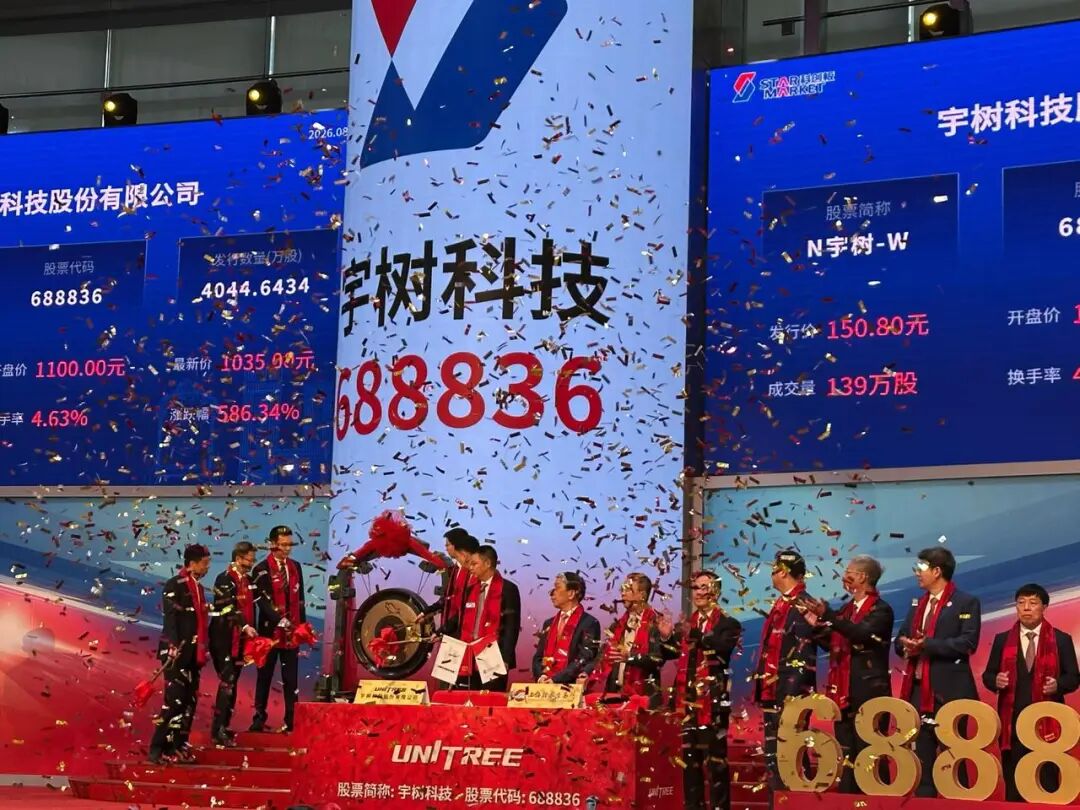
On the occasion of Unitree's listing, we look back at the original investment decision-making process and want to share the behind-the-scenes story—how Source Code initially viewed Unitree, how the investment decision was made, why we chose to add to our position again and again, and what consistent judgment underpinned these choices?
This was not an investment following market hype, but rather a process extending from early long-term research and repeated deliberation to subsequent ongoing tracking. For Source Code, "long-term" does not mean having definitive answers from the start, but rather maintaining the patience to research, validate, and wait amid uncertainty—and giving companies room to grow.
1
Before "Embodied AI" Became Consensus
Today, Unitree is one of the most closely watched companies in the global humanoid robot race. But few know that when Source Code Capital invested in 2024, it was not a deal that institutions were fighting over. At the time, humanoid robots had yet to become market consensus, and the commercial prospects of quadruped robots were still being debated. Later, as humanoid robot products were unveiled one after another and gained widespread attention—especially the dance performance at the Spring Festival Gala—Unitree rapidly shot to fame and entered the public eye.
As Yungang Huang, Managing Partner of Source Code Rhythm, put it: "We saw the company's long-term value. We never expected it to blow up in six months—it could take two or three years or even longer to be validated. But we did invest at an inflection point." How did Source Code Capital form this judgment before the market had reached consensus?
In fact, Source Code's focus on "hardware-software integration" predated the term "embodied AI" by quite a margin. As early as 2016, Source Code was the sole angel-round investor in Chuxin—a back-of-house intelligent service provider that started from connected commercial dishwashers. Back then, nobody was talking about "embodied AI," but Source Code was already betting on "hardware-software integrated automation."
By 2020, Source Code began intensively investing in "vertical robots" across manufacturing, services, household, and other domains. That year alone, it invested in Mech-Mind, Standard Robots, Keenon, Cloud Whale, Woan Robotics (6600.HK), and others. It was precisely this long-term observation and practice in hardware-software automation, robots, and real-world scenarios that provided the foundation for Source Code's later understanding of embodied AI—allowing its judgments and moves to be somewhat more precise.
This thread extended to "general-purpose robots" following the release of ChatGPT in late 2022. In 2023, Source Code's investment team made multiple trips to Silicon Valley for intensive exchanges with frontline researchers, which proved highly fruitful. There was a clear shared sense that AI would bring major changes to both the digital and physical worlds—it's just that the digital world would move faster than the physical one, and both represented enormous opportunities.
This translated into two tracks for Source Code's investments: digital-world AI represented by language models, and physical-world AI driven by embodied intelligence—the former later yielding investments in Moonshot AI, Liblib, Meshy, Sand.ai, and others; the latter kicking off a series of investments in Unitree (688836), Galaxy Universal, Booster Robotics, and more.
It's worth noting that at the time, many people had never even heard the word "embodied," let alone understood what it meant. Yet in a direction so unfamiliar that it didn't even have a name, Source Code had already begun systematically mapping out and sourcing projects. Internally, Source Code repeatedly debated a more specific and highly controversial question: Why must it be humanoid? Why must it be bipedal? To this day, some still question: Wheels are faster and more energy-efficient, so why build two legs?
Source Code's judgment at the time was simple but resolute: First, the bipedal structure is the most general-purpose design; second, throughout the physical world—buildings, streets, corridors, elevators—more than half of all space is built to human dimensions. Where wheeled designs can't go, humanoid forms can.
Source Code believed at the time that general-purpose robots would certainly arrive, and that humanoid robots would be the most important category among them. It was based on these two judgments that Source Code locked in on this direction before the market had formed any consensus, bringing Unitree into its scope of focused observation.
2
The Staircase Crushed by Robot Dogs
What Source Code valued was not merely the concept of "humanoid robots," but what Unitree already had in hand. The joints, actuation, motion control, and body capabilities accumulated over years of quadruped robots had already been repeatedly validated in real products and scenarios. For embodied intelligence still in its early stages, it was precisely these underlying capabilities that determined whether a company could keep moving forward on reliability, cost, and iteration speed.
At the end of 2023, the Source Code team engaged intensively with Unitree again, carefully studied the long-term value of quadruped and humanoid robots, and quickly decided to invest. The investors' first impression of Xingxing Wang was particularly striking—especially the way he talked about products: ask him any product detail, and he would go on at length; whenever he spoke about products, his eyes would light up, and that immersion and commitment was infectious even to those sitting across from him. In his early days, Xingxing Wang was more like a product-oriented founder who had long been immersed in robot bodies.
"Xingxing is an extremely disciplined entrepreneur. He doesn't invest blindly. Even after Unitree became hot and had more resources, his strategy was still to focus on getting the hardware and 'cerebellum' right first," Yungang Huang said.
Another impression came from Unitree's rather rundown office building. The robot dog training ground was on the rooftop; every day, the robot dogs had to climb the stairs up from the office. After climbing and falling so many times, the edges of the stair steps had become chipped and broken. The debris would be cleaned up, but the stairs weren't specially renovated—swept clean and put back to use. It was a feeling of being on-site, getting things done. This detail showed Source Code a team that still devoted most of its energy to product testing and R&D iteration.
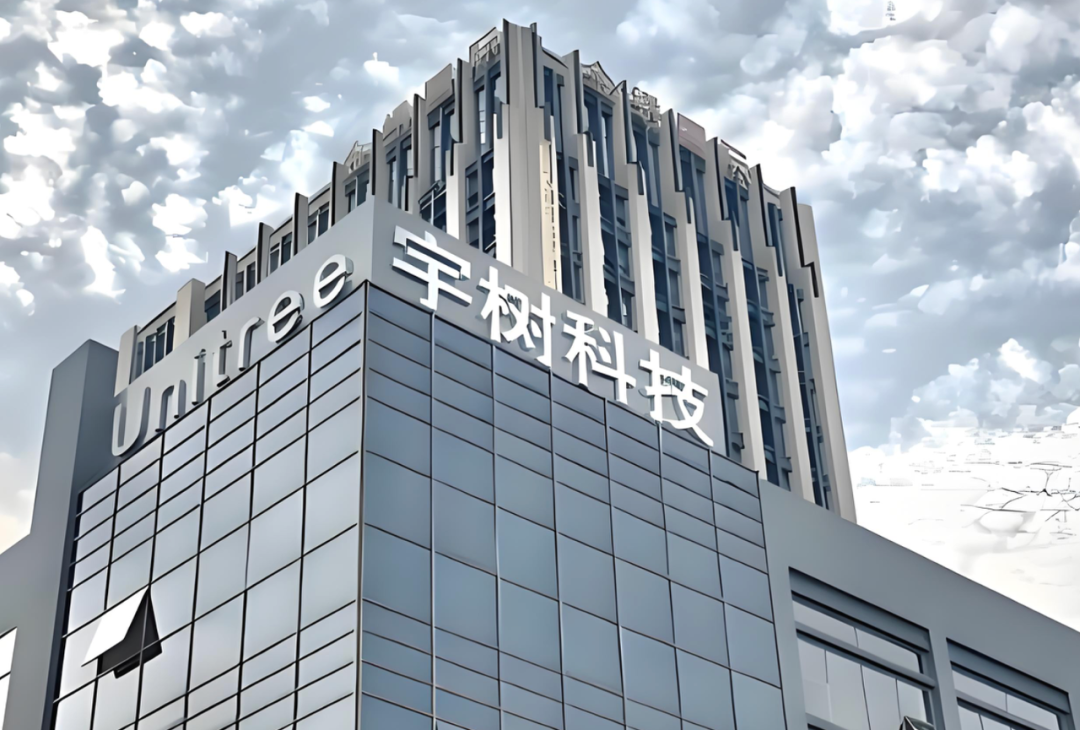
Of course, this investment was not a project that looked "safe" at the time—the market hadn't seen it clearly, and there were differing voices within Source Code as well. Fortunately, these discussions didn't impede the decision, but instead pushed the investment team to think more thoroughly about risks in the sector, product, and organization.
From a longer time horizon, what supported Source Code's firm conviction in adding to its position in Unitree were two consistent commitments: first, a commitment to independent judgment and thinking—not chasing trends, not following the crowd. The team rarely used whether other institutions were participating or whether existing shareholders were following on as primary criteria, focusing instead on its own judgments about the industry, the company, and the founder; second, a commitment to a long-term perspective, caring less about short-term returns and investing in what we believed was right over the long term. Even if this direction needed several more years of validation, even if it meant sitting on the bench for three to five years, the team was prepared to accept that.
After the initial investment, Source Code continued to add to its position in subsequent rounds. But each round of additional investment was based not on market heat, but on whether Unitree continued to make progress in product, business, and organization, and whether the previous uncertainties were gradually converging. Continued investment was not a simple repetition of the first judgment, but a process of re-validation, again and again.
In Source Code's view, a company that has invested for the long term before market heat arrives is often more worthy of careful observation. After Unitree's listing, the market will examine this company with new valuations and expectations. But when Source Code first entered, it was still a robot company repeatedly testing and solving product problems in real-world scenarios. What Source Code did was choose to believe in this kind of long-term accumulation when the answers were not yet clear.
3
More Than Just Unitree
Unitree was not an isolated investment for Source Code in the robotics space.
Over the past decade, Source Code has continuously tracked the evolution of robots from "seeing the world" to "understanding the world," from completing actions to entering real-world scenarios, and has invested and maintained long-term tracking across multiple links in the industry chain.
At the perception and infrastructure layer, Source Code has deployed in companies such as LD Robot (1236.HK), focusing on robot mobile perception and LiDAR modules; at the model and body layer, in addition to Unitree (688836), this includes Galaxy Universal, Independent Variable Robotics, Booster Robotics, and others, covering embodied multimodal large models, end-to-end embodied intelligence, and humanoid robot bodies.
At the application and deployment layer, Source Code's reach extends to industrial, logistics, household, and commercial service scenarios: Standard Robots, XYZ Robotics, HAI ROBOTICS, Mech-Mind Robotics, and Fairino serve industrial AMR, logistics sorting, warehouse automation, industrial vision, and collaborative robots respectively; Cloud Whale, Woan Robotics (6600.HK), Keenon, Oakbot Technology, and Xingmai Innovation target household cleaning, household service, commercial service, catering, and outdoor cleaning terminal scenarios.
Additionally, Source Code Rhythm, led by Yungang Huang, has also made deployments in the robotics direction, investing in projects such as Sudu Tech, Nuoyin Intelligent, and Moqi Intelligent Technology.
These projects do not revolve around a single robot form, but rather correspond to different capabilities needed for the robotics industry to reach scale: perception, models, bodies, control, and ultimately scenario deployment. The legged and humanoid robots represented by Unitree are an important thread in Source Code's long-term observation of AI entering the physical world, and also an important node in this long-term deployment主线.
Neil Han, Managing Director at Source Code Capital, has long focused on the robotics and AI direction, and has led and participated in investments in projects such as Independent Variable Robotics, Meshy, LiblibAI, and Sand.ai.
In a recent sharing, he summarized the relationship between AI, robotics, and computing power as a "great cycle": stronger AI designs better chips, AI-driven robots build more data centers, and larger computing clusters train stronger AI—intelligence moves from the virtual world into the physical world and back to the virtual world, forming a continuously iterating closed loop. In this cycle, robots are not isolated terminal products, but an important link connecting models, computing power, and the physical world.
4
From Robotics to Computing Power
The "great cycle" that Neil Han described also explains why Source Code's AI investments did not stop at robots. Following this interconnected chain, Source Code's deployments extend from robotics further down to underlying materials, chips, and computing power, and upward to cover models and applications.
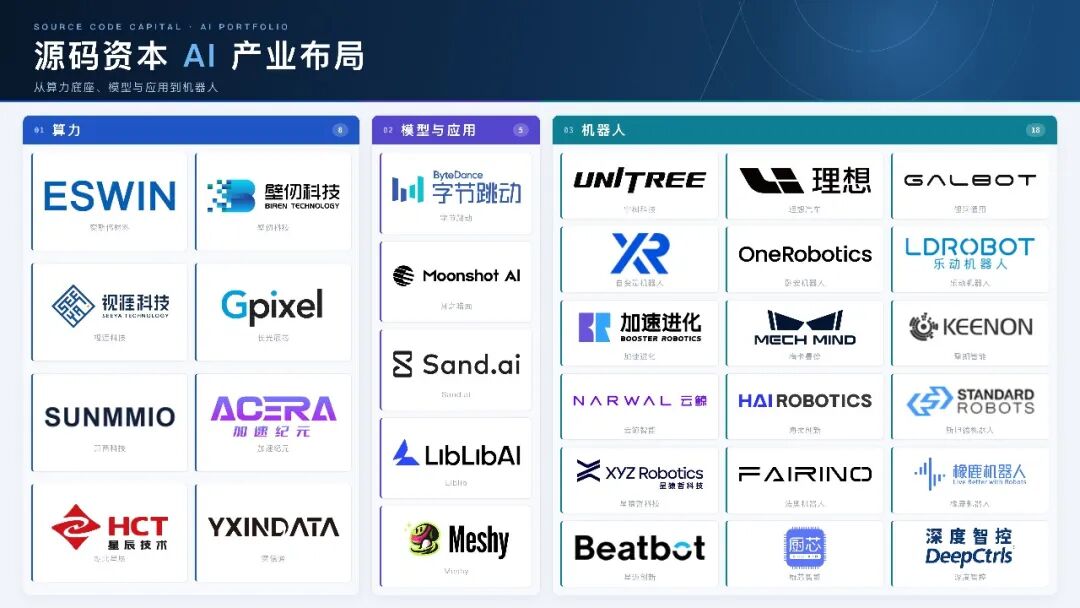
Among these, computing power and related hardware infrastructure are a layer that Source Code has focused on and particularly valued. Improvements in model capabilities, reductions in training and inference costs, and whether AI applications can achieve broader-scale adoption all depend on the continuous development of underlying hardware and computing power. As the scarcest and most strategically valuable infrastructure of the entire AI era, computing power is the true "foundation" of this transformation.
But compared to models and applications, the computing power side typically involves longer R&D cycles, greater capital investment, and slower industry feedback—requiring longer-term judgments about technology trends and industry needs. This direction is led by Xun Zhang, Managing Director at Source Code Capital, who has led and participated in investments in projects such as ESWIN Material (688783), Gpixel (3277.HK), SUNMMIO, Hubei Xingchen, and Biren Technology (6082.HK). Additionally, Source Code has invested in companies such as Seeya Technology (688781) and Accelerated Epoch. These projects cover semiconductor materials, core chips, key components, and computing power infrastructure—occupying different positions and technology paths, together forming the underlying hardware foundation needed for the AI industry to operate.
In discussing computing power investments, Xun Zhang previously stated: "With the development of multi-agent and video models, inference-side computing power demand will continue to grow. Understanding computing power opportunities requires looking not just at individual chips, but observing materials, equipment, chips, models and applications, and robotics scenarios as a complete industry chain. Underlying infrastructure R&D and validation cycles are longer, and even more require maintaining long-term investment."
On top of this computing power foundation, Source Code's deployments continue to extend: at the intelligence layer, investments in large model companies such as Moonshot AI, Meshy, and Sand.ai, focusing on the evolution of foundation model and multimodal model capabilities; at the body layer, the aforementioned embodied intelligence and robotics companies such as Unitree and Galaxy Universal, allowing model capabilities to further enter the physical world; at the application and scenario layer, investment projects include both "AI + industry" deployments such as Li Auto (NASDAQ:LI; 2015.HK) and DeepWise, and AI-native creation platforms such as LiblibAI, allowing AI to truly land in real-world usage scenarios.
From specialized robots to embodied intelligence, from underlying materials and chips to models and applications, Source Code's understanding of the AI industry was not formed all at once, but gradually accumulated and continuously updated through individual project practice and industry changes. In this process, Xun Zhang has continued to lead the chip and semiconductor direction, while Neil Han leads the robotics and AI application direction; research and investments in different tracks connect with each other, together forming Source Code's long-term observation of the AI industry chain.
For Source Code, long-term investment is not about stubbornly adhering to an unchanged conclusion for many years, but about continuously tracking technology and industry developments, revising judgments based on new changes, and maintaining patience for directions that are important but require longer time to validate.